Yes! You can use AI to fill out MC 315, Authorization for Release of Medical Information
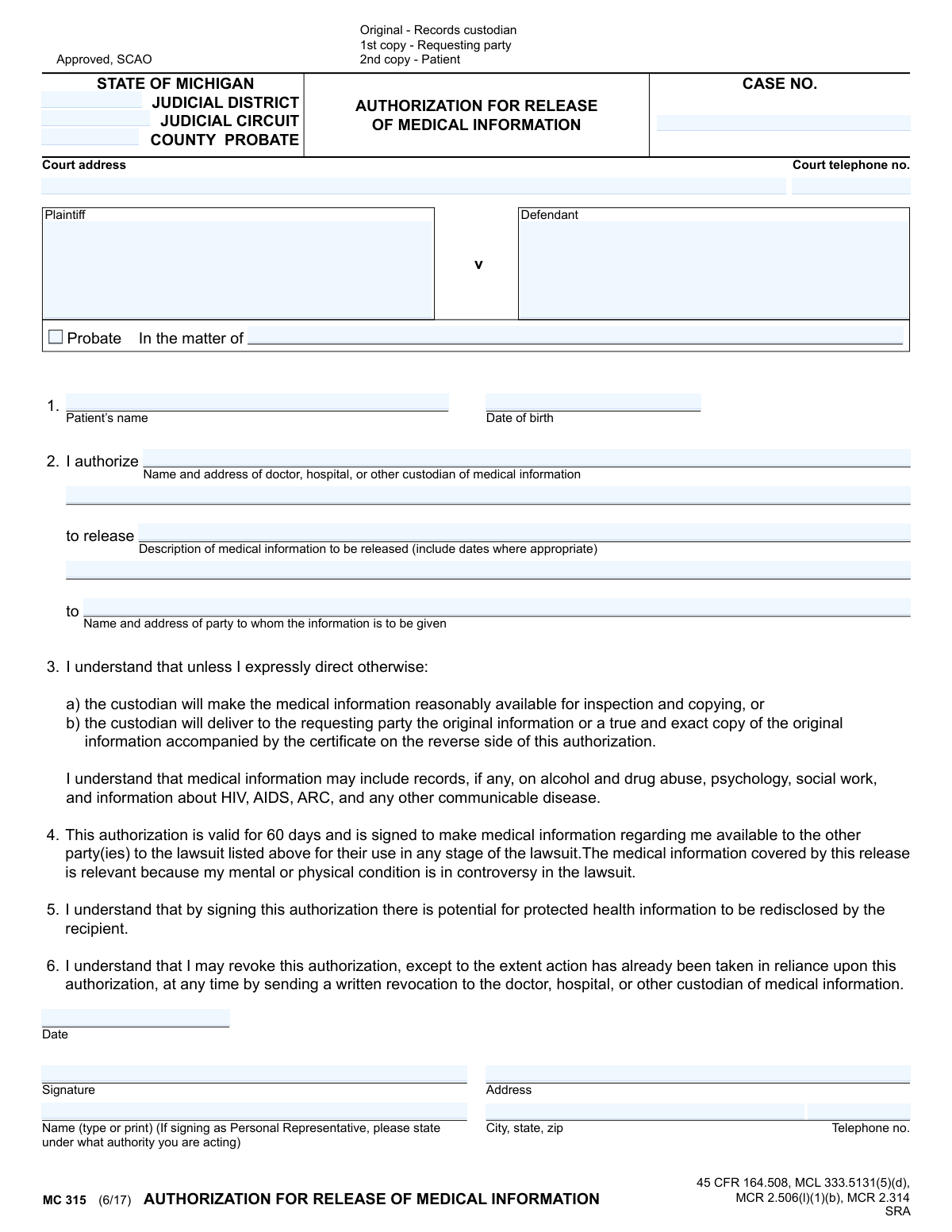
Form MC 315, Authorization for Release of Medical Information, is a legal document used in the state of Michigan to authorize the disclosure of a patient's medical records to a specified party. It is crucial for legal cases where a person's physical or mental health is a point of controversy, ensuring that sensitive information is released only with explicit, time-limited consent. Today, this form can be filled out quickly and accurately using AI-powered services like Instafill.ai, which can also convert non-fillable PDF versions into interactive fillable forms.
MC 315 is part of the
Medi-Cal forms, medical authorization forms, medical release forms and Michigan court forms categories on Instafill.
Our AI automatically handles information lookup, data retrieval, formatting, and form filling.
It takes less than a minute to fill out MC 315 using our AI form filling.
Securely upload your data. Information is encrypted in transit and deleted immediately after the form is filled out.
Form specifications
| Form name: | MC 315, Authorization for Release of Medical Information |
| Number of fields: | 34 |
| Number of pages: | 1 |
| Language: | English |
More forms in Medi-Cal forms
Instafill Demo: How to fill out PDF forms in seconds with AI
How to Fill Out MC 315 Online for Free in 2026
Are you looking to fill out a MC 315 form online quickly and accurately? Instafill.ai offers the #1 AI-powered PDF filling software of 2026, allowing you to complete your MC 315 form in just 37 seconds or less.
Follow these steps to fill out your MC 315 form online using Instafill.ai:
- 1 Navigate to Instafill.ai and upload your MC 315 form, or select it from our library of official documents.
- 2 Use the AI assistant to accurately fill in the case details, including the court, case number, plaintiff, and defendant information.
- 3 Enter the patient's full name and date of birth in the designated fields.
- 4 Specify the custodian of the medical records (doctor, hospital) and the party who will receive the information, along with a clear description of the records to be released.
- 5 Carefully review the authorization terms, including the 60-day validity period and your right to revoke the authorization.
- 6 Electronically sign and date the form. The AI tool will ensure your signature is placed correctly and is legally binding.
- 7 Download the completed form and distribute the copies as indicated: one for the records custodian, one for the requesting party, and one for the patient's records.
Our AI-powered system ensures each field is filled out correctly, reducing errors and saving you time.
Why Choose Instafill.ai for Your Fillable MC 315 Form?
Speed
Complete your MC 315 in as little as 37 seconds.
Up-to-Date
Always use the latest 2026 MC 315 form version.
Cost-effective
No need to hire expensive lawyers.
Accuracy
Our AI performs 10 compliance checks to ensure your form is error-free.
Security
Your personal information is protected with bank-level encryption.
Frequently Asked Questions About Form MC 315
This form authorizes a doctor, hospital, or other medical provider to release your medical records to another party, typically for a lawsuit where your physical or mental condition is relevant.
The patient whose medical records are being requested must complete and sign the form. If the patient is unable, their authorized personal representative (like a legal guardian) can sign, stating the authority under which they are acting.
The custodian is the doctor, hospital, clinic, or other healthcare entity that possesses the medical records you are authorizing to be released. You must provide their full name and address in Section 2.
Be as specific as possible. List the types of records (e.g., 'all records,' 'X-ray reports,' 'lab results') and include the relevant date ranges to ensure only the necessary information is released.
According to the form, this authorization is valid for 60 days from the date you sign it.
Yes, you can revoke the authorization at any time by sending a written notice to the medical custodian. However, the revocation will not apply to any information that has already been released based on the original authorization.
Yes, the form explicitly states that medical information may include records on alcohol and drug abuse, psychology, and communicable diseases like HIV/AIDS. If you wish to exclude certain information, you should specify that.
No, the patient does not fill out the Certificate section. This part is completed by the custodian of the medical records to certify that the copies they are providing are true and complete.
This information is found on the official court documents for the lawsuit this medical information pertains to. You can find the case number, court address, and plaintiff/defendant names on any filings related to the case.
The original form is sent to the records custodian (the doctor or hospital), the first copy goes to the party requesting the information, and you should keep the second copy for your own records.
Yes, services like Instafill.ai use AI to help you accurately auto-fill form fields from your saved profile. This can save time and reduce the chance of making errors on important legal documents.
Simply upload the form's PDF to the Instafill.ai platform. The AI will make the document interactive, allowing you to click and type in each field or use the auto-fill feature to complete it quickly.
You can use a service like Instafill.ai, which is designed to handle this problem. It can convert flat, non-fillable PDFs into interactive forms that you can easily fill out, sign, and download.
Compliance MC 315
Validation Checks by Instafill.ai
1
Ensures Patient's Date of Birth is a Valid Past Date
This check verifies that the 'Date of birth' field contains a valid date in a recognized format (e.g., MM/DD/YYYY) and that the date is in the past. It is crucial for correctly identifying the patient and ensuring the authorization is for a real person, not a future date. A failed validation would prevent processing as the patient's identity cannot be confirmed.
2
Verifies Presence of Case Identification Information
This validation ensures that the form contains sufficient information to identify the legal case, checking that either the 'Plaintiff/Defendant' fields or the 'In the matter of' field is completed, along with the 'Case No.'. This is critical because the authorization is context-dependent on a specific lawsuit. Without a clear case identifier, the release of information would be legally ambiguous and could be misapplied.
3
Validates Authorization Signature Date
This check confirms that the patient's signature date ('Date 1') is a valid, non-future date and is on or after the patient's date of birth. This date establishes the start of the 60-day validity period mentioned in the form. An invalid or future date would make the authorization's effective period unclear, potentially invalidating the entire document.
4
Confirms Completeness of Patient Authorization
This validation ensures that the patient's name, date of birth, signature, and the date of signature are all present. These fields are the absolute minimum required to establish who is granting the authorization and when. Missing any of this information makes the authorization legally unenforceable and must be rejected.
5
Ensures Both Information Source and Recipient are Specified
This check verifies that both the 'Name and address of doctor, hospital, or other custodian' and the 'Name and address of party to whom the information is to be given' fields are filled out. The authorization is meaningless without knowing who is authorized to release the information and who is authorized to receive it. A failure here would halt processing as the core directive of the form is incomplete.
6
Validates that the Scope of Released Information is Described
This validation ensures the 'Description of medical information to be released' field is not empty. A blank authorization is overly broad and legally problematic, violating patient privacy principles. The form must specify what information is being requested to be considered a valid and informed consent.
7
Standardizes and Validates Phone Number Formats
This check verifies that all telephone number fields ('court telephone no', 'telephone number 1', 'telephone number 2') adhere to a standard format like (XXX) XXX-XXXX or XXXXXXXXXX. Consistent formatting is essential for data integrity and for ensuring the parties can be contacted if necessary. An invalid format would trigger an error, requiring the user to correct the entry before submission.
8
Ensures Case Number is Provided and Consistent
This validation confirms that the 'Case No.' field is filled in on both the main authorization page and the certificate page, and that the values match. The case number is the primary key for linking this document to the correct legal proceeding. A missing or mismatched case number would make it impossible to file or associate the document correctly.
9
Cross-Validates Patient Name Fields
This check compares the 'Patient’s name' field in section 1 with the printed name field ('Name 1') near the patient's signature. These names should match to ensure the person signing the form is the same person identified as the patient. A mismatch could indicate an error or that someone is signing on behalf of the patient without noting their authority.
10
Validates Certificate Dates for Logical Consistency
This check ensures the 'Certificate date' (when the request was received) is on or before the custodian's signature date ('Date 2'). It also verifies that the 'Certificate date' is on or after the patient's signature date ('Date 1'). This chronological validation confirms a logical sequence of events; an illogical date sequence would cast doubt on the validity of the certification process.
11
Verifies All Fields in the Certificate Section are Complete
This validation checks that when the certificate section is used, all its fields ('Organization', 'Certificate date', 'Date 2', 'Signature 2', 'Name 2', and address/phone) are filled. The certificate is a legal declaration by the custodian, and its completeness is required by Michigan Court Rule. An incomplete certificate is legally insufficient and cannot be accepted.
12
Validates City, State, and Zip Code Formatting
This check ensures that the 'City, state, zip' fields follow a recognizable pattern, such as 'City, ST XXXXX'. It validates that the state is a valid two-letter abbreviation and the zip code is a 5 or 9-digit number. Proper address formatting is crucial for mail delivery and record-keeping accuracy.
13
Flags Authorizations Submitted After Expiration
This validation compares the patient's signature date ('Date 1') with the current processing date. Since the form states the authorization is valid for 60 days, this check flags any submission where more than 60 days have passed. Processing an expired authorization is a compliance risk, so such forms must be rejected and a new authorization requested.
14
Ensures Required Court Information is Present
This check verifies that essential court details, such as 'Court address' and at least one judicial identifier ('Judicial District', 'Judicial Circuit', or 'County Probate'), are provided. This information is necessary to identify the correct jurisdiction and venue for the associated legal case. Without it, the document cannot be properly filed or routed.
Common Mistakes in Completing MC 315
Users often leave the 'Case No.', 'Judicial District', or 'Judicial Circuit' fields blank or enter incorrect information. This happens because they may not have the court documents handy. Without this information, the authorization cannot be correctly filed with the court or linked to the specific legal proceeding, rendering it useless for the lawsuit and causing significant delays.
In Section 2, people frequently write a generic name like 'My Doctor' or 'The Hospital' instead of the full, specific legal name and address of the practice or facility. Medical facilities are large organizations and cannot process vague requests, leading to immediate rejection. To avoid this, you must provide the complete name and mailing address of the specific clinic, hospital, or doctor's office that holds the records.
The request for 'Description of medical information' is often filled out too broadly (e.g., 'all records') or too vaguely (e.g., 'back injury records'). This can lead to the release of more information than intended or cause the provider to reject the request for lack of specificity. It is crucial to define the scope clearly, including specific types of records (e.g., 'all physician's notes, lab results, and imaging reports') and a precise date range (e.g., 'from January 1, 2022, to December 31, 2023').
The second page of the form contains a 'CERTIFICATE' section intended for the medical records custodian (the hospital or clinic) to fill out upon releasing the documents. Patients or their representatives often mistakenly fill out this section themselves. This invalidates the form, as it appears to be pre-certified, causing confusion and requiring a new, clean form to be submitted.
When an individual signs the form on behalf of the patient (e.g., for a minor child or an incapacitated adult), they often forget to state their legal authority to do so in the designated space. An authorization is legally invalid if the signer's right to act for the patient isn't specified (e.g., 'Parent of minor', 'Power of Attorney', 'Executor of Estate'). This omission will cause the request to be denied.
Simple typographical errors in the patient's name or an incorrect date of birth are very common but critical mistakes. Medical records systems require an exact match to locate the correct file and prevent a data breach. Any discrepancy will result in the system being unable to find the patient, leading to the request being rejected until a corrected form is provided.
The form explicitly states it is valid for 60 days from the signature date. People sometimes sign and date the form but delay submitting it to the medical provider. If the form arrives after the 60-day window has closed, the custodian is legally unable to honor it, forcing the requester to start the entire process over with a newly signed form.
Since this form is often printed and filled out by hand, poor handwriting can make critical information like names, addresses, and case numbers unreadable. This is a primary cause of processing errors and rejections. To ensure clarity, it's best to type the information. AI-powered tools like Instafill.ai can convert a flat PDF like this into a fillable version, allowing you to type directly onto the form for perfect legibility.
The form provides options for 'Plaintiff v Defendant' and 'In the matter of'. Users unfamiliar with legal terminology may fill out the wrong section or both. This creates ambiguity about the nature of the legal case. For a standard lawsuit, only the Plaintiff/Defendant fields should be used; for probate or other matters, 'In the matter of' is appropriate, but not both.
Forgetting to sign or date the form is a simple but fatal error. An unsigned authorization holds no legal weight and will be rejected immediately by any records custodian. The date is equally important as it establishes the start of the 60-day validity period. Using a tool like Instafill.ai can help by highlighting required fields, reducing the chance of overlooking the signature and date boxes before submission.
Saved over 80 hours a year
“I was never sure if my IRS forms like W-9 were filled correctly. Now, I can complete the forms accurately without any external help.”
Kevin Martin Green
Your data stays secure with advanced protection from Instafill and our subprocessors

Robust compliance program
Transparent business model
You’re not the product. You always know where your data is and what it is processed for.
ISO 27001, HIPAA, and GDPR
Our subprocesses adhere to multiple compliance standards, including but not limited to ISO 27001, HIPAA, and GDPR.
Security & privacy by design
We consider security and privacy from the initial design phase of any new service or functionality. It’s not an afterthought, it’s built-in, including support for two-factor authentication (2FA) to further protect your account.
Fill out MC 315 with Instafill.ai
Worried about filling PDFs wrong? Instafill securely fills mc-315-authorization-for-release-of-medical-information forms, ensuring each field is accurate.