
Yes! You can use AI to fill out U.S. Coast Guard Form CG-719K, Application for Medical Certificate
Don't type 460 fields by hand. Tell our AI about yourself, or upload your insurance card, and it fills every field in seconds. You check it, then download, print or sign.
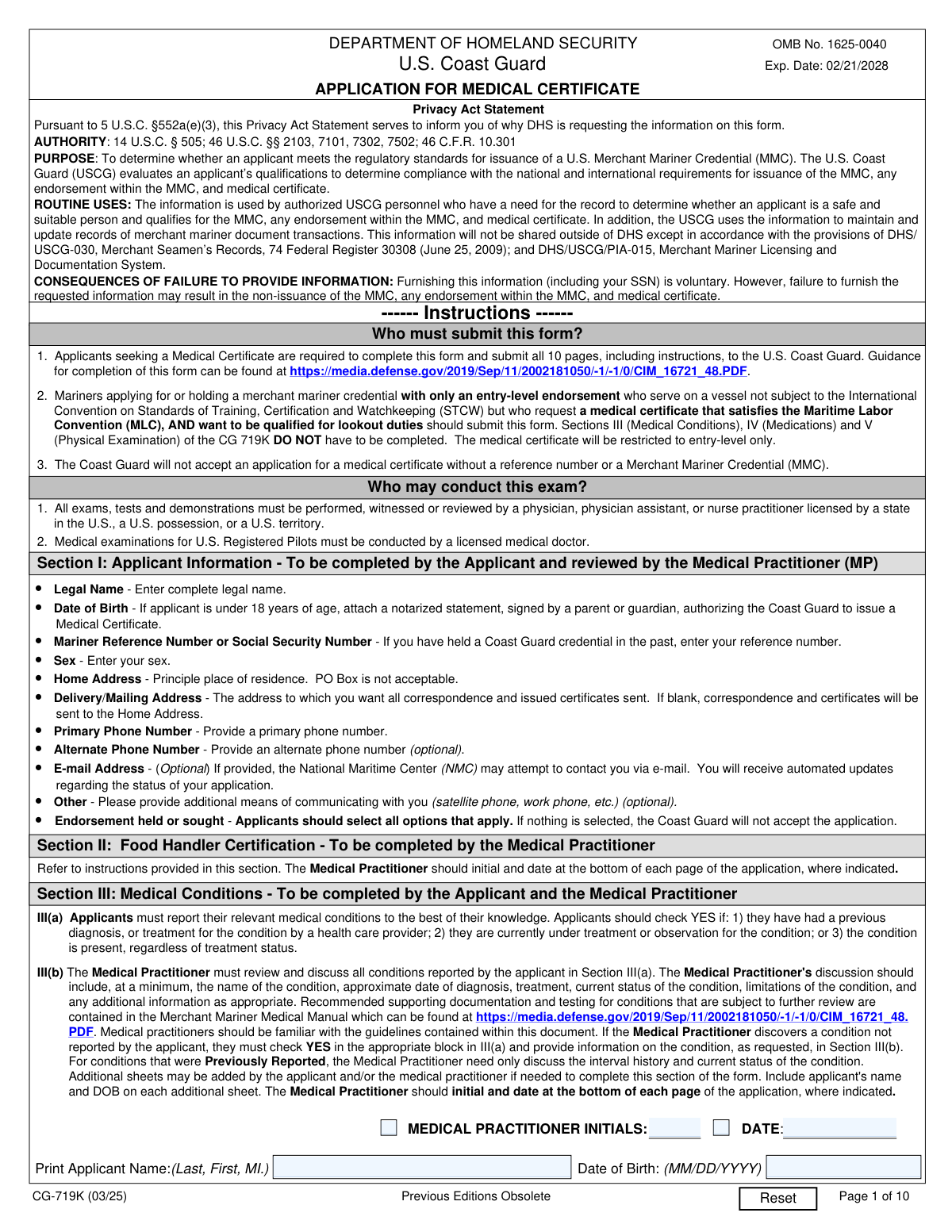
The AI does the filling. You just check it.
No typing into boxes, nothing to install.
What this form asks for
The AI fills all of it, from your answers or your documents.
The AI checks your answers before you download
16 checks built for this form, so a wrong date or a missing answer is caught before anyone else sees it.
Validate that the submission includes all pages required by the Coast Guard (the form explicitly states all 10 pages must be submitted, including instructions). This prevents incomplete packets that cannot be processed or reviewed by the Medical Practitioner (MP) and NMC. If any page is missing, the application should be rejected as incomplete and the applicant prompted to resubmit the full packet.
Check that Last Name and First Name are present and contain only valid name characters (letters, spaces, hyphens, apostrophes), and that Middle Name/Initial and Suffix (if provided) follow expected formats. This is critical for identity matching across Coast Guard systems and for ensuring additional sheets can be correctly attributed to the applicant. If invalid or missing, flag the submission for correction before acceptance.
Ensure Date of Birth is provided and matches MM/DD/YYYY, represents a real calendar date, and is not in the future. If the applicant is under 18, require an attached notarized parent/guardian authorization as stated in the instructions. If DOB is invalid or the under-18 attachment is missing, the submission should fail validation and be returned for completion.
Enforce that either a Mariner Reference Number or a Social Security Number is provided, since the form states the Coast Guard will not accept an application without a reference number or MMC. If SSN is used, validate it is 9 digits (optionally formatted as XXX-XX-XXXX) and not an obviously invalid pattern (e.g., all zeros). If neither identifier is present or the identifier format is invalid, reject the application as non-acceptable.
Confirm that Sex is selected and is one of the allowed options shown on the form (Male/Female). This supports consistent medical evaluation and record matching. If missing or outside allowed values, the submission should be flagged for correction.
Check that Home Address includes street address, city, state, and ZIP, and that the street address does not contain PO Box indicators (e.g., 'PO Box', 'P.O. Box'), as explicitly prohibited. This ensures the principal place of residence is captured correctly for official records. If a PO Box is detected or required components are missing, fail validation and request a corrected physical address.
And 10 more checks
- Validates Delivery/Mailing Address logic and completeness (defaults to Home Address if blank)
- Validates contact information: primary phone required; phone/email formats
- Ensures at least one Endorsement Held or Sought is selected
- Validates 'Other' endorsement explanation is provided when selected
- Food Handler Certification dependency check (Section I vs Section II)
- Medical Conditions Section III(a) completeness and single-response enforcement per item
- Section III(b) required follow-up for every YES condition in III(a)
- Medical Waiver (MW) attachment requirement and consistency
- Medications section logic: 'Do you currently use any medication?' vs medication table completion
- Medical Practitioner credentials and attestation completeness (Section IX.e)
Let AI fill out your CG-719K
No typing. Every field filled in seconds, checked, ready to sign.
How to Fill Out CG-719K Online for Free in 2026
What the AI walks you through.
- Confirm you are applying for a Coast Guard Medical Certificate and gather prerequisites (Mariner Reference Number or MMC/SSN, government photo ID, and any relevant medical records/waivers).
- Complete Section I (Applicant Information), including contact details and selecting all applicable endorsements held or sought (e.g., Deck, Engine, STCW, Food Handler, Pilotage, entry-level).
- Fill out Section III(a) (Medical Conditions) by answering each condition Yes/No and marking Previously Reported (PR) and/or Medical Waiver (MW) where applicable; prepare supporting documentation for any “Yes” items.
- Complete Section IV (Medications) by listing all required prescription/nonprescription medications, supplements, and vitamins per the form’s lookback periods, including dose, frequency, and condition treated.
- Schedule an exam with an eligible Medical Practitioner (physician/PA/NP; MD required for U.S. Registered Pilots) and bring your completed sections, photo ID, and supporting records for the practitioner to review and complete Sections II and V–IX (food handler certification if applicable, physical exam, vision, hearing, physical ability if required, and summary).
- Review the completed application for completeness (initials/dates where required, attachments noted, signatures present), then sign Section X (Applicant Certification) and optionally complete Section XI (Applicant Consent/third-party authorizations).
- Submit all 10 pages (including instructions) and any attachments to the U.S. Coast Guard/National Maritime Center as required, ensuring the application includes your reference number or MMC so it will be accepted.
Common Mistakes in Completing CG-719K
The ones the AI is built to catch.
Submitting fewer than all 10 pages (including instructions)
Missing Mariner Reference Number/MMC requirement (or using the wrong identifier)
Using a PO Box for the Home Address
Not checking any endorsement boxes in Section I
Incorrect date formats or inconsistent dates (DOB, exam date, signatures)
Underreporting medical conditions in Section III(a) (marking “No” when history exists)
Failing to complete Section III(b) details for every “Yes” item (or not attaching supporting documentation)
Misusing PR (Previously Reported) and MW (Medical Waiver) checkboxes
Incomplete medication reporting (missing OTCs, supplements, dose/frequency, or timeframe)
Vision and color vision testing recorded incorrectly or without required specifics
Hearing section not completed according to the decision rules (whisper test vs audiogram/speech discrimination)
Missing required initials/signatures/stamps from the Medical Practitioner and applicant
Frequently Asked Questions About CG-719K
Is it really free for 7 days?
Can I fill other forms too?
How do I cancel?
How does the AI fill out CG-719K?
What happens to my information?
How complex is CG-719K to fill out?
What is Form CG-719K used for?
Who must submit CG-719K?
Do I have to submit all pages, even the instruction pages?
Can I apply without a Mariner Reference Number or MMC?
What address should I use, and can I use a PO Box?
What happens if I don’t check any boxes under “Endorsement Held or Sought” in Section I?
I’m under 18—what extra documentation is required?
Who is allowed to conduct the medical exam for this form?
If I’m entry-level and only need an MLC-compliant medical certificate, do I still complete the whole form?
What proof of identity do I need to show the Medical Practitioner?
How do I answer the Medical Conditions section (Section III(a))—what counts as “YES”?
What does the Medical Practitioner need to write in Section III(b) if I mark a condition as YES or PR?
What medications do I have to list in Section IV?
Do the vision and hearing tests have to be performed by the Medical Practitioner personally?
What are the optional consent/third-party authorization sections, and do I have to sign them?
Get your CG-719K filled out by AI
$0 today. Cancel before Nov 1 and you pay nothing.
Other forms like this one
medical forms: Form OWCP-915, Claim for Medical Reimbursement, Form 8994, Employer Credit for Paid Family and Medical Leave, Form OF-178, Certificate of Medical Examination, Form N-648, Medical Certification for Disability Exceptions, The Department of Medical Assistance Services Applied Behavior Analysis Preservice Service Authorization Request Form (Effective Dates of Service 09/01/2025 and after), State of Illinois Department of Children and Family Services Medical Report on an Adult in a Child Care Facility (CFS 602), Carer Payment and Carer Allowance – Medical Report (SA431) for a child under 16 years, Medically Prescribed Treatment (Non-Medication) Form — Provider Treatment Order Form | Office of School Health | School Year 2025–2026, VA Form 10-7959f-2, Foreign Medical Program (FMP) Claim Cover Sheet, Department of Medical Assistance Services Applied Behavior Analysis (97155, Et al.) Initial Service Authorization Request Form, Applied Behavior Analysis Concurrent Service Authorization Request Form (CPT Codes 97153, 97154, 97155, 97156, 97157, 97158, 0373T) – Virginia Department of Medical Assistance Services, Department of Medical Assistance Services Enhanced Services Individual Service Plan (ISP) Template, Form DS-1843, Medical History and Examination for Individuals Age 12 and Older, Scheduled Medical Leave of Absence (MLOA) - BLET 13, Admissions Application, School of Diagnostic Imaging, Mills-Peninsula Medical Center, Albany Medical Center 2024 Benefits Guide, Form BWC-1141, Request for Medical Information, VA Form 21P-8416, Medical Expense Report, Medicare Enrollment Application for Durable Medical Equipment, Prosthetics, Orthotics, and Supplies (DMEPOS) Suppliers, CMS-855S, Form HFS 2243, Provider Enrollment Application Illinois Medical Assistance Program
medical certificate forms: Form OF-178, Certificate of Medical Examination, Form CMS-10126, Certificate of Medical Necessity for Positive Airway Pressure (PAP) Devices, Form CMS-10126, Certificate of Medical Necessity for Enteral and Parenteral Nutrition
VA medical forms: Form OWCP-915, Claim for Medical Reimbursement, Form 8994, Employer Credit for Paid Family and Medical Leave, Form OF-178, Certificate of Medical Examination, Form N-648, Medical Certification for Disability Exceptions, The Department of Medical Assistance Services Applied Behavior Analysis Preservice Service Authorization Request Form (Effective Dates of Service 09/01/2025 and after), State of Illinois Department of Children and Family Services Medical Report on an Adult in a Child Care Facility (CFS 602), Carer Payment and Carer Allowance – Medical Report (SA431) for a child under 16 years, Medically Prescribed Treatment (Non-Medication) Form — Provider Treatment Order Form | Office of School Health | School Year 2025–2026, VA Form 10-7959f-2, Foreign Medical Program (FMP) Claim Cover Sheet, Department of Medical Assistance Services Applied Behavior Analysis (97155, Et al.) Initial Service Authorization Request Form, Applied Behavior Analysis Concurrent Service Authorization Request Form (CPT Codes 97153, 97154, 97155, 97156, 97157, 97158, 0373T) – Virginia Department of Medical Assistance Services, Department of Medical Assistance Services Enhanced Services Individual Service Plan (ISP) Template, Form DS-1843, Medical History and Examination for Individuals Age 12 and Older, Scheduled Medical Leave of Absence (MLOA) - BLET 13, Admissions Application, School of Diagnostic Imaging, Mills-Peninsula Medical Center, Albany Medical Center 2024 Benefits Guide, Form BWC-1141, Request for Medical Information, VA Form 21P-8416, Medical Expense Report, Medicare Enrollment Application for Durable Medical Equipment, Prosthetics, Orthotics, and Supplies (DMEPOS) Suppliers, CMS-855S, Form HFS 2243, Provider Enrollment Application Illinois Medical Assistance Program
Medi-Cal forms: Form OWCP-915, Claim for Medical Reimbursement, Form 8994, Employer Credit for Paid Family and Medical Leave, Form OF-178, Certificate of Medical Examination, Form N-648, Medical Certification for Disability Exceptions, The Department of Medical Assistance Services Applied Behavior Analysis Preservice Service Authorization Request Form (Effective Dates of Service 09/01/2025 and after), State of Illinois Department of Children and Family Services Medical Report on an Adult in a Child Care Facility (CFS 602), Carer Payment and Carer Allowance – Medical Report (SA431) for a child under 16 years, Medically Prescribed Treatment (Non-Medication) Form — Provider Treatment Order Form | Office of School Health | School Year 2025–2026, VA Form 10-7959f-2, Foreign Medical Program (FMP) Claim Cover Sheet, ABA Authorization Request (Medi-Cal) – Initial and Concurrent Requests, Department of Medical Assistance Services Applied Behavior Analysis (97155, Et al.) Initial Service Authorization Request Form, Applied Behavior Analysis Concurrent Service Authorization Request Form (CPT Codes 97153, 97154, 97155, 97156, 97157, 97158, 0373T) – Virginia Department of Medical Assistance Services, Department of Medical Assistance Services Enhanced Services Individual Service Plan (ISP) Template, Form DS-1843, Medical History and Examination for Individuals Age 12 and Older, Scheduled Medical Leave of Absence (MLOA) - BLET 13, Admissions Application, School of Diagnostic Imaging, Mills-Peninsula Medical Center, Albany Medical Center 2024 Benefits Guide, Form BWC-1141, Request for Medical Information, VA Form 21P-8416, Medical Expense Report, Medicare Enrollment Application for Durable Medical Equipment, Prosthetics, Orthotics, and Supplies (DMEPOS) Suppliers, CMS-855S
Let AI fill out your CG-719K
Your trial starts once a card is added. You pay nothing before Nov 1.
Our AI already knows this form, all 460 fields of it. Skip the typing: tell it about yourself, or upload what you have, and it fills the whole form in seconds.
- AI fills every field on all 10 pages, tables and checkboxes included
- No typing into boxes: answer a few questions, or upload your insurance card, an old copy of this form, a photo of a document
- The AI checks the answers; you review and change anything before you download
- Download the finished PDF, print it, or sign it online
- Encrypted, and never used to train AI
Cancel before Nov 1 and you pay nothing.
A card is needed to start the trial. Cancel in two clicks from your account.
Terms · Privacy