
Yes! You can use AI to fill out Form N-648, Medical Certification for Disability Exceptions
Don't type 79 fields by hand. Tell our AI about yourself, or upload a document you already have, and it fills every field in seconds. You check it, then download, print or sign.
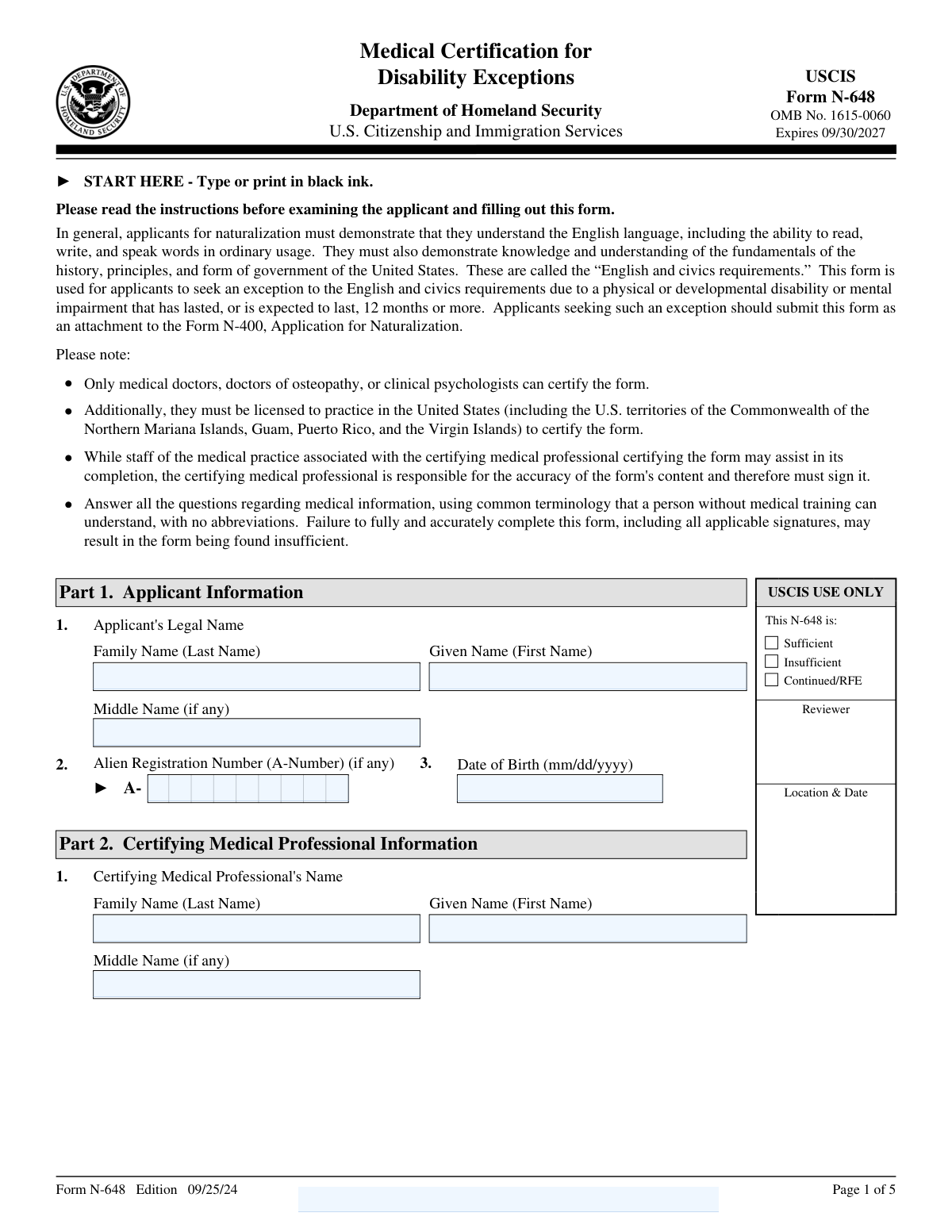
The AI does the filling. You just check it.
No typing into boxes, nothing to install.
What this form asks for
The AI fills all of it, from your answers or your documents.
The AI checks your answers before you download
15 checks built for this form, so a wrong date or a missing answer is caught before anyone else sees it.
This validation check ensures that the applicant's legal name is accurately and completely filled out on the form. It confirms that all necessary components of the name, including the family name, given name, and any applicable middle name, are provided. By doing so, it helps to prevent any discrepancies that could arise during the processing of the application. This thorough verification is crucial for maintaining the integrity of the applicant's identity.
This validation check verifies that the Alien Registration Number, commonly referred to as the A-Number, is included when applicable. It ensures that the applicant has provided this critical identifier, which is essential for tracking their immigration status. By confirming the presence of the A-Number, the check helps to streamline the processing of the application and reduces the likelihood of delays. This step is vital for maintaining accurate records within the immigration system.
This validation check verifies that the applicant's date of birth is entered in the correct format, specifically mm/dd/yyyy. It ensures that the information is presented in a standardized manner, which is crucial for accurate data processing. By enforcing this format, the check helps to prevent errors that could arise from misinterpretation of the date. This attention to detail is essential for maintaining the accuracy of the applicant's personal information.
This validation check ensures that all necessary information regarding the certifying medical professional is included on the form. It verifies that the professional's name, license number, licensing state, email address, and business telephone number are all provided. By confirming the completeness of this information, the check helps to establish the credibility of the medical certification. This thorough verification is important for ensuring that the applicant's medical condition is accurately represented.
This validation check confirms that the certifying medical professional holds a valid license to practice in the United States. It ensures that the professional is qualified to provide the necessary medical certification for the applicant's disability exception. By validating the licensure and type of medical practice, the check helps to uphold the standards of medical professionalism. This step is crucial for ensuring that the certification is credible and reliable.
This validation check ensures that the description of the applicant's disabilities or impairments is articulated in a clear and understandable manner. It verifies that common terminology is used, avoiding any abbreviations that could lead to confusion. By doing so, it confirms that the information provided is accessible to all reviewers, facilitating a smoother evaluation process. This check is crucial for maintaining clarity and comprehensibility in the documentation.
And 9 more checks
- Confirms that clinical diagnoses and medical codes (e.g., DSM or ICD codes) are included for each condition.
- Verifies that the applicant's disabilities have lasted or are expected to last 12 months or more; if not, the form should not be completed.
- Checks if any disabilities are a result of illegal drug use; if all are, the form should not be completed.
- Ensures that the date of the last examination of the applicant is provided.
- Confirms that it is indicated whether the disabilities prevent the applicant from reading, writing, or speaking English, or answering questions about U.S. history and civics.
- Validates that the applicant can understand and communicate their understanding of the Oath of Allegiance, marked 'Yes' or 'No'.
- Checks that interpreter information and signature are provided if an interpreter was used, or that the relevant items are completed if telephonic interpretation was used.
- Ensures that the applicant's attestation and release of information is completed, including their name, signature, and date.
- Verifies that the certifying medical professional has signed and dated the form, certifying the truthfulness of the information and verifying the applicant's identity using a government-issued ID.
Let AI fill out your Form N-648
No typing. Every field filled in seconds, checked, ready to sign.
Common Mistakes in Completing Form N-648
The ones the AI is built to catch.
Not reading the instructions thoroughly before starting
Incorrectly filling the applicant's legal name
Omitting the Alien Registration Number if applicable
Using an incorrect date format for date of birth
Failing to provide complete medical professional information
Not indicating the type of medical practice
Using abbreviations in describing disabilities
Failing to include clinical diagnosis and medical codes
Not confirming the duration of disabilities
Indicating disabilities from illegal drug use incorrectly
Omitting the date of the last examination
Not specifying if disabilities affect English skills
Failing to mark 'Yes' or 'No' for understanding the Oath
Not providing interpreter information when applicable
Omitting applicant's signature and date in attestation
Medical professional not signing or dating the certification
Not verifying the applicant's identity with ID
Submitting without reviewing for completeness
Failing to attach Form N-648 to Form N-400
Frequently Asked Questions About Form N-648
Is it really free for 7 days?
Can I fill other forms too?
How do I cancel?
How does the AI fill out Form N-648?
What happens to my information?
How complex is Form N-648 to fill out?
What is Form N-648 and what is its purpose?
Who is eligible to complete Form N-648?
What types of disabilities or impairments can be certified on Form N-648?
How long must a disability or impairment last to qualify for an exception using Form N-648?
Who can certify Form N-648?
What information must be provided by the certifying medical professional on Form N-648?
What happens if the applicant's disabilities are a result of illegal drug use?
What is the significance of the Oath of Allegiance in relation to Form N-648?
What should the applicant do if they cannot understand the Oath of Allegiance?
Is an interpreter required when completing Form N-648?
What are the consequences of providing false information on Form N-648?
How should the applicant's medical information be presented on Form N-648?
What is the process for submitting Form N-648?
Can the applicant submit Form N-648 without the certifying medical professional's signature?
What should the applicant do if they have questions about completing Form N-648?
How can the applicant ensure that their Form N-648 is complete and accurate?
What is the role of the interpreter in the completion of Form N-648?
What documentation must accompany Form N-648 when submitted?
How does Form N-648 relate to the Form N-400, Application for Naturalization?
What should the applicant do if they need assistance in filling out Form N-648?
Get your Form N-648 filled out by AI
$0 today. Cancel before Nov 1 and you pay nothing.
Other forms like this one
disability forms: Form SSA-3368-BK, Disability Report - Adult, Form SSA-16, Application for Disability Benefits, Form SSA-3820-BK, Disability Report - Child, Form SSA-454-BK, Continuing Disability Review, Form 21-526EZ, Application for Disability Compensation, Form DBQ, Knee and Lower Leg Disability Benefits, Form DBQ, Heart Conditions Disability Benefits, Form DBQ, Hypertension Disability Benefits, Form DBQ, Scars/Disfigurement Disability Benefits, Form DBQ, Diabetes Mellitus Disability Benefits Questionnaire, Form DBQ, Endocrine Diseases Disability Benefits, Form DBQ, Diabetes Mellitus Disability Benefits Questionnaire, Back (Thoracolumbar Spine) Conditions Disability Benefits Questionnaire, Ankle Conditions Disability Benefits Questionnaire, Back (Thoracolumbar Spine) Conditions Disability Benefits Questionnaire, Elbow and Forearm Conditions Disability Benefits Questionnaire, Foot Conditions, Including Flatfoot (Pes Planus) Disability Benefits Questionnaire, Hip and Thigh Conditions Disability Benefits Questionnaire, Knee and Lower Leg Disability Benefits Questionnaire, Neck (Cervical Spine) Conditions Disability Benefits Questionnaire
medical disability forms: Medical Assessment for Transport Disability, SC ISP-2519, Medical Report for Canada Pension Plan Disability Benefits (2025-05-08), SC ISP-2519, Medical Report for Canada Pension Plan Disability Benefits (2024-05-17)
medical forms: Form OWCP-915, Claim for Medical Reimbursement, Form 8994, Employer Credit for Paid Family and Medical Leave, Form OF-178, Certificate of Medical Examination, U.S. Coast Guard Form CG-719K, Application for Medical Certificate, The Department of Medical Assistance Services Applied Behavior Analysis Preservice Service Authorization Request Form (Effective Dates of Service 09/01/2025 and after), State of Illinois Department of Children and Family Services Medical Report on an Adult in a Child Care Facility (CFS 602), Carer Payment and Carer Allowance – Medical Report (SA431) for a child under 16 years, Medically Prescribed Treatment (Non-Medication) Form — Provider Treatment Order Form | Office of School Health | School Year 2025–2026, VA Form 10-7959f-2, Foreign Medical Program (FMP) Claim Cover Sheet, Department of Medical Assistance Services Applied Behavior Analysis (97155, Et al.) Initial Service Authorization Request Form, Applied Behavior Analysis Concurrent Service Authorization Request Form (CPT Codes 97153, 97154, 97155, 97156, 97157, 97158, 0373T) – Virginia Department of Medical Assistance Services, Department of Medical Assistance Services Enhanced Services Individual Service Plan (ISP) Template, Form DS-1843, Medical History and Examination for Individuals Age 12 and Older, Scheduled Medical Leave of Absence (MLOA) - BLET 13, Admissions Application, School of Diagnostic Imaging, Mills-Peninsula Medical Center, Albany Medical Center 2024 Benefits Guide, Form BWC-1141, Request for Medical Information, VA Form 21P-8416, Medical Expense Report, Medicare Enrollment Application for Durable Medical Equipment, Prosthetics, Orthotics, and Supplies (DMEPOS) Suppliers, CMS-855S, Form HFS 2243, Provider Enrollment Application Illinois Medical Assistance Program
VA medical forms: Form OWCP-915, Claim for Medical Reimbursement, Form 8994, Employer Credit for Paid Family and Medical Leave, Form OF-178, Certificate of Medical Examination, U.S. Coast Guard Form CG-719K, Application for Medical Certificate, The Department of Medical Assistance Services Applied Behavior Analysis Preservice Service Authorization Request Form (Effective Dates of Service 09/01/2025 and after), State of Illinois Department of Children and Family Services Medical Report on an Adult in a Child Care Facility (CFS 602), Carer Payment and Carer Allowance – Medical Report (SA431) for a child under 16 years, Medically Prescribed Treatment (Non-Medication) Form — Provider Treatment Order Form | Office of School Health | School Year 2025–2026, VA Form 10-7959f-2, Foreign Medical Program (FMP) Claim Cover Sheet, Department of Medical Assistance Services Applied Behavior Analysis (97155, Et al.) Initial Service Authorization Request Form, Applied Behavior Analysis Concurrent Service Authorization Request Form (CPT Codes 97153, 97154, 97155, 97156, 97157, 97158, 0373T) – Virginia Department of Medical Assistance Services, Department of Medical Assistance Services Enhanced Services Individual Service Plan (ISP) Template, Form DS-1843, Medical History and Examination for Individuals Age 12 and Older, Scheduled Medical Leave of Absence (MLOA) - BLET 13, Admissions Application, School of Diagnostic Imaging, Mills-Peninsula Medical Center, Albany Medical Center 2024 Benefits Guide, Form BWC-1141, Request for Medical Information, VA Form 21P-8416, Medical Expense Report, Medicare Enrollment Application for Durable Medical Equipment, Prosthetics, Orthotics, and Supplies (DMEPOS) Suppliers, CMS-855S, Form HFS 2243, Provider Enrollment Application Illinois Medical Assistance Program
Medi-Cal forms: Form OWCP-915, Claim for Medical Reimbursement, Form 8994, Employer Credit for Paid Family and Medical Leave, Form OF-178, Certificate of Medical Examination, U.S. Coast Guard Form CG-719K, Application for Medical Certificate, The Department of Medical Assistance Services Applied Behavior Analysis Preservice Service Authorization Request Form (Effective Dates of Service 09/01/2025 and after), State of Illinois Department of Children and Family Services Medical Report on an Adult in a Child Care Facility (CFS 602), Carer Payment and Carer Allowance – Medical Report (SA431) for a child under 16 years, Medically Prescribed Treatment (Non-Medication) Form — Provider Treatment Order Form | Office of School Health | School Year 2025–2026, VA Form 10-7959f-2, Foreign Medical Program (FMP) Claim Cover Sheet, ABA Authorization Request (Medi-Cal) – Initial and Concurrent Requests, Department of Medical Assistance Services Applied Behavior Analysis (97155, Et al.) Initial Service Authorization Request Form, Applied Behavior Analysis Concurrent Service Authorization Request Form (CPT Codes 97153, 97154, 97155, 97156, 97157, 97158, 0373T) – Virginia Department of Medical Assistance Services, Department of Medical Assistance Services Enhanced Services Individual Service Plan (ISP) Template, Form DS-1843, Medical History and Examination for Individuals Age 12 and Older, Scheduled Medical Leave of Absence (MLOA) - BLET 13, Admissions Application, School of Diagnostic Imaging, Mills-Peninsula Medical Center, Albany Medical Center 2024 Benefits Guide, Form BWC-1141, Request for Medical Information, VA Form 21P-8416, Medical Expense Report, Medicare Enrollment Application for Durable Medical Equipment, Prosthetics, Orthotics, and Supplies (DMEPOS) Suppliers, CMS-855S
certification forms: Form HS 200, Licensure & Certification Application, W-9, Request for Taxpayer Identification Number and Certification, Form WH-380-E, Certification of Health Care Provider, Form WH-385, Certification for Serious Injury or Illness, Form WH-380-F, Certification of Health Care Provider, Form WH-385-V, Certification for Serious Injury or Illness, Form 8802, Application for U.S. Residency Certification, Form I-905, Application for Authorization to Issue Certification for Health Care Workers, Form 01-339, Texas Sales and Use Tax Resale Certificate / Texas Sales and Use Tax Exemption Certification, Dakota County CDA New Admissions Informal Review Request Form (Housing Choice Voucher Program) and HUD Form 5382, Certification of Domestic Violence, Dating Violence, Sexual Assault, or Stalking, and Alternate Documentation, NJ Department of Labor & Workforce Development Form MW-562, Payroll Certification for Public Works Projects (Contractor and Subcontractor’s Weekly and Final Certification), ROTC Cadet Academic Plan / Degree and Credit Hour Worksheet (Student Identification, Term-by-Term Courses, GPA Summary, and Completion Certification), Certification for Special Assessment (Office of Building, Planning, & Code Compliance, City of Knox, Indiana), Outpatient Behavioral Health (BH) – ABA Treatment Request: Required Information for Precertification (GR-69017-4), Form W-9, Request for Taxpayer Identification Number and Certification, 401(k) Program Rollover Certification, WTIA 401(k) Plan Rollover Contribution Employee Certification, Trust Certification and Trustee Powers, Form GR-68831, Precertification Information Request Form, Precertification request form: Advanced Radiology and Cardiology Services
Let AI fill out your Form N-648
Your trial starts once a card is added. You pay nothing before Nov 1.
Our AI already knows this form, all 79 fields of it. Skip the typing: tell it about yourself, or upload what you have, and it fills the whole form in seconds.
- AI fills every field on all 5 pages, checkboxes included
- No typing into boxes: answer a few questions, or upload a document you already have, an old copy of this form, a photo of a document
- The AI checks the answers; you review and change anything before you download
- Download the finished PDF, print it, or sign it online
- Encrypted, and never used to train AI
Cancel before Nov 1 and you pay nothing.
A card is needed to start the trial. Cancel in two clicks from your account.
Terms · Privacy