Yes! You can use AI to fill out Applied Behavior Analysis for Autism Initial Assessment and Goals and Six Month Reassessment of Goals and Treatment Plan (MMFRM-18)
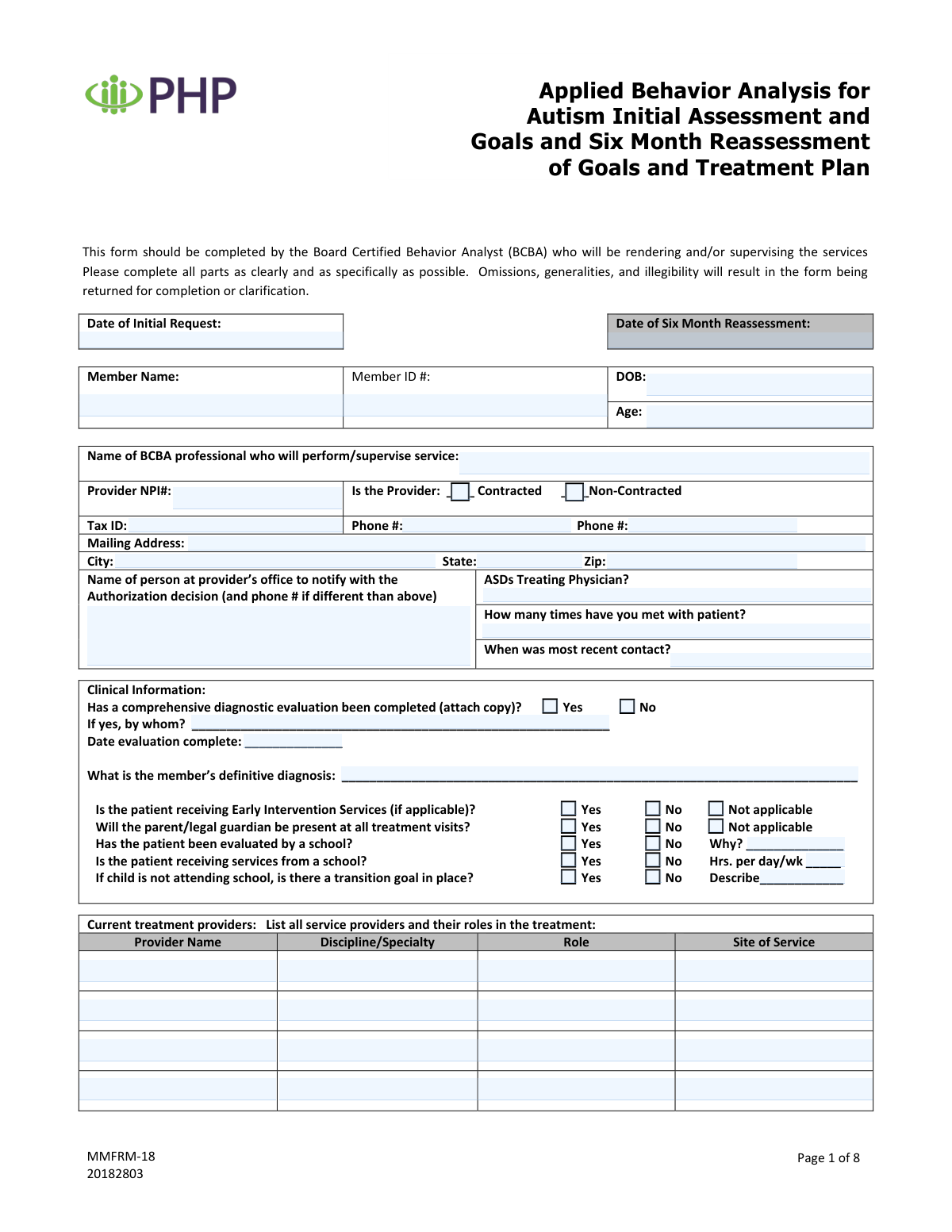
The MMFRM-18, titled 'Applied Behavior Analysis for Autism Initial Assessment and Goals and Six Month Reassessment of Goals and Treatment Plan,' is an 8-page clinical authorization form required to be completed by a Board Certified Behavior Analyst (BCBA) who renders or supervises ABA services for members diagnosed with Autism Spectrum Disorder. The form captures detailed member information, diagnostic history, medication history, behavioral goals targeted for reduction and increase, provider communications, and a formal request for treatment authorization. It is a critical document used by health plans and insurers to evaluate the medical necessity and appropriateness of ABA therapy services. Today, this complex multi-page form can be filled out quickly and accurately using AI-powered services like Instafill.ai, which can also convert non-fillable PDF versions into interactive fillable forms.
Our AI automatically handles information lookup, data retrieval, formatting, and form filling.
It takes less than a minute to fill out MMFRM-18 using our AI form filling.
Securely upload your data. Information is encrypted in transit and deleted immediately after the form is filled out.
Form specifications
| Form name: | Applied Behavior Analysis for Autism Initial Assessment and Goals and Six Month Reassessment of Goals and Treatment Plan (MMFRM-18) |
| Number of pages: | 8 |
| Language: | English |
Instafill Demo: filling out a legal form in seconds
How to Fill Out MMFRM-18 Online for Free in 2026
Are you looking to fill out a MMFRM-18 form online quickly and accurately? Instafill.ai offers the #1 AI-powered PDF filling software of 2026, allowing you to complete your MMFRM-18 form in just 37 seconds or less.
Follow these steps to fill out your MMFRM-18 form online using Instafill.ai:
- 1 Navigate to Instafill.ai and upload the MMFRM-18 form PDF or select it from the available form library to begin the AI-assisted filling process.
- 2 Enter member information including the member's full name, Member ID number, date of birth, and age, along with the dates of the initial request and six-month reassessment.
- 3 Complete the BCBA provider information section, including the provider's name, NPI number, contracted status, Tax ID, phone numbers, and mailing address.
- 4 Fill in the clinical information sections, including diagnostic evaluation details, current diagnosis, Early Intervention Services status, school services, medication history, and a list of all current treatment providers and their roles.
- 5 Document behavioral goals by entering behaviors targeted for reduction and increase over the previous and next six months, including current functioning levels, target dates, and six-month re-evaluation statuses.
- 6 Record communication details with other providers such as occupational therapists, physical therapists, speech therapists, and primary care physicians, and describe parent/caregiver training and participation.
- 7 Complete the authorization request section by specifying the requested hours per day, days per week, and number of months, then enter the relevant service codes, descriptions, frequencies, and units before obtaining the required BCBA and physician signatures.
Our AI-powered system ensures each field is filled out correctly, reducing errors and saving you time.
Why Choose Instafill.ai for Your Fillable MMFRM-18 Form?
Speed
Complete your MMFRM-18 in as little as 37 seconds.
Up-to-Date
Always use the latest 2026 MMFRM-18 form version.
Cost-effective
No need to hire expensive lawyers.
Accuracy
Our AI performs 10 compliance checks to ensure your form is error-free.
Security
Your personal information is protected with bank-level encryption.
Frequently Asked Questions About Form MMFRM-18
This form is used to request authorization for Applied Behavior Analysis (ABA) services for members diagnosed with Autism Spectrum Disorder (ASD). It serves both as an initial assessment and treatment plan submission, as well as a six-month reassessment of goals and treatment progress.
This form must be completed by the Board Certified Behavior Analyst (BCBA) who will be rendering and/or supervising the ABA services. The form also requires a physician signature in addition to the treating BCBA's signature.
The form will be returned to you for completion or clarification if there are omissions, generalities, or illegibility. It is critical to complete all parts as clearly and specifically as possible to avoid delays in the authorization process.
Yes, a comprehensive diagnostic evaluation is required, and a copy must be attached to the form. You must indicate who completed the evaluation and the date it was completed, along with the member's definitive diagnosis.
You must indicate whether the patient has been evaluated by a school, whether they are currently receiving school services (and how many hours per day or week), and whether a transition goal is in place if the child is not attending school. Note that ASD-related services provided by school personnel are not subject to reimbursement.
You must indicate whether the patient has had a medication consultation (and by whom), whether a consultation occurred in the past six months, and whether the patient is currently receiving medication. For each medication, you must list the ordering provider, medication name, dosage, start/stop dates, response to treatment, and any changes in the last six months.
The form requires you to list up to five behaviors targeted for reduction and up to five behaviors targeted for increase, both for the previous six months and the next six months. For each behavior, you must provide the date identified, a description of the behavior, the specific goal, the current level of functioning, a target completion date, and the status at the six-month re-evaluation.
On the final page, you must specify the number of hours per day, days per week, and number of months for which authorization is requested. You must also provide service codes, descriptions, frequency, and units for each service being requested, and the form must be signed and dated by both the treating BCBA and a physician.
Yes, the form requires you to document whether you contacted other providers such as occupational therapists, physical therapists, speech therapists, primary care physicians, and mental health providers, along with a summary of discussions and the date of any six-month update discussions.
You must list all clinical evaluation measurement tools used in the evaluation, development of the treatment plan, and goals. These tools help demonstrate the evidence-based approach used to assess the patient and develop the treatment plan.
Yes, the form requires you to describe parent/caregiver training and their participation in treatment sessions, both at the initial assessment and at the six-month re-evaluation. You must also indicate whether the parent or legal guardian will be present at all treatment visits.
Yes, AI-powered services like Instafill.ai can help BCBAs and provider office staff accurately auto-fill form fields, saving significant time when completing this lengthy 8-page form. Instafill.ai can pre-populate member information, provider details, and other repeating fields to reduce manual data entry errors.
You can visit Instafill.ai, upload the MMFRM-18 form, and use the AI-assisted tool to fill in all required fields digitally. The platform guides you through each section, helps ensure completeness, and allows you to save and submit the form electronically, reducing the risk of the form being returned for corrections.
If you have a flat, non-fillable PDF version of this form, Instafill.ai can convert it into an interactive fillable form. This allows you to type directly into the fields, check boxes, and complete the form digitally without needing to print and handwrite the information.
Yes, the form requires you to document the full ABA service history, including the names of all prior and current ABA providers along with their start and end dates. This information helps establish the continuity of care and the patient's overall treatment history.
Compliance MMFRM-18
Validation Checks by Instafill.ai
1
Ensures Date of Six Month Reassessment is Approximately Six Months After Initial Request Date
This validation checks that the Date of Six Month Reassessment is between 5 and 7 months after the Date of Initial Request, ensuring the reassessment aligns with the intended six-month review cycle. Both dates must be present and valid calendar dates in MM/DD/YYYY format. If the reassessment date falls outside this window or either date is missing, the form should be flagged for clarification, as an incorrect interval may indicate a data entry error or a misaligned treatment timeline.
2
Validates Member Age is Consistent with Date of Birth
This validation cross-references the Member Age field against the Member DOB field to confirm that the entered age matches the calculated age based on the current date or the date of the initial request. Discrepancies between the stated age and the calculated age from the DOB may indicate a transcription error in either field. If the values do not align within a reasonable tolerance (e.g., within the same birth year), the form should be returned for correction, as an incorrect age could affect eligibility determinations and treatment planning.
3
Validates Provider NPI Number Format
This validation ensures the Provider NPI number is exactly 10 numeric digits, conforming to the National Provider Identifier standard established by CMS. The field must not contain letters, special characters, spaces, or be left blank, as the NPI is a critical identifier used to verify provider credentials and process authorization requests. If the NPI is missing, incorrectly formatted, or does not pass a Luhn algorithm check, the form must be returned, as an invalid NPI will prevent proper provider identification and claims processing.
4
Ensures Exactly One Provider Contract Status is Selected
This validation confirms that one and only one of the two checkboxes ā 'Contracted' or 'Non-Contracted' ā is selected for the provider's status. Leaving both unchecked or selecting both simultaneously creates an ambiguous record that cannot be processed for authorization. If neither or both options are selected, the form should be flagged and returned, as the contract status directly affects reimbursement rates, network rules, and authorization approval pathways.
5
Validates Provider Tax ID Format
This validation checks that the Provider Tax ID is entered in the correct format, either as a 9-digit Employer Identification Number (EIN) in the format XX-XXXXXXX or as a 9-digit Social Security Number in the format XXX-XX-XXXX. The field must not be blank, as the Tax ID is required for billing, claims processing, and IRS reporting purposes. If the Tax ID is missing or does not conform to an accepted format, the form should be returned to the provider for correction.
6
Ensures Comprehensive Diagnostic Evaluation Response is Complete and Consistent
This validation checks that exactly one of the 'Yes' or 'No' checkboxes is selected for the diagnostic evaluation completion question, and that if 'Yes' is selected, both the 'Evaluated By' and 'Date Evaluation Complete' fields are populated. A 'Yes' response without supporting details (evaluator name and date) is incomplete and insufficient for clinical review. If 'Yes' is checked but the supporting fields are blank, or if neither checkbox is selected, the form must be returned, as the diagnostic evaluation is a foundational requirement for ABA authorization.
7
Validates Member's Definitive Diagnosis is Provided and Relevant
This validation ensures the Member's Definitive Diagnosis field is not left blank and contains a specific, recognizable diagnosis rather than a vague or generic entry. Since this form is specifically for Applied Behavior Analysis for Autism, the diagnosis should reflect an Autism Spectrum Disorder (ASD) or a related condition that clinically justifies ABA services. A missing or non-specific diagnosis (e.g., 'unknown' or 'TBD') will result in the form being returned, as a definitive diagnosis is required to establish medical necessity for the requested services.
8
Ensures Medication Status Has Exactly One Selection and Required Details if 'Yes' is Chosen
This validation confirms that exactly one of the three options ā 'YES,' 'NO,' or 'UNKNOWN' ā is selected for the current medication status question. If 'YES' is selected, at least one medication entry row must be completed with the provider ordering, medication name, dosage, and start date at minimum. Leaving the medication status unselected or selecting 'YES' without providing medication details creates an incomplete clinical record that could affect treatment planning and safety reviews. The form should be returned if this consistency check fails.
9
Validates That at Least One Behavior Targeted for Reduction or Increase is Documented
This validation ensures that at least one behavior entry is completed in either the 'Behaviors Targeted for Reduction' or 'Behaviors Targeted for Increase' sections for both the previous and next six-month periods. Each completed behavior entry must include, at minimum, the behavior description, the goal, and the target completion date to be considered valid. A form with no documented behavioral targets cannot support a meaningful treatment plan or authorization request. If all behavior sections are blank, the form must be returned as it fails to demonstrate clinical necessity.
10
Ensures Behavior Target Completion Dates are in the Future Relative to the Request Date
This validation checks that all target completion dates entered in the behavior goal sections (both reduction and increase) for the 'next 6 months' are on or after the Date of Initial Request or the Six Month Reassessment Date, as applicable. A target completion date that has already passed at the time of submission suggests outdated or incorrectly copied data from a prior authorization period. If any future-period target dates are in the past, the form should be flagged for review and returned for correction to ensure the treatment plan is current and actionable.
11
Validates Authorization Request Hours, Days, and Months are Numeric and Within Reasonable Ranges
This validation ensures that the Hours Per Day, Days Per Week, and Authorization Months fields in the authorization request section are all populated with positive numeric values and fall within clinically and administratively reasonable ranges (e.g., hours per day between 1 and 8, days per week between 1 and 7, and months between 1 and 12). Non-numeric entries, zeros, or implausible values such as 10 hours per day or 8 days per week indicate data entry errors. If any of these fields are blank or contain out-of-range values, the form must be returned, as these figures directly determine the scope of the authorization being requested.
12
Ensures at Least One Service Code Row is Fully Completed
This validation checks that at least one service row in the authorization request table contains all four required fields: Code, Description, Frequency, and Units. Partial entries ā such as a code without a description or units without a frequency ā are insufficient for processing an authorization request. If no complete service row is present, the form cannot be evaluated for authorization approval and must be returned to the provider for completion, as service codes are the basis for determining covered benefits and reimbursement.
13
Validates BCBA Signature Date is Present and Not Before the Initial Request Date
This validation confirms that the BCBA professional's signature date on the final page is populated and is on or after the Date of Initial Request. A signature date that predates the initial request date is logically inconsistent and may indicate a clerical error or an improperly completed form. Additionally, the signature field itself must not be blank, as an unsigned form lacks the required attestation from the treating BCBA and cannot be accepted for authorization processing.
14
Ensures School Evaluation and School Services Fields are Logically Consistent
This validation checks for logical consistency between the school evaluation status and school services fields: if the patient is marked as not evaluated by a school, they should not simultaneously be marked as receiving school services. Additionally, if the patient is receiving school services, the hours per day/week field should be populated with a numeric value. If the patient is not attending school, the transition goal status field must have a selection ('Yes' or 'No'), and if 'Yes,' the transition goal description must be completed. Inconsistencies among these related fields will result in the form being returned for clarification.
15
Validates Provider Mailing Address is Complete with City, State, and Zip Code
This validation ensures that all components of the provider's mailing address are populated: the street address line, city, state, and zip code must all be present. The state field should contain a valid two-letter U.S. state abbreviation, and the zip code should be either a 5-digit or 9-digit (ZIP+4) numeric code. An incomplete or improperly formatted mailing address will prevent the authorization decision notification from being delivered to the correct location, causing delays in care. If any address component is missing or incorrectly formatted, the form must be returned.
16
Ensures Six-Month Re-Evaluation Fields are Completed When Reassessment Date is Provided
This validation checks that when a Date of Six Month Reassessment is entered, all re-evaluation-specific fields are also completed, including the Six Month Re-Evaluation Date on page 2, the 6-Month Re-Eval Special Services Details, the 6-Month Re-Evaluation Parent/Caregiver Training section, and the status columns in the behavior goal tables. Submitting a reassessment date without completing the corresponding re-evaluation fields creates an incomplete clinical record that cannot be reviewed. If the reassessment date is present but re-evaluation fields are largely blank, the form should be returned for full completion of the reassessment documentation.
Common Mistakes in Completing MMFRM-18
Many submitters check 'Yes' to confirm a diagnostic evaluation was completed but forget to physically attach a copy of the evaluation report. The form explicitly requires the copy to be attached, and omitting it will result in the form being returned for completion. Always ensure the diagnostic evaluation document is included as an attachment before submitting, and double-check that the evaluator's name and completion date are also filled in. AI-powered form tools like Instafill.ai can flag this requirement as a reminder during the submission process.
A common mistake is writing behavior goals in general terms such as 'improve behavior' or 'reduce aggression' rather than using specific, measurable language as illustrated by the form's own examples (e.g., 'Stay with caregiver 100% of time when requested'). Vague goals are considered generalities and will cause the form to be returned for clarification. Each behavior targeted for reduction or increase must include a clearly defined goal, a current baseline level of functioning, and a target completion date. Review the form's examples carefully and ensure every goal is quantifiable and time-bound.
Providers completing an initial assessment often leave the '6-Month Re-Evaluation Status' columns in the behavior tables entirely blank, not realizing these fields are required for reassessment submissions and should be clearly marked as 'N/A' for initial requests. Leaving these fields blank creates ambiguity about whether the form is an initial or reassessment submission. Always clearly indicate 'N/A' or 'Initial Submission' in re-evaluation fields when completing the form for the first time, and ensure the correct date fields (Initial Eval Date vs. Six Month Re-Eval Date) are populated appropriately.
The National Provider Identifier (NPI) is a 10-digit number, and providers frequently enter it incorrectly by including dashes, spaces, or submitting an outdated or incorrect NPI. An invalid NPI will delay or prevent authorization processing. Always verify the NPI directly from the NPPES registry before entering it, and ensure it matches the BCBA professional named on the form. Tools like Instafill.ai can automatically validate NPI format to prevent entry errors.
Providers often check 'Yes' to indicate the patient is receiving medication but then fail to complete all required columns in the medication table, particularly the 'Response to Treatment' and 'When Started/Stopped' fields. Incomplete medication information is considered an omission and will result in the form being returned. For each medication listed, all columnsāordering provider, medication name, dosage, start/stop dates, response to treatment, and any 6-month changesāmust be fully completed. If a field is not applicable, write 'N/A' rather than leaving it blank.
Submitters frequently list only the primary ABA provider and omit other involved providers such as speech therapists, occupational therapists, or school-based service providers in the treatment provider table. The form requires all service providers and their roles, disciplines, and sites of service to be documented. Incomplete provider lists can raise questions about care coordination and lead to the form being returned. Review all active providers involved in the patient's care before completing this section, and cross-reference with the provider communication section on page 3.
When indicating that a patient is receiving school services, providers often check the 'Yes' box but leave the 'Hrs. per day/wk' field blank. This is a required detail that helps the reviewer understand the full scope of services the patient is receiving, particularly since school-based ASD services are not reimbursable. Always specify the exact number of hours per day or per week the patient receives school services, and note the types of services provided. Instafill.ai can prompt users to complete dependent fields like this one automatically.
The form contains multiple date fields including the Date of Initial Request, Date of Six Month Reassessment, Initial Evaluation Date, most recent contact date, and behavior identification dates, and providers frequently enter inconsistent or illogical dates (e.g., a behavior identification date that is later than the current date, or a reassessment date that precedes the initial evaluation date). These inconsistencies raise red flags during review and can result in the form being returned. Carefully review all dates for logical consistency before submission. AI-powered tools like Instafill.ai can cross-validate date fields to catch these errors automatically.
On the final authorization request page, providers often leave service codes blank or fail to specify the frequency and units for each requested service, despite the form explicitly stating that 'providers of the services must supply codes.' Missing codes or incomplete service details will prevent authorization from being processed. Ensure every service row that is used includes a valid CPT/procedure code, a clear description, frequency, and units. Consult your billing department or payer guidelines to confirm the correct codes before submission.
The authorization request section requires both the treating BCBA's signature and a physician's signature along with the physician's printed name, but providers frequently submit the form with only the BCBA signature or leave the physician's printed name blank. A missing physician signature or name will result in the form being rejected or returned. Ensure the form is routed to the appropriate physician for review and signature before submission, and confirm that the physician's name is printed legibly in addition to the signature.
The parent/caregiver training and participation field is often left blank or filled with a generic statement like 'parent is involved,' which does not meet the form's requirement for specific and clear information. Reviewers need to understand the nature, frequency, and content of caregiver training to assess the treatment plan's comprehensiveness. Describe specific training activities, how often caregivers participate, and their role in implementing strategies at home. For six-month reassessments, update this section to reflect any changes in caregiver involvement or training content.
The provider communication section on page 3 requires documentation of contact with occupational therapists, physical therapists, speech therapists, primary care physicians, mental health providers, and others, but providers often leave rows blank for providers they have not contacted rather than noting 'No contact' or explaining why. Leaving these fields blank is treated as an omission. For each provider type listed, indicate whether contact was made, summarize the discussion, and for reassessments, include the six-month update discussion date. If a provider type is not relevant, note 'Not applicable' to demonstrate the field was not overlooked.
Saved over 80 hours a year
āI was never sure if my IRS forms like W-9 were filled correctly. Now, I can complete the forms accurately without any external help.ā
Kevin Martin Green
Your data stays secure with advanced protection from Instafill and our subprocessors

Robust compliance program
Transparent business model
Youāre not the product. You always know where your data is and what it is processed for.
ISO 27001, HIPAA, and GDPR
Our subprocesses adhere to multiple compliance standards, including but not limited to ISO 27001, HIPAA, and GDPR.
Security & privacy by design
We consider security and privacy from the initial design phase of any new service or functionality. Itās not an afterthought, itās built-in, including support for two-factor authentication (2FA) to further protect your account.
Fill out MMFRM-18 with Instafill.ai
Worried about filling PDFs wrong? Instafill securely fills applied-behavior-analysis-for-autism-initial-assessment-and-goals-and-six-month-reassessment-of-goals-and-treatment-1 forms, ensuring each field is accurate.