Fill out autism forms
with AI.
Autism forms are central to the administration and delivery of Applied Behavior Analysis (ABA) therapy and other essential support services. These documents serve as a critical link between a clinical diagnosis and the authorization of treatment, ensuring that insurance providers and state agencies have the data necessary to evaluate medical necessity. By documenting diagnostic evaluations, specific behavioral goals, and progress updates, these forms help maintain a high standard of care and ensure that treatment plans remain tailored to the individual needs of the patient.
By continuing, you acknowledge Instafill's Privacy Policy and agree to get occasional product update and promotional emails.
About autism forms
Typically, these forms are completed by Board-Certified Behavior Analysts (BCBAs), clinical supervisors, and healthcare administrators. They are most often required during initial assessments, six-month reassessments, or when submitting prior authorization requests to organizations like Health Net or state Medicaid programs. Because these documents require precise information—including CPT codes, medication histories, and measurable behavioral targets—accuracy is paramount to avoid delays in service or claim denials.
Navigating the complex requirements of clinical documentation can be an administrative burden for providers. Tools like Instafill.ai use AI to fill these forms in under 30 seconds, handling the data accurately and securely to streamline the reporting process. This allows clinicians to reduce their time spent on paperwork and focus more of their energy on delivering impactful therapy to their clients.
Every form on this page can be completed without typing. Instafill is form filling software that reads a PDF and fills it for you — including flat and scanned documents that carry no fillable fields at all.
Forms in This Category
The forms in this category have a median Form Complexity Index of 53/100 (Moderate), measured across 7 forms by field count, input difficulty, length, conditional logic and structure. See how it is calculated.
- Enterprise-grade security & data encryption
- 99%+ accuracy powered by AI
- 1,000+ forms from all industries
- Complete forms in under 60 seconds
How to Choose the Right Form
Choosing the right documentation for Applied Behavior Analysis (ABA) services is essential for securing medical necessity approvals and ensuring continuous care for patients on the autism spectrum. These forms are primarily used by Board-Certified Behavior Analysts (BCBAs) to communicate clinical progress to insurance payers and state agencies.
Comprehensive Clinical Assessments
If you are conducting a deep-dive evaluation of a patient’s progress or establishing a new treatment plan, you will likely require the Applied Behavior Analysis for Autism Initial Assessment and Goals and Six Month Reassessment of Goals and Treatment Plan (MMFRM-18).
This multi-page form is the industry standard for capturing:
- Member demographics and diagnostic history.
- Specific measurable goals for behavior reduction and skill acquisition.
- Clinical rationale for requested treatment hours.
- Coordination with other healthcare providers.
State-Specific Medicaid Requirements
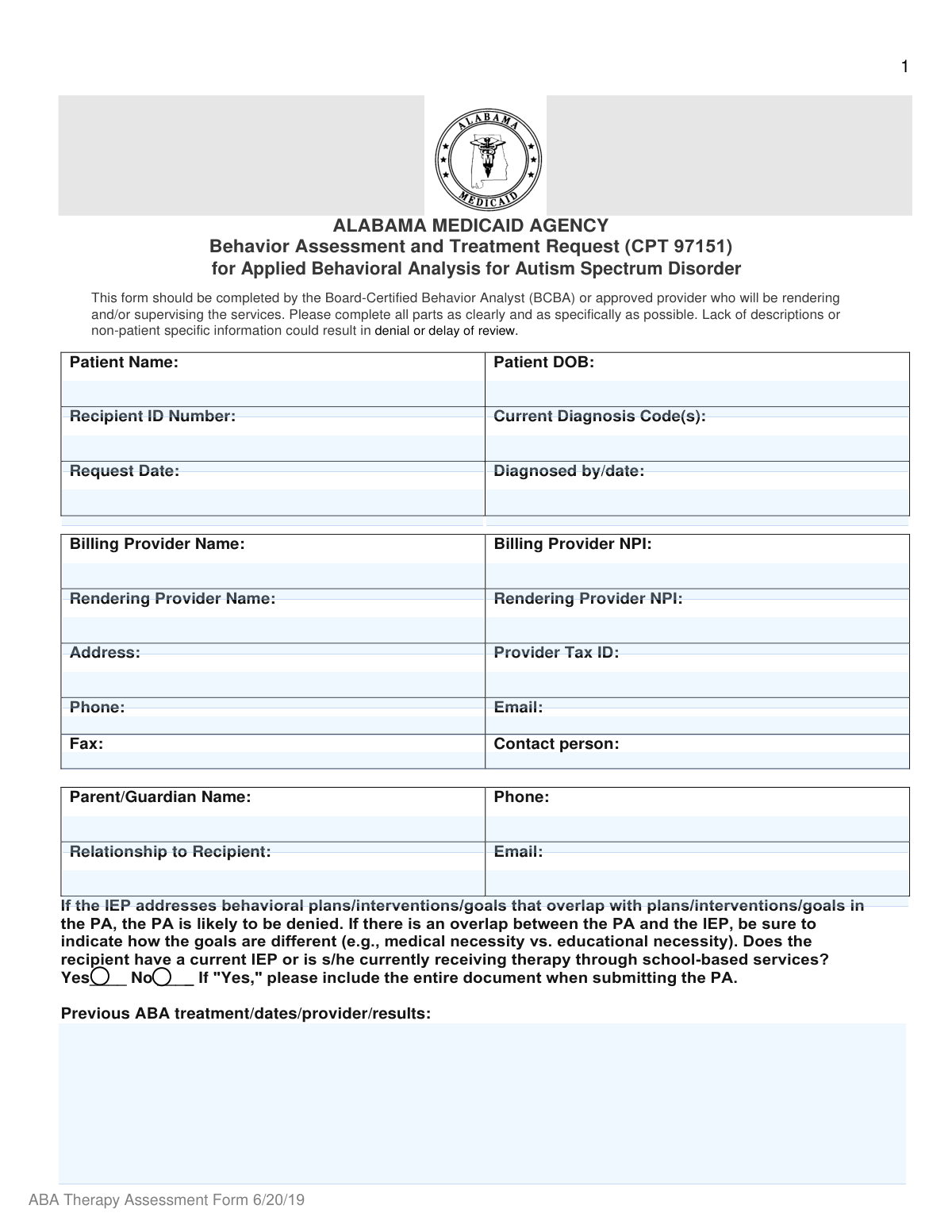
For providers working with patients covered under Alabama’s state plan, the Alabama Medicaid Agency ABA Therapy Assessment Form (6/20/19) is mandatory. This form is specifically designed for billing under CPT code 97151. It is used to justify the medical necessity of behavioral assessments and ensures that the requested ABA services are distinct from educational or school-based IEP services.
Payer-Specific Prior Authorizations
When your primary focus is administrative authorization rather than a full clinical reassessment, look for payer-specific documents. The Applied Behavioral Analysis (ABA) Prior Authorization Request Form (Health Net Behavioral Health Autism Center) is the correct choice for Health Net members. Use this form to:
- Request specific HCPCS/CPT codes.
- Define service units per week or month.
- Provide supervisor NPI and TIN details for billing purposes.
By selecting the form that matches your patient's insurance provider and the current stage of their treatment—whether it is an initial assessment, a six-month review, or a simple authorization renewal—you can minimize delays and focus on patient care.
Form Comparison
| Form | Purpose | Who Files It | When to Use |
|---|---|---|---|
| Applied Behavior Analysis for Autism Initial Assessment and Goals and Six Month Reassessment of Goals and Treatment Plan (MMFRM-18) | Document ABA goals, progress, and request treatment authorization | Treating or supervising BCBA | Initial ABA authorization or every six-month reassessment |
| Alabama Medicaid Agency ABA Therapy Assessment Form (6/20/19) — Behavior Assessment and Treatment Request (CPT 97151) for Applied Behavioral Analysis for Autism Spectrum Disorder | Request Medicaid authorization for ABA behavior assessment and treatment planning | BCBA or Alabama Medicaid-approved provider | When billing CPT 97151 for Alabama Medicaid members |
| Applied Behavioral Analysis (ABA) Prior Authorization Request Form (Health Net Behavioral Health Autism Center) | Request Health Net utilization review approval for ABA services | ABA provider or case supervisor | Before starting or modifying ABA services for Health Net members |
Tips for autism forms
When filling out assessment forms, ensure every behavioral goal for reduction or increase includes a specific, objective baseline. Insurance reviewers look for quantifiable data to justify the medical necessity of the requested ABA hours and to track progress during reassessments.
Clearly state how the requested ABA therapy differs from services provided through a school's IEP or 504 plan. Overlapping goals can lead to denials if the payer believes the services are redundant or should be covered by the educational system rather than clinical insurance.
Always double-check the administrative sections for the correct NPI and Tax ID (TIN) for both the rendering provider and the supervising BCBA. Simple clerical errors in these identifiers are one of the most common reasons for authorization delays or rejected claims.
Most autism authorization forms require evidence that you are communicating with the member's other providers, such as pediatricians or speech therapists. Including specific dates of last contact and shared goals demonstrates a comprehensive care approach that payers prioritize.
AI-powered tools like Instafill.ai can complete these detailed autism forms in under 30 seconds with high accuracy. This technology ensures your data stays secure during the process, providing a significant time-saving advantage for clinicians managing multiple member reassessments.
Have the member's formal DSM-5 diagnosis and recent standardized test scores (such as the VBMAPP or ABLLS-R) ready before you begin. Having this clinical data on hand prevents interruptions and ensures that the clinical rationale for treatment is robust and consistent throughout the document.
Frequently Asked Questions
Autism forms in this category are primarily used to request and justify Applied Behavior Analysis (ABA) therapy. They help insurance providers and state agencies determine the medical necessity of behavioral services for individuals diagnosed with Autism Spectrum Disorder by reviewing clinical goals and diagnostic data.
Most of these clinical forms must be completed by a Board-Certified Behavior Analyst (BCBA) or an approved healthcare provider who is rendering or supervising the treatment. While parents or guardians provide demographic and diagnostic history, the clinical goals and treatment plans require professional evaluation and signature.
The correct form depends on the specific insurance provider or the state agency funding the services. For instance, providers in Alabama working with Medicaid patients must use the Alabama Medicaid Agency ABA Therapy Assessment Form, while Health Net members require the Health Net Behavioral Health Autism Center's specific authorization document.
Reassessment forms, such as the MMFRM-18, are used to track a patient's progress over a specific period and ensure the treatment plan remains effective. Payers require these updates to justify the continuation of authorized therapy hours based on measurable improvements in targeted behaviors.
Yes, you can use AI tools to streamline the process of completing complex autism therapy forms. AI services like Instafill.ai can accurately extract data from source clinical documents and place it directly into the required PDF fields, ensuring high accuracy while reducing manual entry errors.
Most forms require patient demographics, diagnostic evaluation details (such as DSM-5 criteria), current medications, and coordination with other providers. Additionally, providers must include specific, measurable goals for behavior reduction or increase, along with the requested number of treatment units or hours.
Completed forms are typically submitted to the utilization management department of the patient's insurance carrier or the state's Medicaid agency. Submission is generally handled through a secure provider portal, via fax, or through an electronic health record (EHR) system, depending on the payer's specific requirements.
Using traditional manual methods, these multi-page clinical forms can take significant time to complete. However, with AI-powered tools like Instafill.ai, you can fill out these forms in under 30 seconds by automatically extracting and placing data from your existing assessment documents.
Incomplete or non-patient-specific documentation often leads to processing delays or denials of service. It is critical that all clinical history, test scores, and targeted behavior baselines are filled out accurately so that Medicaid or private insurance reviewers can determine if the requested services are appropriate.
No, these forms are distinct from an Individualized Education Program (IEP). While an IEP focuses on educational support and services within a school setting, these forms are used to secure medical insurance coverage for clinical therapy services provided in home, community, or clinic settings.
Glossary
- Form Complexity Index
- Instafill’s 0–100 measure of how much effort a form takes to complete, calculated deterministically from the form’s own structure rather than estimated. It combines the number of fillable fields (the largest factor), how difficult those fields are to complete based on their type, the number of pages that contain fields, the amount of conditional “fill-only-if” logic, and how many sections the form is divided into, then adds modifiers for tables and repeating lists, bundled instruction pages, and dense page layouts. A higher score means the form is harder to fill out by hand. The forms in this category have a median Form Complexity Index of 53/100 (Moderate). See exactly how it is calculated.
- ABA (Applied Behavior Analysis)
- A therapeutic approach that uses specific techniques to improve social, communication, and learning skills through positive reinforcement.
- BCBA (Board Certified Behavior Analyst)
- A graduate-level healthcare professional who is certified to design, implement, and oversee ABA therapy programs and treatment plans.
- Prior Authorization
- A process where a healthcare provider must get approval from an insurance company or Medicaid before providing a specific service for it to be covered.
- Medical Necessity
- The clinical criteria used by insurers to determine if a requested treatment is essential, appropriate, and reasonable for a patient's diagnosis.
- CPT Codes (Current Procedural Terminology)
- Standardized five-digit numeric codes, such as 97151, used to identify and bill specific medical or behavioral health services.
- IEP (Individualized Education Program)
- A legal document for students in public schools that outlines special education services and goals, often referenced to ensure ABA services do not duplicate school-based care.
- NPI (National Provider Identifier)
- A unique 10-digit identification number issued to healthcare providers in the United States to identify themselves on administrative and financial transactions.
- DSM-5 (Diagnostic and Statistical Manual of Mental Disorders)
- The standard classification manual used by clinicians to diagnose developmental disorders, including the specific criteria required for an Autism Spectrum Disorder diagnosis.