Yes! You can use AI to fill out Autism Spectrum Disorder Diagnostic Checklist for Medicaid Participants

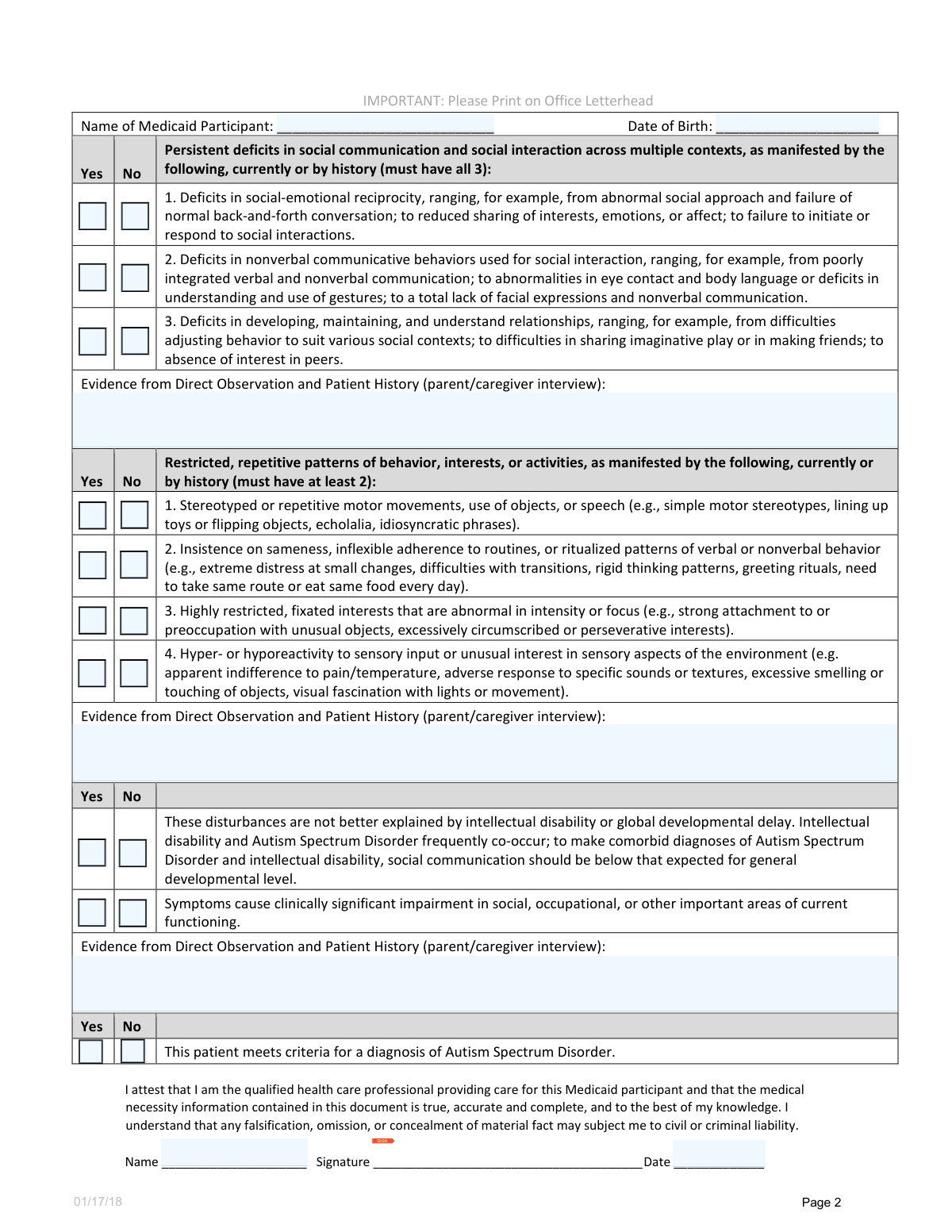
The Autism Spectrum Disorder Diagnostic Checklist is a critical medical document used by healthcare professionals to formally assess and attest to a diagnosis of ASD for a Medicaid participant. It systematically lists the DSM-5 criteria, ensuring a thorough evaluation of social communication deficits and repetitive behaviors, which is essential for authorizing appropriate medical services and support. Today, this form can be filled out quickly and accurately using AI-powered services like Instafill.ai, which can also convert non-fillable PDF versions into interactive fillable forms.
Our AI automatically handles information lookup, data retrieval, formatting, and form filling.
It takes less than a minute to fill out ASD Diagnostic Checklist using our AI form filling.
Securely upload your data. Information is encrypted in transit and deleted immediately after the form is filled out.

Form specifications

Form name: Autism Spectrum Disorder Diagnostic Checklist for Medicaid Participants
Number of fields: 28
Number of pages: 2
Language: English
Categories: autism forms, Medicaid forms
main-image

Instafill Demo: How to fill out PDF forms in seconds with AI

How to Fill Out ASD Diagnostic Checklist Online for Free in 2026

Are you looking to fill out a ASD DIAGNOSTIC CHECKLIST form online quickly and accurately? Instafill.ai offers the #1 AI-powered PDF filling software of 2026, allowing you to complete your ASD DIAGNOSTIC CHECKLIST form in just 37 seconds or less.
Follow these steps to fill out your ASD DIAGNOSTIC CHECKLIST form online using Instafill.ai:
  1. 1 Navigate to Instafill.ai and upload or select the Autism Spectrum Disorder Diagnostic Checklist form.
  2. 2 Allow the AI to scan and identify all the fields on the checklist, including patient information, diagnostic criteria checkboxes, and attestation sections.
  3. 3 Enter the Medicaid participant's name and date of birth in the designated fields.
  4. 4 Carefully review the patient's history and observational data to check the appropriate 'Yes' or 'No' boxes for each diagnostic criterion related to social communication and repetitive behaviors.
  5. 5 Provide detailed narrative evidence in the text boxes for social communication deficits, repetitive behavior patterns, and the explanation of disturbances, drawing from patient history and direct observation.
  6. 6 Complete the attestation section with the professional's name and date, then use the AI's review feature to double-check that all required criteria are met and the form is complete and accurate.
  7. 7 Sign the document electronically and securely download, print, or share the completed diagnostic form.

Our AI-powered system ensures each field is filled out correctly, reducing errors and saving you time.

Why Choose Instafill.ai for Your Fillable ASD Diagnostic Checklist Form?

Speed

Complete your ASD Diagnostic Checklist in as little as 37 seconds.

Up-to-Date

Always use the latest 2026 ASD Diagnostic Checklist form version.

Cost-effective

No need to hire expensive lawyers.

Accuracy

Our AI performs 10 compliance checks to ensure your form is error-free.

Security

Your personal information is protected with bank-level encryption.

Frequently Asked Questions About Form ASD Diagnostic Checklist

This form is a diagnostic checklist used by healthcare professionals to document evidence and determine if a Medicaid participant meets the criteria for an Autism Spectrum Disorder (ASD) diagnosis.

A qualified healthcare professional, such as a physician, psychologist, or other specialist conducting the evaluation, must complete, attest to, and sign this form.

You must provide detailed narrative evidence based on both your direct clinical observation of the participant and the developmental history provided by the patient or their parent/caregiver.

Your selection should be based on a comprehensive clinical evaluation. Check 'Yes' if the participant currently demonstrates the deficit or has a history of it, and 'No' if they do not.

To confirm an ASD diagnosis, the participant must exhibit all three types of social communication deficits and at least two of the four types of repetitive behavior patterns listed on the form.

The form has a specific field for this scenario. If the disturbances are better explained by an intellectual disability, you must indicate that, as it is a key factor in the diagnostic criteria.

This refers to symptoms that are severe enough to cause notable difficulties in the person's social, occupational, or other important areas of current daily functioning.

You should have access to the participant's complete medical and developmental history, your clinical notes from direct observations, and any information gathered from parent or caregiver interviews.

Submission instructions are typically provided by the specific Medicaid agency or healthcare organization that requested the evaluation. Please refer to their guidelines for the correct submission process.

Yes, services like Instafill.ai can use AI to auto-fill standard fields like names and dates to save time. However, all clinical judgments and evidence descriptions must be entered by the attesting professional.

Simply upload the form to the Instafill.ai platform. The service will make the fields interactive, allowing you to type your information, check boxes, and enter your detailed observations before downloading the completed document.

You can use a tool like Instafill.ai, which can convert non-fillable PDFs into interactive online forms. This allows you to easily type in your answers and check the required boxes directly on the document.

Social communication deficits relate to challenges with social interaction, nonverbal cues, and relationships. Repetitive behavior patterns refer to restricted interests, insistence on sameness, stereotyped movements, and sensory sensitivities.

Compliance ASD Diagnostic Checklist
Validation Checks by Instafill.ai

1
Participant Name Completeness
This check ensures that the 'Participant Name' field is not empty. A full name is required for proper identification of the Medicaid participant in all records and subsequent processing. If this field is left blank, the form submission will be rejected with an error message prompting the user to enter the participant's full name.
2
Date of Birth Validity
Validates that the 'Date of Birth' is a real, correctly formatted date and that it occurs in the past. This is crucial for verifying the participant's identity and eligibility for age-specific services. A submission with a future date, an invalid format (e.g., MM/DD/YYYYY), or a non-existent date (e.g., 02/30/2023) will fail validation.
3
Mutual Exclusivity for Symptom Checkboxes
This validation ensures that for any given symptom or criteria (e.g., 'Deficits in social-emotional reciprocity'), only one of the 'Yes' or 'No' options is selected. This prevents contradictory data entry which would make the assessment results ambiguous. If both 'Yes' and 'No' are selected for the same item, an error will be displayed, forcing the user to choose only one.
4
Completeness of All Symptom Questions
Verifies that every 'Yes'/'No' question related to diagnostic criteria has been answered. A complete set of answers is necessary to logically determine the final diagnosis. If any question is left unanswered, the submission will be blocked and the user will be guided to the first unanswered question.
5
Conditional Requirement for Social Communication Evidence
This check ensures the 'Social Communication Evidence' text field is not empty if 'Yes' has been selected for any of the three social communication deficit criteria. The narrative evidence is required to justify the positive findings and is essential for clinical review. If the condition is met and the text field is empty, the form will prompt the user to provide the necessary detailed explanation.
6
Conditional Requirement for Repetitive Behavior Evidence
Ensures the 'Repetitive Behavior Patterns Evidence' text field is filled out if 'Yes' is selected for any of the four repetitive behavior criteria. This narrative evidence from observation and history is mandatory to support the checklist findings. A failure in this validation will prevent submission and require the user to provide the supporting details.
7
Logical Validation for Positive ASD Diagnosis
If the final diagnosis checkbox 'Yes (Disturbances Explanation Evidence)' is selected, this validation confirms that all prerequisite criteria have been met. It checks that all three social communication deficits are marked 'Yes' AND at least two of the four repetitive behavior patterns are marked 'Yes'. If the underlying criteria are not met, the user cannot select a positive diagnosis, preventing logically inconsistent submissions.
8
Logical Validation for Negative ASD Diagnosis
If the final diagnosis checkbox 'No (Disturbances Explanation Evidence)' is selected, this check verifies that the criteria for a positive diagnosis have not been met. This prevents a situation where the user indicates a negative diagnosis despite the evidence supporting a positive one. If the criteria for a 'Yes' diagnosis are met, the system will flag the inconsistency and prompt the user to review their selections.
9
Mutual Exclusivity for Final Diagnosis
This validation ensures that only one of the final diagnosis options, 'Yes' or 'No' for Autism Spectrum Disorder, can be selected. The participant either meets the criteria or does not, and selecting both is a logical impossibility. If a user attempts to select both, the system will show an error and require a single choice.
10
Disturbances Explanation Evidence Completeness
This check verifies that the 'Evidence from Direct Observation and Patient History' text area under the 'Disturbances Explanation' section is not empty. This narrative is a summary of the findings and is critical for the overall assessment. An empty field would result in an incomplete record, so the submission will be blocked until this information is provided.
11
Attesting Professional Name Completeness
Ensures that the 'Attesting Professional Name' field is filled out. The attestation is legally and clinically invalid without the name of the qualified health care professional who performed the assessment. If the field is empty, the form cannot be submitted, ensuring accountability and validity.
12
Attestation Date Logic
Validates that the 'Attestation Date' is a valid date that is not in the future and occurs on or after the participant's 'Date of Birth'. This ensures the attestation is chronologically sound and was not signed before the patient was born or on a future date. An invalid date will block submission and require correction.

Common Mistakes in Completing ASD Diagnostic Checklist

Providing Vague or Unsubstantiated Evidence

This occurs when the text fields for 'Social Communication Evidence' or 'Repetitive Behavior Patterns Evidence' are filled with general statements instead of specific, observable examples. For instance, writing 'has trouble with friends' instead of 'During observation, the participant did not respond to a peer's greeting and turned away when asked to join a game.' This mistake leads to requests for more information, delaying the approval process and access to services. To avoid this, always provide concrete examples from both direct observation and caregiver interviews that directly support the diagnostic criteria.

Incorrectly Calculating the Final Diagnosis

The final 'Yes/No' checkboxes for the ASD diagnosis have complex conditional logic based on nine other checkboxes, which is highly prone to human error. Clinicians may miscount the required criteria or misinterpret the rule, leading to an incorrect final attestation. This can result in a rejected form or, more seriously, an inaccurate diagnosis being recorded. Using an automated tool can prevent this by performing the logical check automatically based on the inputs.

Making Contradictory Checkbox Selections

This error involves checking both the 'Yes' and 'No' box for the same diagnostic criterion, such as for 'Deficits in Nonverbal Communicative Behaviors.' This often happens due to haste or confusion, especially on complex forms. Such contradictions make the form logically invalid and will cause it to be rejected, requiring the filer to correct and resubmit. Carefully reviewing each question pair before submission is crucial to prevent this.

Inconsistent Narrative and Checkbox Evidence

This mistake happens when the detailed narrative provided in the text boxes does not align with or support the 'Yes'/'No' selections made in the checklist section. For example, describing clear deficits in developing relationships but then checking 'No' for that criterion. This inconsistency raises red flags for reviewers, questions the validity of the assessment, and may trigger an audit or a request for complete re-evaluation. Ensure every checkbox selection is directly supported by a corresponding detail in the evidence sections.

Missing Professional Signature or Date

Forgetting to sign or date the 'Attestation' section is one of the most common and critical errors, immediately invalidating the entire document. This often happens when rushing or when dealing with a non-fillable PDF where the signature line is easily overlooked. A missing attestation means the form has no legal standing and will be rejected outright, halting the entire process. If the form is a flat PDF, a tool like Instafill.ai can convert it into a fillable version where a digital signature can be easily applied and validated.

Using an Incorrect Participant Name or DOB

Entering a participant's name or date of birth that does not exactly match their official Medicaid records is a frequent data entry error. Using a nickname, a shortened name, or transposing numbers in the birth date can cause the submission to be rejected by automated systems. This leads to administrative delays and requires manual correction and resubmission. AI-powered form-filling tools like Instafill.ai can help prevent this by storing and accurately populating validated information across documents.

Leaving Required Checkbox Pairs Blank

On this form, every diagnostic criterion has a mandatory 'Yes' or 'No' selection, and failing to check one of the boxes for a given item renders the form incomplete. This often occurs when a user is uncertain about a criterion and decides to skip it rather than make a definitive choice. An incomplete form cannot be processed, leading to automatic rejection and delaying the participant's access to care. It is essential to make a selection for every single criterion based on the clinical evidence.

Misinterpreting Complex Clinical Terminology

The form uses highly specific clinical terms like 'social-emotional reciprocity' or 'stereotyped or repetitive motor movements,' each with a detailed definition. A common mistake is to check the box based on a general understanding rather than the precise definition provided, leading to an inaccurate assessment. This can result in a flawed diagnosis that does not truly reflect the participant's condition. To avoid this, professionals must carefully read and apply the exact definitions provided for each criterion on the form.

Using an Informal or Incomplete Professional Name

In the 'Attesting Professional Name' field, using a nickname, an abbreviation, or failing to provide the full legal name and credentials can cause issues. Official attestations require the full, legally recognized name of the qualified professional to be valid. An informal name may lead to the form being flagged for verification or rejected for failing to meet legal and professional standards. Always use the full name as it appears on your professional license.

Incorrect Date Formatting in Attestation

Entering the 'Attestation Date' in a format different from the required standard (e.g., DD-MM-YYYY instead of MM/DD/YYYY) can cause data processing errors. This simple mistake can lead to the form being flagged by automated systems or causing confusion during manual review, potentially delaying the process. To prevent this, always double-check for any specified date format instructions. Using a tool like Instafill.ai can help by automatically formatting dates correctly according to the form's requirements.
Saved over 80 hours a year

“I was never sure if my IRS forms like W-9 were filled correctly. Now, I can complete the forms accurately without any external help.”

Kevin Martin Green

Your data stays secure with advanced protection from Instafill and our subprocessors

Robust compliance program

Transparent business model

You’re not the product. You always know where your data is and what it is processed for.

ISO 27001, HIPAA, and GDPR

Our subprocesses adhere to multiple compliance standards, including but not limited to ISO 27001, HIPAA, and GDPR.

Security & privacy by design

We consider security and privacy from the initial design phase of any new service or functionality. It’s not an afterthought, it’s built-in, including support for two-factor authentication (2FA) to further protect your account.

Fill out ASD Diagnostic Checklist with Instafill.ai

Worried about filling PDFs wrong? Instafill securely fills autism-spectrum-disorder-diagnostic-checklist-for-medicaid-participants forms, ensuring each field is accurate.