Fill out autism assessment forms
with AI.
Autism assessment forms are clinical and administrative documents used to evaluate, document, and authorize services for individuals diagnosed with Autism Spectrum Disorder (ASD). These forms typically capture diagnostic history, behavioral baselines, measurable treatment goals, and provider recommendations — all of which insurers, Medicaid agencies, and health plans require to determine whether Applied Behavior Analysis (ABA) therapy and related services are medically necessary. Without thorough, accurate documentation, families and providers risk delays or outright denials in getting essential care approved.
By continuing, you acknowledge Instafill's Privacy Policy and agree to get occasional product update and promotional emails.
About autism assessment forms
These forms are most commonly completed by Board Certified Behavior Analysts (BCBAs) and supervising clinicians, often in coordination with families, schools, and other healthcare providers. They come into play at key stages of care — during an initial ASD evaluation, when requesting authorization for ABA therapy, and at reassessment points (typically every six months) to demonstrate progress and justify continued treatment. Forms like the MMFRM-18 and the Alabama Medicaid ABA Therapy Assessment Form are representative examples of the detailed documentation payers require before approving services.
Because these forms are lengthy, multi-page, and require precise clinical data entry, completing them accurately can be time-consuming. Tools like Instafill.ai use AI to fill these forms in under 30 seconds, helping BCBAs and providers reduce administrative burden while keeping patient data accurate and secure.
Every form on this page can be completed without typing. Instafill is form filling software that reads a PDF and fills it for you — including flat and scanned documents that carry no fillable fields at all.
Forms in This Category
The forms in this category have a median Form Complexity Index of 72/100 (Complex), measured across 2 forms by field count, input difficulty, length, conditional logic and structure. See how it is calculated.
- Enterprise-grade security & data encryption
- 99%+ accuracy powered by AI
- 1,000+ forms from all industries
- Complete forms in under 60 seconds
How to Choose the Right Form
All three forms in this category support ABA therapy authorization for Autism Spectrum Disorder, but they differ by payer, purpose, and stage of treatment. Here's how to find the right one:
For Insurance/Health Plan Authorization (Non-Medicaid)
If you're seeking ABA therapy approval through a private insurer or managed care health plan, you'll want one of the two MMFRM-18 forms:
- Applied Behavior Analysis for Autism Initial Assessment and Goals and Six Month Reassessment of Goals and Treatment Plan (MMFRM-18) — Use this 8-page form whether you're submitting an initial assessment or a six-month reassessment. Both versions capture the same core information: member demographics, diagnostic history, behavioral goals, and treatment authorization requests.
- The two MMFRM-18 listings cover the same form — if you're a BCBA completing documentation for a health plan, either entry will get you to the right document.
For Alabama Medicaid Patients
If your patient is enrolled in Alabama Medicaid, use the:
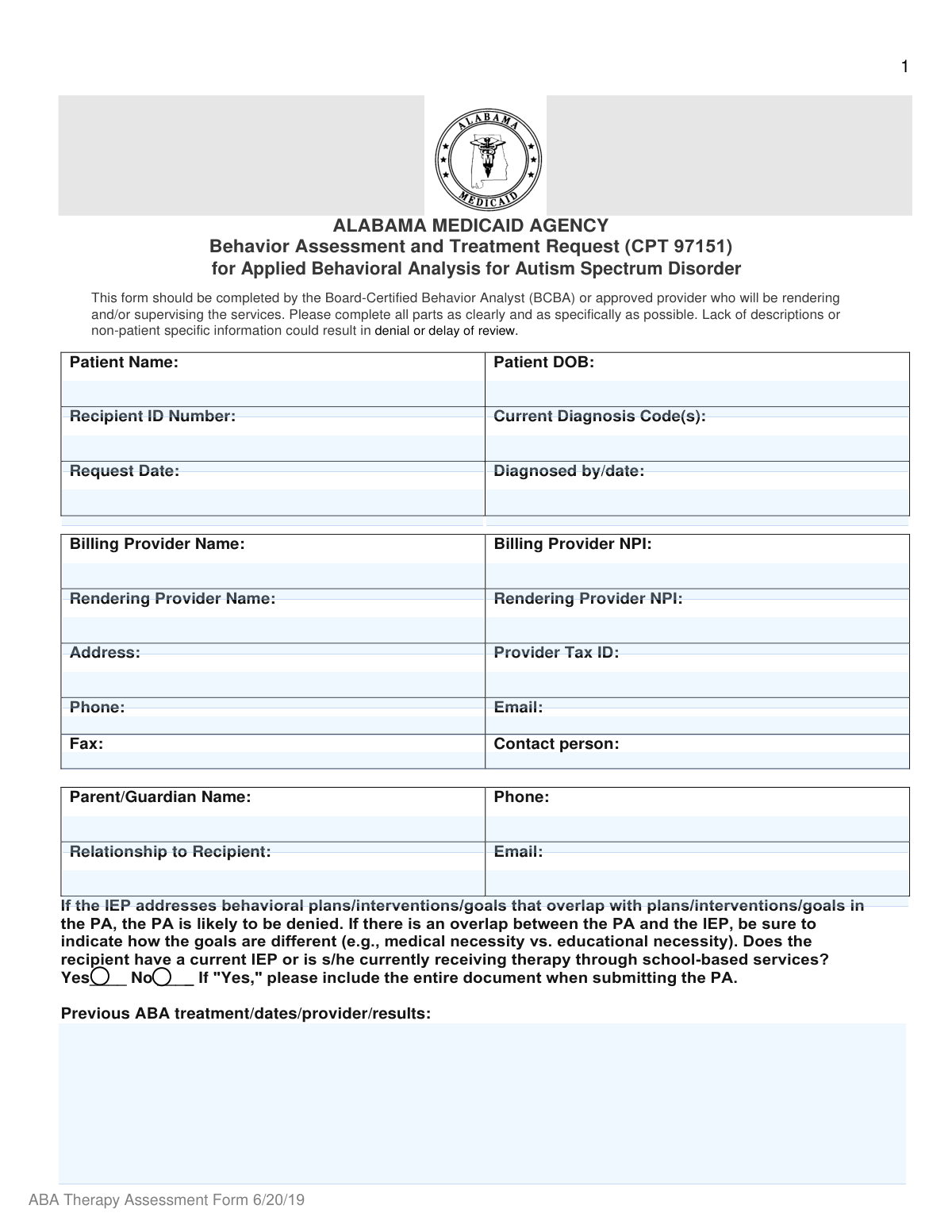
- Alabama Medicaid Agency ABA Therapy Assessment Form (6/20/19) — This form is specifically designed for Alabama Medicaid's requirements and supports billing under CPT 97151. It includes fields for IEP/school-based services, DSM-5 criteria, and Medicaid-specific coordination language that private insurer forms don't require.
Quick Decision Checklist
- Private insurance or health plan? → Use the MMFRM-18
- Alabama Medicaid? → Use the Alabama Medicaid ABA Therapy Assessment Form
- Initial evaluation or 6-month update? → The MMFRM-18 covers both in one document
- Need to document measurable behavior goals and treatment hours? → All three forms require this — choose based on your payer
All forms must be completed by a Board-Certified Behavior Analyst (BCBA) and are critical for demonstrating medical necessity and avoiding claim denials.
Form Comparison
| Form | Purpose | Who Files It | When to Use |
|---|---|---|---|
| Applied Behavior Analysis for Autism Initial Assessment and Goals and Six Month Reassessment of Goals and Treatment Plan (MMFRM-18) | Initial ABA assessment and treatment authorization request | Treating or supervising BCBA | At start of ABA services or six-month reassessment |
| Alabama Medicaid Agency ABA Therapy Assessment Form (6/20/19) — Behavior Assessment and Treatment Request (CPT 97151) for Applied Behavioral Analysis for Autism Spectrum Disorder | Request Medicaid authorization for ABA behavior assessment (CPT 97151) | BCBA or Alabama Medicaid-approved provider | When seeking Alabama Medicaid ABA service approval |
| Applied Behavior Analysis for Autism Initial Assessment and Goals and Six Month Reassessment of Goals and Treatment Plan (MMFRM-18) | Document ABA goals and request health plan treatment authorization | Board Certified Behavior Analyst (BCBA) | Initial authorization or six-month ABA treatment review |
Tips for autism assessment forms
Have the member's official autism diagnosis documentation, DSM-5 criteria findings, and any standardized test scores ready before you begin. These forms require specific diagnostic details, and hunting for records mid-form increases the risk of errors or incomplete entries that can trigger denials.
Payers and Medicaid reviewers scrutinize behavioral goals closely — vague language like 'improve communication' is a common rejection trigger. Always express goals with a baseline frequency or percentage and a specific target (e.g., 'reduce elopement from 5 times/day to 1 time/day within 6 months').
A frequent denial reason — especially on Medicaid forms like the Alabama CPT 97151 form — is failing to clearly differentiate ABA therapy goals from what is already addressed in the child's IEP. Explicitly note how the requested services complement rather than duplicate school-based interventions.
When completing reassessment sections of forms like the MMFRM-18, make sure progress updates directly reference the goals and baselines documented in the initial assessment. Inconsistencies between initial and reassessment data are a red flag for reviewers and can delay reauthorization.
AI-powered tools like Instafill.ai can fill out complex multi-page ABA assessment forms quickly and accurately, pulling in the right clinical language and formatting. Your data stays secure throughout the process, making it a practical time-saver for BCBAs managing multiple authorization requests across different payers.
The requested treatment hours, service codes, and session frequency must be directly supported by the clinical findings and goals documented elsewhere in the form. A mismatch — such as requesting intensive hours without documenting the severity level that warrants them — is a leading cause of authorization delays.
Many of these forms require signatures from the supervising BCBA and sometimes a physician or other coordinating provider. Identify all required signatories early and route the form for signatures before your submission deadline, since chasing signatures at the last minute is one of the most common avoidable delays.
Some versions of these forms are distributed as flat, non-fillable PDFs, which forces providers to print and handwrite responses — increasing the chance of illegible entries and rejection. Tools like Instafill.ai can convert these into interactive fillable forms, making the process faster and cleaner for your whole team.
Frequently Asked Questions
Autism assessment forms are clinical and administrative documents used to document an individual's diagnosis, behavioral history, treatment goals, and progress in Applied Behavior Analysis (ABA) therapy. They are typically submitted to health plans, insurers, or Medicaid agencies to establish medical necessity and obtain authorization for ABA services.
These forms are generally completed by a Board Certified Behavior Analyst (BCBA) who is either directly providing or supervising ABA therapy services for the individual with Autism Spectrum Disorder. Some forms may also require input from other treating providers or coordination with school-based service teams.
The form you need depends on the payer and the state. The MMFRM-18 is used by certain health plans and insurers to request initial ABA authorization and document six-month reassessments. The Alabama Medicaid ABA Therapy Assessment Form is specifically required by the Alabama Medicaid Agency for services billed under CPT 97151. Always confirm which form your specific payer or program requires before submitting.
A BCBA typically needs to submit an autism assessment form at the start of ABA services to obtain initial authorization, and again at regular intervals — such as every six months — to request continued authorization and document treatment progress. Specific timelines vary by payer, so it's important to check your plan's requirements.
Most autism assessment forms require member demographics, ASD diagnosis details, current medications, behavioral baselines and measurable treatment goals, coordination with other providers or school services, and the specific number of therapy hours or units being requested. Some forms also ask for DSM-5 criteria documentation and standardized assessment scores.
Common reasons for delays or denials include incomplete documentation, goals that are not sufficiently measurable or individualized, missing baseline data, or failure to distinguish ABA services from educational services already covered under an IEP. Thorough and patient-specific documentation is key to a successful authorization request.
Submission destinations vary by form and payer. The Alabama Medicaid ABA form is submitted to the Alabama Medicaid Agency, while the MMFRM-18 is submitted to the relevant health plan or insurer. BCBAs should follow their specific payer's submission instructions, which may include online portals, fax, or mail.
Yes — AI-powered tools like Instafill.ai can fill out these complex multi-page forms in under 30 seconds by accurately extracting and placing data from source documents such as clinical records or prior authorizations. This significantly reduces administrative burden for BCBAs and helps minimize errors that could lead to claim denials.
Manually completing a multi-page autism assessment form like the MMFRM-18 can take a BCBA 30 minutes or more due to the volume of clinical detail required. Using an AI-powered service like Instafill.ai, the same form can be populated accurately in under 30 seconds, freeing up time for direct client care.
Yes, most payers require a separate assessment form for the initial authorization request and then reassessment forms — often every six months — to continue services. The MMFRM-18, for example, covers both the initial assessment and the six-month reassessment of goals and treatment plans in a single document.
While ABA therapy is most commonly associated with children, these forms can apply to individuals of any age who have been diagnosed with Autism Spectrum Disorder and are receiving ABA services. Eligibility for coverage may vary by payer, state Medicaid program, and the individual's specific plan.
After submission, the payer or Medicaid agency reviews the documentation to determine whether the requested ABA services meet medical necessity criteria. They may approve the requested hours, request additional information, or issue a partial or full denial — in which case the provider typically has the right to appeal.
Glossary
- Form Complexity Index
- Instafill’s 0–100 measure of how much effort a form takes to complete, calculated deterministically from the form’s own structure rather than estimated. It combines the number of fillable fields (the largest factor), how difficult those fields are to complete based on their type, the number of pages that contain fields, the amount of conditional “fill-only-if” logic, and how many sections the form is divided into, then adds modifiers for tables and repeating lists, bundled instruction pages, and dense page layouts. A higher score means the form is harder to fill out by hand. The forms in this category have a median Form Complexity Index of 72/100 (Complex). See exactly how it is calculated.
- BCBA (Board Certified Behavior Analyst)
- A credentialed professional who specializes in applied behavior analysis and is qualified to design, supervise, and evaluate ABA therapy programs. Most autism assessment forms require a BCBA's signature and license number to be valid for insurance authorization.
- ABA (Applied Behavior Analysis)
- A therapy approach based on the science of learning and behavior, commonly used to improve communication, social, and adaptive skills in individuals with autism. It is the primary treatment type covered by these assessment and authorization forms.
- ASD (Autism Spectrum Disorder)
- A neurodevelopmental condition characterized by challenges in social communication and the presence of restricted or repetitive behaviors, diagnosed according to criteria in the DSM-5. These forms require a formal ASD diagnosis to qualify for ABA therapy authorization.
- Medical Necessity
- A payer's standard for determining whether a requested treatment is clinically appropriate, evidence-based, and required for the patient's condition. Insurers and Medicaid reviewers use the documentation in these forms to decide if ABA services meet this threshold.
- Prior Authorization
- Approval that must be obtained from an insurance plan or Medicaid before ABA therapy services can begin or continue. These assessment forms serve as the primary documentation submitted to request that approval.
- CPT 97151
- A medical billing code for a behavior identification assessment conducted by a BCBA, used to bill insurance for the evaluation that determines an autism patient's treatment needs. The Alabama Medicaid ABA form is specifically tied to this code.
- DSM-5
- The Diagnostic and Statistical Manual of Mental Disorders, Fifth Edition, which provides the standardized criteria used to diagnose Autism Spectrum Disorder. Forms often ask providers to confirm which DSM-5 criteria the patient meets.
- Baseline
- A measured starting point for a target behavior before treatment begins, used to track whether therapy is producing meaningful improvement over time. These forms require baselines to be documented for each behavioral goal.
- IEP (Individualized Education Program)
- A legally mandated school-based plan outlining special education services for a student with a disability. Medicaid ABA forms ask about IEP status to ensure that requested ABA services are distinct from and not duplicating educational services.
- Six-Month Reassessment
- A required clinical review conducted every six months to evaluate a patient's progress toward behavioral goals and justify the continuation of ABA services. The MMFRM-18 form combines both the initial assessment and this reassessment into a single document.