Fill out health care program forms
with AI.
Health care program forms serve as the essential link between individuals and the specialized medical or financial assistance provided by state and federal agencies. These documents are vital for establishing eligibility, authorizing specific treatments, and ensuring that public health resources are distributed correctly. From managing long-term behavioral health support to enrolling in comprehensive state insurance plans, these forms facilitate the administrative processes that keep healthcare systems functioning and accessible to those in need.
By continuing, you acknowledge Instafill's Privacy Policy and agree to get occasional product update and promotional emails.
About health care program forms
Typically, these forms are utilized by both healthcare providers and individual applicants. Providers use them for network enrollment and service authorization, such as when joining the Indiana Health Coverage Programs or requesting behavioral health plan-of-care approvals in Oregon. Families and individuals often encounter these documents when applying for state-funded coverage like the Minnesota Health Care Programs or specialized support for children with specific medical needs. Because these applications often require detailed household, financial, and clinical information, accuracy is paramount to avoid delays in coverage or reimbursement.
Completing these complex, multi-page documents manually can be a significant administrative burden. Tools like Instafill.ai use AI to fill these forms in under 30 seconds, handling sensitive data accurately and securely to streamline the application process for everyone involved.
Every form on this page can be completed without typing. Instafill is form filling software that reads a PDF and fills it for you — including flat and scanned documents that carry no fillable fields at all.
Forms in This Category
The forms in this category have a median Form Complexity Index of 74/100 (Complex), measured across 5 forms by field count, input difficulty, length, conditional logic and structure. See how it is calculated.
- Enterprise-grade security & data encryption
- 99%+ accuracy powered by AI
- 1,000+ forms from all industries
- Complete forms in under 60 seconds
How to Choose the Right Form
Navigating health care program forms can be complex, as requirements vary significantly by state, applicant type, and the specific nature of the medical services required. To select the correct form, identify whether you are a resident applying for personal coverage, a caregiver for a child, or a healthcare provider seeking enrollment or service authorization.
Applying for State Health Coverage (Minnesota & Texas)
If you are an individual or head of household seeking public health insurance or financial assistance, look for these state-specific applications:
- Minnesota Residents: Use DHS-6696-ENG (Minnesota Health Care Programs Application). This is the primary form for determining eligibility for Medical Assistance (MA), MinnesotaCare, and tax credits through MNsure. It requires detailed household, income, and tax filing information.
- Texas Families: Use Form T-3 (Children with Special Health Care Needs Services Program Application) if you are applying for state-funded support for a child with chronic physical or developmental conditions. This form assesses eligibility based on household income and insurance status.
Behavioral Health and Residential Care (Oregon)
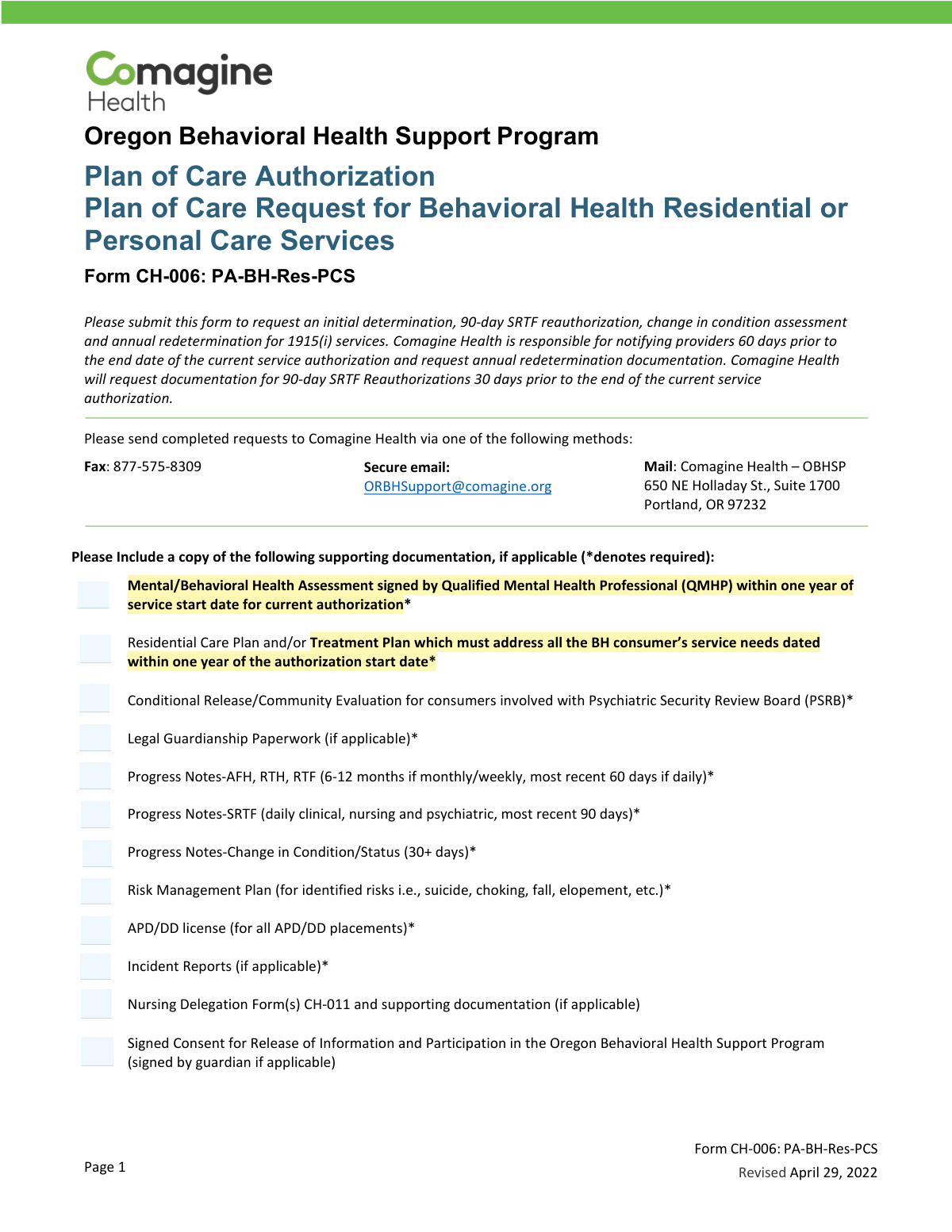
If you are a provider or a representative of a Community Mental Health Program (CMHP) in Oregon, you will likely need Form CH-006 (PA-BH-Res-PCS). This form is specifically used for:
- Requesting initial authorization for behavioral health residential or personal care services.
- Managing 90-day reauthorizations or annual redeterminations.
- Submitting change-in-condition assessments to Comagine Health for service continuity.
Healthcare Provider Enrollment (Indiana)
Healthcare practitioners in Indiana looking to join or update their status within managed care networks should use the Indiana Health Coverage Programs (IHCP) Managed Care Entity (MCE) Provider Enrollment Form. This document is essential for:
- Enrolling in networks that administer the Healthy Indiana Plan (HIP) or Hoosier Healthwise.
- Ensuring the practitioner is credentialed and eligible for reimbursement for services rendered to program members.
Form Comparison
| Form | Primary Purpose | Target Audience | Key Information Required |
|---|---|---|---|
| Form CH-006: PA-BH-Res-PCS, Oregon Behavioral Health Support Program Plan of Care Authorization (Plan of Care Request for Behavioral Health Residential or Personal Care Services) | Requesting authorization for behavioral health residential or personal care services. | Oregon residents requiring specialized behavioral health support services. | Level of care, procedure codes, and supporting clinical documentation. |
| Form T-3, Children with Special Health Care Needs (CSHCN) Services Program Application | Applying for state-funded health services for children with special needs. | Texas families with children having special health care requirements. | Household income, existing insurance coverage, and applicant medical information. |
| Form T-3, Children with Special Health Care Needs (CSHCN) Services Program Application | Enrolling children into the CSHCN Services Program for state benefits. | Families in Texas seeking support for children with special needs. | Household financial details, insurance status, and applicant demographics. |
| Indiana Health Coverage Programs (IHCP) Managed Care Entity (MCE) Provider Enrollment Form | Enrolling healthcare practitioners into Indiana's managed care provider networks. | Indiana healthcare providers seeking reimbursement for state program services. | Professional credentials, tax identification, and practice network details. |
| DHS-6696-ENG, Minnesota Health Care Programs Application (MNsure/DHS) | Determining eligibility for public health programs and financial assistance. | Minnesota individuals and households seeking comprehensive health coverage. | Tax filing status, household income, residency, and citizenship information. |
Tips for health care program forms
Inaccuracies in reporting household size or gross income are the most common reasons for health program denials. Cross-reference your entries with recent tax returns or pay stubs to ensure the data matches what state agencies will see during verification.
Forms for specialized care often require external clinical proof, such as behavioral health assessments or physician statements. Collecting these documents before you begin filling out the application prevents delays and ensures you have all the necessary details for the 'Plan of Care' sections.
AI-powered tools like Instafill.ai can complete these complex health care forms in under 30 seconds with high accuracy. This is a practical time-saver for providers or families managing multiple applications, and your sensitive data stays completely secure during the process.
For provider enrollment forms, even a single digit error in your National Provider Identifier (NPI) or Tax ID can stall the credentialing process. Always verify these numbers against your official registry to ensure seamless reimbursement and network inclusion.
State health applications often hide required signatures in the middle of the document for tax releases or privacy acknowledgments. Review every page specifically for signature lines to ensure your application isn't rejected for being technically incomplete.
Most health programs require an annual renewal or redetermination of eligibility. By saving a digital copy of your initial filing, you can quickly reference previous answers and update only what has changed, rather than starting the entire process from scratch next year.
Frequently Asked Questions
Health care program forms are documents used by state agencies and health organizations to determine eligibility for public health services, manage provider enrollment, or authorize specific treatments. They ensure that individuals receive appropriate benefits like Medicaid, specialized children's services, or behavioral health support.
These forms are used by a variety of people, including parents of children with special needs, healthcare providers seeking to join state networks, and individuals applying for state-funded health insurance. The specific form required depends on your role and the specific state program you are interacting with.
Most health care program forms are state-specific, such as the Oregon CH-006 or the Minnesota DHS-6696-ENG. You should select the form that corresponds to the state where you reside or where you provide medical services to ensure it is processed by the correct local agency.
While requirements vary, you will generally need to provide personal identification, household income details, tax filing status, and information about any existing insurance coverage. For provider-focused forms, you will likely need professional credentials, tax IDs, and network information.
Submission instructions are usually found on the last page of the form or in an accompanying instruction guide. Most can be mailed, faxed, or submitted through a secure online portal provided by the state's Health and Human Services department or the specific program administrator.
Yes, this category includes forms for both patients and healthcare professionals. For instance, the Indiana MCE Provider Enrollment Form is specifically for practitioners looking to join a managed care network, while the Texas T-3 form is for families seeking services for children.
Yes, you can fill out health care program forms using AI tools like Instafill.ai. These tools can accurately extract data from your source documents and place it into the correct fields on the form in under 30 seconds, reducing the risk of manual entry errors.
Filling out these forms online with AI is significantly faster than manual entry, often taking less than half a minute. AI-powered services like Instafill.ai can also turn non-fillable PDF versions into interactive documents, making the process much more efficient.
It is helpful to gather income statements such as W-2s or pay stubs, proof of residency, citizenship documents, and any relevant medical records or provider IDs. Having these documents ready will make the application process smoother and ensure all data provided is accurate.
Many health care program benefits require annual redetermination or periodic reauthorization to ensure you still meet eligibility criteria. Forms like the Oregon CH-006 are specifically used for annual reviews, 90-day reauthorizations, or changes in medical condition.
A general enrollment form, like the Minnesota DHS-6696-ENG, is used to apply for entry into a health program. In contrast, a plan of care authorization, such as Form CH-006, is used by providers to request approval for specific medical services or treatments once a member is already enrolled.
Glossary
- Form Complexity Index
- Instafill’s 0–100 measure of how much effort a form takes to complete, calculated deterministically from the form’s own structure rather than estimated. It combines the number of fillable fields (the largest factor), how difficult those fields are to complete based on their type, the number of pages that contain fields, the amount of conditional “fill-only-if” logic, and how many sections the form is divided into, then adds modifiers for tables and repeating lists, bundled instruction pages, and dense page layouts. A higher score means the form is harder to fill out by hand. The forms in this category have a median Form Complexity Index of 74/100 (Complex). See exactly how it is calculated.
- Managed Care Entity (MCE)
- A private health insurance company or organization that contracts with a state to deliver healthcare services to program members through a specific network of providers.
- Medical Assistance (MA)
- The name used by many state agencies for Medicaid, a program that provides health coverage to individuals and families with low income or disabilities.
- Plan of Care (POC)
- A formal document that outlines a patient's specific health needs, the goals for their treatment, and the specific services authorized to meet those goals.
- Redetermination
- The periodic process used by state health programs to re-evaluate a member's eligibility to ensure they still meet the income or medical requirements to receive benefits.
- Credentialing
- The process health programs use to verify a provider's professional qualifications, including their licenses, education, and experience, before allowing them to join a network.
- CSHCN (Children with Special Health Care Needs)
- A designation for children who have or are at risk for chronic physical, developmental, or behavioral conditions and require health services beyond what is typically required by children.
- 1915(i) Services
- A specific category of Medicaid benefits that allows states to provide home and community-based services to individuals with disabilities or chronic mental health conditions.
- Prior Authorization
- A requirement for a healthcare provider to obtain approval from a health plan or state agency before certain services are rendered to ensure they are medically necessary.