Yes! You can use AI to fill out Maryland Department of Public Safety and Correctional Services Application for Pardon

The Maryland Application for Pardon is a formal request submitted to the Governor of Maryland, through the Parole Commission, to forgive a past criminal offense. The application requires a detailed disclosure of the applicant's personal background, criminal history, financial status, and reasons for seeking the pardon, along with numerous supporting documents. Today, this extensive form can be filled out quickly and accurately using AI-powered services like Instafill.ai, which can also convert non-fillable PDF versions into interactive fillable forms.
Our AI automatically handles information lookup, data retrieval, formatting, and form filling.
It takes less than a minute to fill out Maryland Application for Pardon using our AI form filling.
Securely upload your data. Information is encrypted in transit and deleted immediately after the form is filled out.

Form specifications

Form name: Maryland Department of Public Safety and Correctional Services Application for Pardon
Number of pages: 27
Language: English
Categories: AFE forms, public safety forms
main-image

Instafill Demo: How to fill out PDF forms in seconds with AI

How to Fill Out Maryland Application for Pardon Online for Free in 2026

Are you looking to fill out a MARYLAND APPLICATION FOR PARDON form online quickly and accurately? Instafill.ai offers the #1 AI-powered PDF filling software of 2026, allowing you to complete your MARYLAND APPLICATION FOR PARDON form in just 37 seconds or less.
Follow these steps to fill out your MARYLAND APPLICATION FOR PARDON form online using Instafill.ai:
  1. 1 Navigate to Instafill.ai and upload or select the Maryland Application for Pardon form.
  2. 2 Use the AI assistant to automatically populate your personal details, such as your full name, address, date of birth, and other biographical information.
  3. 3 Systematically complete all sections of the application, including detailed accounts of your criminal history, employment, residences, and financial information, with AI guidance to ensure all questions are answered fully.
  4. 4 Follow the form's checklist to gather and digitally attach all required supporting documents, such as your photo ID, birth certificate, certified driving history, and court judgments.
  5. 5 Provide the character reference letter questionnaires to your three references, and then attach the completed and signed letters to your application.
  6. 6 Carefully review the entire application for accuracy and completeness before digitally signing the Certification, Authorization, and Acknowledgement section, which must be notarized.
  7. 7 Download the final, completed application package, save a copy for your personal records, and submit it as instructed by the Maryland Parole Commission.

Our AI-powered system ensures each field is filled out correctly, reducing errors and saving you time.

Why Choose Instafill.ai for Your Fillable Maryland Application for Pardon Form?

Speed

Complete your Maryland Application for Pardon in as little as 37 seconds.

Up-to-Date

Always use the latest 2026 Maryland Application for Pardon form version.

Cost-effective

No need to hire expensive lawyers.

Accuracy

Our AI performs 10 compliance checks to ensure your form is error-free.

Security

Your personal information is protected with bank-level encryption.

Frequently Asked Questions About Form Maryland Application for Pardon

This form is used to formally request a pardon from the Governor of Maryland for past criminal convictions. A pardon is an official act of forgiveness but does not expunge or remove the conviction from your record.

To be eligible, you must not be incarcerated and must have remained crime-free for a specific period after your sentence or release. This period is generally 5 years for misdemeanors, 10 years for most felonies, and 20 years for violent crimes or controlled substance violations.

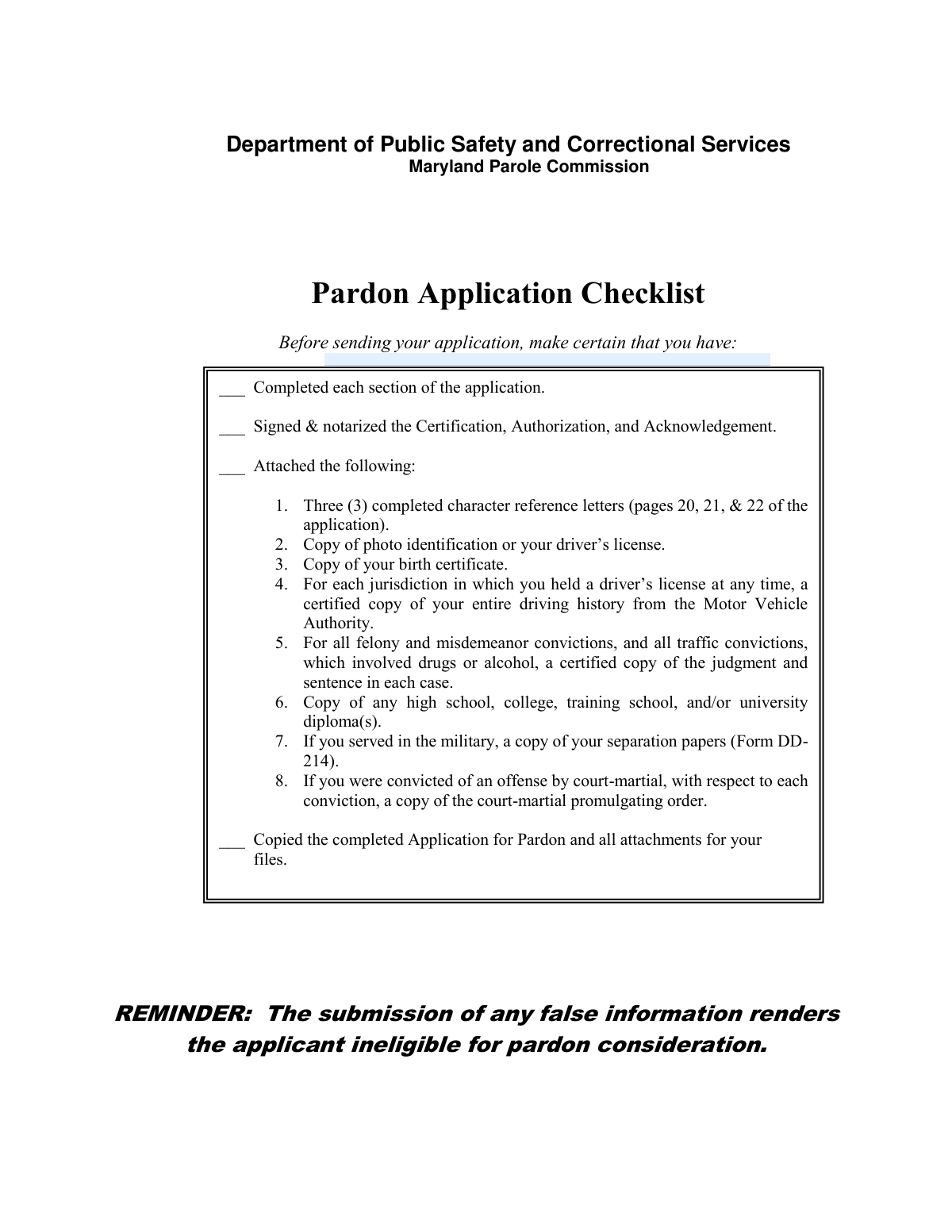
You must attach several documents, including three completed character reference letters, a copy of your photo ID and birth certificate, your complete driving history, and certified copies of the judgment and sentence for each conviction.

You can obtain certified copies from the court clerk in the county where you were convicted. It is important to request these documents well in advance of submitting your application.

You must obtain a certified, complete driving history from the Motor Vehicle Authority for every state or jurisdiction where you have ever held a driver's license. Be sure to specifically request the 'complete' or 'entire' history, as a standard report may be limited.

You must provide three character references who are not related to you by blood or marriage. Each reference needs to fill out the specific questionnaire included in the application packet (pages 20-22).

You must describe the factual circumstances of the offense in your own words, detailing the full extent of your involvement. Simply repeating the legal charge or criminal code citation is not sufficient.

Yes, in Section 8, you must list every incident where you were arrested, taken into custody, or charged by a law enforcement authority, regardless of the final disposition. Any omission is considered a falsification and will make you ineligible.

No, the application clearly states that a pardon does not remove convictions from your record. It is an act of forgiveness that may restore certain civil rights but does not expunge or seal the record.

Providing any false information will render your application ineligible for pardon consideration. It is crucial that all information you provide is completely truthful and accurate.

If your PDF is not interactive, you can use a service like Instafill.ai to convert it into a fillable form. This allows you to easily type your information into the fields, save your progress, and print a clean copy.

Yes, services like Instafill.ai use AI to help you auto-fill form fields accurately and save time. While AI can assist with standard information, you must personally write the narrative sections in your own words.

To fill out the form online, you can upload the Pardon Application PDF to the Instafill.ai platform. The service will make the document interactive, allowing you to type directly into the fields and then download the completed form.

The form is submitted to the Maryland Parole Commission. You should always check the official Department of Public Safety and Correctional Services website for the most current mailing address and submission guidelines before sending your documents.

Compliance Maryland Application for Pardon
Validation Checks by Instafill.ai

1
Validates Social Security Number Format
This check ensures the Social Security Number provided in Section 1 conforms to the standard XXX-XX-XXXX format. Correct formatting is essential for accurate identity verification and cross-referencing with other government databases. An invalid format will cause a hard failure, preventing the system from processing the application until the number is corrected.
2
Ensures Date of Birth is a Valid Past Date
This validation verifies that the 'Date of Birth' entered in Section 1 is a complete and logical date that occurs in the past. It prevents data entry errors such as future dates, invalid date combinations, or incomplete entries. An invalid date of birth would render background checks impossible and make the application ineligible for processing.
3
Conditional Requirement for Prior Pardon Details
This check enforces a conditional rule: if the applicant answers 'Yes' to having previously applied for a pardon in Maryland (Section 1), then the fields for the prior application date and disposition date must be filled. This information is critical for the Parole Commission to access the applicant's history with the pardon process. Failure to provide these details when required will flag the application as incomplete.
4
Verifies Attachment of Certified Judgment for Each Conviction
This validation confirms that for each felony, misdemeanor, or relevant traffic conviction listed in Section 3, a corresponding 'certified copy of the judgment and sentence' is marked as attached. The physical documents are required for official verification of the applicant's criminal history. An application will be considered incomplete and its investigation will be halted if these mandatory documents are missing.
5
Validates Chronological Order of Incarceration Dates
This check ensures that for each entry in the institutional incarceration history (Section 5), the 'Date Released' is on or after the 'Date Entered'. This maintains the logical integrity and accuracy of the applicant's historical timeline. An illogical date sequence indicates a data entry error and must be corrected before the applicant's history can be properly evaluated.
6
Ensures Complete 10-Year Residence History with No Gaps
This validation verifies that the residence history provided in Section 16(b) covers the last ten years completely, with no gaps between the 'From' and 'To' dates of consecutive entries. A continuous timeline is essential for conducting a thorough background investigation. Any unexplained gaps will flag the section as incomplete and require the applicant to provide the missing information.
7
Ensures Complete 7-Year Employment History with No Gaps
This check validates that the employment history in Section 20 accounts for the entire last seven years, ensuring all time periods are covered by either employment or a stated period of unemployment with means of support. This provides a full picture of the applicant's stability and activities. Unexplained gaps will be considered an incomplete response and will delay the application's processing.
8
Conditional Requirement for Military Form DD-214
If the applicant answers 'Yes' to having served in the armed forces (Section 17a), this check verifies that a copy of their separation papers (Form DD-214) is attached. This document is mandatory for verifying military service, rank, and type of discharge, which are important factors in character assessment. The application will be deemed incomplete if the form is not attached when required.
9
Validates Character References are Not Related to Applicant
This check ensures that the three character references listed in Section 25 are not related to, partnered with, or married to the applicant, as explicitly prohibited in the instructions. The rule exists to ensure objective, third-party assessments of the applicant's character. Submitting a reference who is a relative will invalidate that reference and require the applicant to provide a new, compliant one.
10
Verifies Applicant Signature and Notarization
This validation confirms that the 'Certification, Authorization, and Acknowledgement' section has been signed by the applicant and properly notarized, including the notary's seal and commission expiration date. This is a critical legal requirement that attests to the truthfulness of the application's contents. An unsigned or improperly notarized form is legally invalid and cannot be processed.
11
Cross-references Application with Initial Checklist Attachments
This validation ensures that all documents required by the 'Pardon Application Checklist' on the first page (e.g., photo ID, birth certificate, driving history, reference letters) are included with the submission. This serves as a final gatekeeping check before the application enters the formal investigation phase. If any document from the checklist is missing, the entire package is considered incomplete and will be rejected or delayed.
12
Conditional Requirement for Child Support Details
This check validates that if an applicant indicates they have minor children but do not have custody (Section 14a), they must complete Section 14(b) regarding child support payment status. This information is crucial for assessing the applicant's character and fulfillment of their legal and financial responsibilities. Omitting these details when applicable will result in an incomplete application and require further inquiry.

Common Mistakes in Completing Maryland Application for Pardon

Submitting Non-Certified or Incomplete Court Records

Applicants often fail to provide a 'certified' copy of the judgment and sentence for every required conviction, instead submitting standard photocopies. This happens because obtaining certified records from the court clerk requires a specific request and often a fee. An application without certified documents is considered incomplete and will be rejected, causing significant delays. To avoid this, contact the clerk of the court for each conviction and specifically request a certified copy of the judgment and sentence, and use the checklist to confirm you have one for every listed offense.

Providing an Incomplete Driving History

The form requires a 'certified copy of your entire driving history' from 'each jurisdiction' where a license was held, but applicants often submit a standard, limited-history report from only their current state. Motor Vehicle Authorities may issue a 3 or 5-year history by default, which is insufficient. This omission will halt the application process. To prevent this, you must explicitly request a complete or 'full' certified driving history from the MVA of every state you have ever been licensed in.

Omitting Minor or Expunged Criminal Incidents

In Section 8, applicants are required to list every arrest, charge, and investigation, including juvenile incidents and minor traffic violations that resulted in an arrest. Many people mistakenly believe they can omit charges that were dismissed, expunged, or seemed minor. Any omission is considered a falsification and renders the applicant ineligible. Carefully review your personal history and disclose every single incident, regardless of the outcome, to ensure your application is truthful and complete.

Forgetting the Signature and Notarization

The 'Certification, Authorization, and Acknowledgement' page must be signed by the applicant and notarized. It is common for applicants to overlook this final step after filling out the lengthy application. An un-notarized application is legally invalid and will be immediately returned or rejected. Always double-check page 19 to ensure your signature is present and has been sworn/affirmed before a Notary Public who has completed their section and applied their seal.

Using Improper Character References

The instructions explicitly state that character references should not be related to the applicant, but people often use family members out of convenience. Additionally, applicants may submit standard reference letters instead of having their references complete the specific questionnaire forms on pages 20-22. This non-compliance can weaken the application or cause it to be rejected. To avoid this, select three non-related individuals (like employers, mentors, or long-time neighbors) and provide them with pages 20-22 to fill out and sign themselves.

Leaving Gaps in Residence and Employment Histories

Sections 16 and 20 require a complete timeline of all residences for the past 10 years and all employment/unemployment for the past 7 years, with all time periods accounted for. Applicants frequently leave gaps between jobs or addresses, which makes the application incomplete. For any period of unemployment, you must state your means of support. To avoid this, create a separate timeline for yourself before filling out the form to ensure there are no unexplained gaps in your history.

Failing to Disclose All Known Names and Aliases

Section 1 requires listing 'every other name by which you have been known,' including maiden names, nicknames, and aliases. Applicants sometimes forget or intentionally omit names, viewing them as irrelevant. However, this information is critical for the background investigation, and failing to provide it can be seen as a falsification. You must list all names used in any context and provide the reason and dates for their use to ensure a thorough and transparent application.

Providing a Vague or Copied Offense Description

When asked to provide an account of the offense in Section 7, applicants may be tempted to simply copy the legal charge from court documents or be overly brief. The form specifically requests a detailed account in the applicant's 'own words,' including the full extent of involvement if it was a plea agreement. A vague description fails to show accountability and reflection, which is a key part of the pardon consideration. Take the time to write a thoughtful, honest, and detailed narrative of the circumstances surrounding the offense.

Applying Before Eligibility Period is Met

The form outlines strict crime-free waiting periods (e.g., 5 years for misdemeanors, 10-20 years for felonies) that must be met before an application can be considered. Applicants sometimes miscalculate this period or apply prematurely, hoping for an exception. This results in an automatic denial and wasted effort. Before starting, carefully calculate the time elapsed since the completion of your sentence, parole, or probation (whichever was last) to confirm you meet the minimum eligibility guidelines.

Missing Required Supporting Documents

The checklist on the first page lists numerous required attachments, such as a copy of photo ID, birth certificate, and any diplomas. Applicants, overwhelmed by the main application, can easily forget to gather and include these items. Submitting an application with missing documents will render it incomplete and cause processing delays. To avoid this, use the checklist as your final guide, physically checking off each item as you place it into the submission packet. AI-powered tools like Instafill.ai can also help by reminding users of required attachments based on form analysis.
Saved over 80 hours a year

“I was never sure if my IRS forms like W-9 were filled correctly. Now, I can complete the forms accurately without any external help.”

Kevin Martin Green

Your data stays secure with advanced protection from Instafill and our subprocessors

Robust compliance program

Transparent business model

You’re not the product. You always know where your data is and what it is processed for.

ISO 27001, HIPAA, and GDPR

Our subprocesses adhere to multiple compliance standards, including but not limited to ISO 27001, HIPAA, and GDPR.

Security & privacy by design

We consider security and privacy from the initial design phase of any new service or functionality. It’s not an afterthought, it’s built-in, including support for two-factor authentication (2FA) to further protect your account.

Fill out Maryland Application for Pardon with Instafill.ai

Worried about filling PDFs wrong? Instafill securely fills maryland-department-of-public-safety-and-correctional-services-application-for-pardon forms, ensuring each field is accurate.