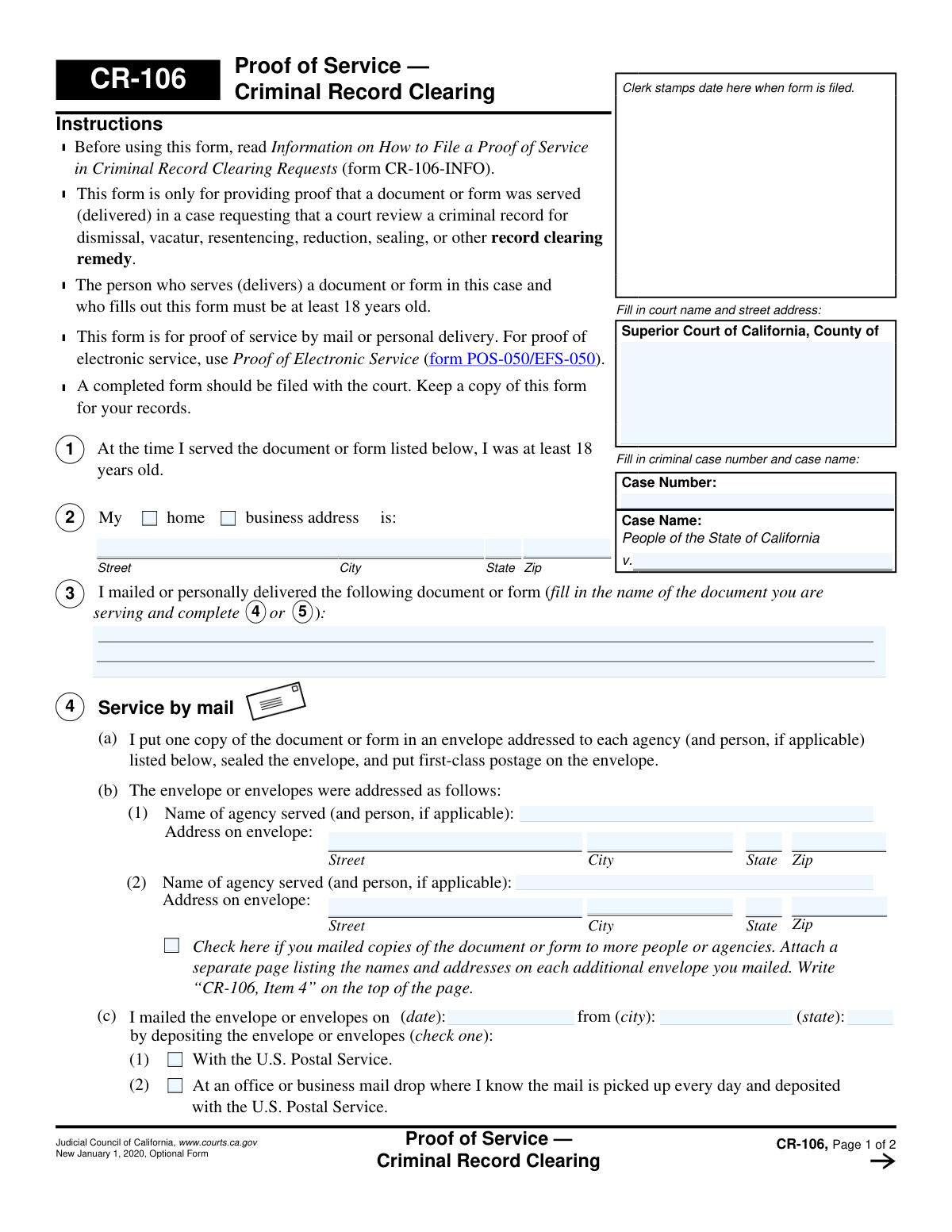
Yes! You can use AI to fill out Form CR-106, Proof of Service — Criminal Record Clearing

Form CR-106, Proof of Service — Criminal Record Clearing, is a legal document filed with the Superior Court of California to provide evidence that documents related to a request for criminal record clearing (e.g., dismissal, vacatur, sealing) have been properly delivered, or 'served,' to the relevant parties. This form is crucial for ensuring the legal process is followed correctly and all parties are officially notified. Today, this form can be filled out quickly and accurately using AI-powered services like Instafill.ai, which can also convert non-fillable PDF versions into interactive fillable forms.
CR-106 is part of the California court forms, criminal record forms and proof of service forms categories on Instafill.
Our AI automatically handles information lookup, data retrieval, formatting, and form filling.
It takes less than a minute to fill out CR-106 using our AI form filling.
Securely upload your data. Information is encrypted in transit and deleted immediately after the form is filled out.

Form specifications

Form name: Form CR-106, Proof of Service — Criminal Record Clearing
Number of fields: 48
Number of pages: 1
Language: English
main-image

Instafill Demo: How to fill out PDF forms in seconds with AI

How to Fill Out CR-106 Online for Free in 2026

Are you looking to fill out a CR-106 form online quickly and accurately? Instafill.ai offers the #1 AI-powered PDF filling software of 2026, allowing you to complete your CR-106 form in just 37 seconds or less.
Follow these steps to fill out your CR-106 form online using Instafill.ai:
  1. 1 Navigate to Instafill.ai and upload or select Form CR-106, Proof of Service — Criminal Record Clearing.
  2. 2 Use the AI assistant to automatically fill in the court name, street address, case number, and case name.
  3. 3 Provide your personal information as the server, including your address, and confirm you are over 18.
  4. 4 Specify the name of the document you served and select the method of service: by mail or by personal delivery.
  5. 5 If served by mail, enter the names and addresses of all recipients, the date of mailing, and how it was deposited with the U.S. Postal Service.
  6. 6 If served by personal delivery, detail the name of the person/agency served, the address of delivery, and the exact date and time of service for each recipient.
  7. 7 Review all entered information for accuracy, then e-sign and date the declaration under penalty of perjury before filing the completed form with the court.

Our AI-powered system ensures each field is filled out correctly, reducing errors and saving you time.

Why Choose Instafill.ai for Your Fillable CR-106 Form?

Speed

Complete your CR-106 in as little as 37 seconds.

Up-to-Date

Always use the latest 2026 CR-106 form version.

Cost-effective

No need to hire expensive lawyers.

Accuracy

Our AI performs 10 compliance checks to ensure your form is error-free.

Security

Your personal information is protected with bank-level encryption.

Frequently Asked Questions About Form CR-106

This form is used to provide official proof to the court that you have delivered (or "served") legal documents related to a criminal record clearing request to all required parties and agencies.

The person who delivers the documents, known as the "server," must fill out and sign this form. The server must be at least 18 years old and should not be a party to the case.

Service by Mail (Section 4) is when you send the documents via the U.S. Postal Service. Service by Personal Delivery (Section 5) is when the documents are hand-delivered directly to the recipient.

The completed and signed form should be filed with the court clerk at the Superior Court where your case is being handled. You should also keep a copy for your personal records.

You need to provide the full name and street address of the Superior Court, the criminal case number, and the case name, which is typically 'People of the State of California v. [Your Name]'.

In Section 2, you must write the official title of the specific criminal record clearing document you served, such as 'Petition for Dismissal' or 'Request for Vacatur'.

The form has space for two recipients. If you served more, check the box at the end of Section 4 or 5 and attach a separate page listing the additional recipients' details, labeling the page 'CR-106, Item 4' or 'CR-106, Item 5'.

No, this form is only for service by mail or personal delivery. For electronic service, you must use the 'Proof of Electronic Service' form (POS-050/EFS-050).

The server must sign and date the form in Section 6 only *after* they have successfully delivered the documents. The signature confirms under penalty of perjury that the service was completed as described.

Yes, services like Instafill.ai use AI to auto-fill form fields accurately with your information. This can help you complete the form faster and reduce the chance of errors.

You can upload the CR-106 PDF to the Instafill.ai platform. It will convert the document into a user-friendly, fillable format that you can complete and save directly from your web browser.

If you have a non-fillable or 'flat' PDF, you can use a service like Instafill.ai. It can convert the static PDF into an interactive, fillable form that you can easily complete online.

Compliance CR-106
Validation Checks by Instafill.ai

1
Case Number Presence and Consistency
This check ensures that the 'Case Number' field is filled out on both page 1 and page 2 of the form. It also verifies that the value entered is identical on both pages. This is critical for correctly associating the proof of service with the proper court case file, and failure to provide a consistent number can lead to filing rejection or misfiling.
2
Case Name Completeness
Validates that the defendant's name has been added to the 'Case Name' field following the pre-filled text 'People of the State of California v.'. An incomplete case name makes it difficult to identify the specific legal matter. If the field only contains the default text, the submission should be flagged as incomplete.
3
Exclusive Service Method Selection
This check ensures that information has been entered into EITHER Section 4 ('Service by mail') OR Section 5 ('Service by Personal Delivery'), but not both. The form requires choosing one method of service per submission. A failure means the user has either selected no method or has ambiguously selected both, requiring clarification before the form can be processed.
4
Served Document Identification
Verifies that the text field in Section 3, which specifies the document or form being served, is not empty. Knowing which document was served is the primary purpose of this form. If this field is blank, the proof of service is meaningless and cannot be accepted.
5
Server's Address Completeness
Ensures that if any part of the server's address in Section 2 (Street, City, State, Zip) is filled, all parts are completed. A complete address is legally required for the server to be identifiable and contactable. An incomplete address could invalidate the proof of service.
6
Server's Address Type Selection
This validation confirms that one of the two checkboxes ('home' or 'business') in Section 2 has been selected to classify the server's address. This classification can be relevant for legal purposes. If neither is selected, the form is incomplete and should be returned for correction.
7
Service by Mail Completeness
If Section 4 ('Service by mail') is used, this check confirms that all sub-parts are filled: at least one recipient's name and full address, the date, city, and state of mailing, and a selected mailing deposit method. Missing any of these details makes the proof of mailing invalid. The form should be rejected if this section is chosen but incomplete.
8
Service by Personal Delivery Completeness
If Section 5 ('Service by Personal Delivery') is used, this validation ensures that the recipient's name, the full delivery address, and the specific date and time of delivery are all provided. Personal delivery requires precise details for verification. The form is invalid if this section is used without all required fields being completed.
9
Valid Service Date Format
This check verifies that the date of service entered in Section 4(b) or Section 5(a)(2) is in a valid date format (e.g., MM/DD/YYYY) and is not a future date. A service cannot have occurred on an invalid or future date. This validation prevents clerical errors and ensures the chronological integrity of the legal process.
10
Logical Date Sequence
Compares the signature date in Section 6 with the service date from Section 4 or 5. The signature date must be on or after the date the service was performed. It is logically impossible to sign a declaration of service before the service has actually occurred, and a violation would invalidate the proof.
11
Signature Block Completion
Ensures that both the server's printed name and the signature date are filled out in Section 6. The signature, printed name, and date together form the legal declaration under penalty of perjury. Missing either the name or the date renders the declaration incomplete and legally void.
12
ZIP Code Format Validation
This check examines all ZIP code fields on the form to ensure they contain a valid 5-digit or 9-digit (ZIP+4) numeric format. Correctly formatted ZIP codes are essential for mail delivery and address verification. An invalid format can lead to processing errors or indicate a data entry mistake.
13
State Abbreviation Validation
Verifies that all 'State' fields contain a valid, 2-letter US state or territory abbreviation. Using standardized abbreviations prevents ambiguity and ensures address data is clean and usable for automated systems or mailings. Non-standard or misspelled state entries should be flagged for correction.
14
Valid Service Time Format
For personal delivery (Section 5), this check ensures the 'Time' field is entered in a recognizable format (e.g., HH:MM with AM/PM). The time of service can be a critical detail in legal disputes. An invalid or ambiguous time entry can weaken the proof of service and should be corrected.

Common Mistakes in Completing CR-106

Wrong Person Completing the Form

The person requesting the criminal record clearing (the defendant) incorrectly fills out and signs this form themselves. This happens due to a misunderstanding of the term 'server.' The form must be completed and signed by a neutral third party who is at least 18 years old and not a party to the case. If the defendant signs as the server, the proof of service is invalid and will be rejected by the court, causing significant delays.

Incomplete or Incorrect Case Identifiers

Users often enter an incomplete case number or fail to fill in the full, correct name and street address of the Superior Court. This can happen from miscopying information or not having the original case documents handy. A wrong case number or court identifier can lead to the document being misfiled or rejected entirely, halting the progress of the record clearing request. It is also common to forget to enter the case number on the top of page 2.

Vague Description of Document Served

In Section 3, filers write a generic description like 'court papers' or 'legal forms' instead of the specific title of the document. The purpose of this form is to prove a specific document was served, so the description must be exact (e.g., 'Petition for Dismissal under Penal Code § 1203.4'). A vague description can invalidate the proof of service, as the receiving party can claim they were not properly notified of the specific legal action.

Incorrect Agency Name or Address

The form requires serving government agencies, but people often use informal names (e.g., 'DA's Office') or outdated addresses found through a quick web search. Agency addresses and official names can be very specific, and using the wrong one can result in the document never being received. This leads to failed service, requiring the process to be started over. Always verify the current, official 'address for service' for the specific District Attorney or prosecuting agency.

Forgetting to Serve All Required Parties

Criminal record clearing petitions typically require service on both the District Attorney and the original prosecuting agency (if different, such as a City Attorney). People often only serve the District Attorney, forgetting other necessary parties. This failure to notify all parties will cause the court to delay or deny the petition until proper service is completed for everyone, extending the timeline of the case.

Confusing Service by Mail and Personal Delivery

A common error is to fill out parts of both Section 4 (Service by Mail) and Section 5 (Service by Personal Delivery) for the same recipient, or to fill out the wrong section altogether. Each method has distinct requirements, and mixing them up creates an ambiguous and invalid proof of service. You must choose one method for each act of service and complete only the corresponding section (4 or 5) fully and accurately.

Incomplete Mailing Information

When using 'Service by Mail' (Section 4), people frequently forget to fill in the date, city, and state from which the document was mailed in subsection (c). This information is legally required to establish when the service was officially completed. Omitting these details makes the proof of service defective and can be grounds for the court to reject the filing.

Omitting the Time of Personal Delivery

For 'Service by Personal Delivery' (Section 5), the form requires the date and the specific time the document was handed to the recipient. Many people fill in the date but overlook the field for the time. Unlike service by mail, the exact time of personal delivery can be a crucial legal detail, and its omission can render the proof of service technically deficient.

Signing the Form Before the Service Date

The server signs the form on a date that is before the date of mailing (Section 4c) or personal delivery (Section 5). The signature on this form is a declaration 'under penalty of perjury' that the service has already been completed. Signing it beforehand constitutes a false statement and invalidates the entire document. The server must perform the service first, then fill out and sign the form.

Missing Signature or Date

The server forgets to sign or date the form in Section 6. An unsigned or undated declaration is legally worthless and will be immediately rejected by the court clerk. This simple oversight is a very common reason for filing rejections, forcing the filer to have the server sign a new form and refile it, causing unnecessary delays. AI-powered form filling tools like Instafill.ai can help prevent this by flagging empty signature and date fields before submission.

Using the Wrong Form for Electronic Service

The filer serves the documents via email or a court's e-filing portal but uses this CR-106 form to prove it. This form explicitly states it is for service by mail or personal delivery and directs users to a different form (POS-050/EFS-050) for electronic service. Using the incorrect form for the method of service will result in the proof of service being rejected.

Illegible Handwriting on a Printed Form

Many people print the PDF and fill it out by hand, but their handwriting is difficult to read. Court clerks and opposing counsel must be able to clearly read case numbers, addresses, and names. If the information is illegible, the filing may be rejected, or worse, the data may be entered incorrectly into the court system, causing major issues. To avoid this, the form should be filled out electronically before printing. If the form is a non-fillable PDF, tools like Instafill.ai can convert it into a fillable version to ensure all text is clear and legible.
Saved over 80 hours a year

“I was never sure if my IRS forms like W-9 were filled correctly. Now, I can complete the forms accurately without any external help.”

Kevin Martin Green

Your data stays secure with advanced protection from Instafill and our subprocessors

Robust compliance program

Transparent business model

You’re not the product. You always know where your data is and what it is processed for.

ISO 27001, HIPAA, and GDPR

Our subprocesses adhere to multiple compliance standards, including but not limited to ISO 27001, HIPAA, and GDPR.

Security & privacy by design

We consider security and privacy from the initial design phase of any new service or functionality. It’s not an afterthought, it’s built-in, including support for two-factor authentication (2FA) to further protect your account.

Fill out CR-106 with Instafill.ai

Worried about filling PDFs wrong? Instafill securely fills form-cr-106-proof-of-service-criminal-record-clearing forms, ensuring each field is accurate.

Related forms by category

California court forms Judicial Council of California Form SC-105, Request for Court Order and Answer (Small Claims), Judicial Council of California Form SC-120, Defendant’s Claim and ORDER to Go to Small Claims Court (Small Claims), Judicial Council of California Form SER-001, Request for Sheriff to Serve Court Papers, Judicial Council of California Form SER-001, Request for Sheriff to Serve Court Papers, Affidavit for Collection of Personal Property California Probate Code Section 13100, Form POS-040, Proof of Service—Civil, Declaration of Facts of Death (California Superior Court), declaration-of-marriage-for-court-proceeding-california-family-law, ADOPT-200, Adoption Request, ADOPT-200, Stepparent Adoption Request, ADOPT-210, Adoption Agreement, ADOPT-310, Contact After Adoption Agreement, Judicial Council of California Form ADOPT-200, Adoption Request, Form ADR-107, Mediation Attendance Sheet, Form ADR-110, Order Appointing Referee, Form ADR-109, Stipulation or Motion for Order Appointing Referee, Form ADR-102, Request for Trial De Novo After Judicial Arbitration, Form ADR-108, Referee's Report (Code Civ. Proc., §§ 638, 639), Form ADR-106, Petition to Confirm, Correct, or Vacate Contractual Arbitration Award, Form ADR-104, Rejection of Award and Request for Trial After Attorney-Client Fee Arbitration · + 126 more →
criminal record forms Maryland Department of Public Safety and Correctional Services Application for Pardon, Resource Family Application - Criminal Record Statement, Form GEN 1331, Criminal Record and Child Abuse Registry Checklist, Form CR-134, Notice Regarding Record on Appeal (Misdemeanor), Form CR-142, Notice of Appeal and Record on Appeal (Infraction), form-cr-105-defendants-financial-statement-on-eligibility-for-appointment-of-counsel-and-reimbursement-and-record-on
proof of service forms Form POS-040, Proof of Service—Civil, Judicial Council of California Form SC-104, Proof of Service (Small Claims), Judicial Council of California Form SC-104, Proof of Service (Small Claims), Form DV-200, Proof of Personal Service (CLETS) (Domestic Violence Prevention), Illinois Circuit Court Eviction Summons and Proof of Service of Eviction Summons & Eviction Complaint (Form E-S 3507.3), proof-of-electronic-service-appellate, Form APP-009, Proof of Service (Appellate Division), Form APP-109, Proof of Service (Appellate Division), Form GC-020(P), PROOF OF PERSONAL SERVICE OF NOTICE OF HEARING— GUARDIANSHIP OR CONSERVATORSHIP, Form APP-109E, Proof of Electronic Service (Appellate Division), Proof of Personal Service of Notice of Initial Appearance—CARE Act Proceedings, Form CARE-116, Proof of Personal Service of Notice of Hearing—CARE Act Proceedings, care-107-proof-of-personal-service-of-notice-of-order-for-care-act-report, form-civ-120-notice-of-entry-of-dismissal-and-proof-of-service