
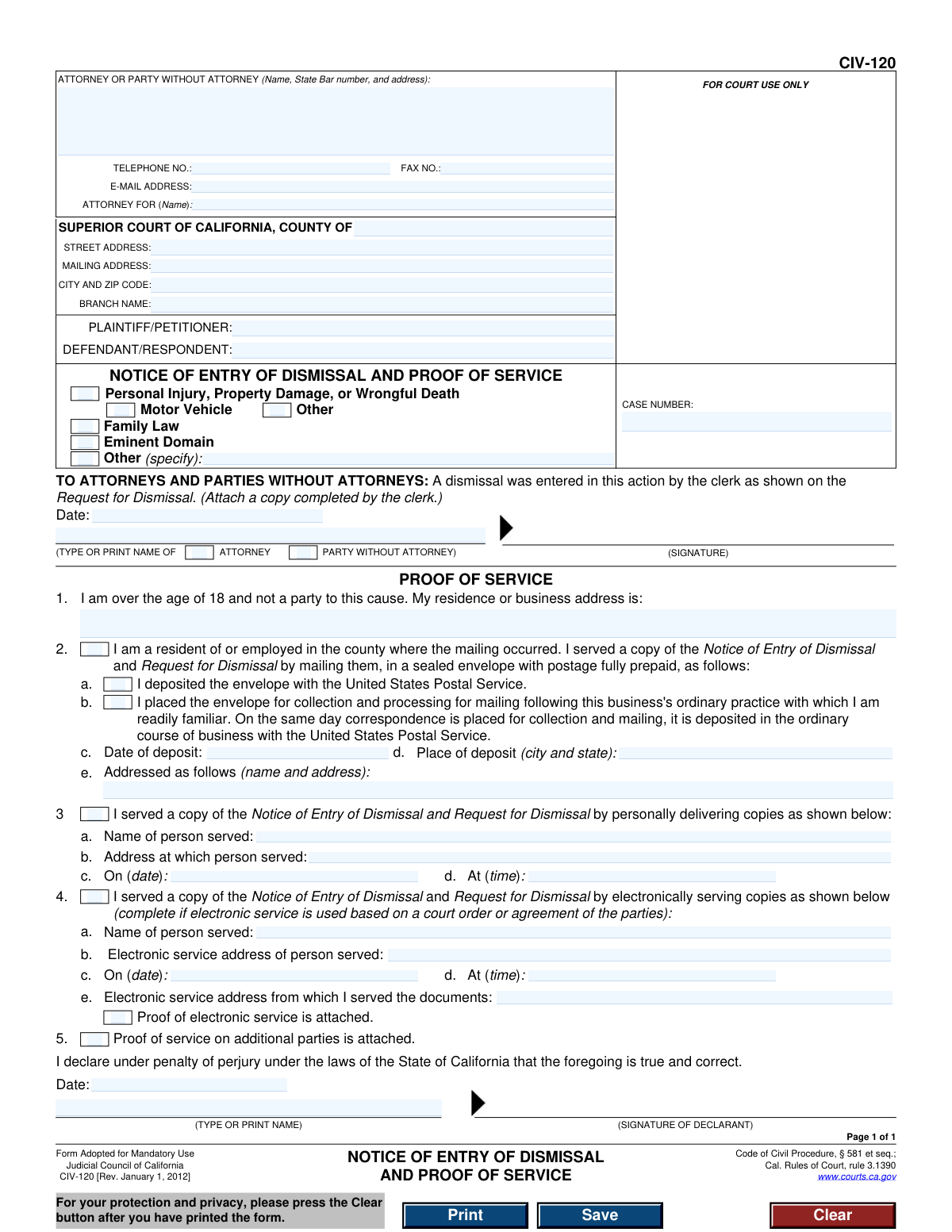
Yes! You can use AI to fill out Form CIV-120, Notice of Entry of Dismissal and Proof of Service
Don't type 49 fields by hand. Tell our AI about yourself, or upload a document you already have, and it fills every field in seconds. You check it, then download, print or sign.
The AI does the filling. You just check it.
No typing into boxes, nothing to install.
What this form asks for
The AI fills all of it, from your answers or your documents.
The AI checks your answers before you download
14 checks built for this form, so a wrong date or a missing answer is caught before anyone else sees it.
Verifies that the 'CASE NUMBER' field is not empty. The case number is a critical unique identifier for the legal action, and its absence would make it impossible to file or associate the document with the correct court record. If this validation fails, the user should be prompted to enter the mandatory case number.
Ensures that the name and address fields under 'ATTORNEY OR PARTY WITHOUT ATTORNEY' are filled out. This information is required to identify who is filing the document and to provide a valid contact and mailing address for correspondence from the court and other parties. A failure prevents proper identification and communication.
Checks that the 'COUNTY OF' field is completed to identify the specific Superior Court jurisdiction. This is essential for ensuring the document is filed in the correct court system and location. Without this information, the document would be rejected as it cannot be routed properly.
Validates that both the 'PLAINTIFF/PETITIONER' and 'DEFENDANT/RESPONDENT' fields contain names. Identifying the primary parties is fundamental to any legal document, as it defines the scope of the action. An omission here would render the document legally insufficient.
Ensures that at least one method of service (Mailing, Personal, or Electronic) is selected in the 'PROOF OF SERVICE' section. The entire purpose of the proof of service is to declare how the notice was delivered. If no method is chosen, the proof is incomplete and invalid.
If service by mail (Section 2) is selected, this check verifies that the date of deposit, place of deposit, and the recipient's name and address are all filled in. Omitting any of these details invalidates the proof of service by mail, as it fails to provide a complete record of the event.
And 8 more checks
- Personal Service Details Completeness
- Electronic Service Details Completeness
- Electronic Service Address Format
- Server's Address Presence
- Declarant Is Not a Party to the Action
- Logical Date Sequence for Service and Signature
- Declaration Signature Date Presence
- Declarant Name Presence
Let AI fill out your CIV-120
No typing. Every field filled in seconds, checked, ready to sign.
How to Fill Out CIV-120 Online for Free in 2026
What the AI walks you through.
- Navigate to Instafill.ai and upload or select the Form CIV-120.
- Use the AI assistant to automatically fill in court and case information, such as the county, case number, and party names.
- Enter the personal or attorney information for the person filing the notice.
- Indicate the date of dismissal and attach a copy of the 'Request for Dismissal' as completed by the court clerk.
- Complete the 'Proof of Service' section by selecting the method of service (mail, personal, electronic) and providing the required details for each party served.
- Review all the information populated by the AI for accuracy, then date and electronically sign the declaration.
- Download, print, or e-file the completed CIV-120 form as required by the court.
Common Mistakes in Completing CIV-120
The ones the AI is built to catch.
Failing to Attach the Clerk-Completed Dismissal Form
Party to the Case Signing the Proof of Service
Confusing the Signatories for the Notice and the Proof of Service
Omitting Required Proof of Service Details
Entering an Incorrect or Incomplete Case Number
Missing Signatures or Dates
Incorrectly Filling the 'ATTORNEY FOR' Field
Failing to Serve All Necessary Parties
Submitting an Illegible Form
Providing Incorrect Court Information
Frequently Asked Questions About CIV-120
Is it really free for 7 days?
Can I fill other forms too?
How do I cancel?
How does the AI fill out CIV-120?
What happens to my information?
How complex is CIV-120 to fill out?
What is the purpose of Form CIV-120?
Who needs to fill out and file this form?
I received this form in the mail. What does it mean?
What is the 'Request for Dismissal' that I need to attach?
Who can sign the 'Proof of Service' section?
What is the difference between the mailing options in section 2?
What do I do after I fill out the form?
What if I need to serve more people than there is space for on the form?
When can I use electronic service as described in section 4?
Can AI tools help me fill out Form CIV-120?
How can I use Instafill.ai to complete this form online?
The PDF of this form I have is not fillable. What should I do?
Get your CIV-120 filled out by AI
$0 today. Cancel before Nov 1 and you pay nothing.
Other forms like this one
California court forms: Judicial Council of California Form SC-105, Request for Court Order and Answer (Small Claims), Judicial Council of California Form SC-120, Defendant’s Claim and ORDER to Go to Small Claims Court (Small Claims), Judicial Council of California Form SER-001, Request for Sheriff to Serve Court Papers, Judicial Council of California Form SER-001, Request for Sheriff to Serve Court Papers, Affidavit for Collection of Personal Property California Probate Code Section 13100, Form POS-040, Proof of Service—Civil, Declaration of Facts of Death (California Superior Court), declaration-of-marriage-for-court-proceeding-california-family-law, ADOPT-200, Adoption Request, ADOPT-200, Stepparent Adoption Request, ADOPT-210, Adoption Agreement, ADOPT-310, Contact After Adoption Agreement, Judicial Council of California Form ADOPT-200, Adoption Request, Form ADR-107, Mediation Attendance Sheet, Form ADR-110, Order Appointing Referee, Form ADR-109, Stipulation or Motion for Order Appointing Referee, Form ADR-102, Request for Trial De Novo After Judicial Arbitration, Form ADR-108, Referee's Report (Code Civ. Proc., §§ 638, 639), Form ADR-106, Petition to Confirm, Correct, or Vacate Contractual Arbitration Award, Form ADR-104, Rejection of Award and Request for Trial After Attorney-Client Fee Arbitration
civil court forms: Petition for Leave to Proceed In Forma Pauperis (Court of Common Pleas of Lehigh County, Pennsylvania, Civil Division), Designation of Record on Appeal (Civil) (Maricopa County Justice Courts, Arizona) (Form APP 8150-702), Certificate of Service (Civil Court Claim), Pfändungs- und Überweisungsbeschluss (Garnishment and Transfer Order) – German Civil Enforcement Court Form, AOPC 308A, Civil Complaint, Form MC 03, Answer, Civil, Form POS-040, Proof of Service—Civil, ONTARIO Form 8: Application (General), Form ATJ 601.9, Application for Waiver of Court Fees (Civil), Nevada Justice / Municipal Civil Court Cover Sheet, Form MC 01, Summons, Form MC 10, Judgment, Civil, Form MC 99, Motion and Affidavit to Set Aside Default (Civil), Form MC 281a, Civil Mediator Application, Ex Parte Motion and Order to Renew Civil Judgment, AO 88B, Subpoena to Produce Documents, Information, or Objects or to Permit Inspection of Premises in a Civil Action, Form APP-031A, Application for Extension of Time to File Brief (Civil Case), Civil Appeal Case Information Statement, Form APP-014, Appellant's Proposed Statement on Appeal (Unlimited Civil Case), form-app-015-respondents-proposed-corrections-toadditions-to-appellants-proposed-settled-statement-unlimited-civil-case
civil service forms: Certificate of Service (Civil Court Claim), Form POS-040, Proof of Service—Civil, Form CH-117, Order Granting Alternative Service, Form CH-200, Proof of Personal Service (Civil Harassment Prevention), Form CH-250, Proof of Service by Mail (CLETS) (Civil Harassment Prevention), Form POS-030(P), Attachment to Proof of Service by First-Class Mail—Civil (Persons Served), Form POS-040(D), Attachment to Proof of Service—Civil (Documents Served), Form POS-020(D), Attachment to Proof of Personal Service—Civil (Documents Served), Form POS-020(P), Attachment to Proof of Personal Service—Civil (Persons Served), Attachment to Proof of Service by First-Class Mail—Civil (Documents Served), Form POS-015, Notice and Acknowledgment of Receipt—Civil, Form POS-040(P), Attachment to Proof of Service—Civil (Persons Served), Form SH-032, Declaration Regarding Notice and Service of Ex Parte Application for Order Shortening Time for Hearing on Motion to Place Documents Under Seal Under Code of Civil Procedure Section 367.3 (Safe at Home), Waiver of Right to Delay or Overturn Court Action Under the Service Members Civil Relief Act
proof of service forms: Form POS-040, Proof of Service—Civil, Judicial Council of California Form SC-104, Proof of Service (Small Claims), Judicial Council of California Form SC-104, Proof of Service (Small Claims), Form DV-200, Proof of Personal Service (CLETS) (Domestic Violence Prevention), Illinois Circuit Court Eviction Summons and Proof of Service of Eviction Summons & Eviction Complaint (Form E-S 3507.3), proof-of-electronic-service-appellate, Form APP-009, Proof of Service (Appellate Division), Form APP-109, Proof of Service (Appellate Division), Form GC-020(P), PROOF OF PERSONAL SERVICE OF NOTICE OF HEARING— GUARDIANSHIP OR CONSERVATORSHIP, Form APP-109E, Proof of Electronic Service (Appellate Division), Proof of Personal Service of Notice of Initial Appearance—CARE Act Proceedings, Form CARE-116, Proof of Personal Service of Notice of Hearing—CARE Act Proceedings, Form CR-106, Proof of Service — Criminal Record Clearing, CARE-107, Proof of Personal Service of Notice of Order for CARE Act Report, Form DAL-012, Proof of Service—Disability Access Litigation, Form DE-120(P), Proof of Personal Service of Notice of Hearing—Decedent's Estate or Trust, Form EA-200, Proof of Personal Service (Elder or Dependent Adult Abuse Prevention), Form EA-260, Proof of Service of Order After Hearing by Mail (Elder or Dependent Adult Abuse Prevention), Form FL-115, Proof of Service of Summons (Family Law—Uniform Parentage—Custody and Support), Form CR-401, Proof of Service for Petition/Application Under Health and Safety Code Section 11361.8—Adult Crimes
Let AI fill out your CIV-120
Your trial starts once a card is added. You pay nothing before Nov 1.
Our AI already knows this form, all 49 fields of it. Skip the typing: tell it about yourself, or upload what you have, and it fills the whole form in seconds.
- AI fills every field on the form, checkboxes included
- No typing into boxes: answer a few questions, or upload a document you already have, an old copy of this form, a photo of a document
- The AI checks the answers; you review and change anything before you download
- Download the finished PDF, print it, or sign it online
- Encrypted, and never used to train AI
Cancel before Nov 1 and you pay nothing.
A card is needed to start the trial. Cancel in two clicks from your account.
Terms · Privacy