
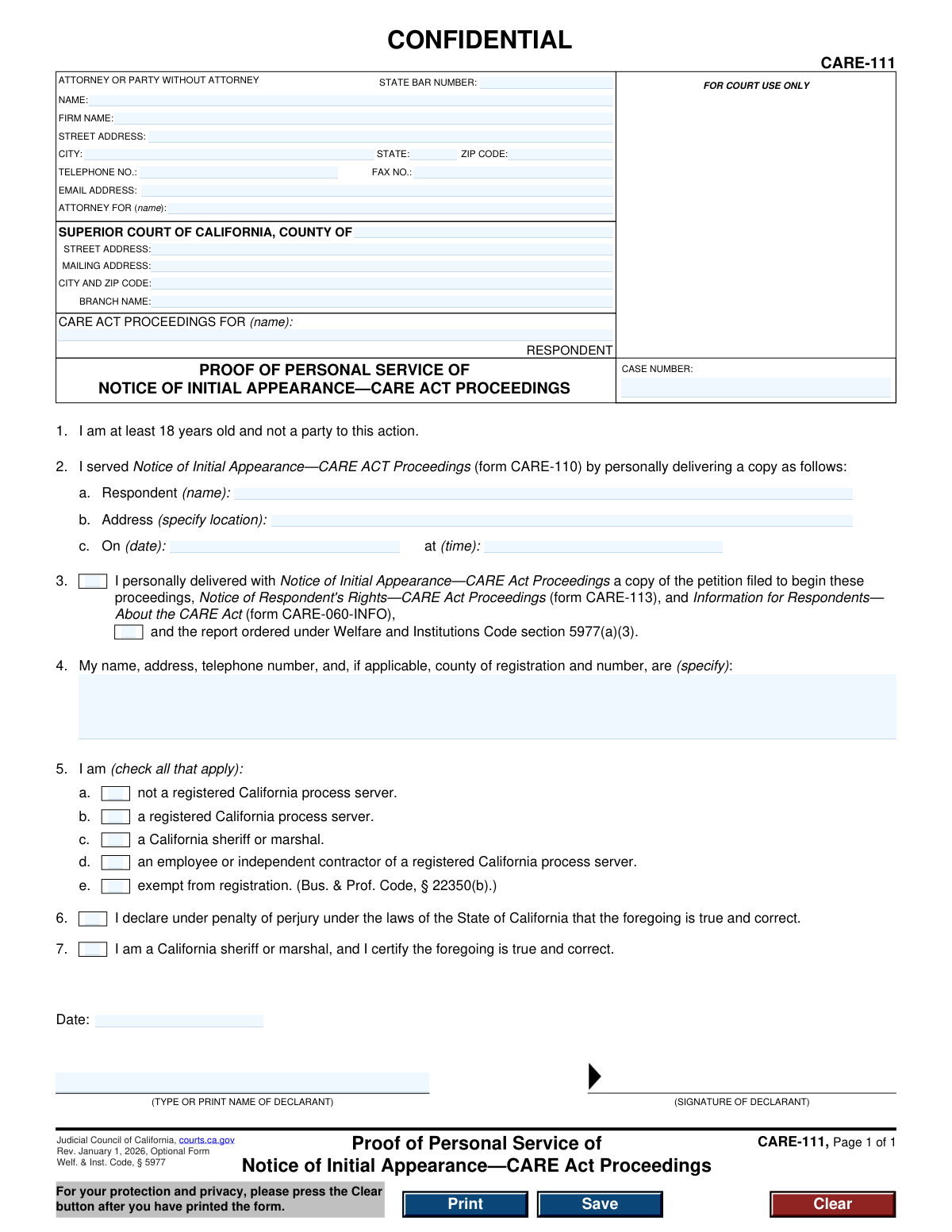
Yes! You can use AI to fill out Proof of Personal Service of Notice of Initial Appearance—CARE Act Proceedings
Don't type 37 fields by hand. Tell our AI about yourself, or upload a document you already have, and it fills every field in seconds. You check it, then download, print or sign.
The AI does the filling. You just check it.
No typing into boxes, nothing to install.
What this form asks for
The AI fills all of it, from your answers or your documents.
The AI checks your answers before you download
12 checks built for this form, so a wrong date or a missing answer is caught before anyone else sees it.
This check ensures the respondent's name listed in the main case caption ('CARE ACT PROCEEDINGS FOR') is identical to the name of the person served in section 2a. This is critical for verifying that the correct individual in the case received the legal notice. A mismatch could invalidate the proof of service, causing delays or dismissal of the proceedings.
Validates that both the date and time of service in section 2c are filled out. The exact date and time are legally required elements for a valid proof of service, as they establish the precise moment the notice was delivered. If either field is missing, the form is incomplete and the service may be deemed invalid by the court.
Ensures the date of service entered in section 2c is a valid calendar date and is not a future date. Service must have already occurred to be proven. This check prevents typographical errors and fraudulent future-dating, which would render the proof of service void. The system should reject any date that is after the current date.
This validation confirms that the signature date at the bottom of the form is on or after the date of service listed in section 2c. A person cannot legally declare under penalty of perjury that an event occurred before it has happened. This logical check ensures the timeline of events is credible and upholds the integrity of the declaration.
Verifies that at least one checkbox is selected in section 5 to identify the status of the person who performed the service. This information is required to determine if the server is legally qualified to serve court documents in California. Failure to select a status makes the server's qualifications unknown and the service potentially invalid.
Checks for logical conflicts in the checkboxes selected in section 5. For example, a user cannot select both 5a ('not a registered California process server') and 5b ('a registered California process server') simultaneously. This validation prevents contradictory information and ensures the declarant's status is clearly and accurately stated.
And 6 more checks
- Declaration vs. Certification Exclusivity
- Case Number Presence
- Attorney Bar Number Format
- Court County Requirement
- Declarant Information Completeness
- Signature Block Completeness
Let AI fill out your CARE-111
No typing. Every field filled in seconds, checked, ready to sign.
How to Fill Out CARE-111 Online for Free in 2026
What the AI walks you through.
- Navigate to Instafill.ai and upload or select the CARE-111 form.
- Enter the attorney/party information and the specific Superior Court details, including county and branch name.
- Input the case name (respondent's name) and the corresponding case number.
- Detail the service information in section 2, including the respondent's name, the address where service occurred, and the exact date and time.
- Confirm in section 3 that all required accompanying documents (like forms CARE-110, CARE-113, and CARE-060-INFO) were also delivered.
- Provide the server's information in section 4 and check the appropriate boxes in section 5 to declare their status (e.g., registered process server, sheriff).
- Review all entered information for accuracy, then date and sign the declaration under penalty of perjury to finalize the form for filing.
Common Mistakes in Completing CARE-111
The ones the AI is built to catch.
Incorrectly Identifying the 'ATTORNEY FOR'
Failing to Specify the Exact Location of Service
Forgetting to Check the Box in Item 3
Incomplete or Missing Server Information in Item 4
Incorrectly Selecting Server Status in Item 5
Confusing the Declaration and Certification Sections (6 and 7)
Missing or Incorrect Case Number
Mismatched Respondent Names
Missing Signature or Date
Using an Incorrect Court Address
Frequently Asked Questions About CARE-111
Is it really free for 7 days?
Can I fill other forms too?
How do I cancel?
How does the AI fill out CARE-111?
What happens to my information?
How complex is CARE-111 to fill out?
What is the purpose of the CARE-111 form?
Who is supposed to fill out and sign this form?
What documents must be delivered to the respondent along with the Notice?
I am not a registered process server. Can I still serve the papers and complete this form?
What is the difference between the declaration in box 6 and the certification in box 7?
Where do I file the completed CARE-111 form?
What information is required in Section 2 of the form?
Why is the CARE-111 form marked as 'CONFIDENTIAL'?
The form says it is an 'Optional Form.' What does that mean?
Can I use an AI tool to help me fill out the CARE-111 form?
How can I fill out this form online?
The PDF of the CARE-111 form I have is not fillable. What should I do?
What happens after I file the Proof of Service form?
Get your CARE-111 filled out by AI
$0 today. Cancel before Oct 30 and you pay nothing.
Other forms like this one
California court forms: Judicial Council of California Form SC-105, Request for Court Order and Answer (Small Claims), Judicial Council of California Form SC-120, Defendant’s Claim and ORDER to Go to Small Claims Court (Small Claims), Judicial Council of California Form SER-001, Request for Sheriff to Serve Court Papers, Judicial Council of California Form SER-001, Request for Sheriff to Serve Court Papers, Affidavit for Collection of Personal Property California Probate Code Section 13100, Form POS-040, Proof of Service—Civil, Declaration of Facts of Death (California Superior Court), declaration-of-marriage-for-court-proceeding-california-family-law, ADOPT-200, Adoption Request, ADOPT-200, Stepparent Adoption Request, ADOPT-210, Adoption Agreement, ADOPT-310, Contact After Adoption Agreement, Judicial Council of California Form ADOPT-200, Adoption Request, Form ADR-107, Mediation Attendance Sheet, Form ADR-110, Order Appointing Referee, Form ADR-109, Stipulation or Motion for Order Appointing Referee, Form ADR-102, Request for Trial De Novo After Judicial Arbitration, Form ADR-108, Referee's Report (Code Civ. Proc., §§ 638, 639), Form ADR-106, Petition to Confirm, Correct, or Vacate Contractual Arbitration Award, Form ADR-104, Rejection of Award and Request for Trial After Attorney-Client Fee Arbitration
proof of service forms: Form POS-040, Proof of Service—Civil, Judicial Council of California Form SC-104, Proof of Service (Small Claims), Judicial Council of California Form SC-104, Proof of Service (Small Claims), Form DV-200, Proof of Personal Service (CLETS) (Domestic Violence Prevention), Illinois Circuit Court Eviction Summons and Proof of Service of Eviction Summons & Eviction Complaint (Form E-S 3507.3), proof-of-electronic-service-appellate, Form APP-009, Proof of Service (Appellate Division), Form APP-109, Proof of Service (Appellate Division), Form GC-020(P), PROOF OF PERSONAL SERVICE OF NOTICE OF HEARING— GUARDIANSHIP OR CONSERVATORSHIP, Form APP-109E, Proof of Electronic Service (Appellate Division), Form CARE-116, Proof of Personal Service of Notice of Hearing—CARE Act Proceedings, Form CR-106, Proof of Service — Criminal Record Clearing, CARE-107, Proof of Personal Service of Notice of Order for CARE Act Report, Form CIV-120, Notice of Entry of Dismissal and Proof of Service, Form DAL-012, Proof of Service—Disability Access Litigation, Form DE-120(P), Proof of Personal Service of Notice of Hearing—Decedent's Estate or Trust, Form EA-200, Proof of Personal Service (Elder or Dependent Adult Abuse Prevention), Form EA-260, Proof of Service of Order After Hearing by Mail (Elder or Dependent Adult Abuse Prevention), Form FL-115, Proof of Service of Summons (Family Law—Uniform Parentage—Custody and Support), Form CR-401, Proof of Service for Petition/Application Under Health and Safety Code Section 11361.8—Adult Crimes
Let AI fill out your CARE-111
Your trial starts once a card is added. You pay nothing before Oct 30.
Our AI already knows this form, all 37 fields of it. Skip the typing: tell it about yourself, or upload what you have, and it fills the whole form in seconds.
- AI fills every field on the form, checkboxes included
- No typing into boxes: answer a few questions, or upload a document you already have, an old copy of this form, a photo of a document
- The AI checks the answers; you review and change anything before you download
- Download the finished PDF, print it, or sign it online
- Encrypted, and never used to train AI
Cancel before Oct 30 and you pay nothing.
A card is needed to start the trial. Cancel in two clicks from your account.
Terms · Privacy