
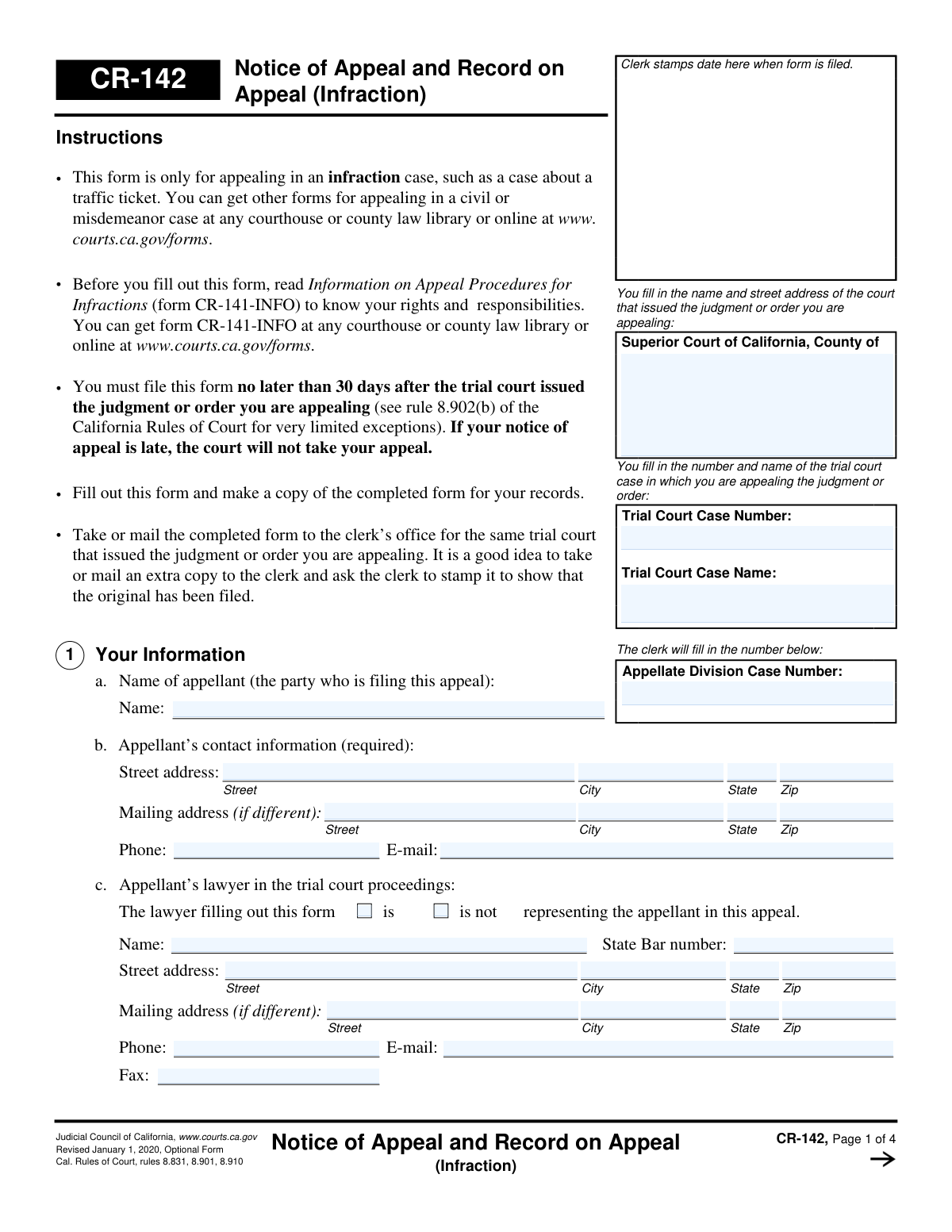
Yes! You can use AI to fill out Form CR-142, Notice of Appeal and Record on Appeal (Infraction)
Don't type 65 fields by hand. Tell our AI about yourself, or upload a document you already have, and it fills every field in seconds. You check it, then download, print or sign.
The AI does the filling. You just check it.
No typing into boxes, nothing to install.
What this form asks for
The AI fills all of it, from your answers or your documents.
The AI checks your answers before you download
14 checks built for this form, so a wrong date or a missing answer is caught before anyone else sees it.
This check verifies that the appellant's name (Section 1a) and all required contact information fields in Section 1b (Street address, City, State, Zip, and Phone) are filled out. This information is critical for the court to identify and communicate with the party filing the appeal. A failure in this validation would render the form incomplete and could lead to its rejection.
Ensures that both the 'Trial Court Case Number' and 'Trial Court Case Name' fields are completed on the first page. These identifiers are the primary method for linking the appeal to the original infraction case. Without this information, the clerk's office cannot process the appeal, as they would not know which judgment to review.
Validates that only one of the three options (a, b, or c) in Section 2, 'Judgment or Order You Are Appealing,' is selected. The form requires the appellant to appeal a specific action. Selecting multiple options creates ambiguity and prevents the court from understanding the precise subject of the appeal, leading to processing delays or rejection.
This is a logical check on Section 2. If 'the final judgment' (2a) or 'an order made by the trial court after judgment' (2b) is checked, the corresponding date field must be filled. If 'Other' (2c) is checked, the description text box must be filled. This ensures that the choice made is substantiated with the necessary details for the court to proceed.
Verifies that any date entered in Section 2 ('The trial court issued this judgment on' or '...this order on') follows a valid date format (e.g., MM/DD/YYYY). An invalid date format can cause data entry errors and confusion regarding the timeliness of the appeal, which must be filed within 30 days of the judgment.
Ensures that if the appellant elects to proceed 'WITH a record of the oral proceedings' (Section 4b), then exactly one choice is made in Section 5 (a, b, c, or d). Conversely, if the choice is 'WITHOUT a record' (Section 4a), Section 5 must be empty. This prevents contradictory or incomplete requests regarding the record on appeal.
And 8 more checks
- Initials for 'Without Record' Acknowledgment
- Exclusive Record Type Selection
- Free Record Request Attachment Check
- Lawyer Information Requirement
- Phone Number Format Validation
- Email Address Format Validation
- Case Information Consistency Across Pages
- Signature and Date Presence
Let AI fill out your CR-142
No typing. Every field filled in seconds, checked, ready to sign.
How to Fill Out CR-142 Online for Free in 2026
What the AI walks you through.
- Navigate to Instafill.ai and upload or select the CR-142 Notice of Appeal form.
- Provide your personal information, your lawyer's details (if applicable), and the trial court case name and number.
- Specify the exact judgment or order you are appealing and the date it was issued by the trial court.
- Elect whether to proceed with or without a record of the oral proceedings from the trial court.
- If you choose to include a record, select the type (e.g., Statement on Appeal, transcript) and indicate how you will cover the cost or if you are requesting a fee waiver.
- Carefully review all the information populated by the AI for accuracy, then electronically sign and date the form.
- Download the completed CR-142 and file it with the correct trial court clerk's office within the legal deadline.
Common Mistakes in Completing CR-142
The ones the AI is built to catch.
Missing the 30-Day Filing Deadline
Entering Incorrect Trial Court Information
Omitting Required Appellant Contact Information
Failing to Specify the Date of Judgment or Order
Misunderstanding the 'Record of Oral Proceedings' Election
Forgetting to Initial the Record Election in Section 4
Requesting an Unavailable Type of Record in Section 5
Failing to Complete Follow-Up Actions for the Chosen Record
Forgetting to Include Required Attachments
Leaving Header Information Blank on Subsequent Pages
Submitting an Unsigned or Undated Form
Frequently Asked Questions About CR-142
Is it really free for 7 days?
Can I fill other forms too?
How do I cancel?
How does the AI fill out CR-142?
What happens to my information?
How complex is CR-142 to fill out?
What is the purpose of Form CR-142, Notice of Appeal and Record on Appeal?
What is the deadline to file this form?
Can I use this form to appeal a misdemeanor conviction?
Where do I submit the completed Form CR-142?
What is the 'record of oral proceedings' and do I have to provide one?
What are my options for the 'record of oral proceedings' in Section 5?
What if I cannot afford to pay for a transcript or court recording?
What other form should I read before filling this one out?
What happens if I choose to provide a 'Statement on Appeal' but don't attach it to this notice?
What basic information do I need to fill out the top of the form?
Can AI tools help me fill out this form?
How can I fill out Form CR-142 online?
The PDF of this form I downloaded isn't fillable. What should I do?
Get your CR-142 filled out by AI
$0 today. Cancel before Oct 31 and you pay nothing.
Other forms like this one
California court forms: Judicial Council of California Form SC-105, Request for Court Order and Answer (Small Claims), Judicial Council of California Form SC-120, Defendant’s Claim and ORDER to Go to Small Claims Court (Small Claims), Judicial Council of California Form SER-001, Request for Sheriff to Serve Court Papers, Judicial Council of California Form SER-001, Request for Sheriff to Serve Court Papers, Affidavit for Collection of Personal Property California Probate Code Section 13100, Form POS-040, Proof of Service—Civil, Declaration of Facts of Death (California Superior Court), declaration-of-marriage-for-court-proceeding-california-family-law, ADOPT-200, Adoption Request, ADOPT-200, Stepparent Adoption Request, ADOPT-210, Adoption Agreement, ADOPT-310, Contact After Adoption Agreement, Judicial Council of California Form ADOPT-200, Adoption Request, Form ADR-107, Mediation Attendance Sheet, Form ADR-110, Order Appointing Referee, Form ADR-109, Stipulation or Motion for Order Appointing Referee, Form ADR-102, Request for Trial De Novo After Judicial Arbitration, Form ADR-108, Referee's Report (Code Civ. Proc., §§ 638, 639), Form ADR-106, Petition to Confirm, Correct, or Vacate Contractual Arbitration Award, Form ADR-104, Rejection of Award and Request for Trial After Attorney-Client Fee Arbitration
court appeal forms: Form N161, Appellant's Notice (All appeals except small claims track appeals and appeals to the Family Division of the High Court), Designation of Record on Appeal (Civil) (Maricopa County Justice Courts, Arizona) (Form APP 8150-702), Form N161, Appellant’s notice (All appeals except small claims track appeals and appeals to the Family Division of the High Court), Declaration for Court of Appeal Proceedings, Form MC 55, Claim of Appeal, Form MC 56, Bond on Appeal, Form MC 57, Certificate of Records Transmitted for Appeal and Notice to Parties, Form MC 60, Notice of Record Return from Circuit Court/Court of Appeals, Form MC 501, Reporter/Recorder Certificate of Ordering Transcript on Appeal, Form MC 503, Motion to Change Time for Filing Transcript on Appeal, Civil Appeal Case Information Statement, Form APP-014, Appellant's Proposed Statement on Appeal (Unlimited Civil Case), Form CR-125, Notice of Appeal—Commitment (Penal Code or Welfare and Institutions Code), Form CR-134, Notice Regarding Record on Appeal (Misdemeanor), Form CR-135, Proposed Statement on Appeal (Misdemeanor), Form CR-136, Order Concerning Appellant's Proposed Statement on Appeal (Misdemeanor), Form CR-137, Abandonment of Appeal (Misdemeanor), Form CR-143, Proposed Statement on Appeal (Infraction), Form CR-105, Defendant's Financial Statement on Eligibility for Appointment of Counsel and Reimbursement and Record on Appeal at Public Expense, Form CR-133, Request for Court-Appointed Lawyer in Misdemeanor Appeal
criminal record forms: Maryland Department of Public Safety and Correctional Services Application for Pardon, Resource Family Application - Criminal Record Statement, Form GEN 1331, Criminal Record and Child Abuse Registry Checklist, Form CR-134, Notice Regarding Record on Appeal (Misdemeanor), Form CR-106, Proof of Service — Criminal Record Clearing, Form CR-105, Defendant's Financial Statement on Eligibility for Appointment of Counsel and Reimbursement and Record on Appeal at Public Expense, Form CR-409, Petition to Seal Arrest and Related Records, Judicial Council of California Form CR-410, Order to Seal Arrest and Related Records (Pen. Code, Sections 851.91, 851.92), Petition for Expunction of Criminal Records [Charges Not Filed] (Form CV-EXPU-100)
Let AI fill out your CR-142
Your trial starts once a card is added. You pay nothing before Oct 31.
Our AI already knows this form, all 65 fields of it. Skip the typing: tell it about yourself, or upload what you have, and it fills the whole form in seconds.
- AI fills every field on all 4 pages, checkboxes included
- No typing into boxes: answer a few questions, or upload a document you already have, an old copy of this form, a photo of a document
- The AI checks the answers; you review and change anything before you download
- Download the finished PDF, print it, or sign it online
- Encrypted, and never used to train AI
Cancel before Oct 31 and you pay nothing.
A card is needed to start the trial. Cancel in two clicks from your account.
Terms · Privacy