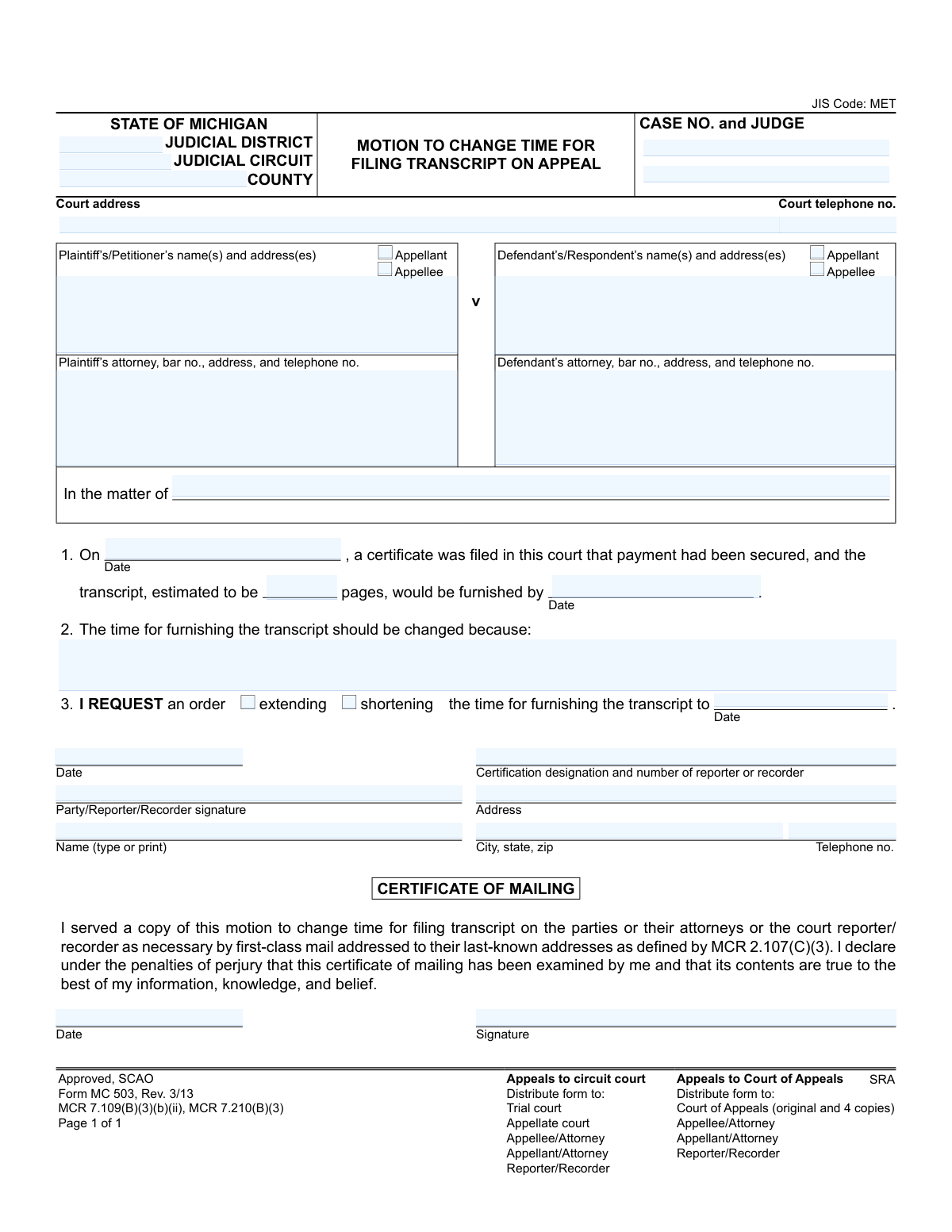
Yes! You can use AI to fill out Form MC 503, Motion to Change Time for Filing Transcript on Appeal
Form MC 503 is a legal document used in the State of Michigan for parties in an appeal to formally request an extension or shortening of the time to file a court transcript. It is crucial for managing the appellate timeline, ensuring that delays are officially sanctioned by the court and all parties are properly notified. Today, this form can be filled out quickly and accurately using AI-powered services like Instafill.ai, which can also convert non-fillable PDF versions into interactive fillable forms.
MC 503 is part of the
court appeal forms, court filing forms and Michigan court forms categories on Instafill.
Our AI automatically handles information lookup, data retrieval, formatting, and form filling.
It takes less than a minute to fill out MC 503 using our AI form filling.
Securely upload your data. Information is encrypted in transit and deleted immediately after the form is filled out.
Form specifications
| Form name: | Form MC 503, Motion to Change Time for Filing Transcript on Appeal |
| Number of fields: | 32 |
| Number of pages: | 1 |
| Language: | English |
More forms in Court appeal forms
Instafill Demo: How to fill out PDF forms in seconds with AI
How to Fill Out MC 503 Online for Free in 2026
Are you looking to fill out a MC 503 form online quickly and accurately? Instafill.ai offers the #1 AI-powered PDF filling software of 2026, allowing you to complete your MC 503 form in just 37 seconds or less.
Follow these steps to fill out your MC 503 form online using Instafill.ai:
- 1 Navigate to an AI-powered form-filling service like Instafill.ai and upload or select the MC 503 form.
- 2 Provide the court and case information, including the judicial district, circuit, county, case number, and judge's name.
- 3 Enter the details for the plaintiff/petitioner and defendant/respondent, along with their attorneys' information.
- 4 State the original transcript filing details, such as the date the certificate was filed, the estimated pages, and the original due date.
- 5 Explain the reason for the time change and check the box to indicate whether you are requesting to extend or shorten the time, specifying the new requested date.
- 6 Sign and date the motion. If you are mailing the form, complete the Certificate of Mailing section to certify that all parties have been served.
- 7 Review all the information auto-filled by the AI for accuracy, then download the completed form for filing with the appropriate court and distribution to all parties.
Our AI-powered system ensures each field is filled out correctly, reducing errors and saving you time.
Why Choose Instafill.ai for Your Fillable MC 503 Form?
Speed
Complete your MC 503 in as little as 37 seconds.
Up-to-Date
Always use the latest 2026 MC 503 form version.
Cost-effective
No need to hire expensive lawyers.
Accuracy
Our AI performs 10 compliance checks to ensure your form is error-free.
Security
Your personal information is protected with bank-level encryption.
Frequently Asked Questions About Form MC 503
This form is used to formally request a court order to either extend or shorten the deadline for the court reporter or recorder to provide a written transcript of court proceedings for an appeal.
This form can be filled out by the party appealing (Appellant), the other party (Appellee), their attorneys, or the court reporter/recorder responsible for producing the transcript.
You will need your case information (case number, judge, court), the date the original transcript certificate was filed, the original due date for the transcript, and a clear reason for requesting the time change.
Valid reasons could include the reporter's or recorder's workload, the complexity or length of the transcript, illness, or other unforeseen circumstances that prevent the transcript from being completed by the original deadline.
A transcript is the official written record of everything said in a court proceeding. The court reporter or recorder is the certified professional who creates this official record.
The form specifies distribution at the bottom. You must provide copies to the trial court, the appellate court, and all parties involved (appellant, appellee, and reporter/recorder) as indicated for your specific type of appeal.
This section is your sworn statement that you have sent a copy of the completed motion to all other required parties. You must sign this to certify that you have properly notified everyone involved.
Processing time varies by court and the judge's caseload. After filing, the court will review the motion and issue an order granting or denying your request.
No, this form is specifically for changing the deadline for the court reporter to furnish the official transcript. A different motion would be required to request an extension for filing your own legal briefs.
If the court denies your motion, the original deadline for filing the transcript remains in effect. The transcript must be furnished by that original date.
Yes, services like Instafill.ai use AI to accurately auto-fill repetitive fields like your name, address, and case information, which can save you time and help prevent errors.
You can use a service like Instafill.ai to fill this form online. Simply upload the form, and the platform will make it interactive, allowing you to type your information directly into the fields before downloading the completed document.
If you have a non-fillable or 'flat' PDF, you can upload it to a platform like Instafill.ai. The service can convert the static form into an interactive, fillable one for you to complete online.
Compliance MC 503
Validation Checks by Instafill.ai
1
Case Number and County Required
This check ensures that the 'Case No.' and 'County' fields are not empty. These fields are critical for identifying the specific legal case and jurisdiction, and their absence would make it impossible to file the motion with the correct court and associate it with the proper record. If this validation fails, the form submission should be rejected with an error message indicating the required fields.
2
Exclusive Extend/Shorten Selection
Validates that exactly one of the two options, 'extending' or 'shortening', is selected in Section 3. A user must specify the nature of the time change request. Submitting with neither or both selected would make the motion ambiguous and unserviceable by the court. The form should enforce this choice, for example, by using radio buttons.
3
Logical Date for Extension Request
If the 'extending' option is selected, this check verifies that the new requested date ('date change') is chronologically after the original furnished date ('date furnished on'). Requesting an extension to a date that has already passed or is the same as the original due date is illogical and would be rejected. This prevents nonsensical requests from being submitted.
4
Logical Date for Shortening Request
If the 'shortening' option is selected, this validation ensures the new requested date ('date change') is chronologically before the original furnished date ('date furnished on'). It is illogical to request to shorten the time to a date that is later than the original deadline. This check maintains the logical integrity of the request.
5
Reason for Change is Mandatory
This check confirms that the text area for Section 2, explaining why the time for furnishing the transcript should be changed, is not left blank. This justification is the core of the motion and is legally required for a judge to consider the request. A submission without a reason is incomplete and would be summarily denied.
6
Valid Page Estimate Format
Ensures that the 'estimated pages' field contains a positive integer. The number of pages is a key factor in determining a reasonable timeline for transcript preparation. The value cannot be zero, negative, a decimal, or text. This validation prevents data entry errors and ensures the information is useful for the court's assessment.
7
Consistent Appellant/Appellee Designation
This validation checks that across the Plaintiff and Defendant sections, at least one party is designated 'Appellant' and at least one is designated 'Appellee'. An appeal requires opposing sides. Furthermore, it ensures a single party (e.g., Plaintiff) is not marked as both Appellant and Appellee, which is a logical contradiction.
8
Chronological Filing Dates
Verifies that the 'date cert filed' (the date the certificate of secured payment was filed) is on or before the original 'date furnished on' (the original transcript due date). The original due date cannot logically precede the event that established it. This check ensures the timeline of events presented in the motion is coherent.
9
Valid Date Formatting
This check applies to all date fields on the form, including 'date cert filed', 'date furnished on', and 'date change'. It ensures that the entered values are valid, parseable dates (e.g., MM/DD/YYYY). This prevents data corruption and ensures that legal deadlines are recorded unambiguously.
10
Attorney Bar Number Format
Validates that the 'bar no.' field for any listed attorney conforms to the expected format for the State of Michigan (e.g., 'P' followed by a sequence of digits). An incorrect bar number can prevent proper identification of the attorney of record and cause filing delays or rejections. This ensures the attorney can be verified in the state's registry.
11
Signatory Information Completeness
This check ensures that if a signature is present, the corresponding 'Name (type or print)', 'Address', and 'Telephone no.' fields for the signing party are also filled out. This information is required to verify the identity of the person filing the motion and to provide contact information for any follow-up. An anonymous or unidentifiable signature is invalid.
12
Certificate of Mailing Date Logic
This validation confirms that the date on the 'Certificate of Mailing' is on or after the signature date of the main motion. A party cannot certify that they have mailed a document before it has been finalized and signed. This check ensures the declaration of service is chronologically possible and therefore credible.
13
Valid Telephone Number Format
This check verifies that all telephone number fields on the form contain a valid format, such as 10 digits, optionally with parentheses, spaces, or hyphens. This ensures that the contact information for the court, attorneys, and parties is usable. Invalid phone numbers hinder communication and can delay case proceedings if a party needs to be contacted urgently.
Common Mistakes in Completing MC 503
Users frequently enter the wrong Case Number, Judge's name, or Judicial District/Circuit. This often happens when dealing with multiple cases or referencing incorrect documents. An incorrect case number can cause the motion to be filed in the wrong case file or rejected by the court clerk, leading to critical delays and potentially missed deadlines for the appeal.
People often incorrectly check the boxes for 'Appellant' (the party appealing) and 'Appellee' (the party responding to the appeal). This confusion can fundamentally misrepresent the posture of the case to the court. Misidentifying the parties creates significant legal ambiguity and will likely result in the motion being returned for correction, delaying the entire appellate process.
In section 2, filers often write a generic or insufficient reason like 'need more time' or 'busy schedule.' A judge requires a specific, compelling reason—such as the complexity of the testimony, a reporter's illness, or unexpected delays in payment—to grant a motion. A weak justification is the most common reason for these motions to be denied, forcing the filer to adhere to the original, now-imminent deadline.
Forgetting to include the attorney's bar number or entering it incorrectly is a frequent oversight. The bar number is a unique identifier required by the court to verify an attorney's standing and eligibility to practice. Its absence or inaccuracy can lead to the form's rejection and cause delays while the clerk's office attempts to verify the attorney's information.
Filers may enter conflicting dates, such as requesting a new deadline (in section 3) that is earlier than the original deadline (in section 1). This error, born from haste or carelessness, undermines the credibility of the motion and demonstrates a lack of attention to detail. The court will reject such a motion due to the logical impossibility, requiring a corrected resubmission.
In section 3, filers must check one of two boxes to indicate whether they are requesting to 'extend' or 'shorten' the time. It is a common mistake to leave both boxes unchecked, making the request ambiguous. The court cannot act on an unclear motion, so it will be denied or returned, forcing the filer to start over.
The 'Certificate of Mailing' is a sworn statement that all parties have been notified, and it is often left incomplete or unsigned. This is a critical procedural failure, as proper service is a matter of due process. A motion without a valid, signed certificate of mailing will be denied outright, as there is no proof that opposing parties were properly informed.
The form requires a signature from the filing party, reporter, or recorder, but people often sign in the wrong section or forget to sign altogether. Furthermore, the printed name and contact information must be legible and correspond to the signature. An improper or missing signature invalidates the motion, as it cannot be authenticated by the court.
This form is often available as a flat PDF, leading people to print it and fill it out by hand. Illegible handwriting for critical details like names, case numbers, and addresses can cause the court clerk to reject the document. To avoid this, it's best to use a tool like Instafill.ai, which can convert non-fillable PDFs into fillable ones, ensuring all entries are clear, legible, and professional.
The form explicitly lists who must receive a copy, including the appellate court, trial court, opposing counsel, and the court reporter. A common procedural error is failing to send copies to all required parties after the motion is filed. This can lead to delays, sanctions from the court, and motions from other parties who were not properly served.
Saved over 80 hours a year
“I was never sure if my IRS forms like W-9 were filled correctly. Now, I can complete the forms accurately without any external help.”
Kevin Martin Green
Your data stays secure with advanced protection from Instafill and our subprocessors

Robust compliance program
Transparent business model
You’re not the product. You always know where your data is and what it is processed for.
ISO 27001, HIPAA, and GDPR
Our subprocesses adhere to multiple compliance standards, including but not limited to ISO 27001, HIPAA, and GDPR.
Security & privacy by design
We consider security and privacy from the initial design phase of any new service or functionality. It’s not an afterthought, it’s built-in, including support for two-factor authentication (2FA) to further protect your account.
Fill out MC 503 with Instafill.ai
Worried about filling PDFs wrong? Instafill securely fills form-mc-503-motion-to-change-time-for-filing-transcript-on-appeal forms, ensuring each field is accurate.