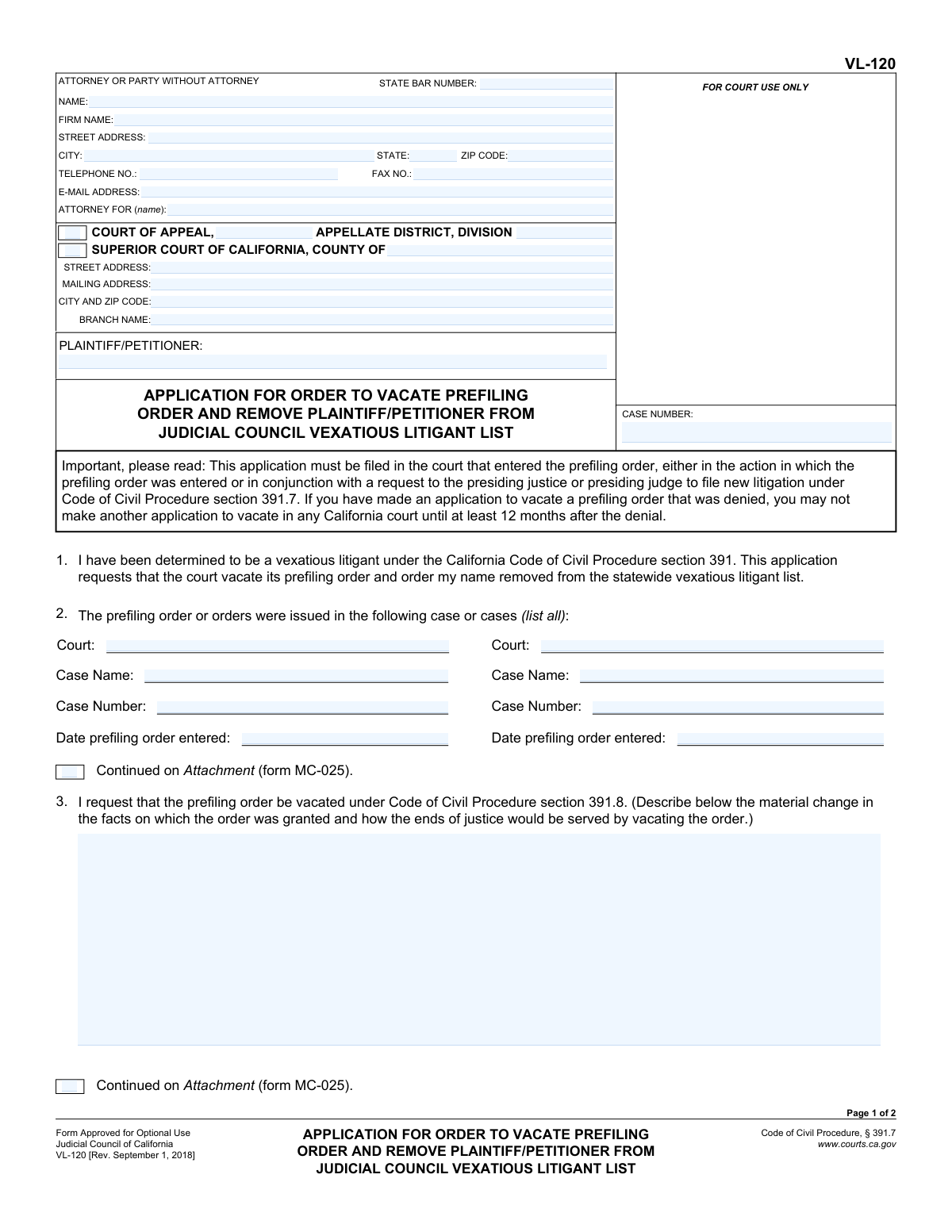
Yes! You can use AI to fill out Form VL-120, Application for Order to Vacate Prefiling Order and Remove Plaintiff/Petitioner From Judicial Council Vexatious Litigant List
Form VL-120 is a legal document used in California for an individual previously declared a 'vexatious litigant' to petition the court to lift that designation. Filing this application is the official process to request the vacation of a prefiling order and removal from the Judicial Council's Vexatious Litigant List, which is essential for restoring standard litigation rights. Today, this form can be filled out quickly and accurately using AI-powered services like Instafill.ai, which can also convert non-fillable PDF versions into interactive fillable forms.
VL-120 is part of the
California court forms, California judicial forms, court filing forms and Judicial Council forms categories on Instafill.
Our AI automatically handles information lookup, data retrieval, formatting, and form filling.
It takes less than a minute to fill out VL-120 using our AI form filling.
Securely upload your data. Information is encrypted in transit and deleted immediately after the form is filled out.
Form specifications
| Form name: | Form VL-120, Application for Order to Vacate Prefiling Order and Remove Plaintiff/Petitioner From Judicial Council Vexatious Litigant List |
| Number of fields: | 42 |
| Number of pages: | 1 |
| Language: | English |
Instafill Demo: How to fill out PDF forms in seconds with AI
How to Fill Out VL-120 Online for Free in 2026
Are you looking to fill out a VL-120 form online quickly and accurately? Instafill.ai offers the #1 AI-powered PDF filling software of 2026, allowing you to complete your VL-120 form in just 37 seconds or less.
Follow these steps to fill out your VL-120 form online using Instafill.ai:
- 1 Navigate to Instafill.ai, and upload or select the Form VL-120 from the form library.
- 2 Enter the court information, your personal details as the plaintiff/petitioner, and your attorney's information if applicable.
- 3 List the case details for the prefiling order(s) you wish to have vacated, including the court, case name, case number, and date the order was entered.
- 4 Provide a detailed explanation describing the material change in facts since the order was granted and argue how vacating the order serves the ends of justice.
- 5 List all cases filed in the last five years where you were a party, including the number of motions filed in each, as required by the form.
- 6 Carefully review all entered information for completeness and accuracy before dating and signing the declaration under penalty of perjury.
- 7 Download the completed, signed form and file it with the court that entered the original prefiling order.
Our AI-powered system ensures each field is filled out correctly, reducing errors and saving you time.
Why Choose Instafill.ai for Your Fillable VL-120 Form?
Speed
Complete your VL-120 in as little as 37 seconds.
Up-to-Date
Always use the latest 2026 VL-120 form version.
Cost-effective
No need to hire expensive lawyers.
Accuracy
Our AI performs 10 compliance checks to ensure your form is error-free.
Security
Your personal information is protected with bank-level encryption.
Frequently Asked Questions About Form VL-120
This form is an application used to ask a California court to vacate a prefiling order against you and remove your name from the Judicial Council's Vexatious Litigant List.
You should fill out this form only if you have been previously declared a 'vexatious litigant' by a California court and you believe there has been a significant change in circumstances that warrants your removal from the list.
You must file this application in the same court that originally entered the prefiling order against you. This can be done in the original case or with a request to file new litigation.
This refers to a significant change in your situation since the prefiling order was issued. You must describe this change and explain why removing the order and your name from the list would serve the ends of justice.
You must list every case you have been involved in as a plaintiff, cross-complainant, or defendant in the last five years. For each case, you need to include the case name, number, court, filing date, and the approximate number of motions you filed.
If your application is denied, you must wait at least 12 months before you can file another application to vacate the prefiling order in any California court.
If you run out of space on the form, you can use Form MC-025, the official Attachment form, to provide the additional information. Make sure to check the 'Continued on Attachment' box where applicable.
You will need the case details (name, number, court, date) for the original prefiling order(s) against you. You will also need a complete list of your litigation history for the past five years.
If the court approves your application, it will issue an order to vacate the prefiling order and direct the Judicial Council to remove your name from the statewide vexatious litigant list.
Yes, services like Instafill.ai use AI to help you accurately auto-fill form fields with your personal and case information, which can save you time and reduce errors.
You can use a service like Instafill.ai to fill out the form online. Simply upload the form, and the AI-powered platform will help you populate the fields before you download the completed document for filing.
If you have a non-fillable or 'flat' PDF, you can upload it to Instafill.ai. The service can convert it into an interactive, fillable form that you can complete on your computer.
While you can file this form yourself ('pro per'), the legal standard for vacating a vexatious litigant order can be complex. Consulting with an attorney is often recommended to ensure your application is as strong as possible.
Compliance VL-120
Validation Checks by Instafill.ai
1
Court County Presence
This check ensures that the 'SUPERIOR COURT OF CALIFORNIA, COUNTY OF' field is not empty. This information is critical for routing the document to the correct jurisdiction and courthouse for processing. A failure to provide the county would result in the form being rejected as it cannot be filed in the proper legal venue.
2
Plaintiff/Petitioner Name Completeness
Validates that the 'PLAINTIFF/PETITIONER' name field is filled out on the first page. This field identifies the individual applying to be removed from the vexatious litigant list and is the primary subject of the legal action. An application without this information is incomplete and cannot be processed.
3
Case Number Consistency Across Pages
This check verifies that the 'CASE NUMBER' entered in the header of page 2 matches the 'CASE NUMBER' entered in the main caption on page 1. This ensures document integrity and confirms that all pages belong to the same case file. A mismatch could lead to pages being misfiled or the document being rejected.
4
Attorney State Bar Number Format
If an attorney is representing the party (indicated by filling the 'ATTORNEY FOR' field), this validation ensures the 'STATE BAR NUMBER' field contains a valid, numeric identifier. The State Bar number is required to verify the attorney's credentials and authority to practice. An invalid or missing number would call the representation into question.
5
Email Address Format Validation
Checks if the value entered in the 'E-MAIL ADDRESS' field follows the standard format for an email address (e.g., [email protected]). This is important for ensuring the court and other parties have a valid method for electronic communication and service. An invalid format would prevent electronic correspondence, causing delays.
6
Prefiling Order Details Completeness
Ensures that at least one complete prefiling order is listed in Section 1, meaning the 'Court', 'Case Name', 'Case Number', and 'Date prefiling order entered' fields are all filled for at least the first entry. The application's purpose is to vacate a specific order, so this information is fundamental. Incomplete details would make it impossible to identify the order in question.
7
Prefiling Order Date Validity
Validates that the 'Date prefiling order entered' is a valid calendar date and is not a future date. This date must correspond to a past legal event. An invalid or future date would be a logical impossibility and would cause the application to be rejected for containing incorrect information.
8
Justification for Vacating Presence
This check verifies that the text area in Section 2, which describes the material change in facts, is not empty. This justification is the core legal argument for the application, as required by Code of Civil Procedure section 391.8. An empty justification means the applicant has provided no basis for their request, making the application invalid on its face.
9
Case History Disclosure Completeness
Verifies that Section 4, which requires a list of all cases filed in the last five years, is either filled out or indicates that an attachment (form MC-025) is being used. This disclosure is a mandatory part of the application, providing the court with necessary context about the litigant's history. Failure to provide this information results in an incomplete application.
10
Declaration Date Presence and Validity
Ensures the 'DATE' field next to the signature line on page 2 is filled with a valid calendar date that is not in the future. The date establishes when the declaration was made under penalty of perjury. A missing or future date invalidates the declaration, which is a critical component for the form's legal standing.
11
Declarant Printed Name Presence
This check validates that the 'TYPE OR PRINT NAME OF DECLARANT' field is completed on page 2. This field clearly identifies the person signing the document and making the declaration under penalty of perjury. A missing name makes the signature and the entire declaration ambiguous and legally insufficient.
12
Party Name Consistency Across Pages
Verifies that the 'PLAINTIFF/PETITIONER' name in the header of page 2 is consistent with the name provided in the main caption on page 1. This cross-page check ensures the document is internally consistent and reduces the risk of clerical errors. A discrepancy could lead to confusion or rejection of the filing.
13
Phone Number Format
Validates that the 'TELEPHONE NO.' field contains a sequence of numbers that conforms to a standard phone number format (e.g., 10 digits, possibly with parentheses, spaces, or hyphens). This ensures that the court has a reliable means of contacting the filer or their attorney. An invalid number could hinder communication and delay proceedings.
14
ZIP Code Format
This check ensures the 'ZIP CODE' field in the address block contains a valid 5-digit or 9-digit (ZIP+4) numerical format. A valid ZIP code is essential for the proper delivery of mail by the postal service. An incorrect format could lead to returned mail and missed deadlines or notifications.
Common Mistakes in Completing VL-120
This application must be filed in the court that issued the original prefiling order, not necessarily the applicant's local court. Applicants often misunderstand this jurisdictional requirement and file in the wrong venue out of convenience. Filing in the wrong court will result in an automatic rejection, causing significant delays and requiring the applicant to start the process over again in the correct jurisdiction.
In Section 2, applicants often provide an emotional plea or re-argue the merits of the original case instead of describing a 'material change in the facts' as legally required. The court is not reviewing the old case; it is looking for new facts that justify removal from the list. An application without a legally sufficient justification will be denied on its merits, wasting the applicant's time and filing fee.
Section 4 explicitly requires a list of all cases from the last five years to be provided on an attachment (Form MC-025). Many applicants overlook this requirement or fail to attach the separate form, rendering their application incomplete. An application submitted without this mandatory attachment will be rejected by the court clerk before it is even reviewed by a judge.
Section 1 requires the applicant to list *all* cases in which a prefiling order was issued, not just one. Applicants may forget older orders or intentionally omit them, but the court has access to these records. Submitting an incomplete or inaccurate list undermines the applicant's credibility and can lead to the application being denied for being untruthful or incomplete.
The declaration on page 2 must be signed and dated to be legally valid, as it is made under penalty of perjury. This is a simple but critical step that is frequently missed. An unsigned or undated form is not a valid legal document and will be returned by the court without being processed, halting the entire application.
The form clearly states that an applicant cannot file another application to vacate for at least 12 months after a previous one was denied. Applicants may forget the date of their last denial or simply ignore this rule, hoping for a different outcome. Filing before the 12-month waiting period has expired will result in an automatic rejection by the court.
The top of Page 2 requires the applicant to re-enter the Plaintiff/Petitioner name and the Case Number. This is a common oversight on multi-page forms. If the pages become separated during processing, the unsigned second page cannot be matched to the first, causing administrative delays or potential rejection of the filing.
The top section of the form requires the precise name, branch, and address of the court that issued the original order. Applicants may enter incomplete or incorrect information, such as using a mailing address in the street address field. These errors can cause mail to be returned and delay the filing until the caption is corrected, a task that AI-powered tools like Instafill.ai can automate to ensure accuracy.
When filling out the required MC-025 attachment, applicants must provide a detailed and accurate history of their litigation for the past five years, including the number of motions filed. Applicants often guess or estimate these numbers, but significant inaccuracies can be seen as an attempt to mislead the court. This can severely damage the applicant's credibility and is a strong basis for denial.
The applicant's name must be written exactly the same way in every field: in the top caption, on the page 2 header, and in the printed name block for the signature. Any variation, such as using a middle initial in one place but not another, can cause confusion and processing issues. The name must also match what is on the official Vexatious Litigant List.
Saved over 80 hours a year
“I was never sure if my IRS forms like W-9 were filled correctly. Now, I can complete the forms accurately without any external help.”
Kevin Martin Green
Your data stays secure with advanced protection from Instafill and our subprocessors

Robust compliance program
Transparent business model
You’re not the product. You always know where your data is and what it is processed for.
ISO 27001, HIPAA, and GDPR
Our subprocesses adhere to multiple compliance standards, including but not limited to ISO 27001, HIPAA, and GDPR.
Security & privacy by design
We consider security and privacy from the initial design phase of any new service or functionality. It’s not an afterthought, it’s built-in, including support for two-factor authentication (2FA) to further protect your account.
Fill out VL-120 with Instafill.ai
Worried about filling PDFs wrong? Instafill securely fills form-vl-120-application-for-order-to-vacate-prefiling-order-and-remove-plaintiffpetitioner-from-judicial-council forms, ensuring each field is accurate.