Yes! You can use AI to fill out Debtor’s(s’) Chapter 13 Plan (Containing a Motion for Valuation)
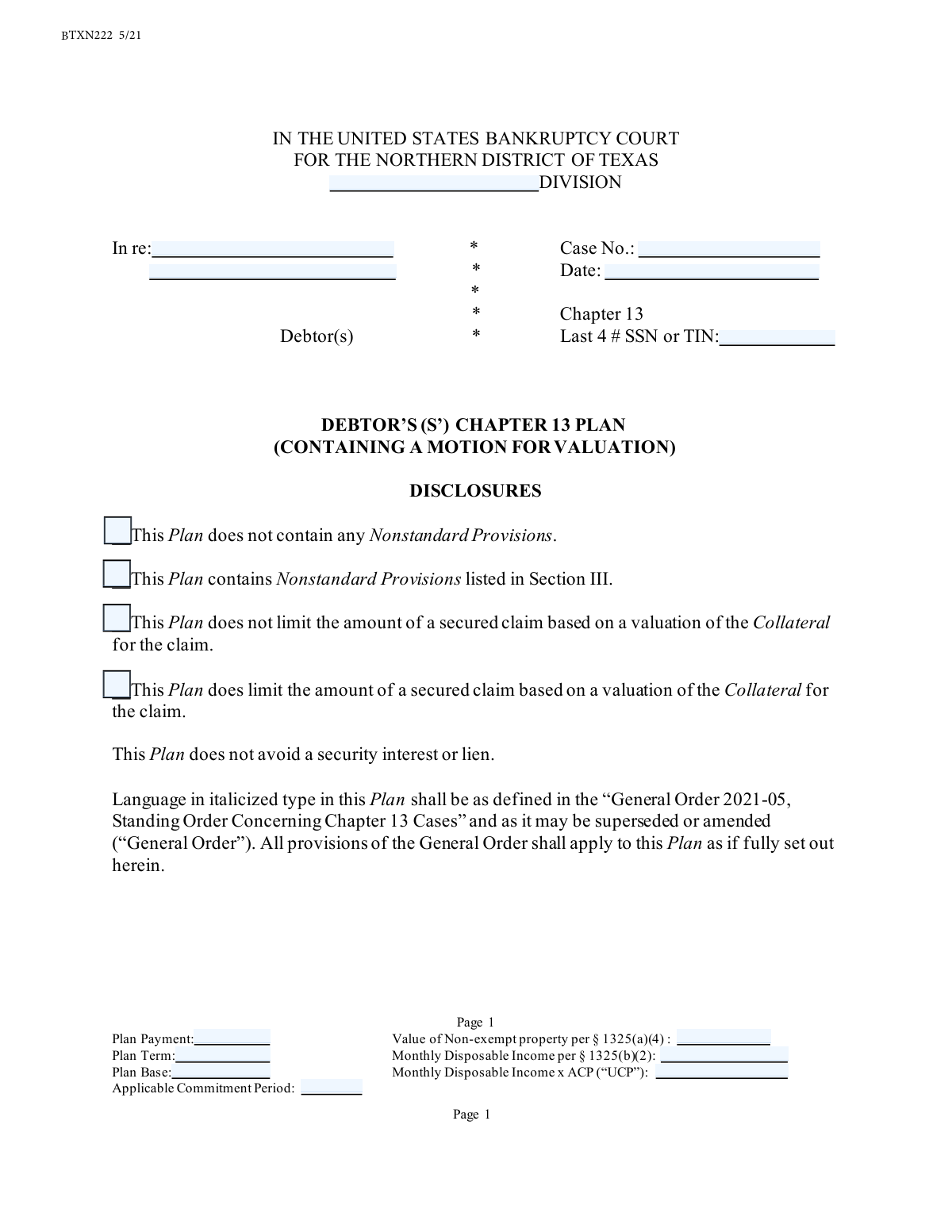
This form, officially the Debtorās(sā) Chapter 13 Plan, is a comprehensive document filed in the United States Bankruptcy Court for the Northern District of Texas. It details how a debtor proposes to repay their debts over a period of three to five years, specifying payments to the trustee, treatment of various creditor classes (secured, priority, unsecured), and the handling of assets and contracts. The confirmation of this plan by the court is a critical step in the Chapter 13 bankruptcy process, making its terms legally binding on all parties. Today, this form can be filled out quickly and accurately using AI-powered services like Instafill.ai, which can also convert non-fillable PDF versions into interactive fillable forms.
Our AI automatically handles information lookup, data retrieval, formatting, and form filling.
It takes less than a minute to fill out BTXN222 using our AI form filling.
Securely upload your data. Information is encrypted in transit and deleted immediately after the form is filled out.
Form specifications
| Form name: | Debtor’s(s’) Chapter 13 Plan (Containing a Motion for Valuation) |
| Number of pages: | 14 |
| Language: | English |
Instafill Demo: How to fill out PDF forms in seconds with AI
How to Fill Out BTXN222 Online for Free in 2026
Are you looking to fill out a BTXN222 form online quickly and accurately? Instafill.ai offers the #1 AI-powered PDF filling software of 2026, allowing you to complete your BTXN222 form in just 37 seconds or less.
Follow these steps to fill out your BTXN222 form online using Instafill.ai:
- 1 Navigate to Instafill.ai and upload or select the Debtor’s Chapter 13 Plan form for the Northern District of Texas.
- 2 Enter the case information, including the court division, case number, and the debtor's personal details and Social Security/TIN information.
- 3 Specify the plan payment details in Section I, including the monthly payment amount, the term of the plan, and the total estimated base amount.
- 4 Detail the treatment of all claims, including mortgage arrearages, secured creditors, priority debts like domestic support obligations, and general unsecured creditors.
- 5 Use the AI assistant to accurately populate complex financial calculations, such as monthly disposable income and the unsecured creditors' pool.
- 6 Review all sections, including any nonstandard provisions in Section III, and provide the necessary signatures for the debtor and their attorney.
- 7 Download the completed, signed plan and the Certificate of Service for filing with the bankruptcy court and serving on all required parties.
Our AI-powered system ensures each field is filled out correctly, reducing errors and saving you time.
Why Choose Instafill.ai for Your Fillable BTXN222 Form?
Speed
Complete your BTXN222 in as little as 37 seconds.
Up-to-Date
Always use the latest 2026 BTXN222 form version.
Cost-effective
No need to hire expensive lawyers.
Accuracy
Our AI performs 10 compliance checks to ensure your form is error-free.
Security
Your personal information is protected with bank-level encryption.
Frequently Asked Questions About Form BTXN222
This form outlines your proposed plan to repay some or all of your debts over a period of time, typically three to five years. It details how much you will pay the Chapter 13 trustee each month and how the trustee will distribute those funds to your creditors.
Individuals who have filed for Chapter 13 bankruptcy in the Northern District of Texas must complete and file this plan. It serves as the roadmap for your repayment and must be approved by the court for your case to proceed.
You will need your bankruptcy case number, detailed information about all your creditors, the amounts you owe, the value of any collateral, and your calculated monthly disposable income. It is crucial to work with your attorney to gather this information accurately from your bankruptcy schedules.
Surrendering collateral means you are giving back property, like a car, to the secured creditor to satisfy the debt owed on it. By doing this, you are no longer responsible for payments on that specific property through the plan, and the automatic stay is lifted for that item.
A nonstandard provision is any term in your plan that is not part of the court's standard form language. Any such provisions must be clearly listed *only* in Section III of the form to be considered valid.
The Motion for Valuation asks the court to determine the value of property securing a debt, which can potentially reduce the amount you have to pay on that secured claim. This is often used for vehicles or other personal property where the debt exceeds the item's value.
If a creditor files an objection, you may need to negotiate a resolution or attend a court hearing where a judge will decide on the issue. Objections must be filed by the deadline noted on page 2 of the form, which is typically 7 or 21 days before the hearing, depending on the division.
Section E.(1) is for secured claims where you can 'cram down' the value to the collateral's worth. Section E.(2) is for certain recent debts, like car loans made within 910 days of filing, that must be paid in full and cannot be crammed down.
Creditors are paid in a specific order of priority detailed in Section II, Part U of the plan. Generally, administrative costs, secured creditors, and priority debts are paid before general unsecured creditors receive any funds.
Your attorney's fees are typically paid through the plan itself, as detailed in Section C and Section II, Part C. The Chapter 13 trustee will disburse payments to your attorney from the funds you pay into the plan each month.
Yes, services like Instafill.ai use AI to accurately auto-fill form fields from your case information, which can save significant time and reduce errors. This helps ensure all required data is entered correctly into the plan.
Simply upload the Chapter 13 Plan form to the Instafill.ai platform. The AI will identify the fields, and you can provide your information once to have it automatically and accurately populated throughout the document.
If you have a non-fillable or 'flat' PDF, you can use a service like Instafill.ai to convert it into an interactive, fillable form. This allows you to easily type your information directly into the fields online without needing to print and write by hand.
You cannot dispose of or encumber non-exempt property without consent from the trustee or an order from the court. You must seek court approval to sell or refinance real property before your case is discharged or dismissed.
A 'conduit' payment means your regular, ongoing mortgage payments are made by the Chapter 13 trustee from the funds you pay into the plan. This is different from curing an arrearage and ensures your post-petition mortgage payments are made on time.
Compliance BTXN222
Validation Checks by Instafill.ai
1
Validates Case Number Format and Presence
This check ensures the 'Case Number' field is not empty and follows the court's standard format, such as 'YY-NNNNN'. A valid and present case number is essential for the document to be correctly filed and associated with the proper case docket in the court's system. An incorrect or missing number will lead to filing rejection or processing errors.
2
Ensures Last 4 of SSN/TIN is a 4-Digit Number
This validation verifies that the 'Last 4 of Debtor's SSN or TIN' field contains exactly four numeric digits. This information is a critical personal identifier required for case processing, creditor verification, and reporting. Failure to provide a valid 4-digit number can cause significant processing delays and identification issues with the Trustee's office.
3
Verifies Mutually Exclusive Disclosure Selections
This check ensures that contradictory checkboxes on Page 1 are not selected simultaneously. For example, a user cannot select both 'This Plan contains Nonstandard Provisions' and 'This Plan does not contain any Nonstandard Provisions.' This prevents ambiguity in the plan's declarations, which is crucial for legal interpretation and for the Trustee to understand the plan's structure at a glance.
4
Confirms Unsecured Creditors' Pool (UCP) Calculation
This validation confirms that the 'Unsecured Creditors' Pool (UCP)' amount is the correct product of the 'Monthly Disposable Income (DI)' and the 'ACP (applicable commitment period)'. The form explicitly defines this calculation, and its accuracy is essential for determining the minimum amount unsecured creditors must receive under the plan. An incorrect UCP value misrepresents the debtor's commitment and is grounds for an objection to confirmation.
5
Validates Plan Base Amount Calculation
This check verifies that the 'Estimated Base Amount (Total)' in Section I.A is the correct product of the 'Monthly Payment Amount' and the total number of months in the payment term. This mathematical consistency is fundamental to the plan's viability and ensures the total proposed payments align with the monthly schedule. An incorrect total could lead to plan rejection by the Trustee or funding shortfalls.
6
Ensures First Payment Due Date is a Valid Future Date
This check validates that the 'First Payment Due Date' is a valid calendar date that occurs after the case filing date. A payment due date in the past is illogical and impossible to fulfill, indicating a data entry error. This check ensures the payment schedule is feasible from the outset and can be correctly administered by the Trustee.
7
Validates Attorney Fee Total Against Components
This check ensures the 'total' attorney fee listed in Section C is greater than or equal to the sum of the 'Pre-petition' amount and the amount to be 'disbursed by the Trustee'. The total fee must account for all its specified parts. A discrepancy suggests a mathematical error that could lead to incorrect disbursements by the Trustee and disputes over legal fees.
8
Validates Chronological Order of Payment Term Months
This check verifies that for any payment term range specified in the format 'months ___ to ___', the starting month number is less than or equal to the ending month number. An inverted or illogical term range makes the plan's payment schedule nonsensical and impossible to interpret. This ensures the duration for payments to specific creditor classes is clearly and correctly defined.
9
Ensures Consistency Between Secured Claim Valuation and Disclosure
This check cross-references the disclosures on Page 1 with the data in Section E.(1). If any creditor in Section E.(1) has a 'VALUE' listed that is less than the 'SCHED. AMT.', the checkbox 'This Plan does limit the amount of a secured claim...' must be selected. This ensures the plan's summary accurately reflects its detailed provisions regarding cram-downs, preventing misrepresentation to the court and creditors.
10
Validates MM-DD-YY Date Format for Conduit Payments
This check ensures that the 'FIRST CONDUIT PAYMENT DUE DATE' in Section D.(2) adheres to the specified MM-DD-YY format. Proper date formatting is critical for automated processing and for the Trustee to schedule payments correctly. An invalid format could cause payment delays or errors in administering these critical mortgage payments.
11
Verifies Consistency Between Plan Term and ACP
This check ensures the 'Plan Term' from the summary on Page 1 is consistent with the 'ACP (applicable commitment period)' specified in Section I.A. The ACP is a legally defined period (typically 36 or 60 months) that dictates the minimum length of the plan. A discrepancy between these values indicates a fundamental inconsistency in the plan's structure that must be resolved before confirmation.
12
Requires Treatment Selection for Executory Contracts
This check verifies that for every executory contract or unexpired lease listed in Section K, a selection has been made in the 'ASSUME/REJECT' column. The debtor is required by law to either assume or reject such contracts. Failing to make a selection leaves the status of the contract ambiguous, creating legal uncertainty for both the debtor and the other party to the contract.
13
Validates Court Division Entry
This check ensures that the 'Court Division' field contains one of the valid divisions for the Northern District of Texas (e.g., Dallas, Fort Worth, Lubbock). Specifying the correct division is the first step in ensuring the case is routed and handled in the proper venue. An invalid or blank entry would cause filing errors and delays.
14
Requires Justification for Special Class Creditors
This validation ensures that if any creditors are listed in Section I, 'SPECIAL CLASS', the corresponding 'JUSTIFICATION' field is not empty. Treating certain unsecured creditors differently requires a specific legal justification that must be approved by the court. Failure to provide this justification will result in an objection from the Trustee and likely denial of that classification.
Common Mistakes in Completing BTXN222
This mistake occurs when the summary figures on Page 1 (e.g., Plan Base, Plan Term) do not match the detailed calculations provided later in the form, such as in Section I-A. This often happens due to manual updates in one section without correcting the corresponding entry in the other. Such inconsistencies create confusion and will likely trigger an objection from the Trustee, delaying the confirmation of the plan until the discrepancies are resolved.
On Page 1, filers sometimes check conflicting boxes, such as selecting both 'This Plan does contain Nonstandard Provisions' and 'This Plan does not contain any Nonstandard Provisions.' This error indicates a lack of understanding of the plan's contents and results in a defective filing. It requires an amendment to clarify the plan's terms, causing delays and scrutiny from the court and Trustee.
In Section I-A, the monthly payment amount multiplied by the plan term (in months) must equal the 'Total (estimated āBase Amountā).' Filers often make simple arithmetic errors here, leading to a plan that is mathematically infeasible. The Trustee's office will automatically flag this inconsistency, halting the confirmation process until a corrected and balanced plan is submitted.
In Section E(1), a debtor may enter an unrealistically low 'Value' for collateral (like a vehicle) to reduce the secured portion of a loan, known as a 'cram down.' This is often based on wishful thinking rather than a recognized valuation source. Creditors will almost always object to an improper valuation, leading to valuation disputes, additional hearings, and potential denial of confirmation if the valuation is not substantiated.
A frequent legal error is listing a vehicle loan incurred within 910 days of filing in Section E(1) to attempt a 'cram down.' Per § 1325(a)(9), these claims are not eligible for cram down and must be listed in Section E(2) to be paid in full. This fundamental mistake makes a plan unconfirmable on its face and requires a significant amendment, wasting time and resources.
Filers may forget to list priority debts, such as recent income taxes owed to the IRS, in Section H. This is a critical omission because priority claims must be paid in full through the plan. The IRS or Trustee will file an objection, and failure to amend the plan to include and fully pay the priority debt will result in the case being dismissed.
The form explicitly requires any unique plan terms to be listed only in Section III, stating that a 'nonstandard provision placed elsewhere in the Plan is void.' A common mistake is to write a special condition into another section, such as 'Justification' or 'Comment.' This renders the provision legally unenforceable and means the court and Trustee will ignore the debtor's intended request.
Debtors often forget to list all executory contracts and unexpired leases in Section K and clearly state whether they are being assumed or rejected. Forgetting to assume a car lease, for example, can result in the creditor repossessing the vehicle even if the debtor is making payments. This oversight can lead to the unintended loss of important assets or housing.
The Certificate of Service on the final page is often filled out incorrectly, either by omitting creditors or using outdated addresses. Proper service is a legal requirement to notify all parties of the proposed plan. An incomplete certificate means some creditors are not legally bound by the plan's terms, which will prevent confirmation until service is properly completed and documented.
In Section I-A, the UCP must be calculated by multiplying the Monthly Disposable Income (DI) by the Applicable Commitment Period (ACP). Debtors frequently miscalculate this figure or leave it blank. This value is essential for demonstrating the plan meets the 'best efforts' test, and an error here will lead to an immediate objection from the Trustee for failing to comply with the Bankruptcy Code.
Saved over 80 hours a year
āI was never sure if my IRS forms like W-9 were filled correctly. Now, I can complete the forms accurately without any external help.ā
Kevin Martin Green
Your data stays secure with advanced protection from Instafill and our subprocessors

Robust compliance program
Transparent business model
Youāre not the product. You always know where your data is and what it is processed for.
ISO 27001, HIPAA, and GDPR
Our subprocesses adhere to multiple compliance standards, including but not limited to ISO 27001, HIPAA, and GDPR.
Security & privacy by design
We consider security and privacy from the initial design phase of any new service or functionality. Itās not an afterthought, itās built-in, including support for two-factor authentication (2FA) to further protect your account.
Fill out BTXN222 with Instafill.ai
Worried about filling PDFs wrong? Instafill securely fills debtorss-chapter-13-plan-containing-a-motion-for-valuation forms, ensuring each field is accurate.