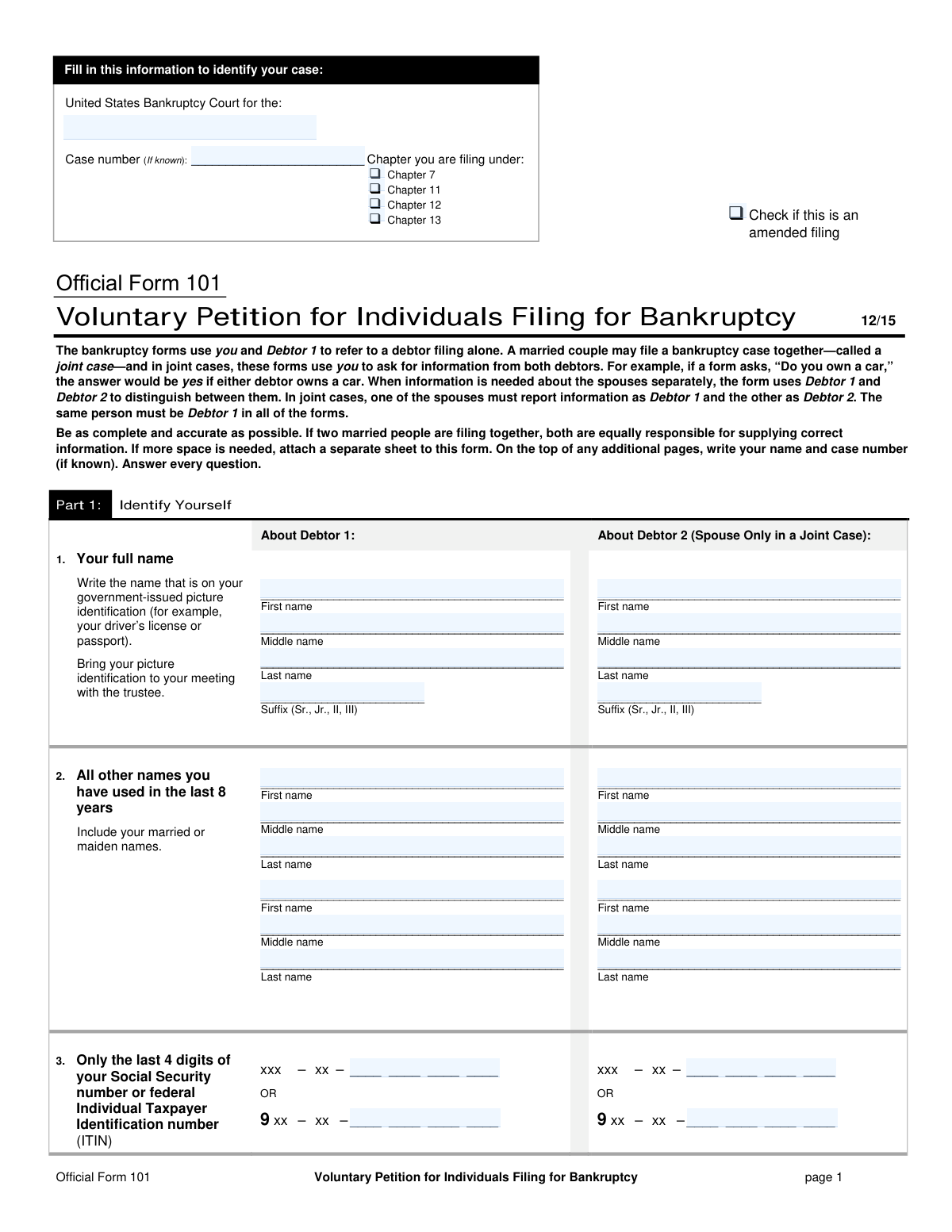
Yes! You can use AI to fill out Official Form 101, Voluntary Petition for Individuals Filing for Bankruptcy
Official Form 101 is the initial petition filed with a federal bankruptcy court to commence a personal bankruptcy case under Chapter 7, 11, 12, or 13. It is a critical document that provides the court with essential information about the debtor's identity, financial status, and the specific type of bankruptcy relief being sought. Today, this form can be filled out quickly and accurately using AI-powered services like Instafill.ai, which can also convert non-fillable PDF versions into interactive fillable forms.
Our AI automatically handles information lookup, data retrieval, formatting, and form filling.
It takes less than a minute to fill out Official Form 101 using our AI form filling.
Securely upload your data. Information is encrypted in transit and deleted immediately after the form is filled out.
Form specifications
| Form name: | Official Form 101, Voluntary Petition for Individuals Filing for Bankruptcy |
| Number of pages: | 8 |
| Language: | English |
| Categories: | bankruptcy forms |
Instafill Demo: How to fill out PDF forms in seconds with AI
How to Fill Out Official Form 101 Online for Free in 2026
Are you looking to fill out a OFFICIAL FORM 101 form online quickly and accurately? Instafill.ai offers the #1 AI-powered PDF filling software of 2026, allowing you to complete your OFFICIAL FORM 101 form in just 37 seconds or less.
Follow these steps to fill out your OFFICIAL FORM 101 form online using Instafill.ai:
- 1 Navigate to Instafill.ai and upload or select Official Form 101, the Voluntary Petition for Individuals Filing for Bankruptcy.
- 2 Use the AI assistant to provide personal identification for Debtor 1 (and Debtor 2, if a joint case), including full names, addresses, and the last four digits of your Social Security or Taxpayer ID number.
- 3 Specify the details of your bankruptcy case, such as the chapter you are filing under (e.g., Chapter 7 or 13) and your plan for paying the filing fee.
- 4 Answer questions about any sole proprietorships, hazardous properties, and provide information regarding your mandatory credit counseling briefing.
- 5 Complete the reporting section by estimating your total number of creditors, the value of your assets, and the total amount of your liabilities.
- 6 Carefully review all the information populated by the AI for accuracy, then electronically sign and date the petition in Part 7.
- 7 Download the completed, signed form, ready for filing with the correct U.S. Bankruptcy Court.
Our AI-powered system ensures each field is filled out correctly, reducing errors and saving you time.
Why Choose Instafill.ai for Your Fillable Official Form 101 Form?
Speed
Complete your Official Form 101 in as little as 37 seconds.
Up-to-Date
Always use the latest 2026 Official Form 101 form version.
Cost-effective
No need to hire expensive lawyers.
Accuracy
Our AI performs 10 compliance checks to ensure your form is error-free.
Security
Your personal information is protected with bank-level encryption.
Frequently Asked Questions About Form Official Form 101
This is the official starting document for an individual (or a married couple) to file for bankruptcy. It provides the court with essential information about who you are, where you live, and which type of bankruptcy you are choosing.
No, a married couple can file a 'joint case' using a single Form 101. One spouse will be designated as Debtor 1 and the other as Debtor 2, and this designation must be used consistently across all bankruptcy forms.
Yes, the law requires you to receive a briefing about credit counseling from an approved agency within the 180 days before you file for bankruptcy. You must attach the completion certificate to your petition or file it shortly after, unless you qualify for a specific exemption.
Part 2 of the form outlines your options: you can pay the fee in full, apply to pay in installments using Form 103A, or, if filing for Chapter 7, apply for a fee waiver using Form 103B if you meet the income requirements.
This is a security measure to protect your sensitive personal information while still allowing the court system to accurately identify your case. You should not write your full Social Security number on this part of the form.
You must list your current legal name as it appears on your government ID in question 1. Then, in question 2, you must list all other names you have used in the last 8 years, including any married or maiden names.
Yes, you are legally permitted to file on your own, which is known as filing 'pro se'. However, the form strongly advises hiring a qualified attorney because the process is complex and mistakes can have serious, long-term financial and legal consequences.
You must provide details about your business in Part 3 of the form. This includes the business name, address, and its classification, such as a Health Care Business or Single Asset Real Estate.
In Part 2, Question 11, you must disclose this. If you want to try and stay in your residence, you must also complete and file Form 101A, 'Initial Statement About an Eviction Judgment Against You,' along with your petition.
Each chapter has different eligibility requirements and outcomes, which this form does not explain in detail. It is crucial to research each chapter or consult with a bankruptcy attorney to determine which is the right choice for your financial situation.
Yes, services like Instafill.ai use AI to accurately auto-fill form fields, which can save time and help prevent errors. You are still responsible for ensuring all information is true and correct before signing and submitting the form.
Simply upload the form to the Instafill.ai platform, and its AI will identify all the fields. You can then answer simple questions, and the service will automatically and accurately populate the information into the correct spots on the form.
Services like Instafill.ai can convert flat, non-fillable PDFs into interactive, fillable forms. This allows you to easily type your information directly onto the document, save your progress, and print the completed form.
Compliance Official Form 101
Validation Checks by Instafill.ai
1
Debtor 1 Name Completeness
This check ensures that the First Name and Last Name fields for Debtor 1 in Part 1 are not empty. A full legal name is required for proper identification of the individual filing for bankruptcy. If these fields are left blank, the petition cannot be processed as the primary filer is not identified.
2
SSN or ITIN Last 4 Digits Format
Validates that the entry for the last 4 digits of the Social Security or Individual Taxpayer Identification Number in question 3 consists of exactly four numeric digits. This is crucial for correct identification while protecting the debtor's full identity. An invalid format could lead to processing errors or rejection of the filing.
3
Bankruptcy Chapter Selection Consistency
This validation cross-references the bankruptcy chapter selected in the header on page 1 with the chapter selected in Part 2, Question 7. Both selections must be identical to ensure there is no ambiguity about the type of relief being sought. A mismatch would create a legal contradiction and halt the case until clarified.
4
Amended Filing Case Number Requirement
Checks if the 'Amended filing' box is checked in the header of page 1. If it is, this validation ensures that the 'Case number' field is not empty. An amended petition must reference the original case it is amending, so the case number is essential for the court to link the documents correctly.
5
Joint Filer (Debtor 2) Data Integrity
If any information for Debtor 2 (spouse) is entered on the form, this check verifies that all critical identifying information is also present, including their full name, SSN/ITIN, and a selection in the credit counseling section (Part 5). In a joint case, both debtors are equally responsible for providing complete information. Incomplete data for Debtor 2 can invalidate the joint filing.
6
Prior Bankruptcy Details Requirement
If the filer answers 'Yes' to having filed for bankruptcy within the last 8 years (Question 9), this check ensures that the District, Date, and Case Number fields for at least one prior case are completed. This information is legally required to determine eligibility for a new discharge. The date provided must also be a valid date within the last 8 years from the current filing date.
7
District Filing Justification
In Part 1, Question 6, if a debtor selects the option 'I have another reason' for choosing the filing district, this validation confirms that the corresponding multi-line explanation field is not empty. The court requires a valid legal justification for venue if it's not based on residency. Failure to provide an explanation will result in the petition being questioned or rejected.
8
Employer Identification Number (EIN) Format
This check validates that any Employer Identification Number (EIN) entered in Question 4 adheres to the standard 9-digit format, typically XX-XXXXXXX. Correct formatting is necessary for the system to properly identify any associated businesses for legal and financial scrutiny. An incorrectly formatted EIN is unusable and would be flagged as an error.
9
Chapter 11 Small Business Debtor Logical Consistency
This validation applies if the filer selects Chapter 11. It ensures that in Question 13, the filer does not select 'No. I am not filing under Chapter 11.' This would be a direct contradiction. The filer must instead indicate whether or not they are a small business debtor, which has significant procedural implications for a Chapter 11 case.
10
Mandatory Credit Counseling Certification
Verifies that each debtor (Debtor 1 and Debtor 2, if applicable) has selected one of the mandatory options in Part 5 regarding their credit counseling briefing. Receiving credit counseling is a prerequisite for bankruptcy eligibility under federal law. Failing to make a selection and provide the required certification or waiver request will result in the dismissal of the case.
11
Fee Waiver and Chapter 7 Correlation
This check ensures that if the filer requests their filing fee be waived (Question 8), they have also selected Chapter 7 as their filing chapter (Question 7). By law, a fee waiver is only permissible for individuals filing under Chapter 7. Requesting a waiver for any other chapter is not allowed and would be an error.
12
Signature Date Validity
Validates that the 'Executed on' date provided with each signature in Part 7 is a complete and valid date in MM/DD/YYYY format. The date cannot be in the future. This date legally establishes when the debtor attested to the truthfulness of the information under penalty of perjury, and an invalid or future date would render the signature invalid.
13
Hazardous Property Explanation Requirement
If a filer answers 'Yes' in Question 14, indicating they own property that poses a hazard or needs immediate attention, this check ensures the subsequent explanation fields are filled out. The trustee must be immediately aware of such properties to take necessary protective actions. Missing this information could endanger public safety or lead to the destruction of estate assets.
14
Conditional Business Name Entry
In Question 4, if the checkbox 'I have not used any business names or EINs' is left unchecked for a debtor, this validation ensures that at least one business name has been entered. Leaving the box unchecked implies the debtor has used business names, and failing to list them would be an incomplete and potentially misleading declaration. The form must be complete to proceed.
Common Mistakes in Completing Official Form 101
Filers often write a common nickname or a slightly different version of their name instead of the exact full legal name shown on their government-issued ID. This discrepancy can cause delays in identity verification by the court and the bankruptcy trustee, potentially leading to questions about the filer's identity and requiring amendments. To avoid this, carefully copy your first, middle, and last name exactly as it appears on your driver’s license or passport.
Filers frequently forget to list all previous names, such as maiden names, former married names, or business aliases used within the last eight years. This is a critical error because creditors may have records under these old names, and failing to list them can result in those creditors not being properly notified of the bankruptcy. To prevent this, review your financial and personal history for the last eight years and list every name under which you may have incurred debt.
The form explicitly asks for only the last four digits of the Social Security Number (SSN) or ITIN to protect the filer's identity. However, people are accustomed to providing the full number and often fill it in out of habit, creating a significant privacy risk and a formatting error. This can lead to the document being rejected or requiring redaction. Always read the instructions for sensitive data fields carefully to ensure you are only providing the required information.
Filers sometimes list only their physical address, even if they receive mail at a different location like a P.O. Box, or if they are in the process of moving. The court and trustee will send all official notices, hearing dates, and deadlines to the mailing address provided. An incorrect or outdated mailing address will cause you to miss critical communications, which can lead to your case being dismissed for failure to appear or respond.
When a married couple files jointly, one spouse must be designated as Debtor 1 and the other as Debtor 2 consistently across all bankruptcy forms. Spouses may accidentally switch these roles on different schedules or pages, causing confusion, data entry errors for the court clerk, and potential delays in processing the case. To avoid this, decide at the outset who is Debtor 1 and use that designation on every document; AI-powered tools like Instafill.ai can enforce this consistency automatically across a set of forms.
The law requires individuals to complete a credit counseling course from an approved agency within 180 days before filing for bankruptcy. A very common and fatal mistake is filing the petition without having completed the course or failing to attach the certificate of completion. This almost always results in the automatic dismissal of the case, forcing the filer to start over and pay the filing fee again.
Question 9 requires the disclosure of all bankruptcy cases filed within the last 8 years, but filers may forget a previous filing, especially if it was dismissed, or fail to provide the correct case number, district, and filing date. This omission can be viewed as making a false statement under penalty of perjury and can jeopardize the filer's ability to receive a discharge of their debts. It is crucial to search your records thoroughly for any prior filings before completing this section.
In Question 12, filers are asked if they operate a business as a sole proprietor, but many misunderstand this term. They may fail to report side hustles, freelance work, or gig economy income, or incorrectly list a formal LLC or corporation, which is a separate legal entity. Omitting a sole proprietorship is a failure to disclose assets and income, which can have serious legal consequences, including denial of discharge.
Bankruptcy must be filed in the correct federal judicial district, which is typically where the debtor has lived for the majority of the last 180 days. Filers who have recently moved may file in their new district too soon or choose a district based on convenience rather than the legal requirement. Filing in the wrong venue can lead to the case being dismissed or transferred, which causes significant delays and may incur additional legal fees.
The form allows filers to pay the fee in installments (Form 103A) or request a waiver for Chapter 7 (Form 103B), but many people check the box without attaching the corresponding application. The court will not grant the request without the completed application, leading to a demand for the full fee and potential dismissal if it's not paid promptly. If this form is a non-fillable PDF, a tool like Instafill.ai can convert it to a fillable version and help manage the attachment of these required supplemental forms.
Saved over 80 hours a year
“I was never sure if my IRS forms like W-9 were filled correctly. Now, I can complete the forms accurately without any external help.”
Kevin Martin Green
Your data stays secure with advanced protection from Instafill and our subprocessors

Robust compliance program
Transparent business model
You’re not the product. You always know where your data is and what it is processed for.
ISO 27001, HIPAA, and GDPR
Our subprocesses adhere to multiple compliance standards, including but not limited to ISO 27001, HIPAA, and GDPR.
Security & privacy by design
We consider security and privacy from the initial design phase of any new service or functionality. It’s not an afterthought, it’s built-in, including support for two-factor authentication (2FA) to further protect your account.
Fill out Official Form 101 with Instafill.ai
Worried about filling PDFs wrong? Instafill securely fills official-form-101-voluntary-petition-for-individuals-filing-for-bankruptcy forms, ensuring each field is accurate.