Fill out bankruptcy forms
with AI.
Bankruptcy forms are the legal foundation for individuals and businesses seeking debt relief or financial restructuring. These insolvency forms are required by the U.S. Bankruptcy Court to initiate a case, provide financial transparency, and ensure that both creditors and debtors are treated fairly under the law. Filing for bankruptcy is often a stressful and complex process, but completing these documents accurately is the essential first step toward obtaining legal protection and a fresh financial start.
By continuing, you acknowledge Instafill's Privacy Policy and agree to get occasional product update and promotional emails.
About bankruptcy forms
Typically, these forms are used by individuals filing for Chapter 7 or Chapter 13 bankruptcy, as well as by petition preparers who assist them. For instance, the Voluntary Petition for Individuals Filing for Bankruptcy (Form 101) is the primary document that triggers a case and the automatic stay, while supplementary documents like the Bankruptcy Petition Preparer’s Notice (Form 119) ensure compliance with legal standards. Whether you are navigating personal debt or business insolvency, these forms collect critical information regarding your assets, liabilities, and income to determine your eligibility for relief.
Manually entering data into these extensive documents can be time-consuming and prone to errors that might delay your case. Tools like Instafill.ai use AI to fill these forms in under 30 seconds, handling your data accurately and securely to simplify the administrative side of the filing process. This practical approach allows you to focus on your financial recovery rather than the burden of repetitive paperwork.
Every form on this page can be completed without typing. Instafill is form filling software that reads a PDF and fills it for you — including flat and scanned documents that carry no fillable fields at all.
Forms in This Category
The forms in this category have a median Form Complexity Index of 80/100 (Very Complex), measured across 7 forms by field count, input difficulty, length, conditional logic and structure. See how it is calculated.
| Form Name | Pages | FCI | |
|---|---|---|---|
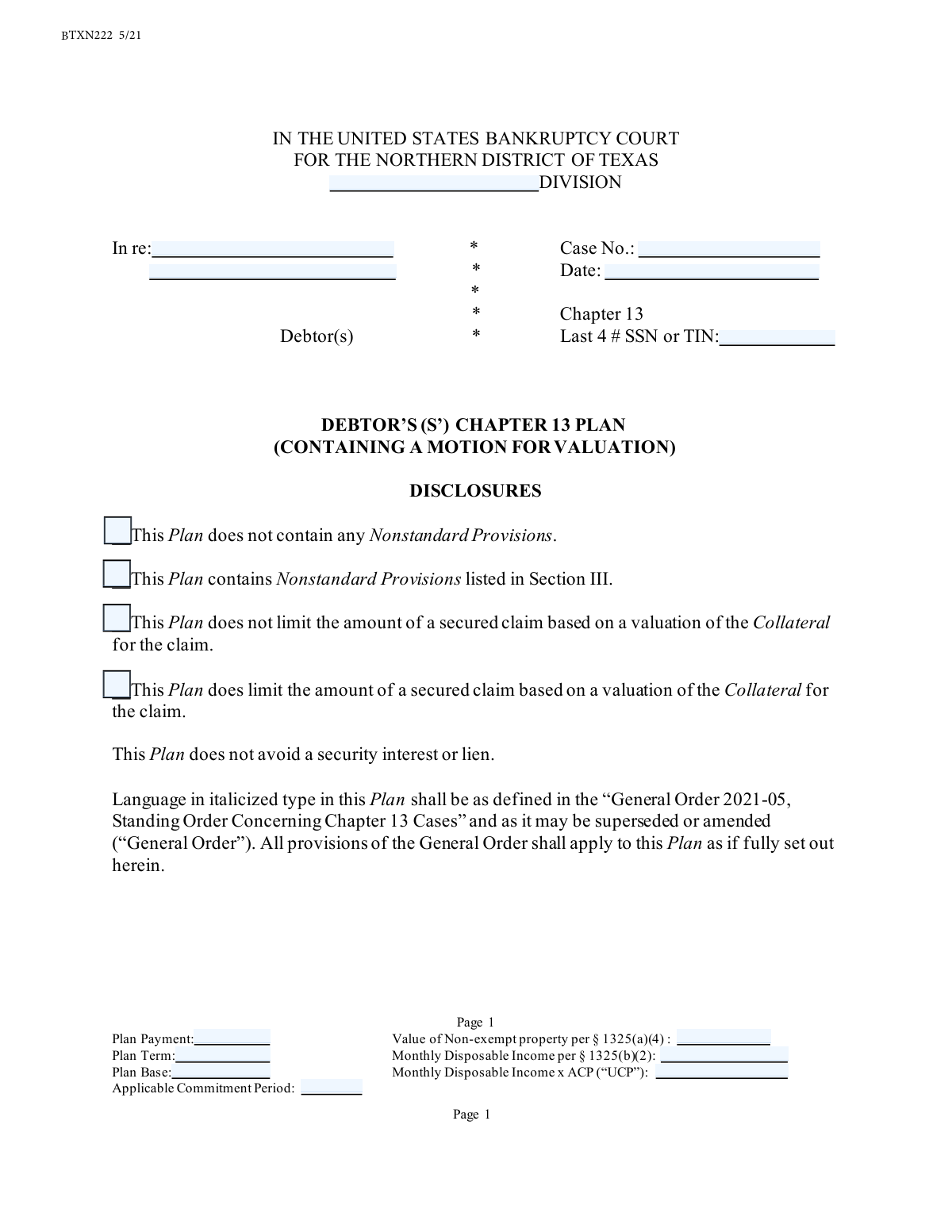
| 1. | Debtor’s(s’) Chapter 13 Plan (Containing a Motion for Valuation) | 14 | Complex 64 |
| 2. | Form 119, Bankruptcy Petition Preparer’s Notice | 2 | Basic 44 |
| 3. | Form 101, Voluntary Petition for Bankruptcy | 9 | – |
| 4. | Official Form 101, Voluntary Petition for Individuals Filing for Bankruptcy | 117 | Very Complex 89 |
| 5. | Official Form 101, Voluntary Petition for Individuals Filing for Bankruptcy | 8 | Complex 72 |
| 6. | Official Form 107, Statement of Financial Affairs for Individuals Filing for Bankruptcy (04/19) | 12 | Very Complex 100 |
| 7. | Official Form 107, Statement of Financial Affairs for Individuals Filing for Bankruptcy (04/25) | 2 | Very Complex 80 |
- Enterprise-grade security & data encryption
- 99%+ accuracy powered by AI
- 1,000+ forms from all industries
- Complete forms in under 60 seconds
How to Choose the Right Form
Navigating debt relief can be overwhelming, but selecting the correct bankruptcy forms is the first step toward a fresh financial start. Depending on whether you are filing as an individual or using a professional service, you will need specific documents to initiate your case in U.S. Bankruptcy Court.
Starting Your Bankruptcy Case
If you are an individual or a married couple ready to file for bankruptcy (such as Chapter 7 or Chapter 13), your primary document is the Voluntary Petition. This form officially opens your case and triggers the "automatic stay," which halts most collection actions from creditors.
- Form 101 (Voluntary Petition for Bankruptcy): This is the standard document used to declare bankruptcy. It collects your personal information, financial summary, and the specific chapter under which you are filing.
- Official Form 101 (Voluntary Petition for Individuals Filing for Bankruptcy): This is the primary "opening" document for your case. It is critical for providing details on credit counseling status, prior bankruptcy history, and any pending eviction-judgment information. Use this form to ensure your case is not dismissed due to missing disclosures, as it sets the deadlines for all subsequent schedules and statements.
Working with a Petition Preparer
Not everyone chooses to file alone or with an attorney. If you have hired a non-lawyer service to help you type or organize your paperwork, you must include specific disclosures to comply with federal law.
- Form 119 (Bankruptcy Petition Preparer’s Notice): If you are using a bankruptcy petition preparer, this form is mandatory. It serves as a notice, declaration, and signature page that informs you of your legal rights and ensures the preparer is not providing unauthorized legal advice. It must be filed alongside your petition to maintain compliance with court requirements.
Quick Summary
- For all individual filers: You must start with Form 101 / Official Form 101. This is the mandatory entry point for any individual or joint bankruptcy filing.
- If using a paid service (non-attorney): You must also complete and sign Form 119 to disclose who assisted you with the paperwork and to acknowledge your obligations as a debtor.
Form Comparison
| Form | Primary Purpose | Who Submits It | Key Details Included | Main Legal Effect |
|---|---|---|---|---|
| Form 101, Voluntary Petition for Bankruptcy | Starts a bankruptcy case for individuals seeking debt relief. | Individual debtors or married couples filing jointly. | Identity, bankruptcy chapter, and prior filing history. | Triggers the automatic stay to halt creditor actions. |
| Form 119, Bankruptcy Petition Preparer’s Notice | Discloses use of a non-attorney to prepare bankruptcy forms. | Non-attorney preparers who help debtors complete paperwork. | Preparer's contact info, SSN, and fees charged to debtor. | Confirms compliance with regulations for non-attorney assistance. |
| Official Form 101, Voluntary Petition for Individuals Filing for Bankruptcy | Initiates a formal personal bankruptcy case in federal court. | Individual debtors filing for Chapter 7, 11, or 13. | Credit counseling status, eviction info, and filing fee method. | Commences the case and establishes mandatory filing deadlines. |
Tips for bankruptcy forms
Discrepancies between your Voluntary Petition and later financial schedules can cause delays or case dismissal. Always double-check that your personal information, debt totals, and asset lists match exactly throughout the entire filing package.
Most individual filers must complete a credit counseling course within 180 days before filing Form 101. Failure to include the certificate or a valid waiver with your petition can lead to an immediate dismissal of your case by the court.
Before starting these forms, collect your tax returns, pay stubs, and a full list of creditors. Having these documents ready saves time and ensures that the financial disclosures in your petition are accurate and verifiable.
If you use a non-attorney to help type your forms, ensure they complete Form 119 to disclose their services. Be aware that preparers cannot provide legal advice; they are strictly limited to clerical tasks, and you remain responsible for the accuracy of the information.
AI-powered tools like Instafill.ai can complete these forms in under 30 seconds with high accuracy, serving as a real time-saver for people dealing with multiple forms. Your sensitive financial data stays secure during the process, allowing you to focus on the legal aspects of your filing.
Filing Form 101 requires a fee unless you qualify for an installment plan or a full waiver. Review the current court fees and determine if you need to submit additional forms to request a payment plan at the time of your initial filing.
Official Form 101 requires you to list any bankruptcy cases filed within the last eight years. Missing a prior filing can be seen as a lack of transparency, so it is vital to check your records or court history before submitting the petition.
Frequently Asked Questions
The most important document for starting the process is Form 101, the Voluntary Petition for Individuals Filing for Bankruptcy. This form officially opens your case in the U.S. Bankruptcy Court and triggers the 'automatic stay,' which legally stops most creditors from continuing collection actions against you.
Individuals or married couples who are unable to repay their debts and are seeking legal relief under the U.S. Bankruptcy Code must file these forms. The documents provide the court with a comprehensive overview of your financial situation, including your assets, liabilities, and income.
Form 119, the Bankruptcy Petition Preparer’s Notice, is necessary if you are paying a non-attorney to help you prepare your bankruptcy paperwork. This form ensures that the preparer identifies themselves and confirms they have provided you with required legal notices without offering unauthorized legal advice.
Yes, AI tools like Instafill.ai can be used to fill out these complex bankruptcy forms in under 30 seconds. The technology accurately extracts data from your financial source documents and places it into the appropriate fields on the official forms, helping to minimize manual entry errors.
Manually completing bankruptcy petitions can be a time-consuming process that takes several hours. However, by using an automated platform, you can complete the data entry and form population in less than a minute once your supporting documents are uploaded.
You must file your completed forms with the clerk's office at the U.S. Bankruptcy Court in the district where you live. While many courts offer electronic filing systems, individuals filing without an attorney (pro se) may still be required to submit physical paper copies depending on local rules.
Yes, married couples have the option to file a 'joint' petition using Form 101. The form is designed to accommodate information for both spouses, referred to as Debtor 1 and Debtor 2, allowing them to address their combined debts in a single legal proceeding.
Most individual filers are required to complete a credit counseling course from an approved agency within the 180-day period before filing. You must disclose whether you have completed this requirement directly on Form 101 when you submit your petition to the court.
Form 101 is used to initiate both Chapter 7 and Chapter 13 cases, but you must select the specific chapter you are filing under on the form. Chapter 7 typically involves the liquidation of non-exempt assets, while Chapter 13 involves a structured repayment plan over several years.
Because these forms are signed under penalty of perjury, accuracy is essential. Errors or omissions can lead to the dismissal of your case, the loss of your right to debt discharge, or other legal complications, so it is vital that the information is consistent with your financial records.
The U.S. Bankruptcy Court requires a filing fee, the amount of which depends on the chapter of bankruptcy you are filing. If you are unable to pay the full amount upfront, you may be eligible to apply for a fee waiver or a schedule to pay the fee in installments.
Glossary
- Form Complexity Index
- Instafill’s 0–100 measure of how much effort a form takes to complete, calculated deterministically from the form’s own structure rather than estimated. It combines the number of fillable fields (the largest factor), how difficult those fields are to complete based on their type, the number of pages that contain fields, the amount of conditional “fill-only-if” logic, and how many sections the form is divided into, then adds modifiers for tables and repeating lists, bundled instruction pages, and dense page layouts. A higher score means the form is harder to fill out by hand. The forms in this category have a median Form Complexity Index of 80/100 (Very Complex). See exactly how it is calculated.
- Debtor
- The individual or married couple who is filing the bankruptcy case and owes money to creditors.
- Automatic Stay
- A legal protection that starts the moment a petition is filed, immediately stopping creditors from continuing collection actions, lawsuits, or foreclosures.
- Chapter 7
- A type of bankruptcy where a trustee may sell your non-exempt property to pay creditors, often resulting in the discharge of most unsecured debts.
- Chapter 13
- A bankruptcy option for those with regular income to keep their property by following a court-approved plan to repay debts over three to five years.
- Credit Counseling
- A required educational session from an approved non-profit agency that individuals must complete within 180 days before filing their bankruptcy petition.
- Bankruptcy Petition Preparer (BPP)
- A person or service, other than an attorney, who is paid to help a debtor type or prepare bankruptcy forms but is legally barred from giving legal advice.
- Trustee
- An impartial official appointed by the court to oversee the bankruptcy case, review financial documents, and manage distributions to creditors.
- Schedules
- A set of official forms filed alongside the petition that provide a detailed list of a debtor's assets, liabilities, income, and expenses.