Fill out debt relief forms
with AI.
Debt relief forms are official documents used to formally address overwhelming financial obligations — whether through bankruptcy proceedings, tax liability disputes, or structured debt restructuring programs. These forms serve as the legal foundation for individuals and, in some cases, creditors to initiate processes that can provide meaningful financial protection. Getting them right matters: incomplete or inaccurate submissions can delay proceedings, result in rejections, or in serious cases, carry legal consequences.
By continuing, you acknowledge Instafill's Privacy Policy and agree to get occasional product update and promotional emails.
About debt relief forms
People who need these forms are often navigating some of the most stressful financial situations of their lives. A spouse seeking to separate themselves from a partner's tax debt may turn to Form 8857, Request for Innocent Spouse Relief, while someone facing insurmountable personal debt might file a Voluntary Petition for Bankruptcy (Form 101) to begin the legal process of debt discharge. This category also includes international forms, such as German consumer insolvency forms and the Swedish debt restructuring application (Ansökan om skuldsanering), reflecting that debt relief processes exist across many legal systems — each with its own detailed requirements.
Because these forms often involve extensive personal, financial, and legal information, accuracy is critical and the paperwork can feel daunting. Tools like Instafill.ai use AI to help fill out these forms in under 30 seconds, handling the data accurately and securely — a practical option when time and precision both matter.
Every form on this page can be completed without typing. Instafill is form filling software that reads a PDF and fills it for you — including flat and scanned documents that carry no fillable fields at all.
Forms in This Category
The forms in this category have a median Form Complexity Index of 64/100 (Complex), measured across 1 forms by field count, input difficulty, length, conditional logic and structure. See how it is calculated.
| Form Name | Pages | FCI | |
|---|---|---|---|
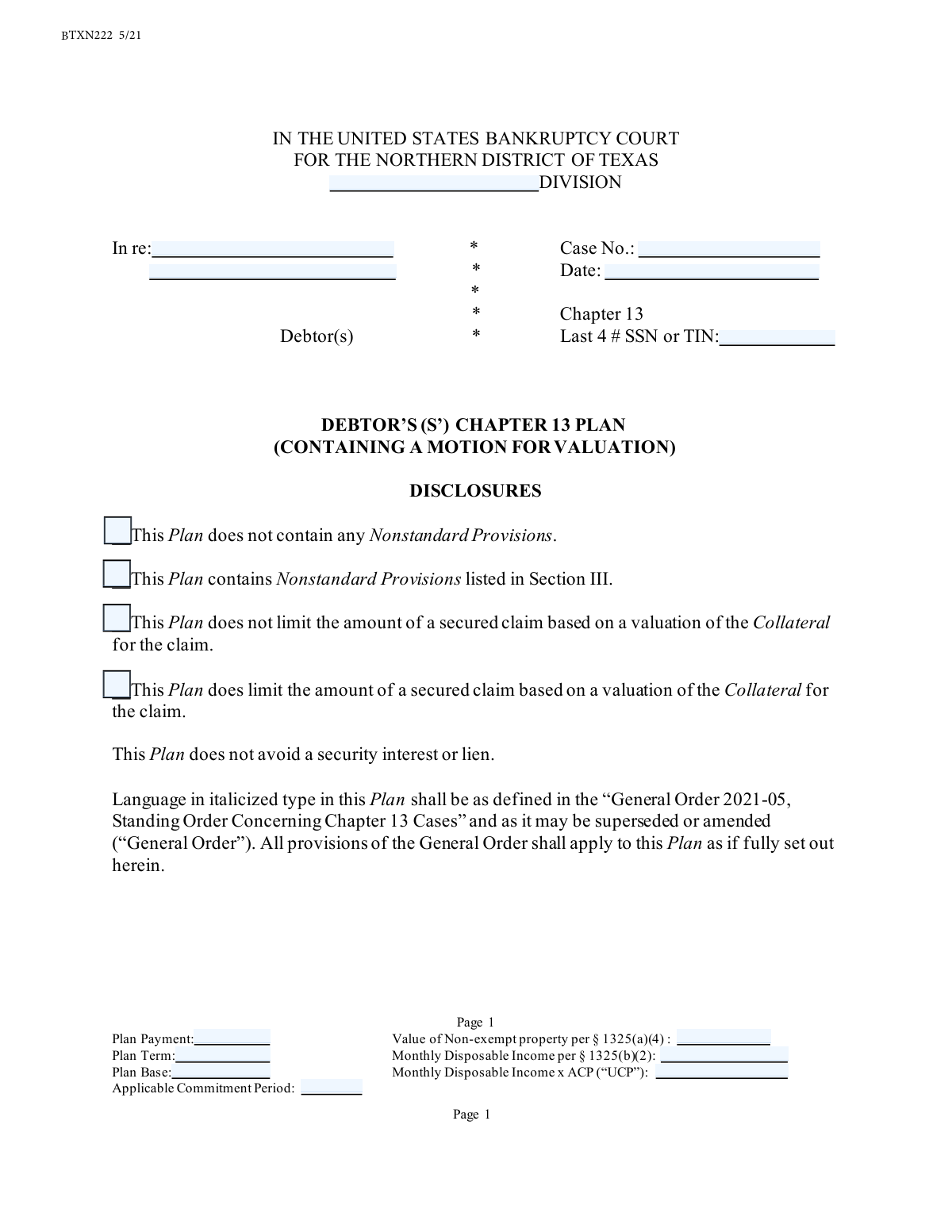
| 1. | Debtor’s(s’) Chapter 13 Plan (Containing a Motion for Valuation) | 14 | Complex 64 |
- Enterprise-grade security & data encryption
- 99%+ accuracy powered by AI
- 1,000+ forms from all industries
- Complete forms in under 60 seconds
How to Choose the Right Form
Not all debt relief forms serve the same purpose — your situation, location, and role in the debt will determine which form you need. Here's a quick breakdown to help you find the right one.
Dealing with Tax Debt from a Joint Return?
If your tax debt stems from a spouse's actions on a joint return, Form 8857, Request for Innocent Spouse Relief is your starting point. This form lets you ask the IRS to evaluate whether you should be held responsible for your spouse's tax liabilities — it's specifically for tax-related debt, not general debt.
Filing for Personal Bankruptcy (U.S.)?
- Filing yourself? Use Form 101, Voluntary Petition for Bankruptcy. This is the standard form for individuals who choose to declare bankruptcy and want legal protection from creditors.
- Are you a creditor? If you're owed money and need to force a debtor into bankruptcy proceedings, use Form 105, Involuntary Petition Against an Individual instead. This form initiates a case *against* a debtor rather than by them.
Seeking Debt Relief in Sweden?
The Ansökan om skuldsanering is the official form for applying for debt restructuring (*skuldsanering*) through the Swedish Enforcement Authority (Kronofogden). It covers your full financial picture — income, expenses, assets, and debts. Accuracy is critical here, as errors can lead to rejection.
Filing for Consumer Insolvency in Germany?
The Formulare für das Verbraucherinsolvenzverfahren und das Restschuldbefreiungsverfahren (Amtliche Fassung 1/2021) is a comprehensive official form package required by German courts for personal insolvency and debt discharge proceedings. It includes multiple attachments covering your finances, creditors, and a debt settlement plan — incomplete submissions can be treated as withdrawn.
Quick tip: If you're unsure which form applies, identify your country and whether you're the debtor or creditor — that alone will narrow it down significantly.
Form Comparison
| Form | Purpose | Who Files It | When to Use |
|---|---|---|---|
| Form 8857, Request for Innocent Spouse Relief | Seek relief from joint IRS tax liability | Spouse who disputes shared tax debt | When unfairly held responsible for partner's tax errors |
| Form 101, Voluntary Petition for Bankruptcy | Voluntarily declare personal bankruptcy for debt relief | Individual debtor filing on their own behalf | When individual chooses to initiate bankruptcy protection |
| Form 105, Involuntary Petition Against an Individual | Force a debtor into bankruptcy proceedings | Creditors seeking repayment from a debtor | When creditors initiate bankruptcy against an unwilling debtor |
| Ansökan om skuldsanering | Apply for Swedish debt restructuring and relief | Swedish residents overwhelmed by unmanageable debt | When seeking official debt relief through Kronofogden |
| Formulare für das Verbraucherinsolvenzverfahren und das Restschuldbefreiungsverfahren (Amtliche Fassung 1/2021) | Apply for German consumer insolvency and debt discharge | German consumers filing for personal insolvency | When seeking court-supervised debt relief in Germany |
Tips for debt relief forms
Before starting any debt relief form, collect bank statements, tax returns, pay stubs, a full list of creditors, and records of all assets and liabilities. Having everything on hand prevents incomplete submissions, which can delay processing or even result in your petition being dismissed. A complete financial picture upfront makes the entire process smoother.
Debt relief forms — whether for bankruptcy, innocent spouse relief, or debt restructuring — are legal documents where errors or omissions can have serious consequences, including denial of relief or legal penalties. Double-check every figure, date, and name before submitting. If something is unclear, consult a financial advisor or legal professional rather than guessing.
Not all debt relief forms serve the same purpose — Form 101 is for individuals voluntarily filing for bankruptcy, while Form 105 is filed by creditors against a debtor, and Form 8857 specifically addresses joint tax liability disputes. Using the wrong form wastes time and can set back your case. Read each form's description carefully or seek professional guidance before filing.
Debt relief forms are often lengthy and complex, but AI-powered tools like Instafill.ai can complete them in under 30 seconds with high accuracy, saving you hours of manual work. This is especially helpful when dealing with multiple related forms at once, such as the multi-part German consumer insolvency package. Your data stays secure throughout the process, so you can file with confidence.
Many debt relief forms — particularly official court filings like the German Verbraucherinsolvenzverfahren forms — can be treated as withdrawn or invalid if required fields are left empty. If a section doesn't apply to you, write 'N/A' or '0' rather than skipping it entirely. Always follow the specific instructions provided with each form.
Always retain a dated copy of every debt relief form you file, along with any supporting documents and confirmation of submission. These records are essential if questions arise later about your filing or if you need to reference previously reported figures. Store copies both digitally and in print for easy access.
Some forms in this category, such as the Swedish Ansökan om skuldsanering and the German consumer insolvency forms, are jurisdiction-specific and must be submitted to the correct authority in the correct language. Filing with the wrong agency or using an outdated form version can invalidate your application. Always verify you have the current, official version required by the relevant authority.
When completing bankruptcy or debt restructuring forms, include all creditors and debts, even those you dispute or believe are incorrect. Omitting a creditor can mean that debt is not covered by your relief filing, leaving you still liable after the process concludes. It's always better to include and dispute separately than to leave a debt off entirely.
Frequently Asked Questions
This category includes five debt relief forms covering a range of situations: IRS innocent spouse relief (Form 8857), voluntary and involuntary bankruptcy petitions (Forms 101 and 105), a Swedish debt restructuring application (Ansökan om skuldsanering), and German consumer insolvency forms (Verbraucherinsolvenzverfahren). Whether you're dealing with tax debt, personal bankruptcy, or insolvency proceedings in Sweden or Germany, you'll find the relevant form here.
The right form depends on your specific circumstances and jurisdiction. If you're dealing with a shared IRS tax debt you believe your spouse incurred, Form 8857 is appropriate. If you're an individual in the U.S. seeking bankruptcy protection, Form 101 is used for voluntary filings, while Form 105 is filed by creditors against a debtor. For debt restructuring in Sweden, use the Ansökan om skuldsanering, and for consumer insolvency in Germany, use the official Verbraucherinsolvenzverfahren forms.
Debt relief forms are typically filed by individuals who are overwhelmed by financial obligations they cannot meet, spouses who believe they are unfairly held liable for a partner's tax debts, or creditors seeking legal recourse against a debtor. The appropriate filer varies by form — some are filed by the debtor themselves, while others, like Form 105, are initiated by creditors.
Yes. Form 105, the Involuntary Petition Against an Individual, allows creditors to initiate a bankruptcy case against a debtor without the debtor's consent. This is distinct from voluntary bankruptcy, where the debtor themselves files for protection. Creditors must meet specific legal requirements under the U.S. Bankruptcy Code to use this form.
A voluntary bankruptcy petition (Form 101) is filed by the individual debtor who chooses to seek bankruptcy protection and debt relief. An involuntary petition (Form 105) is filed by qualifying creditors who want to force a debtor into bankruptcy proceedings. Both forms initiate a legal process under the U.S. Bankruptcy Code, but they differ in who initiates the case and why.
Yes, this category includes debt relief forms for Sweden and Germany in addition to U.S. forms. Swedish residents can use the Ansökan om skuldsanering to apply for debt restructuring through the Swedish Enforcement Authority (Kronofogden), while German residents can use the official Verbraucherinsolvenzverfahren forms to apply for consumer insolvency and discharge of remaining debts through their local insolvency court (Amtsgericht).
Most debt relief forms require detailed personal and financial information, including your identity, household composition, income, expenses, assets, and outstanding debts. Some forms, like the Swedish and German insolvency applications, also ask about employment status and housing. Accuracy and completeness are critical, as errors or omissions can lead to rejection or legal consequences.
Submission depends on the form and jurisdiction. U.S. forms like Form 8857 are submitted to the IRS, while bankruptcy petitions (Forms 101 and 105) are filed with the appropriate U.S. Bankruptcy Court. The Swedish skuldsanering application is submitted to Kronofogden, and German consumer insolvency forms are filed with the local Amtsgericht (insolvency court). Always verify the correct submission address or portal before filing.
Yes. AI-powered tools like Instafill.ai can fill out debt relief forms in under 30 seconds by accurately extracting and placing your data from source documents into the correct fields. This is especially useful for complex multi-part forms like the German Verbraucherinsolvenzverfahren package or the Swedish skuldsanering application, where completeness and accuracy are legally critical.
Manually completing debt relief forms can take anywhere from 30 minutes to several hours, depending on the complexity of the form and how readily available your financial information is. With AI tools like Instafill.ai, the data entry process can be completed in under 30 seconds, as the AI extracts and populates information directly from your documents.
Incomplete or inaccurate information on debt relief forms can have serious consequences. For example, errors on the German consumer insolvency forms can result in the application being considered withdrawn, and false statements can lead to criminal liability or denial of debt discharge. Similarly, the Swedish Kronofogden may reject a skuldsanering application if required information is missing. Always double-check your entries before submitting.
While it is not always legally required to have an attorney, debt relief processes — especially bankruptcy — can be legally complex, and professional guidance is often strongly recommended. A lawyer or certified debt counselor can help ensure you choose the right form, complete it correctly, and understand the legal implications of filing. For some forms, like the German consumer insolvency application, prior out-of-court debt settlement attempts are required before filing.
Glossary
- Form Complexity Index
- Instafill’s 0–100 measure of how much effort a form takes to complete, calculated deterministically from the form’s own structure rather than estimated. It combines the number of fillable fields (the largest factor), how difficult those fields are to complete based on their type, the number of pages that contain fields, the amount of conditional “fill-only-if” logic, and how many sections the form is divided into, then adds modifiers for tables and repeating lists, bundled instruction pages, and dense page layouts. A higher score means the form is harder to fill out by hand. The forms in this category have a median Form Complexity Index of 64/100 (Complex). See exactly how it is calculated.
- Innocent Spouse Relief
- A provision that allows one spouse to be released from responsibility for tax debts or errors caused by the other spouse on a jointly filed tax return. It is requested using IRS Form 8857.
- Voluntary Petition
- A formal legal request filed by an individual to initiate their own bankruptcy case, as opposed to being forced into bankruptcy by creditors.
- Involuntary Petition
- A bankruptcy filing initiated by creditors against a debtor, rather than by the debtor themselves, to compel repayment or restructuring of debts through the court.
- Discharge of Debt
- A court order that legally eliminates a debtor's obligation to repay certain debts, typically granted at the conclusion of a successful bankruptcy case.
- Joint Tax Liability
- The shared legal responsibility of both spouses for the full amount of taxes, interest, and penalties reported on a jointly filed tax return, regardless of who earned the income.
- Creditor
- A person, company, or institution to whom money is owed by a debtor, and who may have legal rights to collect that debt or participate in bankruptcy proceedings.
- Debt Restructuring
- A process in which the terms of existing debts are renegotiated or reorganized—often through a court-approved plan—to make repayment more manageable for the debtor.
- Means Test
- A financial eligibility assessment used in bankruptcy proceedings to determine whether a debtor's income and expenses qualify them for a particular type of bankruptcy relief, such as Chapter 7.
- Skuldsanering (Debt Restructuring/Debt Relief, Swedish)
- A Swedish legal process administered by the Kronofogden (Enforcement Authority) that allows individuals in severe financial distress to have their debts reduced or eliminated after a formal review of their finances.
- Restschuldbefreiung (Residual Debt Discharge, German)
- A German legal term for the final discharge of remaining debts at the end of a consumer insolvency procedure, freeing the debtor from obligations that could not be fully repaid during the process.