Fill out court filing forms
with AI.
Court filing forms are the essential bridge between individuals and the legal system, providing a structured way to submit petitions, motions, and financial disclosures to the court. This category specifically encompasses critical documents used in federal and local jurisdictions to address complex legal proceedings. For those navigating the legal landscape, these forms ensure that all necessary information is presented clearly and in compliance with court rules, which is vital for the progression of any legal case.
By continuing, you acknowledge Instafill's Privacy Policy and agree to get occasional product update and promotional emails.
About court filing forms
These forms are typically required by individuals or legal professionals dealing with debt relief and financial restructuring. For instance, bankruptcy forms and chapter 13 forms are fundamental for debtors seeking to reorganize their finances under court supervision. Whether you are filing a Chapter 13 Plan to outline a repayment schedule or submitting motions for asset valuation, these documents serve as the legal foundation for your path toward financial stability. Navigating debt relief forms requires precision, as the details provided will dictate the terms of court-ordered agreements and creditor interactions.
Managing the complexities of court filing forms can be time-consuming, but tools like Instafill.ai use AI to complete these documents accurately and securely in under 30 seconds. By automating the data entry process, users can focus on the strategic aspects of their legal matters while ensuring their paperwork meets the necessary filing standards.
Every form on this page can be completed without typing. Instafill is form filling software that reads a PDF and fills it for you — including flat and scanned documents that carry no fillable fields at all.
Forms in This Category
The forms in this category have a median Form Complexity Index of 37/100 (Basic), measured across 19 forms by field count, input difficulty, length, conditional logic and structure. See how it is calculated.
- Enterprise-grade security & data encryption
- 99%+ accuracy powered by AI
- 1,000+ forms from all industries
- Complete forms in under 60 seconds
How to Choose the Right Form
Navigating court filing forms for bankruptcy requires precision, as these documents dictate your financial future for years to come. In this category, the focus is specifically on the reorganization of debt for individuals with regular income.
Determining if This Form is Right for You
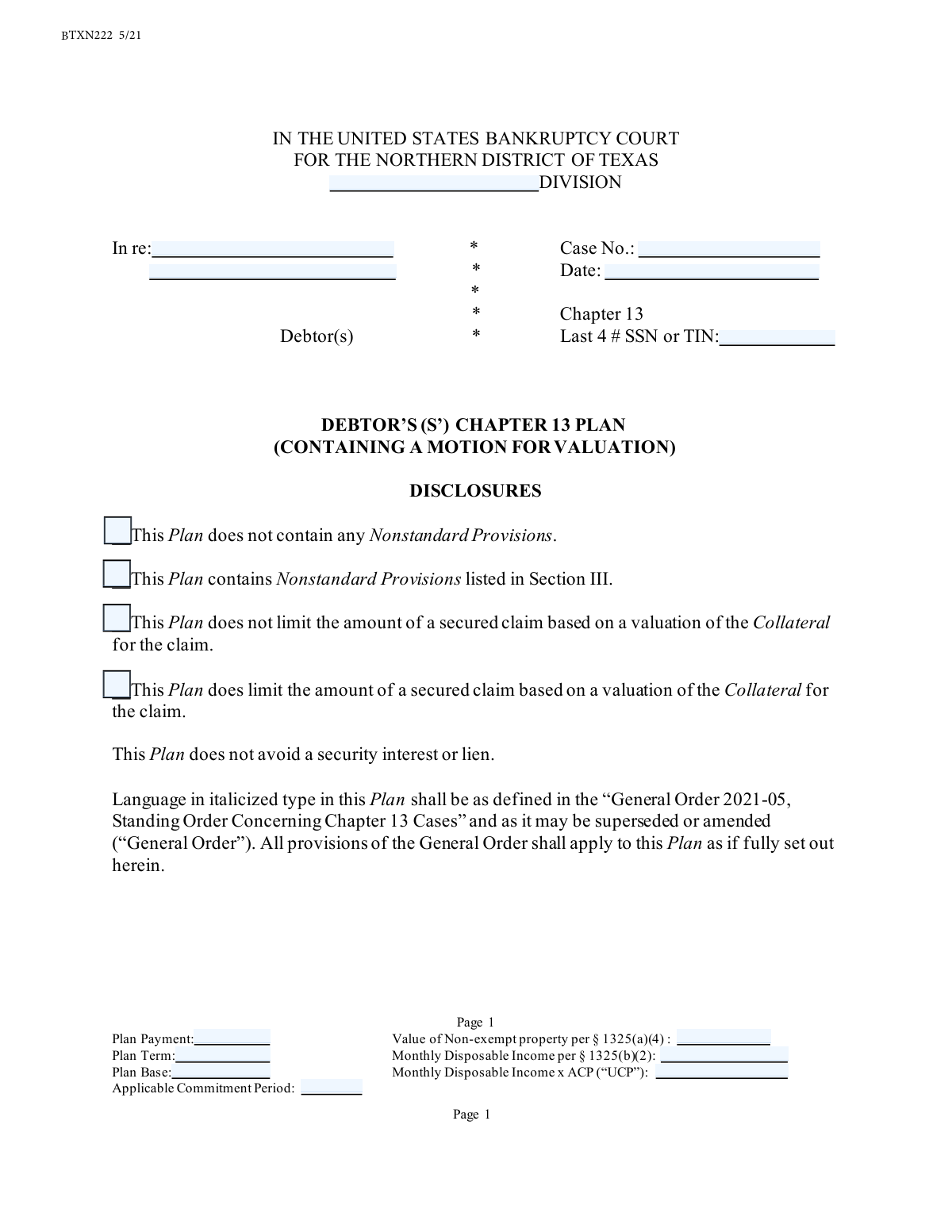
Currently, this category features the Debtor’s(s’) Chapter 13 Plan (Containing a Motion for Valuation). Because bankruptcy forms are often district-specific, it is important to ensure this matches your legal jurisdiction and filing status.
You should choose this form if:
- You are filing in the Northern District of Texas: This specific version is tailored for the United States Bankruptcy Court for the Northern District of Texas.
- You are pursuing Chapter 13, not Chapter 7: Use this form if you intend to keep your assets and pay back creditors over a three-to-five-year period rather than liquidating assets.
- You need to value collateral: The inclusion of a "Motion for Valuation" within the plan is crucial if you are asking the court to determine the fair market value of secured property (such as a vehicle) to potentially reduce the amount you owe to the secured creditor.
Key Components of the Chapter 13 Plan
The Debtor’s(s’) Chapter 13 Plan is more than just a filing; it is your formal proposal to the court. When completing this form via Instafill.ai, you will be detailing:
- Monthly Payments: The exact amount you propose to pay to the bankruptcy trustee.
- Creditor Treatment: How you plan to handle priority claims (like taxes), secured claims (like home or auto loans), and general unsecured claims.
- Executory Contracts: Decisions on whether to continue or reject existing leases or service contracts.
By using AI-powered tools to complete the Debtor’s(s’) Chapter 13 Plan, you can ensure that all required fields for the Northern District of Texas are addressed, helping you move toward a court-confirmed repayment plan with confidence.
Form Comparison
| Form | Purpose | Key Feature | Filing Party | Plan Duration |
|---|---|---|---|---|
| Debtor’s(s’) Chapter 13 Plan (Containing a Motion for Valuation) | Outlines a strategy to repay debts through a court-approved repayment schedule. | Includes a specific motion to determine the value of secured collateral. | Individuals filing for Chapter 13 bankruptcy in Northern District of Texas. | Requires a repayment period typically lasting between three and five years. |
Tips for court filing forms
Ensure all debt amounts and creditor addresses match your records exactly. Even minor discrepancies in financial data can lead to plan objections from creditors or delays in court confirmation.
Bankruptcy forms often vary significantly by district, such as the specific requirements for the Northern District of Texas. Always confirm you are using the correct local version of a Chapter 13 plan to avoid administrative rejection.
AI-powered tools like Instafill.ai can complete these complex court forms in under 30 seconds with high accuracy. This technology ensures your sensitive financial data stays secure while eliminating the stress of manual data entry.
Be diligent when categorizing claims as secured, priority, or general unsecured. Misclassifying a debt can significantly impact your calculated monthly payment and the feasibility of your overall repayment plan.
If your plan includes a motion for valuation, have appraisals or market data ready to justify the collateral's value. The court requires clear evidence to determine how much you must pay toward secured claims.
Ensure the information on your Chapter 13 plan perfectly matches your bankruptcy schedules and tax returns. The trustee will cross-reference these documents, and consistency is vital for a successful meeting of creditors.
Frequently Asked Questions
These forms are used to propose a structured repayment plan to creditors under the supervision of the bankruptcy court. They detail how much the debtor will pay each month and how those funds will be distributed among different classes of debt over a three-to-five-year period.
Individuals with a regular source of income who have unsecured and secured debts below certain statutory limits may file for Chapter 13. This process is often chosen by those who want to prevent a home foreclosure or catch up on missed payments while keeping their assets.
Court filing forms must be submitted to the clerk's office of the United States Bankruptcy Court in the district where you reside. Many districts now require or allow electronic filing through the CM/ECF system, though individuals filing without an attorney may have different submission requirements.
Yes, AI tools like Instafill.ai can assist in completing complex court filing forms by accurately extracting data from your source documents and placing it into the correct fields. This reduces the manual effort involved in navigating lengthy legal documents while ensuring the information is consistently applied.
Using traditional methods, completing detailed bankruptcy forms can take several hours, but AI-powered services can significantly speed up the process. With Instafill.ai, these forms can often be filled in under 30 seconds by automating the data entry process from your existing records.
A Motion for Valuation is often included within the repayment plan to ask the court to determine the current value of collateral securing a debt. This is important because it can potentially reduce the amount of a secured claim to the actual value of the property, affecting the total repayment amount.
You will generally need comprehensive records of your monthly income, detailed lists of all creditors and the amounts owed, and a full inventory of your assets. Additionally, you must provide information regarding your monthly living expenses to demonstrate that the proposed repayment plan is feasible.
While individuals have the legal right to file bankruptcy forms on their own, the process is technically demanding. Many filers choose to consult with a bankruptcy lawyer to ensure their plan meets all legal requirements and to navigate the court's procedural rules effectively.
After filing, a trustee is appointed to oversee the case and a meeting of creditors is scheduled. The court will eventually hold a confirmation hearing to determine if the plan meets the requirements of the Bankruptcy Code and is legally binding for all parties involved.
Chapter 13 forms focus on a repayment schedule for those with consistent income who wish to keep their property. In contrast, Chapter 7 forms are designed for a liquidation process where non-exempt assets may be sold to pay off debts in exchange for a faster discharge of remaining liabilities.
Glossary
- Form Complexity Index
- Instafill’s 0–100 measure of how much effort a form takes to complete, calculated deterministically from the form’s own structure rather than estimated. It combines the number of fillable fields (the largest factor), how difficult those fields are to complete based on their type, the number of pages that contain fields, the amount of conditional “fill-only-if” logic, and how many sections the form is divided into, then adds modifiers for tables and repeating lists, bundled instruction pages, and dense page layouts. A higher score means the form is harder to fill out by hand. The forms in this category have a median Form Complexity Index of 37/100 (Basic). See exactly how it is calculated.
- Bankruptcy Trustee
- An official appointed by the court to oversee the bankruptcy case, collect payments from the debtor, and distribute those funds to creditors according to the approved plan.
- Confirmation
- The formal court approval of a Chapter 13 repayment plan, which makes the terms of the plan legally binding on both the debtor and the creditors.
- Secured Claim
- A debt backed by collateral, such as a home or a vehicle, where the creditor has the legal right to seize the property if the debt is not paid.
- Priority Claim
- Specific types of debts, such as taxes or child support, that bankruptcy law requires to be paid in full before most other debts.
- Unsecured Claim
- A debt that is not backed by collateral, such as credit card balances or medical bills, which is typically paid after secured and priority claims.
- Motion for Valuation
- A legal request asking the court to determine the current fair market value of an asset, which can limit the amount a creditor is paid to the actual value of the property.
- Arrearage
- The total amount of overdue or missed payments on a debt that the debtor must catch up on through the duration of their repayment plan.
- Discharge
- A court order issued at the end of a bankruptcy case that releases the debtor from personal liability for certain debts, preventing creditors from taking further collection action.