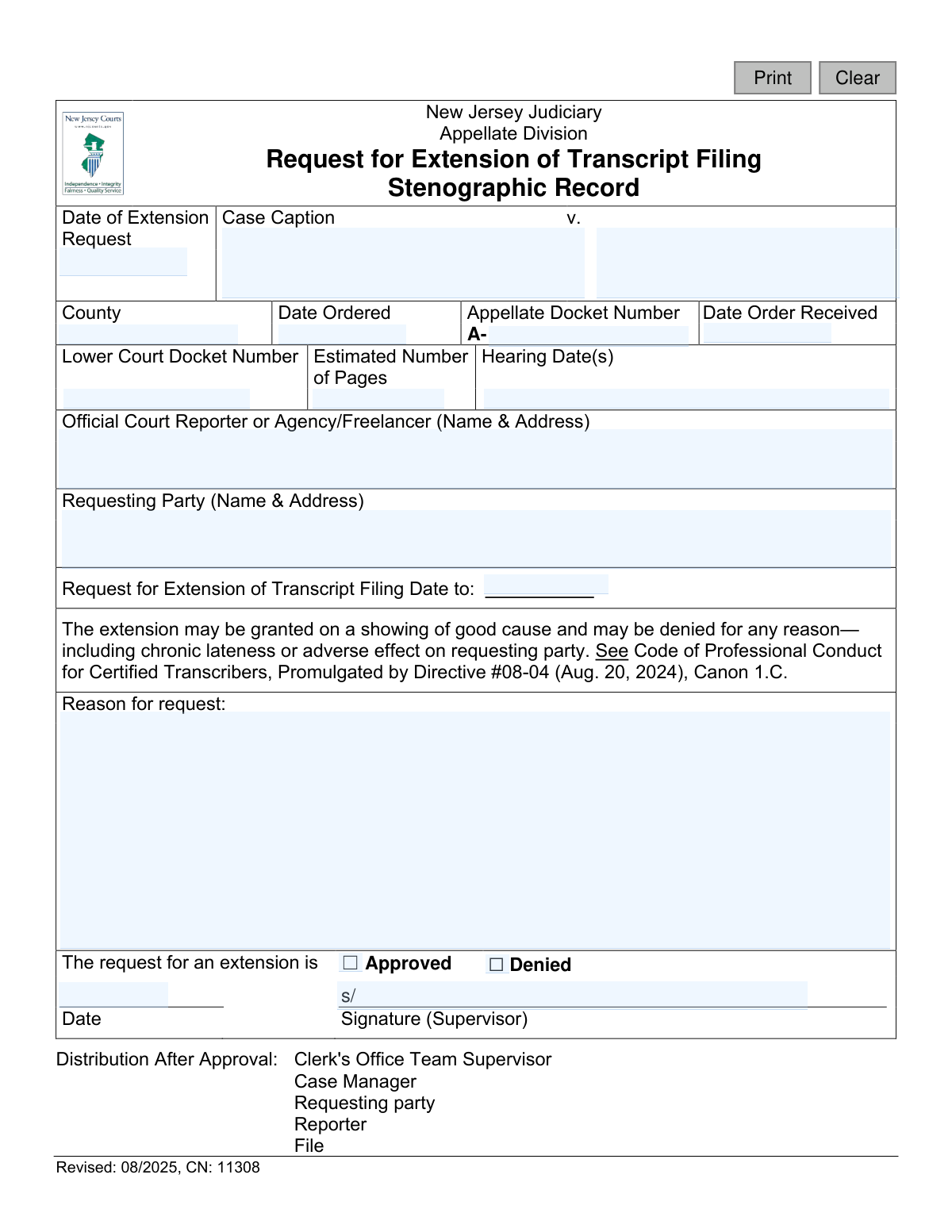
Yes! You can use AI to fill out New Jersey Judiciary, Appellate Division, Request for Extension of Transcript Filing
This form is a formal request submitted to the Appellate Division of the New Jersey Judiciary to extend the deadline for filing a stenographic record or transcript. It is used by court reporters, transcription agencies, or parties in a case when they cannot meet the original filing deadline and need to show 'good cause' for an extension. Ensuring timely submission of this request is crucial for maintaining the procedural integrity of an appeal. Today, this form can be filled out quickly and accurately using AI-powered services like Instafill.ai, which can also convert non-fillable PDF versions into interactive fillable forms.
Our AI automatically handles information lookup, data retrieval, formatting, and form filling.
It takes less than a minute to fill out CN 11308 using our AI form filling.
Securely upload your data. Information is encrypted in transit and deleted immediately after the form is filled out.
Form specifications
| Form name: | New Jersey Judiciary, Appellate Division, Request for Extension of Transcript Filing |
| Number of fields: | 20 |
| Number of pages: | 1 |
| Language: | English |
Instafill Demo: How to fill out PDF forms in seconds with AI
How to Fill Out CN 11308 Online for Free in 2026
Are you looking to fill out a CN 11308 form online quickly and accurately? Instafill.ai offers the #1 AI-powered PDF filling software of 2026, allowing you to complete your CN 11308 form in just 37 seconds or less.
Follow these steps to fill out your CN 11308 form online using Instafill.ai:
- 1 Navigate to Instafill.ai and upload or select the 'Request for Extension of Transcript Filing' form.
- 2 Use the AI assistant to automatically populate key case information, such as the Case Caption, Appellate Docket Number, and Lower Court Docket Number.
- 3 Enter the relevant dates, including the date the transcript was ordered, the date the order was received, and the specific hearing dates covered by the transcript.
- 4 Provide the full name and address for both the Official Court Reporter/Agency and the Requesting Party.
- 5 Specify the new requested filing date for the transcript and clearly write out the reason for the extension request in the provided section.
- 6 Carefully review all auto-filled and manually entered information for complete accuracy before finalizing the document.
- 7 Download the completed form to print and submit to the appropriate New Jersey Judiciary office as per their guidelines.
Our AI-powered system ensures each field is filled out correctly, reducing errors and saving you time.
Why Choose Instafill.ai for Your Fillable CN 11308 Form?
Speed
Complete your CN 11308 in as little as 37 seconds.
Up-to-Date
Always use the latest 2026 CN 11308 form version.
Cost-effective
No need to hire expensive lawyers.
Accuracy
Our AI performs 10 compliance checks to ensure your form is error-free.
Security
Your personal information is protected with bank-level encryption.
Frequently Asked Questions About Form CN 11308
This form is used by court reporters or transcription agencies to formally request more time to prepare and file a court hearing transcript for an appellate case in the New Jersey Judiciary.
The Official Court Reporter, transcription agency, or freelancer responsible for producing the official stenographic record for an appeal must complete this form if they cannot meet the original filing deadline.
You will need the case caption, appellate and lower court docket numbers, the date the transcript was ordered, the hearing dates, and the estimated number of pages. You must also provide a clear reason for needing the extension.
Clearly and concisely explain why you need more time, such as a high volume of pending transcripts, unexpected illness, or the complexity of the case. This is your opportunity to show 'good cause' for the extension.
These numbers are critical for identifying the case and should be on the original transcript order you received. The Appellate Docket Number will begin with 'A-'.
No, approval is not guaranteed. The request may be denied for various reasons, including a history of late filings or if the delay negatively impacts the case, so providing a strong justification is important.
If your request is denied, you are expected to file the transcript by the original deadline. Failure to do so may result in further action as outlined by court rules and directives.
The form should be submitted to the Appellate Division for review by a supervisor. After a decision is made, copies are distributed to the Clerk's Office, Case Manager, and other relevant parties.
Yes, services like Instafill.ai use AI to accurately auto-fill form fields from your saved information, which can save you significant time and reduce errors.
You can use Instafill.ai to easily complete this form online. Simply upload the PDF, and the tool will make it fillable, allowing you to type your information directly into the fields and save or print the completed document.
If you have a non-fillable PDF, you can upload it to a service like Instafill.ai. The platform can convert flat PDFs into interactive, fillable forms that you can complete on your computer.
The signature line is for the Supervisor at the Appellate Division who reviews and either approves or denies your request. The requesting party does not sign in this section.
'Good cause' refers to a legally sufficient reason for the delay, such as a heavy workload, personal emergency, or the unusual length or complexity of the transcript. It must be a valid reason beyond simple inconvenience.
Compliance CN 11308
Validation Checks by Instafill.ai
1
Appellate Docket Number Format Validation
This check ensures the 'Appellate Docket Number' field begins with the prefix 'A-' followed by a sequence of numbers and/or hyphens. This format is critical for correctly identifying and indexing the case within the New Jersey Judiciary's appellate system. A failure in this validation would prevent the form from being linked to the correct case file, causing significant processing delays.
2
Required Party Information Completeness
Validates that both the 'Official Court Reporter or Agency/Freelancer' and the 'Requesting Party' fields, including names and addresses, are not empty. This information is essential for identifying all stakeholders and ensuring proper communication and distribution of the approved or denied request. An omission could lead to a breakdown in communication and failure to notify a necessary party of the outcome.
3
Logical Date Chronology for Order
This validation confirms that the 'Date Order Received' is on or after the 'Date Ordered'. It is logically impossible to receive an order before it has been officially issued. This check maintains the integrity of the timeline of events and prevents clerical errors that could complicate the case record.
4
Extension Date Must Be in the Future
Ensures the 'Request for Extension of Transcript Filing Date to' is a future date relative to the 'Date of Extension Request'. Requesting an extension to a date that has already passed is illogical and would render the request invalid. This validation ensures the request is for a prospective deadline, which is the fundamental purpose of an extension.
5
Reason for Request Completeness
This check verifies that the 'Reason for request' text area is not empty. The form explicitly states that an extension is granted based on a 'showing of good cause,' making this justification a mandatory and critical component of the submission. Without a reason, the reviewing supervisor has no basis on which to approve the request.
6
Estimated Pages is a Positive Integer
Validates that the 'Estimated Number of Pages' field contains a positive whole number. This number is a key metric used to assess the workload and determine if the requested extension length is reasonable. Submitting text, a negative number, or zero would make it impossible to evaluate the scope of the transcription work.
7
Case Caption Completeness
Ensures that at least one of the party names in the 'Case Caption' field (plaintiff or defendant) is filled out. The case caption is the primary human-readable identifier for the legal proceeding. An empty caption would make it difficult to identify the case at a glance, even if the docket number is present.
8
Lower Court Docket Number Presence
This check confirms that the 'Lower Court Docket Number' field is not left blank. This number is essential for cross-referencing the appellate case with the original proceedings in the lower court. Its absence would hinder the ability to retrieve related documents and verify case history.
9
Hearing Date(s) Format and Validity
Verifies that the 'Hearing Date(s)' field contains one or more valid, properly formatted dates. These dates define the scope of the stenographic record to be transcribed. Incorrect or unparseable dates would create ambiguity about which proceedings are covered by the transcript request, potentially leading to an incomplete or incorrect transcript.
10
Supervisor Decision Completeness
This validation applies when the form is processed by a supervisor. If either the 'Approved' or 'Denied' checkbox is selected, then the 'Signature (Supervisor)' and 'Date' fields in that section must also be completed. This ensures that any official decision is properly authenticated, dated, and attributed to a specific supervisor.
11
Logical Sequence of Hearing and Order Dates
This check ensures that the 'Date Ordered' is after all of the specified 'Hearing Date(s)'. A transcript cannot be ordered for a hearing that has not yet occurred. This validation prevents chronological impossibilities in the form data, ensuring the record of events is accurate and logical.
12
Request Date is Not in the Future
Validates that the 'Date of Extension Request' is not a future date. The request date should reflect when the form was actually filled out, establishing an accurate timestamp for the request. Allowing future dates could compromise the integrity of the filing timeline.
Common Mistakes in Completing CN 11308
Users often incorrectly enter the case caption by reversing the plaintiff and defendant names or using unofficial abbreviations. This can lead to filing errors and difficulty in locating the case within the court's system. To avoid this, meticulously copy the case caption exactly as it appears on official court documents. AI-powered tools like Instafill.ai can help by saving and accurately auto-filling recurring case information, ensuring consistency across all documents.
A frequent error is entering the Appellate Docket Number without the required 'A-' prefix or transposing it with the Lower Court Docket Number. The 'A-' prefix is a critical identifier for the Appellate Division, and its omission will cause the request to be rejected or significantly delayed. Always double-check that the full, correct number, including the prefix, is entered in the appropriate field.
The form requires a showing of 'good cause,' yet many filers provide generic or insufficient reasons like 'heavy workload.' This almost always leads to a denial of the request. To be successful, the reason must be specific, professional, and directly related to the transcript in question, such as citing the large number of pages, complexity of testimony, or conflicting high-priority orders. Justifying the need for more time is critical.
Filers often mix up the 'Date Ordered' (when the client requested the transcript) and the 'Date Order Received' (when the transcriber's office formally received the work order). This discrepancy can misrepresent the timeline and weaken the justification for an extension. It is crucial to consult internal records to enter both dates accurately, as this timeline is used to assess the transcriber's diligence.
When a transcript covers multiple days, users may only list the first or last day of the hearing, or forget to list them all. This provides an incomplete picture of the workload and can undermine the reason for the extension request. All relevant hearing dates must be listed clearly to accurately reflect the volume of work required and justify the need for additional time.
Submitting a request with a date that is excessively far in the future, or failing to specify a new target date at all, is a common mistake. Courts expect a reasonable and definite timeline. An open-ended or overly generous request is likely to be denied for failing to demonstrate a concrete plan for completion. Propose a new date that is realistic and justifiable based on the reason provided.
Providing a wild guess or leaving the 'Estimated Number of Pages' field blank can lead to the request being questioned or denied. This estimate helps the court understand the scope of the work and evaluate if the requested extension is reasonable. Transcribers should use their professional experience and hearing length to provide a realistic estimate that supports their request.
Filers sometimes provide only a name for the court reporter or agency, omitting the full business address. This is a critical error as it prevents the court from properly identifying and communicating with the responsible party. Always provide the full, official name and mailing address to ensure all correspondence and approvals are sent to the correct location without delay.
Instead of writing the full county name (e.g., 'Monmouth'), users may use unofficial abbreviations (e.g., 'Monm.'). This can cause confusion or routing errors, especially in a statewide system. To prevent any ambiguity, always spell out the full name of the county where the lower court case was heard. Using a tool like Instafill.ai can help standardize such entries and prevent these errors.
There can be confusion over who the 'Requesting Party' is on this form. The requesting party is the person or agency asking for the extension (the court reporter or transcriber), not the attorney who ordered the transcript. Entering the attorney's information here can cause confusion about who is responsible for the delay and who should receive notifications. The transcriber filling out the form should enter their own official name and address. If the form is only a non-fillable PDF, Instafill.ai can convert it into a fillable version to make data entry clearer and more accurate.
Saved over 80 hours a year
“I was never sure if my IRS forms like W-9 were filled correctly. Now, I can complete the forms accurately without any external help.”
Kevin Martin Green
Your data stays secure with advanced protection from Instafill and our subprocessors

Robust compliance program
Transparent business model
You’re not the product. You always know where your data is and what it is processed for.
ISO 27001, HIPAA, and GDPR
Our subprocesses adhere to multiple compliance standards, including but not limited to ISO 27001, HIPAA, and GDPR.
Security & privacy by design
We consider security and privacy from the initial design phase of any new service or functionality. It’s not an afterthought, it’s built-in, including support for two-factor authentication (2FA) to further protect your account.
Fill out CN 11308 with Instafill.ai
Worried about filling PDFs wrong? Instafill securely fills new-jersey-judiciary-appellate-division-request-for-extension-of-transcript-filing forms, ensuring each field is accurate.