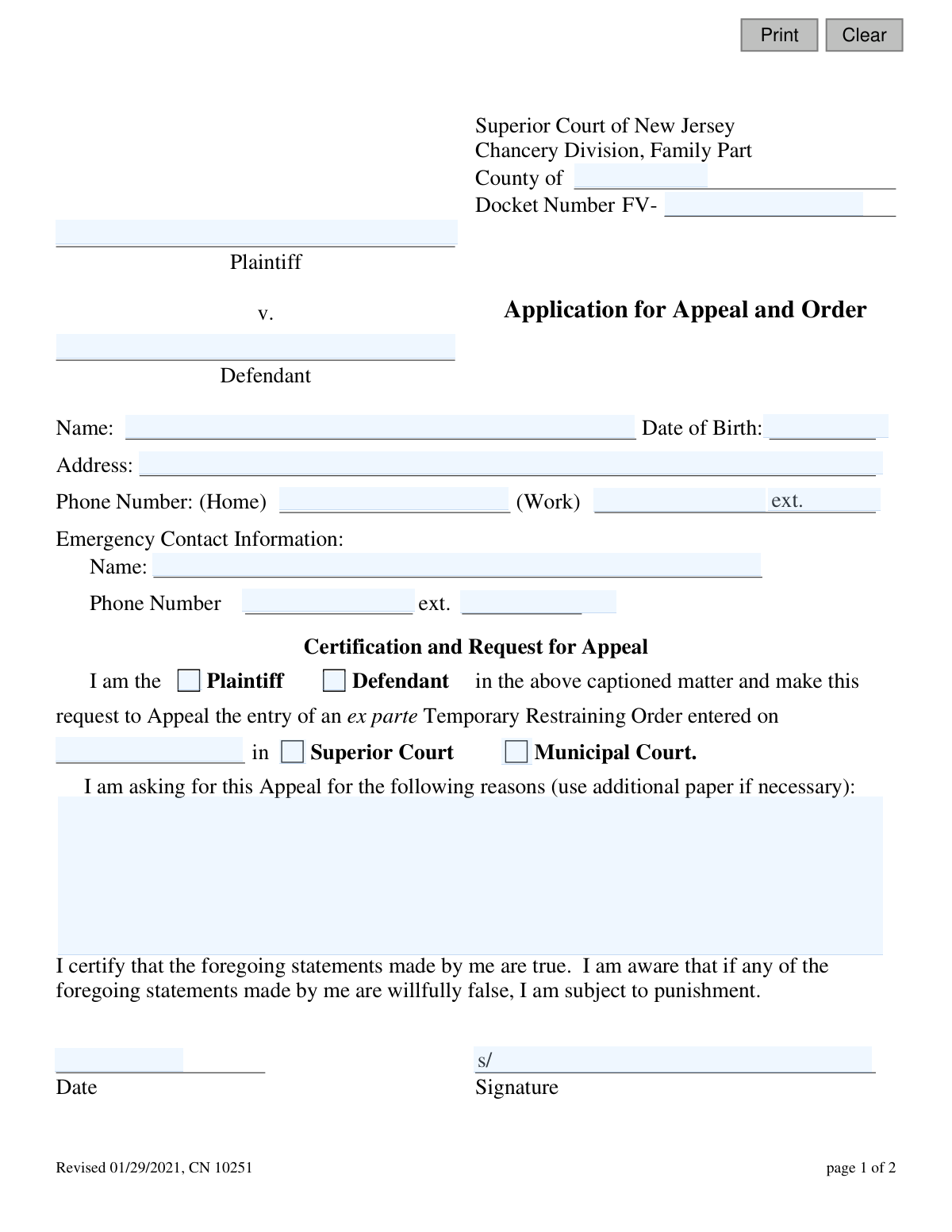
Yes! You can use AI to fill out Superior Court of New Jersey, Application for Appeal and Order
This form, officially known as the Application for Appeal and Order (CN 10251), is a legal document used in the Superior Court of New Jersey's Family Part. It allows a plaintiff or defendant to formally request an appeal of an ex parte Temporary Restraining Order (TRO) that was previously granted. The applicant must state the reasons for the appeal, which a judge will then review to either deny the appeal or grant a new hearing. Today, this form can be filled out quickly and accurately using AI-powered services like Instafill.ai, which can also convert non-fillable PDF versions into interactive fillable forms.
CN 10251 is part of the
court appeal forms, New Jersey forms and superior court forms categories on Instafill.
Our AI automatically handles information lookup, data retrieval, formatting, and form filling.
It takes less than a minute to fill out CN 10251 using our AI form filling.
Securely upload your data. Information is encrypted in transit and deleted immediately after the form is filled out.
Form specifications
| Form name: | Superior Court of New Jersey, Application for Appeal and Order |
| Number of fields: | 52 |
| Number of pages: | 1 |
| Language: | English |
Instafill Demo: How to fill out PDF forms in seconds with AI
How to Fill Out CN 10251 Online for Free in 2026
Are you looking to fill out a CN 10251 form online quickly and accurately? Instafill.ai offers the #1 AI-powered PDF filling software of 2026, allowing you to complete your CN 10251 form in just 37 seconds or less.
Follow these steps to fill out your CN 10251 form online using Instafill.ai:
- 1 Navigate to Instafill.ai and upload or select the 'Application for Appeal and Order' form.
- 2 Enter the court and case information, including the County and Docket Number (FV-), as well as the full names of the Plaintiff and Defendant.
- 3 Provide your personal details as the applicant, including your name, date of birth, address, and phone numbers.
- 4 Indicate whether you are the Plaintiff or Defendant, the date the Temporary Restraining Order was entered, and which court issued it.
- 5 Clearly write the specific reasons you are requesting the appeal in the 'Certification and Request for Appeal' section.
- 6 Review all the information you've entered for accuracy, then electronically sign and date the certification statement.
- 7 Download the completed, signed form to file with the appropriate Superior Court of New Jersey, Chancery Division, Family Part.
Our AI-powered system ensures each field is filled out correctly, reducing errors and saving you time.
Why Choose Instafill.ai for Your Fillable CN 10251 Form?
Speed
Complete your CN 10251 in as little as 37 seconds.
Up-to-Date
Always use the latest 2026 CN 10251 form version.
Cost-effective
No need to hire expensive lawyers.
Accuracy
Our AI performs 10 compliance checks to ensure your form is error-free.
Security
Your personal information is protected with bank-level encryption.
Frequently Asked Questions About Form CN 10251
This form is used to request that a judge reconsider a Temporary Restraining Order (TRO) that was issued on an 'ex parte' basis, meaning without the other party being present. It is an emergency request to challenge the TRO before the final hearing.
Either the plaintiff or the defendant in a case where a Temporary Restraining Order has been entered can file this form. You must check the box indicating whether you are the plaintiff or defendant.
You will need your case information (County and Docket Number), your personal details, the date the TRO was entered, and a written explanation for why you are appealing the order.
In this section, you must clearly state the facts and reasons why you believe the Temporary Restraining Order should be overturned or modified. Be truthful and specific, and use additional paper if you run out of space.
A judge will review your request and issue an order either denying or granting the appeal. If denied, the original final hearing date stands; if granted, a new hearing will be scheduled to address the TRO.
If 'Denied', the TRO remains in effect until your originally scheduled final hearing. If 'Granted', the court will schedule a new, earlier hearing to reconsider the terms of the TRO.
No, the 'Order of the Court' section is for the judge to complete. You should only fill out the 'Certification and Request for Appeal' section on the first page.
This form must be filed with the Superior Court of New Jersey, Chancery Division, Family Part, in the county where your case is located.
Appeals of Temporary Restraining Orders are treated as emergencies and are typically reviewed by a judge very quickly, often on the same day or the next business day.
While you are not required to have a lawyer, restraining order cases can be very complex. It is highly recommended to consult with an attorney for legal advice.
Yes, services like Instafill.ai use AI to help you accurately auto-fill form fields with your personal and case information, which saves time and helps prevent errors.
You can use a service like Instafill.ai to upload the PDF form and fill it out directly on your computer. After completing the fields, you can download the finished document for printing and filing.
If you have a non-fillable or 'flat' PDF, you can upload it to a platform like Instafill.ai. It can convert the document into an interactive, fillable form that you can complete online.
Compliance CN 10251
Validation Checks by Instafill.ai
1
Docket Number Format Validation
This check ensures the Docket Number field begins with the prefix 'FV-' followed by a valid sequence of numbers. Correct docket numbers are essential for accurate filing and retrieval of case documents within the court system. A failure in this format would prevent the application from being associated with the correct case file.
2
Applicant Identity Consistency Check
Validates that the applicant's name ('appName') matches either the Plaintiff's name ('plaName') or the Defendant's name ('defName'), based on the 'partyType' checkbox selection. This is critical to confirm that the person filing the appeal is a legitimate party to the original restraining order. An inconsistency would halt processing until the applicant's identity and role in the case are clarified.
3
Applicant Date of Birth Validity
Ensures the 'appDob' field contains a complete and valid date that is logically in the past. This validation prevents data entry errors like future dates or impossible dates (e.g., February 30th). Accurate birthdate information is necessary for identity verification and official records.
4
Party Type Selection Completeness
This check verifies that exactly one of the party type options ('Plaintiff' or 'Defendant') has been selected in the 'Certification and Request for Appeal' section. This selection is fundamental to understanding the context of the appeal and is a required field for legal processing. The form cannot be submitted without this information.
5
Chronological Date Integrity for Appeal
Verifies that the application signature date ('sigDt') is on or after the date the Temporary Restraining Order was entered ('orderDt'). It is logically impossible to appeal an order before it has been issued. This check prevents invalid applications based on incorrect date entries and ensures a valid timeline of events.
6
Reason for Appeal Presence
This validation ensures that the text field explaining the reasons for the appeal is not empty. The justification for the appeal is the most critical part of the application and provides the basis for the judge's decision. An application without a stated reason is incomplete and cannot be evaluated by the court.
7
Conditional Hearing Date Requirement
If the 'orderStatus' is marked as 'GRANTED', this check ensures that the 'hearingDt' field is populated with a valid date. When an appeal is granted, a new hearing must be scheduled to proceed with the case. Failure to provide a hearing date would leave the case in an unresolved state, defeating the purpose of the appeal.
8
Future Hearing Date Logic
This validation confirms that the 'hearingDt', if provided, is a date in the future and occurs after the date the new order is signed ('orderDay', 'orderMoYr'). Scheduling a hearing in the past is a logical impossibility and indicates a data entry error. This ensures sufficient time for all parties to be properly notified of the new court date.
9
Conditional Limited Purpose Description
If the appeal is 'GRANTED' and the 'grantedStatus' is for a 'Limited purpose', this check requires the 'purposeDesc' field to be filled out. This description is essential for defining the scope of the new hearing for the judge, plaintiff, and defendant. Without this detail, the purpose of the hearing would be ambiguous, leading to confusion in court.
10
Judge's Signature and Order Reasons Requirement
Verifies that the Judge's signature ('sigJdge') and the reasons for the order ('orderDesc') fields are completed in the 'Order of the Court' section. A judicial order is not legally valid or enforceable without a judge's signature and a stated basis for the decision. Missing information would render the entire order section invalid.
11
Phone Number Format Validation
This check ensures that all phone number fields ('appPhHome', 'appPhWork', 'contactPh') adhere to a standard format, such as a 10-digit number. Correctly formatted phone numbers are crucial for the court to contact the applicant or their emergency contact regarding case updates. An invalid number could lead to missed hearings or critical communications.
12
Cross-Field TRO Date Consistency
Validates that the TRO date entered by the applicant ('orderDt') is the same as the TRO date referenced in the 'Order of the Court' section ('troDt'). This consistency check ensures that the applicant and the court are referencing the exact same legal order. A mismatch could mean the court is ruling on the wrong document, invalidating the entire process.
Common Mistakes in Completing CN 10251
The docket number, prefixed with 'FV-', is the unique identifier for the case. Applicants often forget this number, don't know where to find it, or write it incorrectly. Without the correct docket number, the court clerk cannot locate the case file, leading to significant processing delays or rejection of the application. To avoid this, carefully copy the full docket number from the original Temporary Restraining Order (TRO) or any other official court correspondence.
The form requires the applicant to check a box indicating if they are the Plaintiff or the Defendant in the original matter. Under stress, individuals can confuse these roles, but checking the wrong box fundamentally misrepresents the case to the court. This can cause procedural confusion and may even be grounds for dismissing the appeal. Always refer to the original TRO to confirm your official designation before filling out this section.
The free-text section for the appeal's reasoning is the most critical part of the application. A common mistake is to provide emotional but legally insufficient statements like 'This is unfair' or 'It's all lies.' The judge needs specific, factual reasons to consider overturning the initial order. Applicants should clearly and concisely state why the TRO was improperly granted, referencing facts or evidence that support their claim.
Page 2 of this form, including the 'Order of the Court' and 'Return of Service' sections, is strictly for official use by the judge and law enforcement. Applicants sometimes mistakenly fill out these areas, for example, by checking 'GRANTED' or signing on the judge's signature line. This invalidates the form, causes confusion, and requires the applicant to start over, delaying the entire appeal process.
The signature and date on page 1 certify that the statements made are true under penalty of perjury. An unsigned or undated application is legally invalid and will be rejected by the court clerk immediately. This simple oversight can cause the applicant to miss crucial legal deadlines. Always double-check that you have signed and dated the form in the designated spots before submission.
The application requires the exact date the TRO was entered and whether it was from a Superior or Municipal Court. Applicants often mistakenly use the date they were served or guess the date, and may not know which court issued the order. This incorrect data hinders the clerk's ability to locate the original order and can lead to the appeal being denied. This information can be found on the first page of the TRO document itself.
This form is marked 'Revised 01/29/2021.' Courts frequently update their forms to comply with new laws or procedures. Submitting an old version can lead to automatic rejection because it may be missing required information or certifications. Always ensure you are using the most current version by downloading it directly from the official New Jersey Courts website. AI-powered services like Instafill.ai can help by maintaining libraries of up-to-date official forms.
When a form is filled out by hand, illegible handwriting can make it impossible for court staff to process. If the clerk or judge cannot read the docket number, names, or the reasons for the appeal, the form may be rejected or critical information could be misinterpreted. To prevent this, print clearly in block letters. If the form is a non-fillable PDF, a tool like Instafill.ai can convert it into a fillable version, allowing you to type your information for maximum clarity.
In the 'Plaintiff v. Defendant' section, the names must be listed exactly as they appear on the original court documents. A common error is to reverse the names, which creates an incorrect case caption and can cause filing errors and administrative confusion. The person who initially sought the restraining order is the Plaintiff, and this role does not change on the appeal application.
Leaving out details like an apartment number, a full ZIP code, or a valid phone number can have serious consequences. If the court cannot mail important notices or contact the applicant to schedule a hearing, the applicant could miss their court date, resulting in the appeal being dismissed. All personal information must be complete, current, and clearly legible. AI form-filling tools like Instafill.ai can help prevent this by validating address formats and ensuring all required fields are complete.
Saved over 80 hours a year
“I was never sure if my IRS forms like W-9 were filled correctly. Now, I can complete the forms accurately without any external help.”
Kevin Martin Green
Your data stays secure with advanced protection from Instafill and our subprocessors

Robust compliance program
Transparent business model
You’re not the product. You always know where your data is and what it is processed for.
ISO 27001, HIPAA, and GDPR
Our subprocesses adhere to multiple compliance standards, including but not limited to ISO 27001, HIPAA, and GDPR.
Security & privacy by design
We consider security and privacy from the initial design phase of any new service or functionality. It’s not an afterthought, it’s built-in, including support for two-factor authentication (2FA) to further protect your account.
Fill out CN 10251 with Instafill.ai
Worried about filling PDFs wrong? Instafill securely fills superior-court-of-new-jersey-application-for-appeal-and-order forms, ensuring each field is accurate.