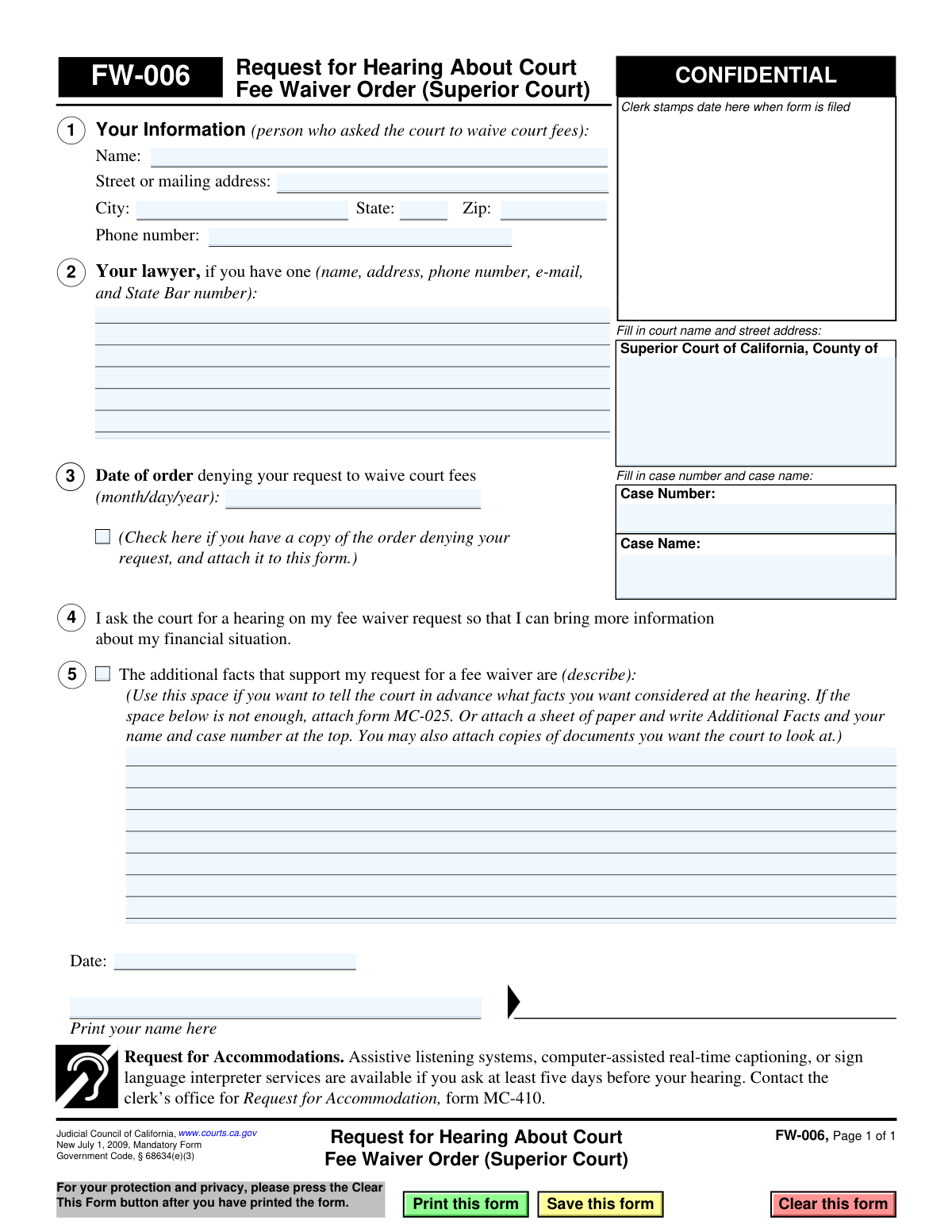
Yes! You can use AI to fill out Form FW-006, Request for Hearing About Court Fee Waiver Order (Superior Court)
This is a Judicial Council of California form used to ask the Superior Court for a hearing regarding a denied fee waiver request. It allows an individual to present more information about their financial situation to a judge in person. Filing this form is a crucial step for those who believe their fee waiver was wrongly denied and wish to contest the decision. Today, this form can be filled out quickly and accurately using AI-powered services like Instafill.ai, which can also convert non-fillable PDF versions into interactive fillable forms.
FW-006 is part of the
California court forms, fee waiver forms and superior court forms categories on Instafill.
Our AI automatically handles information lookup, data retrieval, formatting, and form filling.
It takes less than a minute to fill out FW-006 using our AI form filling.
Securely upload your data. Information is encrypted in transit and deleted immediately after the form is filled out.
Form specifications
| Form name: | Form FW-006, Request for Hearing About Court Fee Waiver Order (Superior Court) |
| Number of fields: | 21 |
| Number of pages: | 1 |
| Language: | English |
Instafill Demo: How to fill out PDF forms in seconds with AI
How to Fill Out FW-006 Online for Free in 2026
Are you looking to fill out a FW-006 form online quickly and accurately? Instafill.ai offers the #1 AI-powered PDF filling software of 2026, allowing you to complete your FW-006 form in just 37 seconds or less.
Follow these steps to fill out your FW-006 form online using Instafill.ai:
- 1 Navigate to Instafill.ai and upload or select the FW-006, Request for Hearing About Court Fee Waiver Order form.
- 2 Provide the AI assistant with the court information, including the county, case number, and case name.
- 3 Enter your personal information (name, address, phone) and your lawyer's details, if you have one.
- 4 Input the date of the court order that denied your fee waiver and check the box if you are attaching a copy of the order.
- 5 Clearly describe the additional facts that support your request for a fee waiver in the provided space, or note that you will attach a separate document.
- 6 Review all the information populated by the AI for accuracy, then e-sign the document and provide the date.
- 7 Download, print, and file the completed form with the court clerk's office.
Our AI-powered system ensures each field is filled out correctly, reducing errors and saving you time.
Why Choose Instafill.ai for Your Fillable FW-006 Form?
Speed
Complete your FW-006 in as little as 37 seconds.
Up-to-Date
Always use the latest 2026 FW-006 form version.
Cost-effective
No need to hire expensive lawyers.
Accuracy
Our AI performs 10 compliance checks to ensure your form is error-free.
Security
Your personal information is protected with bank-level encryption.
Frequently Asked Questions About Form FW-006
This form is used to ask the court for a hearing after your initial request to waive court fees was denied. It provides an opportunity to present more information about your financial situation directly to a judge.
You should file this form if you previously submitted a request for a fee waiver and the court issued an order denying it. This form is your official request to appeal that decision.
After you file the form, the court will schedule a hearing where you can explain your financial situation in person. The court clerk will notify you of the date, time, and location of your hearing.
In Section 5, you should briefly describe any new or additional information that supports your request, such as a recent job loss, unexpected medical bills, or other details about your financial hardship not included in your original request.
If you run out of space, you can attach Form MC-025 or a separate sheet of paper. Be sure to write 'Additional Facts' along with your name and case number at the top of any attached pages.
Yes, if you have a copy of the denial order, you should check the box in Section 3 and attach it to this form. Including the order helps the court process your request for a hearing more efficiently.
You must file the completed form with the clerk's office at the same Superior Court where your case is being heard. The court's name and address should be filled in at the top of the form.
You should file this request as soon as possible after receiving the denial order. While the form doesn't list a specific deadline, acting promptly is crucial for your request to be considered.
To request an accommodation, you must fill out and file Form MC-410, Request for Accommodations. It is recommended to submit this request at least five business days before your scheduled hearing date.
No, you are not required to have a lawyer to file Form FW-006. If you do have legal representation, you must provide their information in Section 2.
Yes, services like Instafill.ai use AI to accurately auto-fill form fields, which can save you time and help prevent common errors.
You can use a service like Instafill.ai to easily complete this form online. Simply upload the form to the platform, and it will allow you to type your information directly into the fields before printing for submission.
If you have a non-fillable or 'flat' PDF, you can use a tool like Instafill.ai to convert it into an interactive, fillable form. This allows you to easily type your answers instead of having to print and write by hand.
Compliance FW-006
Validation Checks by Instafill.ai
1
Case Number Presence and Format
Ensures the 'Case Number' field is not empty and follows a standard format expected by the court. The case number is critical for associating this request with the correct legal case file. If this validation fails, the form cannot be correctly filed by the clerk, leading to processing delays or rejection of the request.
2
Case Identification Completeness
Verifies that both the 'Case Number' and 'Case Name' fields are filled out. Both pieces of information are required for the court clerk to unambiguously identify the case to which this fee waiver hearing request pertains. An incomplete identification could result in the document being misfiled or returned to the filer.
3
Requester Information Completeness
Checks that the requester's name, street or mailing address, city, state, and ZIP code in Section 1 are all provided. This contact information is mandatory for the court to send notifications about the hearing date and other official correspondence. Failure to provide a complete address will prevent the court from communicating with the requester.
4
Denial Order Date Validity
Validates that the date entered in Section 3, 'Date of order denying your request', is a valid calendar date and is not a future date. This date establishes the event that gives the filer the right to request a hearing. An invalid or future date would make the request logically unsound and likely cause it to be rejected by the court.
5
Signature Date Validity
Ensures the 'Date' field in the signature block is a valid calendar date and is not set in the future. The signature date legally attests to when the document was signed. A future date is not permissible and would invalidate the document's authenticity, leading to its rejection.
6
Logical Date Sequence
Performs a logical check to ensure the signature 'Date' is on or after the 'Date of order denying your request' (Section 3). A person cannot sign a request for a hearing about an order before that order was officially issued. If this validation fails, it indicates a data entry error that must be corrected before filing.
7
Printed Name Consistency
Compares the name entered in Section 1 ('Your Information') with the name entered in the 'Print your name here' field at the bottom. These names should match to confirm the identity of the person signing the request. A mismatch could raise questions about who is actually making the request and may require clarification.
8
U.S. ZIP Code Format
Validates that the 'Zip' code field in Section 1 contains a value in a valid 5-digit or 9-digit (ZIP+4) format. A correct ZIP code is essential for the U.S. Postal Service to deliver court notices efficiently. An incorrect format can lead to returned mail and missed hearing dates.
9
Phone Number Format
Checks if the 'Phone number' in Section 1 is in a recognizable 10-digit format (e.g., (XXX) XXX-XXXX or XXXXXXXXXX). While not always mandatory for mailings, a valid phone number provides the court with an alternative method of contact for urgent communications. An invalid format makes the provided number useless.
10
Court Name Completeness
Verifies that the county name is filled in for the 'Superior Court of California, County of' field. This information is fundamental as it directs the filing to the correct court jurisdiction. Submitting the form without specifying the county will result in immediate rejection as the clerk won't know where to file it.
11
Attachment Reminder for Denial Order
Checks if the box in Section 3 ('Check here if you have a copy of the order...') is ticked. If it is, the system should display a reminder to the user to ensure the corresponding document is physically or digitally attached. This is a helpfulness check to prevent incomplete submissions, as the court will need to see the order being appealed.
12
Rationale for Hearing Presence
Checks if the text area in Section 5 ('The additional facts that support my request...') is left blank. If it is empty, a warning should be issued to the user explaining that providing facts in advance helps the court prepare for the hearing. While not a mandatory field, leaving it blank may be a missed opportunity for the filer to strengthen their case.
Common Mistakes in Completing FW-006
Applicants often enter the wrong court address, or they transcribe the case number or case name incorrectly. This happens due to carelessness or confusion between different legal matters. An incorrect case number or court name will cause the clerk to reject the filing, as they cannot place it in the correct file, potentially causing the applicant to miss a strict filing deadline.
A frequent mistake is to leave Section 5 empty, assuming the request for a hearing is sufficient on its own. The purpose of the hearing is to present new or clarifying information that was not in the original fee waiver request. Leaving this section blank gives the judge no new information to consider and signals that the applicant may not have a stronger case to present, weakening their position before the hearing even occurs.
Forgetting to date the form and provide a signature is one of the most common and critical errors. In the rush to complete paperwork, the signature line is easily overlooked. An unsigned form is legally invalid and will be rejected by the court clerk, which can be disastrous if the filing deadline for the hearing request is near.
In Section 3, applicants may guess the date of the denial order or leave it blank. The court needs this date to confirm the request for a hearing is filed within the legally allowed timeframe. Submitting the form with an incorrect or missing date can lead to its rejection or a summary denial for being untimely.
Applicants often check the box in Section 3 indicating the denial order is attached but then forget to include the physical copy. This slows down the process, as the clerk or judge may need to locate the original order in the case file. To avoid this, you should make a copy of the denial order and staple it to this request form immediately after checking the box.
In Section 5, instead of providing specific financial details, applicants sometimes write about the merits of their lawsuit or make emotional pleas. The judge can only grant a fee waiver based on specific financial criteria. Irrelevant information wastes a valuable opportunity to explain why you qualify, such as a recent job loss, new medical debt, or other expenses you forgot to list initially.
The applicant's name in Section 1 must exactly match the name used on all other documents in the case file, including the original fee waiver application. Using a nickname, a shortened name, or a slightly different spelling can cause processing delays. The court clerk may struggle to match the request to the correct person and case, leading to confusion and potential rejection.
When a form is filled out by hand, messy or unclear handwriting can make it impossible for the court clerk to process. If the case number, name, or other key details cannot be read, the form will be returned. To prevent this, it is best to fill out the form on a computer before printing. If the form is a non-fillable PDF, tools like Instafill.ai can convert it into a fillable version to ensure all entries are clear and legible.
The form explicitly states that accommodations like interpreters or assistive listening systems are available if requested at least five days before the hearing. People often overlook this notice at the bottom of the page and show up to the hearing unprepared. This can severely hinder their ability to communicate with the judge and may result in the hearing being postponed, causing significant delays.
Saved over 80 hours a year
“I was never sure if my IRS forms like W-9 were filled correctly. Now, I can complete the forms accurately without any external help.”
Kevin Martin Green
Your data stays secure with advanced protection from Instafill and our subprocessors

Robust compliance program
Transparent business model
You’re not the product. You always know where your data is and what it is processed for.
ISO 27001, HIPAA, and GDPR
Our subprocesses adhere to multiple compliance standards, including but not limited to ISO 27001, HIPAA, and GDPR.
Security & privacy by design
We consider security and privacy from the initial design phase of any new service or functionality. It’s not an afterthought, it’s built-in, including support for two-factor authentication (2FA) to further protect your account.
Fill out FW-006 with Instafill.ai
Worried about filling PDFs wrong? Instafill securely fills form-fw-006-request-for-hearing-about-court-fee-waiver-order-superior-court forms, ensuring each field is accurate.