Yes! You can use AI to fill out Superior Court of Chatham County, Georgia, Hearing Request Form

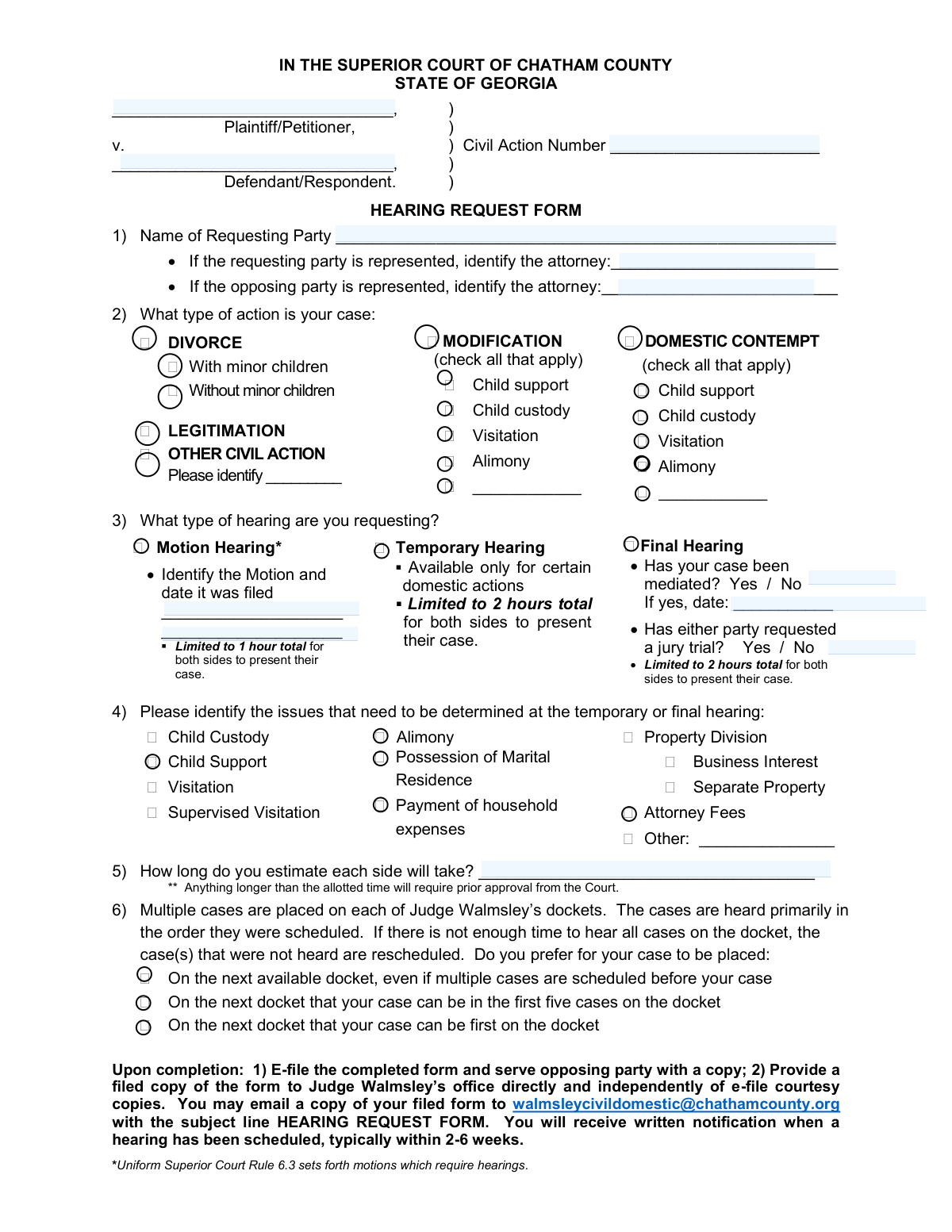
The Hearing Request Form for the Superior Court of Chatham County, Georgia, is a legal document used by parties in a lawsuit to formally request a court date. It is essential for scheduling motion, temporary, or final hearings in civil and domestic cases, ensuring that legal matters can be presented before a judge for resolution. Today, this form can be filled out quickly and accurately using AI-powered services like Instafill.ai, which can also convert non-fillable PDF versions into interactive fillable forms.
Chatham County Hearing Request Form is part of the County court forms, court forms, superior court forms and UK court forms categories on Instafill.
Our AI automatically handles information lookup, data retrieval, formatting, and form filling.
It takes less than a minute to fill out Chatham County Hearing Request Form using our AI form filling.
Securely upload your data. Information is encrypted in transit and deleted immediately after the form is filled out.

Form specifications

Form name: Superior Court of Chatham County, Georgia, Hearing Request Form
Number of fields: 41
Number of pages: 1
Filled form examples: Form Chatham County Hearing Request Form Examples
Language: English
main-image

Instafill Demo: How to fill out PDF forms in seconds with AI

How to Fill Out Chatham County Hearing Request Form Online for Free in 2026

Are you looking to fill out a CHATHAM COUNTY HEARING REQUEST FORM form online quickly and accurately? Instafill.ai offers the #1 AI-powered PDF filling software of 2026, allowing you to complete your CHATHAM COUNTY HEARING REQUEST FORM form in just 37 seconds or less.
Follow these steps to fill out your CHATHAM COUNTY HEARING REQUEST FORM form online using Instafill.ai:
  1. 1 Navigate to Instafill.ai and upload or select the Chatham County Hearing Request Form.
  2. 2 Use the AI assistant to accurately enter the case information, including the Plaintiff/Petitioner name, Defendant/Respondent name, and the Civil Action Number.
  3. 3 Identify the requesting party, their legal representation, and select the type of action, such as Divorce, Legitimation, or Modification.
  4. 4 Choose the type of hearing you are requesting (Motion, Temporary, or Final) and provide any required details, like the motion's filing date or mediation status.
  5. 5 Check the boxes for all legal issues that need to be determined at the hearing, such as Child Custody or Alimony, and provide an estimate for how long your side will take.
  6. 6 Indicate your preference for docket scheduling, then carefully review all the information entered on the form for accuracy and completeness.
  7. 7 Finalize the form, then download the completed document, ready for e-filing with the court and serving the opposing party as instructed.

Our AI-powered system ensures each field is filled out correctly, reducing errors and saving you time.

Why Choose Instafill.ai for Your Fillable Chatham County Hearing Request Form Form?

Speed

Complete your Chatham County Hearing Request Form in as little as 37 seconds.

Up-to-Date

Always use the latest 2026 Chatham County Hearing Request Form form version.

Cost-effective

No need to hire expensive lawyers.

Accuracy

Our AI performs 10 compliance checks to ensure your form is error-free.

Security

Your personal information is protected with bank-level encryption.

Frequently Asked Questions About Form Chatham County Hearing Request Form

This form is used to formally request a motion, temporary, or final hearing before Judge Walmsley in the Superior Court of Chatham County for a civil or domestic case.

Any party in a civil or domestic case in Chatham County Superior Court who wishes to have a hearing scheduled for a pending motion or to resolve temporary or final issues must complete this form.

First, you must e-file the form and serve a copy on the opposing party. Second, you must email a copy of the filed form directly to Judge Walmsley's office at [email protected].

You will typically receive written notification of your scheduled hearing date within 2 to 6 weeks after properly submitting the form.

A Motion Hearing is for a specific legal request, a Temporary Hearing sets short-term arrangements in domestic cases, and a Final Hearing resolves all remaining issues in the case. Each has different time limits, as noted on the form.

This section allows you to indicate your preference for scheduling. You can choose the absolute soonest date, even if you are low on the list, or wait longer for a date where your case will be heard first or among the first five.

The form states that any time longer than the standard allotment requires prior approval from the Court. You should indicate your time estimate in question 5 and be prepared to justify the need for more time.

If there is not enough time to hear all cases on the docket for a particular day, the cases that were not heard will be rescheduled for a future date.

The form requires you to state whether your case has been mediated before a Final Hearing can be set. This indicates that mediation is a standard and likely required step before the court will hear final issues.

Yes, services like Instafill.ai use AI to accurately auto-fill form fields with your information, which can save you time and help reduce errors.

You can use a service like Instafill.ai, which can convert flat, non-fillable PDFs into interactive forms. Simply upload the document, and the tool will allow you to type directly into the fields.

To fill this form using Instafill.ai, upload the document to the platform. The AI will identify all the fields, and you can then fill them in, save your progress, and download the completed document.

You must send a copy directly to the judge's office so they can begin the scheduling process immediately. This is a required separate step and is not replaced by the e-filing system's courtesy copies.

You will need your Civil Action Number, the full names of the plaintiff and defendant, and the names of the attorneys for both parties if they are represented.

Compliance Chatham County Hearing Request Form
Validation Checks by Instafill.ai

1
Ensures Core Case Identification Fields are Complete
This check verifies that the Plaintiff/Petitioner name, Defendant/Respondent name, and the Civil Action Number are all provided. These fields are essential for the court to identify the specific case file to which this hearing request pertains. A submission without this information cannot be processed as it's impossible to link the request to an existing case.
2
Validates Civil Action Number Format
This validation ensures the 'Civil Action Number' conforms to the court's standard format, which typically includes letters, year indicators, and a unique sequence number. Correct formatting is crucial for accurate electronic filing and retrieval of case documents. An incorrectly formatted number could lead to the request being misfiled or rejected by the court's case management system.
3
Verifies Requesting Party is a Party to the Case
This logical check confirms that the name entered in the 'Name of Requesting Party' field matches either the Plaintiff/Petitioner or the Defendant/Respondent listed in the case information. This is a crucial integrity check to ensure the hearing request is being made by a valid party to the action. A mismatch would indicate a significant error and would cause the form to be rejected pending correction.
4
Ensures a Primary Case Type is Selected
This validation verifies that the user has selected at least one primary case type from the options in Section 2 (e.g., Divorce, Legitimation, Modification). This information is fundamental as it dictates the nature of the proceedings and the applicable rules. A form submitted without a case type cannot be properly categorized or scheduled, leading to its rejection.
5
Conditional Check for Divorce Sub-Type
This rule ensures that if 'DIVORCE' is selected as the case type, the filer must also specify whether the case involves minor children or not. This distinction is critical as cases with children often involve different legal issues and may be subject to different procedures. An incomplete selection will prevent the court from understanding the full scope of the hearing.
6
Requires Description for 'Other Civil Action'
This validation rule enforces that if the 'OTHER CIVIL ACTION' checkbox is selected, the accompanying text field must contain a description of the action. This is necessary for the court to understand the nature of the case, as it falls outside the standard categories. Submissions lacking this description will be considered incomplete and will not be processed.
7
Ensures Specifics for Modification/Contempt Actions
This check validates that if 'MODIFICATION' or 'DOMESTIC CONTEMPT' is selected, at least one corresponding sub-issue (e.g., Child support, Custody, Alimony) is also checked. This provides the court with the necessary details about the specific matters to be addressed in the hearing. A request without these specifics is too vague and will be rejected for lack of clarity.
8
Validates Single Hearing Type Selection
This check ensures that the user selects exactly one type of hearing from the options in Section 3 (Motion, Temporary, or Final). Each hearing type has different rules and time limits, so selecting more than one would create ambiguity. The form must be rejected if zero or more than one option is chosen to ensure clarity for scheduling.
9
Requires Motion Details for Motion Hearing Request
This validation confirms that if 'Motion Hearing' is requested, the filer must provide the description of the motion and the date it was filed. This information is essential for the court to locate the relevant motion in the case file and prepare for the hearing. Without these details, the request is incomplete and cannot be scheduled.
10
Validates Date Field Format and Plausibility
This check ensures that any date fields, such as 'Date Motion Filed' and 'Mediation Date', are entered in a valid format (e.g., MM/DD/YYYY) and represent a real, past date. Proper date formatting is critical for data integrity and accurate record-keeping. An invalid date format or a future date would cause a processing error and lead to the rejection of the form.
11
Requires Mediation Date if Case was Mediated
This validation ensures that if the user indicates the case has been mediated ('Yes'), they must also provide the specific date of the mediation. This date is important for the court to verify compliance with procedural rules and to have a complete timeline of the case. A 'Yes' response without a corresponding date will cause the form to be flagged as incomplete.
12
Ensures Prerequisite Questions for Final Hearing are Answered
This rule verifies that if a 'Final Hearing' is requested, the questions regarding prior mediation and jury trial requests have been answered ('Yes' or 'No'). This information is crucial for the court's case management, as mediation is often a prerequisite for a final hearing. The form will be considered incomplete if these questions are left unanswered.
13
Requires Issues to be Identified for Temporary/Final Hearings
This validation ensures that if a 'Temporary Hearing' or 'Final Hearing' is requested, the filer specifies at least one issue to be determined from the list in Section 4. The court needs to know the specific topics to allocate the appropriate amount of time and to allow parties to prepare. A request for a hearing without any specified issues is not actionable and will be rejected.
14
Validates Time Estimate Against Hearing Limits
This check verifies that the 'Estimated Time Per Side' is provided and is reasonable in the context of the selected hearing type's time limit. For example, a time estimate for a Motion Hearing cannot exceed the 1-hour total limit for both sides. This validation prevents unrealistic requests and helps the court manage its docket efficiently.

Common Mistakes in Completing Chatham County Hearing Request Form

Failure to Email a Copy to the Judge's Office

The form requires a two-step submission: e-filing and then separately emailing a copy to the judge's office. Filers often assume e-filing is sufficient and miss the second step, causing their hearing request to never be seen or scheduled. This oversight leads to significant, preventable delays. To avoid this, always complete both steps and use the exact email and subject line specified in the instructions.

Incorrect or Missing Civil Action Number

The Civil Action Number is the unique identifier for the entire case. Entering this number incorrectly due to a typo, or omitting it entirely, is a critical error that can lead to the form being rejected, misfiled, or lost. This mistake halts all progress until it is corrected. Always double-check this number against official court documents before submitting.

Incomplete Nested Checkbox Selections

In Section 2, filers often check a primary category like 'Modification' or 'Domestic Contempt' but forget to check the required sub-options (e.g., 'Child support', 'Custody'). This leaves the court guessing as to the specific nature of the request. An incomplete selection forces court staff to seek clarification, which delays the scheduling of a hearing. Always review each section to ensure all necessary sub-checkboxes are marked.

Omitting Required Details for Hearing Type

Section 3 contains conditional fields that are frequently missed. For instance, a filer may check 'Motion Hearing' but fail to provide the motion's name and filing date. This renders the request incomplete and unusable by the court. This omission prevents the request from being processed and requires the filer to submit a corrected form, causing delays.

Using an Incorrect Email Subject Line

The instructions explicitly demand the subject line 'HEARING REQUEST FORM' for the email to the judge's office. This specific format is crucial for automated sorting and staff workflow. Using a different subject line, such as the case name, can cause the email to be filtered as spam, misrouted, or simply ignored, meaning the hearing will not be scheduled. Always use the exact subject line provided.

Leaving 'Other' Fields Blank After Checking the Box

The form includes 'Other' checkboxes in several sections that require a written explanation on the adjacent line. A common mistake is to check the 'Other' box but neglect to specify the details. This provides no useful information to the court and is equivalent to leaving the section blank, leading to processing delays while the court requests clarification. If you check 'Other', you must provide a concise explanation.

Misinterpreting the Docket Preference Trade-off

In Section 6, filers may automatically select 'first on the docket' without understanding the consequences. This option, while guaranteeing your case will be heard on its scheduled day, often results in a much later hearing date. Choosing 'next available docket' may get you an earlier date but carries the risk of being rescheduled. It is crucial to understand this trade-off between speed and certainty to make the best choice for your situation.

Submitting an Illegible Hand-Filled Form

When a form is only available as a non-fillable PDF, people often print it and fill it out by hand. This frequently results in illegible handwriting, which can cause data entry errors by court staff or lead to the form's rejection. To ensure clarity and accuracy, it is better to use a tool to type directly onto the document. AI tools like Instafill.ai can convert flat PDFs into fillable forms, preventing legibility issues and reducing the chance of errors.

Failing to Answer Final Hearing Questions

When requesting a 'Final Hearing' in Section 3, filers must answer two specific questions: 'Has your case been mediated?' and 'Has either party requested a jury trial?'. People often check the 'Final Hearing' box but overlook these mandatory yes/no questions. This information is essential for proper docketing and scheduling, and its absence will delay the processing of the request.

Confusing Party and Attorney Information

In Section 1, a self-represented party might mistakenly write their own name in the field for the 'attorney', or a filer may leave the opposing counsel's information blank. This creates confusion for the court and can lead to improper service or communication delays. It is vital to accurately identify the requesting party and the attorneys for both sides in their respective fields. AI-powered form filling tools like Instafill.ai can help by using saved contact information to populate these fields correctly every time.
Saved over 80 hours a year

“I was never sure if my IRS forms like W-9 were filled correctly. Now, I can complete the forms accurately without any external help.”

Kevin Martin Green

Your data stays secure with advanced protection from Instafill and our subprocessors

Robust compliance program

Transparent business model

You’re not the product. You always know where your data is and what it is processed for.

ISO 27001, HIPAA, and GDPR

Our subprocesses adhere to multiple compliance standards, including but not limited to ISO 27001, HIPAA, and GDPR.

Security & privacy by design

We consider security and privacy from the initial design phase of any new service or functionality. It’s not an afterthought, it’s built-in, including support for two-factor authentication (2FA) to further protect your account.

Fill out Chatham County Hearing Request Form with Instafill.ai

Worried about filling PDFs wrong? Instafill securely fills superior-court-of-chatham-county-georgia-hearing-request-form forms, ensuring each field is accurate.