Yes! You can use AI to fill out Affidavit of Direct Payments (Superior Court of Arizona in Maricopa County)

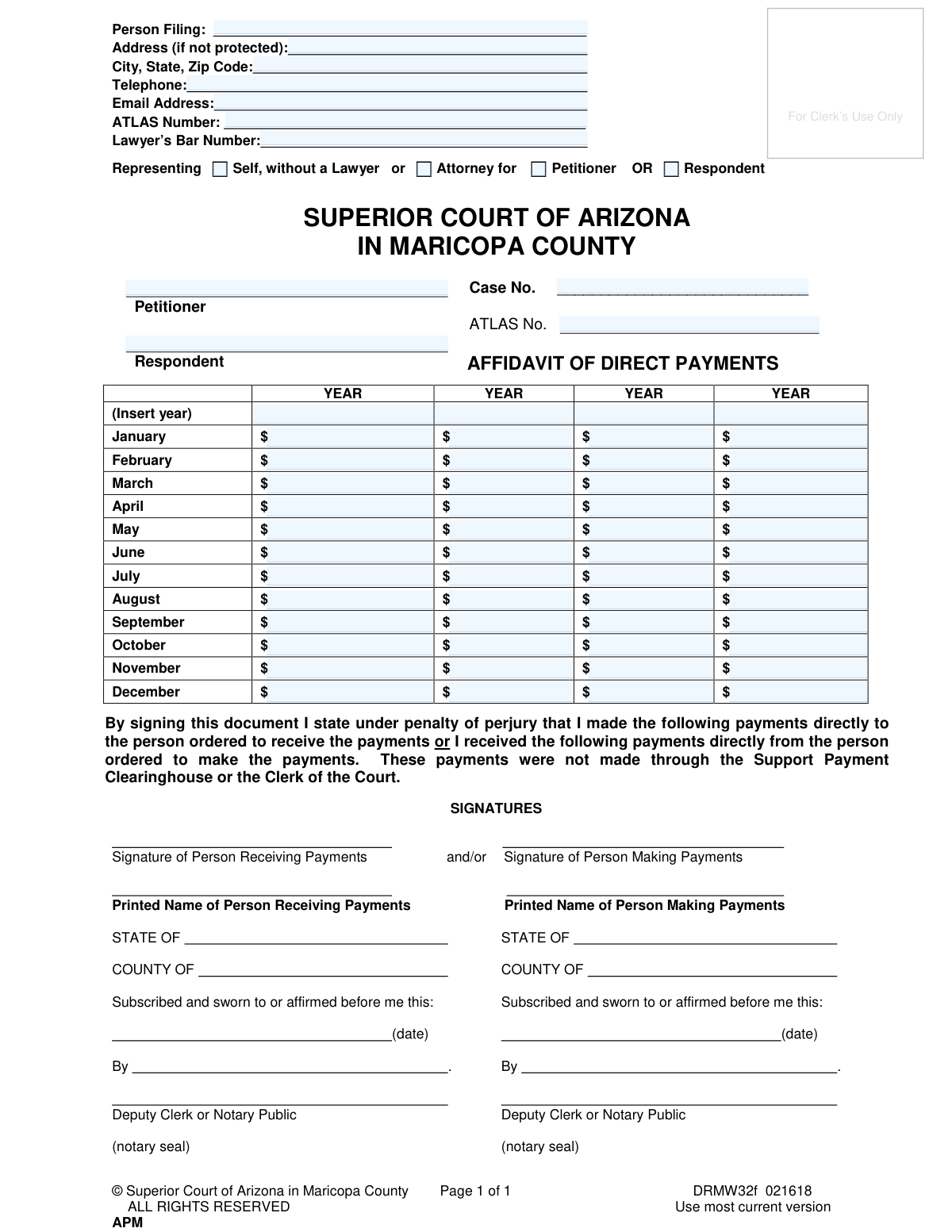
The Affidavit of Direct Payments is a sworn legal statement filed with the Superior Court of Arizona in Maricopa County to document payments, such as child or spousal support, that were exchanged directly between the involved parties instead of going through the official Support Payment Clearinghouse. This affidavit is crucial for ensuring the court has an accurate record of fulfilled financial obligations, which can prevent disputes over payment history. Today, this form can be filled out quickly and accurately using AI-powered services like Instafill.ai, which can also convert non-fillable PDF versions into interactive fillable forms.
DRMW32f is part of the County court forms and superior court forms categories on Instafill.
Our AI automatically handles information lookup, data retrieval, formatting, and form filling.
It takes less than a minute to fill out DRMW32f using our AI form filling.
Securely upload your data. Information is encrypted in transit and deleted immediately after the form is filled out.

Form specifications

Form name: Affidavit of Direct Payments (Superior Court of Arizona in Maricopa County)
Number of fields: 67
Number of pages: 1
Language: English
main-image

Instafill Demo: How to fill out PDF forms in seconds with AI

How to Fill Out DRMW32f Online for Free in 2026

Are you looking to fill out a DRMW32F form online quickly and accurately? Instafill.ai offers the #1 AI-powered PDF filling software of 2026, allowing you to complete your DRMW32F form in just 37 seconds or less.
Follow these steps to fill out your DRMW32F form online using Instafill.ai:
  1. 1 Navigate to Instafill.ai and upload the Affidavit of Direct Payments form or select it from the template library.
  2. 2 Provide your personal information, including your name, address, contact details, and case information like the ATLAS and Case numbers.
  3. 3 Use the AI assistant to accurately fill in the table of payments, specifying the amounts paid for each month across the relevant years.
  4. 4 Indicate your role in the case (Petitioner or Respondent) and whether you are the person making or receiving the payments.
  5. 5 Carefully review the entire document to ensure all payment figures, dates, and personal details are correct.
  6. 6 Download the completed affidavit. Since this document requires a sworn signature, print it to be signed in the presence of a Notary Public or Deputy Clerk.

Our AI-powered system ensures each field is filled out correctly, reducing errors and saving you time.

Why Choose Instafill.ai for Your Fillable DRMW32f Form?

Speed

Complete your DRMW32f in as little as 37 seconds.

Up-to-Date

Always use the latest 2026 DRMW32f form version.

Cost-effective

No need to hire expensive lawyers.

Accuracy

Our AI performs 10 compliance checks to ensure your form is error-free.

Security

Your personal information is protected with bank-level encryption.

Frequently Asked Questions About Form DRMW32f

This form is a sworn legal document used to officially record support payments that were made directly between parties, instead of going through the official Support Payment Clearinghouse or the Clerk of the Court.

Either the person who made the payments or the person who received them can complete this form. It is most effective when both parties sign to acknowledge the payments and avoid future disputes.

You should only use this form to document payments made directly to the other person. Do not list any payments that were processed through the official Support Payment Clearinghouse, as those are already tracked.

The ATLAS number is a unique identifier for your case within the Arizona court system. You can typically find this number on other official documents related to your case, such as the original court order.

The form provides columns for four years. If you need to document payments spanning more than four years, you will need to fill out and attach a second copy of the form.

While the form can be submitted with just one signature, it carries much more weight if both parties sign. Signatures from both individuals show the court that you both agree on the payment amounts listed.

Yes, this is a sworn affidavit and must be signed in the presence of a Notary Public or a Deputy Clerk. Each person signing the document will need their signature notarized separately.

After the form is signed and notarized, you must file it with the Clerk of the Superior Court in Maricopa County for your specific case number. This ensures the payments are officially credited to your court record.

You can still fill out, notarize, and file the affidavit with only your signature. However, you should also attach proof of the payments, such as copies of cashed checks or bank transfer records, to support your claim.

Yes, services like Instafill.ai use AI to accurately auto-fill form fields with your information, which saves time and helps prevent errors. This is useful for entering your case number, name, and address consistently.

You can use a service like Instafill.ai to upload the PDF and fill it out electronically. This allows you to type directly into the fields for a clean, legible document that you can then print for signing and notarization.

If you have a non-fillable or 'flat' PDF, you can upload it to a platform like Instafill.ai. Their technology can convert the static document into an interactive, fillable form that you can easily complete on your computer.

Filing this affidavit creates an official court record of payments made outside the state's system. This ensures you receive proper credit and helps prevent future disagreements or legal actions regarding payment arrears.

Compliance DRMW32f
Validation Checks by Instafill.ai

1
Case Number Presence and Format
This check verifies that the 'Case No.' field is not empty and conforms to the specific format used by the Superior Court of Arizona in Maricopa County. The case number is critical for associating the affidavit with the correct legal proceeding. If the format is incorrect or the field is empty, the document cannot be filed correctly, leading to processing delays or rejection.
2
Mutually Exclusive Representation Selection
Validates that the filer has selected exactly one representation status: either 'Self, without a Lawyer' OR 'Attorney for'. The system should prevent the user from selecting both options or submitting the form without selecting one. This is essential for correctly identifying the filer's legal capacity in the case.
3
Mutually Exclusive Party Selection
Ensures the filer has checked exactly one box to identify which party they are: 'Petitioner' OR 'Respondent'. Selecting both or neither would create ambiguity about the filer's role. This validation is crucial for the court to understand who is submitting the affidavit.
4
Conditional Lawyer's Bar Number
This check makes the 'Lawyer’s Bar Number' field required only if the 'Attorney for' option is selected. If 'Self, without a Lawyer' is chosen, this field should be optional or disabled. This ensures that attorneys provide their required credentials while pro se litigants are not blocked by a field that is irrelevant to them.
5
Payment Grid Year Format
Verifies that each 'YEAR' field at the top of the payment grid contains a valid, four-digit year (e.g., 2023). This prevents entry of nonsensical data like 'abc' or '23'. Maintaining a valid year format is fundamental for the affidavit's clarity and legal standing as a record of payments over time.
6
Payment Amount Numeric Format
This validation ensures that all entered payment amounts in the monthly grid are valid numeric or currency values. It should reject any text or special characters that are not part of a number (e.g., commas, decimal points). This is critical for ensuring the accuracy of financial records and any subsequent calculations or orders based on this affidavit.
7
At Least One Payment Entry Required
Checks that at least one payment amount has been entered into the payment grid. Since the purpose of the form is to declare direct payments, a completely empty grid likely indicates an incomplete form or user error. If the grid is empty, the form should be flagged for review or blocked from submission to ensure it serves its intended purpose.
8
Minimum Signature Requirement
Validates that at least one signature is provided, either from the 'Person Receiving Payments' or the 'Person Making Payments'. The form is an affidavit that requires a sworn statement from at least one of the involved parties. A submission without any signature would render the document invalid and legally unenforceable.
9
Printed Name Matches Case Party
This check cross-references the 'Printed Name of Person Receiving Payments' and 'Printed Name of Person Making Payments' against the 'Petitioner' and 'Respondent' names listed in the case caption. While not a strict match, it flags potential discrepancies where the names do not align with the known parties. This helps prevent fraudulent or erroneous filings by ensuring the signatories are the actual parties to the case.
10
Email Address Format Validation
Ensures that the value entered in the 'Email Address' field follows the standard format of a valid email address (e.g., '[email protected]'). This is important for ensuring the court and other parties have a reliable method of electronic communication with the filer. An invalid email address could lead to missed notifications and deadlines.
11
Telephone Number Format
Verifies that the 'Telephone' number is entered in a recognizable format (e.g., 10 digits, possibly with parentheses, spaces, or hyphens). This ensures the contact information is valid and usable by the court clerk or other parties if they need to contact the filer directly. An improperly formatted number could be unusable.
12
Notary Date Validity
This check confirms that the date entered in the notary block is a valid calendar date and is not a future date. An affidavit cannot be sworn to on a future date. This validation upholds the integrity of the notarization process, which is a legal requirement for an affidavit.
13
ATLAS Number Format
Validates that the 'ATLAS Number', a case management system identifier, conforms to the expected format (e.g., a specific number of digits or alphanumeric pattern). This number is a key identifier for parties within the court's system. An incorrect ATLAS number can lead to misidentification and filing errors.
14
Completeness of Filer and Party Names
Ensures that the 'Person Filing', 'Petitioner', and 'Respondent' name fields are all filled out. These names are fundamental to identifying who is filing the document and who the parties to the case are. Missing any of these names would make the document ambiguous and likely cause it to be rejected by the court clerk.

Common Mistakes in Completing DRMW32f

Signing the Affidavit Before Notarization

People often sign the document at home for convenience before taking it to a notary. However, an affidavit requires the signer to swear an oath and sign in the physical presence of the notary public. Signing beforehand invalidates the notarization, rendering the entire affidavit legally void and causing the court to reject it. To avoid this, do not sign the document until you are in front of the notary and they have administered the oath.

Listing Payments Made Through the Official Clearinghouse

This form is specifically for 'Direct Payments' not processed by the Support Payment Clearinghouse. Filers sometimes mistakenly include all payments made, regardless of the method, to create a complete record. This defeats the purpose of the affidavit, which is to credit payments the court has no official record of, leading to confusion and potential rejection of the document. Only list payments made directly from one person to the other (e.g., cash, personal check, Zelle) and exclude any payments made through the official state system.

Incorrect or Missing Case Number

The case number is the primary identifier for your court file, and transcription errors are common. Entering the wrong number, or leaving it blank, can cause your affidavit to be misfiled in another case or rejected entirely by the clerk's office. This can result in significant delays and failure to get credit for payments made. Always double-check the case number against official court documents; AI-powered tools like Instafill.ai can help by saving and accurately populating recurring information like case numbers.

Incomplete or Ambiguous Payment Grid

Filers often forget to write the corresponding year at the top of each column or leave months with no payments blank. This ambiguity can be interpreted as missing information rather than a zero-dollar payment, potentially delaying the case. To prevent this, always fill in the year for every column you use and enter '$0.00' or '0' for any month in which no direct payment was made to be explicitly clear.

Forgetting to Get the Document Notarized

An affidavit is a sworn statement, and its legal validity depends on being properly notarized. Filers sometimes submit the form after signing it but without the required notary seal and signature, not understanding its importance. An unnotarized affidavit has no legal weight and will be immediately rejected by the court, meaning the payments listed will not be officially credited. Always ensure that each signature on the document is individually acknowledged and sealed by a licensed Notary Public or Deputy Clerk.

Transposing Petitioner and Respondent Information

It is a frequent error for the person filling out the form to mix up the Petitioner (the person who initiated the case) and the Respondent. This can happen due to haste or misunderstanding of the legal terms. Incorrectly identifying the parties can cause significant confusion in the court record and may require filing a corrected affidavit. Carefully verify who is the Petitioner and Respondent from a previous court order or filing before completing this section.

Illegible Handwriting on a Printed Form

This form is often available as a non-fillable PDF, forcing individuals to print and complete it by hand. Rushed or poor handwriting can make names, numbers, and payment amounts impossible for the court clerk to read accurately. This can lead to data entry errors in the court's system or outright rejection of the form. To avoid this, use a tool like Instafill.ai that can convert flat PDFs into digitally fillable forms, ensuring all entries are clear and legible.

Missing Printed Name Below Signature

A signature can often be illegible, and filers sometimes forget to print their name clearly in the designated space below it. Without a printed name, the court clerk cannot verify the identity of the signer, which can be grounds for rejecting the document. This simple oversight can cause unnecessary delays. Always ensure you legibly print your full name in the space provided directly below your signature.

Omitting the ATLAS Number

The ATLAS number is a unique identifier used by the Arizona court system for case participants, separate from the main case number. People often leave this field blank because they don't know their number or don't understand its purpose. Omitting the ATLAS number can slow down processing as court staff may need to manually look it up. You can find your ATLAS number on previous court notices or orders; entering it correctly helps ensure your filings are processed smoothly.

Ambiguous Representation Status

The form requires the filer to specify if they are representing themselves ('Self') or are an attorney for the Petitioner or Respondent. Filers sometimes forget to check any box or, if they are an attorney, forget to also check whether they represent the Petitioner or Respondent. This ambiguity forces the court clerk to guess the filer's role, potentially leading to incorrect docket entries or rejection. Always check one box to indicate you are 'Self' or 'Attorney for,' and if an attorney, also check the box for the party you represent.
Saved over 80 hours a year

“I was never sure if my IRS forms like W-9 were filled correctly. Now, I can complete the forms accurately without any external help.”

Kevin Martin Green

Your data stays secure with advanced protection from Instafill and our subprocessors

Robust compliance program

Transparent business model

You’re not the product. You always know where your data is and what it is processed for.

ISO 27001, HIPAA, and GDPR

Our subprocesses adhere to multiple compliance standards, including but not limited to ISO 27001, HIPAA, and GDPR.

Security & privacy by design

We consider security and privacy from the initial design phase of any new service or functionality. It’s not an afterthought, it’s built-in, including support for two-factor authentication (2FA) to further protect your account.

Fill out DRMW32f with Instafill.ai

Worried about filling PDFs wrong? Instafill securely fills affidavit-of-direct-payments-superior-court-of-arizona-in-maricopa-county forms, ensuring each field is accurate.

Related forms by category

County court forms Affidavit for Service by Publication/Posting (Circuit Court of Cook County, Illinois) (CCG 0013 A/B), Petition for Leave to Proceed In Forma Pauperis (Court of Common Pleas of Lehigh County, Pennsylvania, Civil Division), Designation of Record on Appeal (Civil) (Maricopa County Justice Courts, Arizona) (Form APP 8150-702), Maricopa County Justice Courts, Motion to Set Aside / Vacate Judgment, Circuit Court of Cook County, Illinois, Form CCM 0346, Order/Trial Call, Superior Court of Chatham County, Georgia, Hearing Request Form, Form CFS 601-2, County Treasurer's and Judge's Certification of Expenditures for Care and Support of Minors Other Than Wards of the Court, Tax Court of New Jersey, County Equalization Table Complaint (CN 10339), Application for Judgment to Apply Freeze Act using County Board of Taxation figures (N.J.S.A. 54:3-26), Family Department Pleading/Motion and Order, Disclosure Statement (Superior Court of Arizona in Maricopa County), Proposed Divorce / Legal Separation Resolution Statement, Notice of Default Hearing, Superior Court of Arizona in Maricopa County, Acceptance of Service for Family Court Cases, A.R.F.L.P. Rule 40(F), Affidavit of Financial Information, Superior Court of Arizona in Maricopa County, Affidavit of Non-Compliance (Form DR41f), Affidavit Regarding Minor Children (Superior Court of Arizona in Maricopa County), Affidavit of Service with Signature Confirmation for Family Cases, Alternative Dispute Resolution Statement to the Court (A.R.F.L.P. 66(E)), Current Employer or Other Payor Information (DRS88f) · + 17 more →
superior court forms FW-003, Order on Court Fee Waiver (Superior Court), FW-003, Order on Court Fee Waiver (Superior Court), Form FW-003, Order on Court Fee Waiver (Superior Court), Declaration of Facts of Death (California Superior Court), Form FW-003-GC, Order on Court Fee Waiver (Superior Court) (Ward or Conservatee), Superior Court of Chatham County, Georgia, Hearing Request Form, Form FW-006, Request for Hearing About Court Fee Waiver Order (Superior Court), Form FW-002, Request to Waive Additional Court Fees (Superior Court), Form FW-008, Order on Court Fee Waiver After Hearing (Superior Court), Form FW-002-GC, Request to Waive Additional Court Fees (Superior Court) (Ward or Conservatee), Form REC-001(N), Notice of Intent to Destroy Superior Court Records; Offer to Transfer Possession, Form REC-001(R), Request for Transfer or Extension of Time for Retention of Superior Court Records, Notice of Hearing on Request for Transfer or Extension of Time for Retention of Superior Court Records; Court Order; Release and Receipt of Superior Court Records, Form REC-002(R), Release and Receipt of Superior Court Records, Superior Court of New Jersey, Application for Appeal and Order, Superior Court of New Jersey Dissolution (FM) Case Management Order, New Jersey Judiciary – Superior Court, Appellate Division Application for Permission to File Emergent Motion, New Jersey Judiciary Superior Court - Appellate Division Civil Case Information Statement, New Jersey Judiciary Superior Court - Appellate Division Criminal Case Information Statement, New Jersey Judiciary Superior Court - Appellate Division Notice of Appeal (CN: 10502) · + 71 more →