Yes! You can use AI to fill out Notice of Default Hearing, Superior Court of Arizona in Maricopa County
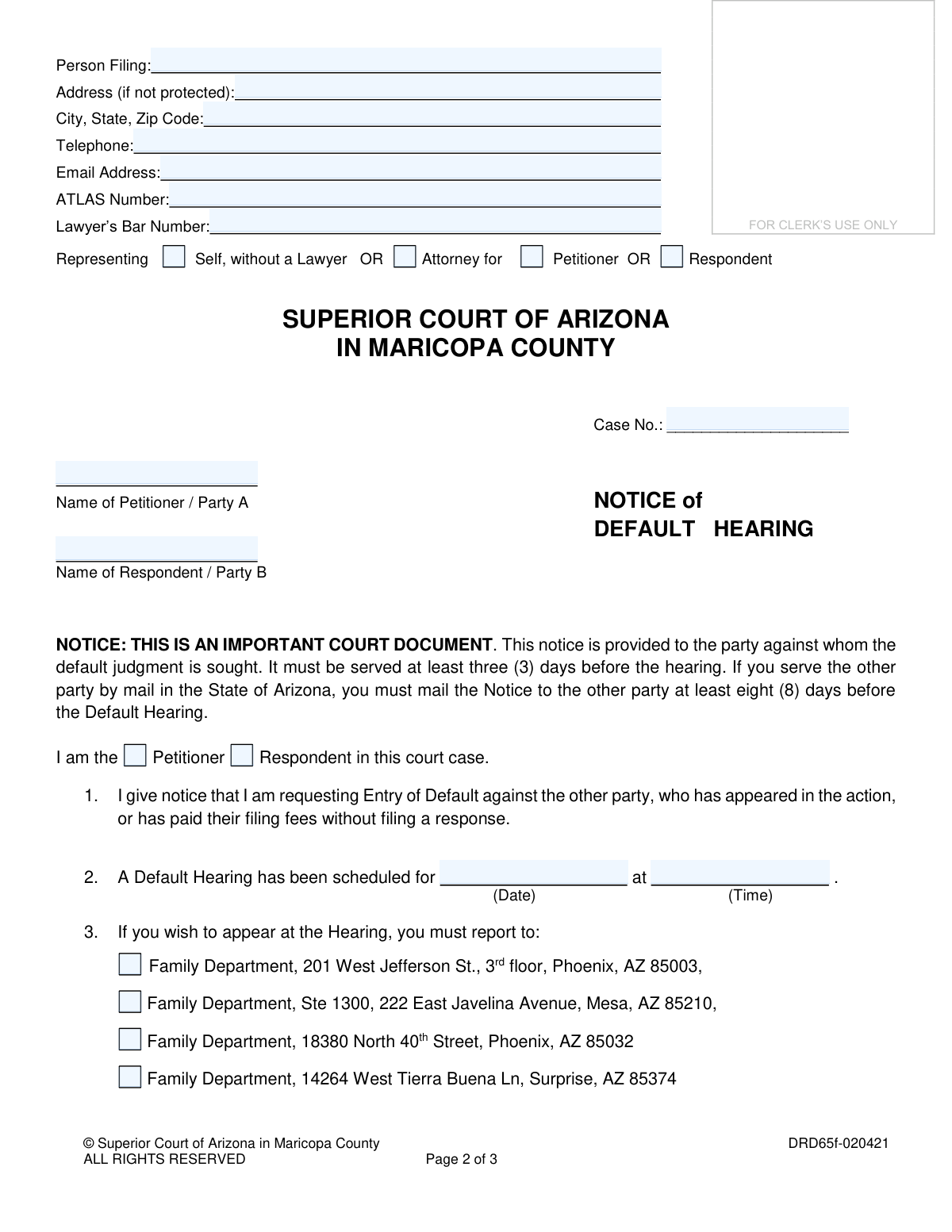
Form DRD65f, the Notice of Default Hearing, is a legal document used in Maricopa County, Arizona, to inform a party who has appeared in a case but failed to file a response that a default hearing has been scheduled. It is crucial for ensuring proper legal procedure is followed, requiring service to the other party at least three days prior to the hearing. Today, this form can be filled out quickly and accurately using AI-powered services like Instafill.ai, which can also convert non-fillable PDF versions into interactive fillable forms.
DRD65f is part of the
County court forms, family court forms, family law forms and superior court forms categories on Instafill.
Our AI automatically handles information lookup, data retrieval, formatting, and form filling.
It takes less than a minute to fill out DRD65f using our AI form filling.
Securely upload your data. Information is encrypted in transit and deleted immediately after the form is filled out.
Form specifications
| Form name: | Notice of Default Hearing, Superior Court of Arizona in Maricopa County |
| Number of fields: | 34 |
| Number of pages: | 1 |
| Language: | English |
Instafill Demo: How to fill out PDF forms in seconds with AI
How to Fill Out DRD65f Online for Free in 2026
Are you looking to fill out a DRD65F form online quickly and accurately? Instafill.ai offers the #1 AI-powered PDF filling software of 2026, allowing you to complete your DRD65F form in just 37 seconds or less.
Follow these steps to fill out your DRD65F form online using Instafill.ai:
- 1 Navigate to Instafill.ai and upload or select the Notice of Default Hearing (DRD65f) form.
- 2 Use the AI assistant to automatically populate your personal information, such as your name, address, contact details, and the case number.
- 3 Enter the specific date, time, and location of the scheduled Default Hearing as provided by the court.
- 4 Indicate your role in the case (Petitioner or Respondent) and provide the names of both parties.
- 5 Complete the 'Certificate of delivery' section by specifying the date and method of service (mail, hand-delivery, or email) used to provide the notice to the other party or their attorney.
- 6 Carefully review all the entered information for accuracy, then digitally sign and date the document.
- 7 Download the completed form to file the original with the Clerk of Superior Court and serve a copy on the other party.
Our AI-powered system ensures each field is filled out correctly, reducing errors and saving you time.
Why Choose Instafill.ai for Your Fillable DRD65f Form?
Speed
Complete your DRD65f in as little as 37 seconds.
Up-to-Date
Always use the latest 2026 DRD65f form version.
Cost-effective
No need to hire expensive lawyers.
Accuracy
Our AI performs 10 compliance checks to ensure your form is error-free.
Security
Your personal information is protected with bank-level encryption.
Frequently Asked Questions About Form DRD65f
This form is used to officially notify the other party in your case that you have scheduled a default hearing. It is required when the other party has appeared in the case or paid filing fees but has not filed a necessary response.
The person who requested the default hearing, whether they are the Petitioner or the Respondent, must complete, serve, and file this form to provide notice to the other party.
You should use this form after you have successfully scheduled a default hearing with the court. It must be used if the other party has already made an appearance in the case or paid their filing fees.
You will need an original and two copies. The original is for the Clerk of the Superior Court, one copy is to be served on the other party, and the final copy is for your personal records.
You must serve the notice at least three days before the hearing. However, if you are serving by mail within Arizona, you must send it at least eight days before the hearing date.
You can mail the notice, hand-deliver it, leave it at the other party's residence, or email it if they have consented to email service in writing. You must certify the method of service on the form.
If the other party is represented by an attorney, you are required to serve the notice on the attorney directly, not on the party themselves, unless the court has ordered otherwise.
You must file the original, signed form with the Clerk of the Superior Court at one of the locations listed on the form, such as the courthouses in Phoenix, Mesa, or Surprise.
You will need the case number, the names of the petitioner and respondent, your contact information, and the specific date, time, and location of the scheduled default hearing.
This section is your sworn statement to the court confirming how and when you sent a copy of the notice to the other party or their attorney. You must complete this section before filing the form.
Yes, services like Instafill.ai use AI to help you accurately auto-fill form fields with your case and personal information, which can save time and reduce errors.
You can upload the Notice of Default Hearing PDF to the Instafill.ai platform. The service will make the form fillable online, allowing you to type your information once and have it automatically populate all the correct fields.
If you have a non-fillable PDF, you can use a service like Instafill.ai. It can convert flat PDFs into interactive, fillable forms so you can easily type your information online before printing.
Compliance DRD65f
Validation Checks by Instafill.ai
1
Case Number Presence and Format
This check ensures the 'Case No.' field is not empty and conforms to the Maricopa County Superior Court's expected format. The case number is the primary identifier for the legal proceeding, and its absence or incorrect format would make it impossible to file the document correctly. If validation fails, the user should be prompted to enter a valid case number before submission.
2
Filer Representation and Bar Number Logic
This validation verifies that if the 'Attorney for' option is selected, the 'Lawyer’s Bar Number' field is filled out. Conversely, if 'Self, without a Lawyer' is selected, the bar number field should be empty. This is important for correctly identifying the filer's legal representation status. A failure would trigger a message requiring the bar number or clearing it, depending on the selection.
3
Party Names Completeness
This check confirms that both the 'Name of Petitioner / Party A' and 'Name of Respondent / Party B' fields are completed. These names are fundamental to the legal notice, as they identify the specific individuals involved in the case. Failure to provide both names would render the notice legally insufficient and should prevent form submission.
4
Filer Role Consistency
This validation ensures the filer's role is consistent across the form. The selection under 'Representing' (Petitioner or Respondent) must match the selection in the body of the notice ('I am the Petitioner / Respondent'). This consistency is crucial for legal clarity and prevents ambiguity about who is filing the notice. A mismatch should trigger an error requiring the user to align the selections.
5
Hearing Date is a Future Date
This check validates that the 'Default Hearing Date' entered is a valid date that occurs in the future. A hearing cannot be scheduled for a past or current date. This is critical for providing proper legal notice of a future event. If the date is in the past, the system should display an error and require the user to enter a valid future date.
6
Hearing Time Format
This validation ensures the 'Default Hearing Time' is entered in a proper time format (e.g., HH:MM AM/PM). The time is a required component for the hearing notice, and an invalid or missing time would make the notice defective. The system should reject improperly formatted time entries and guide the user to correct them.
7
Hearing Location Selection
This check verifies that at least one of the four 'Family Department' court location checkboxes is selected. The other party must be officially notified of the exact location of the hearing. If no location is selected, the form submission should be blocked until the user chooses the appropriate courthouse.
8
Service Date and Hearing Date Interval
This validation enforces the legal requirement that the notice is served at least three days before the hearing. It calculates the difference between the 'On this date' of service (from section 6) and the 'Default Hearing Date'. If the interval is less than three days (or eight for mail), the submission should be flagged with a warning or error, as it violates procedural rules and could invalidate the hearing.
9
Service Date is Not in the Future
This check ensures the 'On this date:' of service in section 6 is the current date or a date in the past. The form certifies that service has already been completed, so a future date is logically impossible. An invalid entry would prompt the user to enter the actual date the service was performed.
10
Exclusive Service Method Selection
This validation ensures that exactly one method of service ('Mailed', 'Delivered by', or 'Emailed') is selected in section 6. Selecting none or more than one creates ambiguity about how the notice was served. The system should require the user to select one and only one option to proceed.
11
Conditional Delivery Person Name
This check is dependent on the service method. If the 'Delivered by' option is selected, this validation ensures that the name of the person who performed the delivery is provided in the corresponding field. This information is required for a complete and verifiable record of personal service. The field should be marked as required only when this delivery method is chosen.
12
Email Address Format Validation
This check verifies that any entry in the 'Email Address' field follows the standard format of a valid email address (e.g., '[email protected]'). While not always mandatory, a correctly formatted email is essential for electronic communication and service. An invalid format should trigger a correction prompt to ensure contact information is usable.
13
Service Certification Selection
This validation ensures that one of the two checkboxes in section 5 is selected, indicating whether the notice was served on the other party directly or on their attorney. This certification is a required declaration under penalty of perjury and is essential for the notice's validity. The form should not be submittable until one of these options is checked.
14
Signature Role Match
This check confirms that the signature selection ('Party A' or 'Party B') corresponds to the filer's role as Petitioner or Respondent. If the filer identified as the Petitioner (Party A), they must sign as Party A. This ensures the signature correctly attests to the identity of the person submitting the document.
Common Mistakes in Completing DRD65f
Users often forget to enter the case number or transcribe it incorrectly from other court documents. This form requires the case number in two separate places, and failing to include it or providing a mismatched number will cause the Clerk of Court to reject the filing. This prevents the notice from being associated with the correct case file, leading to significant delays. To avoid this, double-check the case number on existing court documents and enter it carefully in all required fields.
A frequent and critical error is swapping the names of the Petitioner (the party who initiated the case) and the Respondent. This mistake creates significant confusion in the court record and can invalidate the notice, as it misidentifies the parties involved in the hearing. The consequences can include the dismissal of the notice and the need to re-file and re-serve, wasting time and money. Always verify the original petition to confirm who is the Petitioner and who is the Respondent before filling out the form.
The form has strict and different deadlines for service: at least three days before the hearing for hand-delivery, but at least eight days if serving by mail within Arizona. People often miscalculate these dates or fail to account for the longer period required for mail service. Improper or late service will render the notice invalid, forcing the hearing to be canceled and requiring the filer to restart the notification process. It is crucial to carefully calculate the date and serve the document well ahead of the deadline.
In Section 3, the form lists four different courthouse addresses for the Family Department, but filers must select the specific one where their hearing is scheduled. Many people overlook this and fail to check the correct box, leaving the other party without clear instructions on where to appear. This makes the notice defective and can be grounds for the other party to claim they were not properly notified, potentially leading to the default judgment being overturned later. Always confirm the hearing location from the court's scheduling notice and check the corresponding box.
Section 5 requires the filer to certify whether they served the other party directly or the party's attorney. The instructions explicitly state that if the other party is represented, service *must* be made on the attorney. Filers who are unaware of this rule may serve the party directly and check the wrong box, which constitutes improper service. This is a serious procedural error that can invalidate the hearing and require the entire process to be repeated.
Section 6, the 'Certificate of delivery,' is the filer's proof of service, but it is often filled out incompletely. Common errors include forgetting to enter the date of service, failing to check the method used (mail, delivery, email), or omitting the name of the person who delivered the notice. An incomplete certificate can lead the court to deem service as unproven, causing the filing to be rejected or the hearing to be postponed until proper proof is provided.
The form requires the filer to identify themselves as either the 'Petitioner' or 'Respondent' at the beginning of the main section. In the stress of legal proceedings, individuals sometimes get confused about their official designation and circle the wrong one. This creates ambiguity and can lead to the notice being questioned or rejected for being unclear. It is essential to confirm your role from the initial case filings before completing this section.
A simple data entry error in Section 2, such as writing the wrong date or time for the default hearing, has severe consequences. It provides the other party with incorrect information, which will almost certainly lead to them missing the hearing. If a default is granted based on a notice with the wrong date or time, it is highly likely to be set aside later, forcing the filer to start over. AI-powered form-filling tools like Instafill.ai can help prevent such errors by validating data formats and ensuring consistency.
The instructions clearly state to file the 'original Notice' with the Clerk of Superior Court. However, filers sometimes get their papers mixed up and accidentally submit a photocopy while keeping the original, or worse, serve the original on the other party. The Clerk's office will not accept a copy for an original filing, leading to immediate rejection and a delay in the legal process. Since this form is a non-fillable PDF, tools like Instafill.ai can convert it into a fillable version, making it easier to manage and print clean originals.
In the top section, the filer must check a box to indicate if they are representing themselves ('Self, without a Lawyer') or if they are an attorney representing the Petitioner or Respondent. Overlooking this small but important detail can cause the filing to be flagged for correction by the clerk. This creates unnecessary administrative friction and can delay the processing of the notice. Ensuring every single checkbox is correctly filled is crucial for a smooth filing.
Saved over 80 hours a year
“I was never sure if my IRS forms like W-9 were filled correctly. Now, I can complete the forms accurately without any external help.”
Kevin Martin Green
Your data stays secure with advanced protection from Instafill and our subprocessors

Robust compliance program
Transparent business model
You’re not the product. You always know where your data is and what it is processed for.
ISO 27001, HIPAA, and GDPR
Our subprocesses adhere to multiple compliance standards, including but not limited to ISO 27001, HIPAA, and GDPR.
Security & privacy by design
We consider security and privacy from the initial design phase of any new service or functionality. It’s not an afterthought, it’s built-in, including support for two-factor authentication (2FA) to further protect your account.
Fill out DRD65f with Instafill.ai
Worried about filling PDFs wrong? Instafill securely fills notice-of-default-hearing-superior-court-of-arizona-in-maricopa-county forms, ensuring each field is accurate.