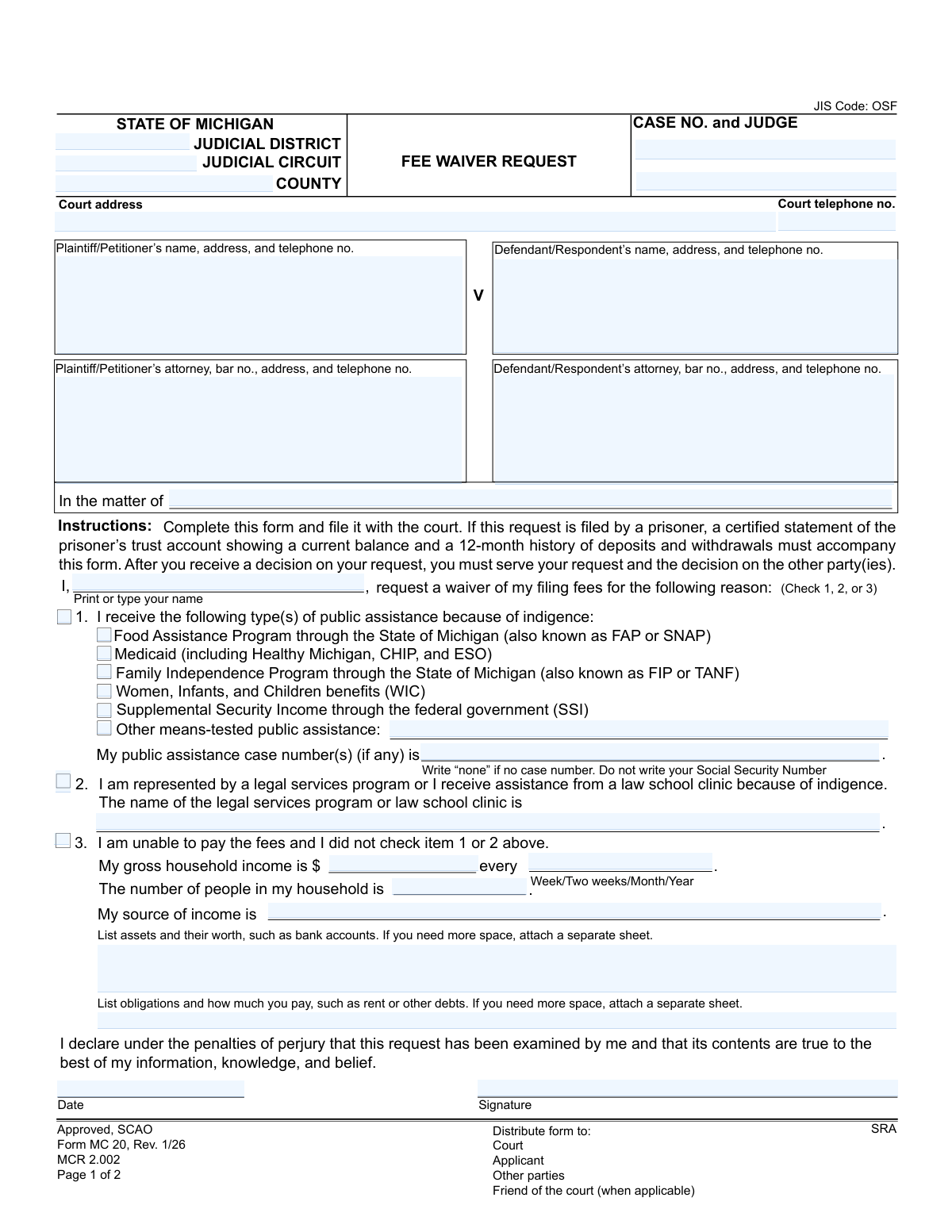
Yes! You can use AI to fill out Form MC 20, Fee Waiver Request
Form MC 20, Fee Waiver Request, is a legal document submitted to a Michigan court by individuals who cannot afford to pay required court filing fees. By demonstrating financial hardship through public assistance, legal aid representation, or low income, a person can request that the court waive these costs, ensuring access to the justice system. Today, this form can be filled out quickly and accurately using AI-powered services like Instafill.ai, which can also convert non-fillable PDF versions into interactive fillable forms.
Our AI automatically handles information lookup, data retrieval, formatting, and form filling.
It takes less than a minute to fill out MC 20 using our AI form filling.
Securely upload your data. Information is encrypted in transit and deleted immediately after the form is filled out.
Form specifications
| Form name: | Form MC 20, Fee Waiver Request |
| Number of fields: | 44 |
| Number of pages: | 1 |
| Language: | English |
More forms in Fee waiver forms
Instafill Demo: How to fill out PDF forms in seconds with AI
How to Fill Out MC 20 Online for Free in 2026
Are you looking to fill out a MC 20 form online quickly and accurately? Instafill.ai offers the #1 AI-powered PDF filling software of 2026, allowing you to complete your MC 20 form in just 37 seconds or less.
Follow these steps to fill out your MC 20 form online using Instafill.ai:
- 1 Navigate to Instafill.ai and upload the MC 20 Fee Waiver Request form or select it from their template library.
- 2 Provide your personal details, case information, and court details (e.g., plaintiff/defendant names, case number, court address).
- 3 Select the basis for your request: receipt of public assistance, representation by a legal services program, or general inability to pay.
- 4 If applicable, enter the details of your public assistance (like FAP, Medicaid, SSI) and case number, or the name of your legal services provider.
- 5 If claiming general inability to pay, input your gross household income, household size, sources of income, assets, and financial obligations.
- 6 Review all the information auto-filled by the AI for accuracy, then e-sign and date the declaration under penalty of perjury.
- 7 Download the completed form to file with the appropriate Michigan court and serve on other parties as required.
Our AI-powered system ensures each field is filled out correctly, reducing errors and saving you time.
Why Choose Instafill.ai for Your Fillable MC 20 Form?
Speed
Complete your MC 20 in as little as 37 seconds.
Up-to-Date
Always use the latest 2026 MC 20 form version.
Cost-effective
No need to hire expensive lawyers.
Accuracy
Our AI performs 10 compliance checks to ensure your form is error-free.
Security
Your personal information is protected with bank-level encryption.
Frequently Asked Questions About Form MC 20
This form is used to ask a Michigan court to waive your filing fees because you cannot afford to pay them. If your request is approved, you can proceed with your court case without paying the required fees upfront.
Anyone involved in a Michigan court case who believes they cannot afford to pay court filing fees can fill out this form. You may qualify if you receive public assistance, are represented by legal aid, or if your income is too low to cover the fees.
You can qualify by checking one of three options: showing you receive public assistance (like SNAP or Medicaid), stating you are represented by a legal services program due to indigence, or providing details about your low household income, assets, and debts.
Generally, you do not need to attach proof of your income or benefits unless the court specifically requests it. However, if you are a prisoner, you must attach a certified statement of your trust account.
Yes, if you are a prisoner filing this request, you must include a certified statement of your prisoner’s trust account. This statement must show your current balance and a 12-month history of all deposits and withdrawals.
You must file the completed form with the clerk of the court where your case is being heard. It should be submitted along with your other initial court documents.
A court clerk or judge will review your request and issue a decision to approve or deny it. You are then responsible for serving a copy of your request and the court's decision on the other party in your case.
If your request is denied, you have 14 days from the issue date on the notice to either pay the filing fees or file a 'Request for Review of Denied Fee Waiver' (form MC 114) with the court.
If you become able to pay the fees before your case is resolved, you are required to notify the court of your change in circumstances.
The form's instructions state that if you do not have a case number, you should write 'none' in that space. You should never write your Social Security Number on the form.
Under option 3, you must list your gross household income, how many people are in your household, and your sources of income. You also need to list your assets (like bank accounts) and obligations (like rent or other debts).
Yes, services like Instafill.ai use AI to help you accurately auto-fill form fields, which can save you time and help avoid common errors. This is especially useful for filling in repetitive case and personal information.
Simply upload the MC 20 form to the Instafill.ai platform. The AI will identify the fields, allowing you to provide your information once to have it automatically and accurately placed throughout the document.
If you have a non-fillable or 'flat' PDF, you can use a service like Instafill.ai. It can convert the non-fillable PDF into an interactive, fillable form that you can easily complete on your computer.
Compliance MC 20
Validation Checks by Instafill.ai
1
Exclusive Reason for Waiver Selection
This check ensures that the applicant selects only one of the three primary reasons for requesting a fee waiver (Public Assistance, Legal Services Representation, or General Inability to Pay). The form's structure implies these are mutually exclusive choices for justification. If more than one option is selected, the submission should be flagged for user correction to ensure a clear and singular basis for the court's review.
2
Public Assistance Type Specification
If the applicant indicates they receive public assistance (Option 1), this validation confirms that at least one specific program (e.g., FAP, Medicaid, WIC) is checked. This detail is essential for the court to verify eligibility under this criterion. A submission without a specified program would be considered incomplete and could not be properly evaluated.
3
Assistance Case Number Presence and Content
This validation verifies that the 'public assistance case number(s)' field is filled if Option 1 is chosen, and critically, that it does not contain a Social Security Number. The form explicitly allows 'none' as an entry, but the field cannot be left blank. This check prevents the disclosure of sensitive information and ensures the application is complete for verification purposes.
4
Legal Services Program Name Requirement
When an applicant selects Option 2, claiming representation by a legal services program, this check ensures the 'name of the legal services program or law school clinic' field is filled. This information is mandatory for the court to confirm the applicant's representation and basis for indigence. An empty field would render the claim under Option 2 invalid.
5
Gross Household Income Validation for Option 3
This check validates that if Option 3 ('I am unable to pay') is selected, the 'My Gross Household Income' field contains a valid, non-negative numeric value. This figure is the primary data point for calculating financial hardship against federal poverty guidelines. A missing, non-numeric, or negative value would prevent the court from making a determination and result in rejection.
6
Income Frequency Selection for Option 3
When an income amount is provided under Option 3, this validation ensures that one of the corresponding frequency options (Week, Two weeks, Month, or Year) is selected. This context is critical for standardizing the income data for an accurate poverty guideline comparison. An income amount without a specified frequency is ambiguous and makes the financial assessment impossible.
7
Household Size Validation for Option 3
This check ensures the 'number of people in my household' field contains a positive integer (1 or greater) when Option 3 is chosen. Household size is a key variable in determining the applicable federal poverty level for the applicant. An invalid, zero, or missing number would halt the eligibility calculation and make the application incomplete.
8
Source of Income Requirement for Option 3
This validation verifies that the 'My source of income is' field is completed if the applicant is proceeding under Option 3. This information provides necessary context to the stated income, helping the court understand the applicant's financial stability. An empty field represents an incomplete financial disclosure and may lead to the request being denied.
9
Case Number Format and Presence
This check validates that the 'CASE NO.' field is filled and conforms to the expected format for the specified court. A valid case number is essential for associating the fee waiver request with the correct court file. An incorrect or missing case number would cause significant processing delays and could lead to the document being rejected or misfiled.
10
Declaration Date Validity
This validation ensures the 'Date' field next to the applicant's signature contains a valid, properly formatted date that is not in the future. The date of signature legally establishes when the applicant attested to the truthfulness of the form's contents. An invalid or future date would compromise the legal validity of the declaration.
11
Printed Name Requirement
This check ensures the 'Print or type your name' field is filled out. This provides a clear, legible identification of the applicant, which is crucial for official court records, especially if the signature is difficult to read. A missing printed name can cause administrative delays or rejection of the form.
12
Prisoner Trust Account Statement Verification
This validation checks if the applicant is a prisoner and, if so, confirms that the required certified statement of their trust account is attached. The form explicitly mandates this documentation for incarcerated individuals to prove indigence. Failure to include this required attachment would result in an incomplete filing and likely denial of the fee waiver request.
13
Conditional Requirement for 'Other' Public Assistance
This check ensures that if the 'Other means-tested public assistance' checkbox is selected under Option 1, the corresponding text field is filled with a description. This provides the necessary detail for the court to evaluate a non-standard assistance program. An empty description field would render this specific selection incomplete and invalid.
14
Court Telephone Number Format
This validation checks that the 'Court telephone no.' field contains a number in a valid phone number format (e.g., XXX-XXX-XXXX). While this is pre-filled or court-entered data, ensuring its integrity within the system is important for data quality and any automated processes. An improperly formatted number could cause data parsing errors or issues with record management.
Common Mistakes in Completing MC 20
Applicants often leave the top section with court details like the Judicial District/Circuit and Case Number blank, assuming the clerk will fill it in. This is a critical error because without a case number, the fee waiver cannot be linked to the correct legal proceeding, causing significant processing delays or rejection. To avoid this, always fill in all known case information; if filing with a new complaint where a number isn't assigned yet, write 'To be assigned'.
The form requires the applicant to check one of the three main options to establish their reason for needing a fee waiver. Some applicants, in their haste, fill out personal details but forget to check box 1, 2, or 3. This makes the application invalid from the start, resulting in an automatic denial and forcing the applicant to refile, which delays their case.
When completing option 3, a frequent mistake is stating the 'Gross household income' amount without specifying the pay period (Week/Two weeks/Month/Year). An income figure of '$2,000' is meaningless without this context, making it impossible for the court to assess financial hardship and leading to denial. It is crucial to provide both the amount and the frequency to present a clear financial picture.
Applicants who qualify under option 1 by receiving public assistance often check the relevant program box but forget to write in their corresponding case number. The form requires this number for verification, and its absence can lead to delays or denial. The form explicitly states to write 'none' if no case number exists, so leaving the field blank is a common and avoidable mistake.
An unsigned or undated form is legally invalid. Applicants may carefully complete all financial details but overlook the signature and date line at the bottom of the first page. This simple oversight means the declaration under penalty of perjury is not affirmed, invalidating the entire request and forcing a refiling.
Under option 3, the court requires a complete financial picture, including assets (e.g., bank accounts) and obligations (e.g., rent, debts). Applicants often provide vague answers or leave these sections blank, perhaps due to privacy concerns or underestimating their importance. This lack of detail prevents the court from properly evaluating financial hardship and is a common reason for denial.
The form has a very specific, non-negotiable requirement for incarcerated individuals, stated clearly at the top: a certified statement of the prisoner's trust account must be attached. Prisoners who fail to include this mandatory documentation with their request will have their fee waiver denied for being incomplete. This is a critical step that is easily missed if the top instructions are not read carefully.
The form explicitly warns, 'Do not write your Social Security Number,' yet applicants sometimes mistakenly enter it in the 'public assistance case number(s)' field. This happens out of habit or confusion about which number is required. Submitting a SSN on a public court document creates a significant privacy risk and fails to provide the verification number the court actually needs.
Applicants may get confused about what constitutes 'gross household income' or who is included in the 'household.' They might report net (after-tax) income instead of gross (pre-tax) income, or only include their own income when other working adults live in the home. This can lead to an inaccurate financial picture and a potential denial if the court discovers the discrepancy.
The instructions at the very top state, 'After you receive a decision on your request, you must serve your request and the decision on the other party(ies).' Many applicants miss this final step, believing the process is over once the judge signs the order. Failing to properly notify the other parties can cause procedural problems and delays later in the case. It is the applicant's responsibility to ensure all parties are served.
Saved over 80 hours a year
“I was never sure if my IRS forms like W-9 were filled correctly. Now, I can complete the forms accurately without any external help.”
Kevin Martin Green
Your data stays secure with advanced protection from Instafill and our subprocessors

Robust compliance program
Transparent business model
You’re not the product. You always know where your data is and what it is processed for.
ISO 27001, HIPAA, and GDPR
Our subprocesses adhere to multiple compliance standards, including but not limited to ISO 27001, HIPAA, and GDPR.
Security & privacy by design
We consider security and privacy from the initial design phase of any new service or functionality. It’s not an afterthought, it’s built-in, including support for two-factor authentication (2FA) to further protect your account.
Fill out MC 20 with Instafill.ai
Worried about filling PDFs wrong? Instafill securely fills form-mc-20-fee-waiver-request forms, ensuring each field is accurate.