Yes! You can use AI to fill out Form FW-020, Request for Court Reporter by Party with Fee Waiver
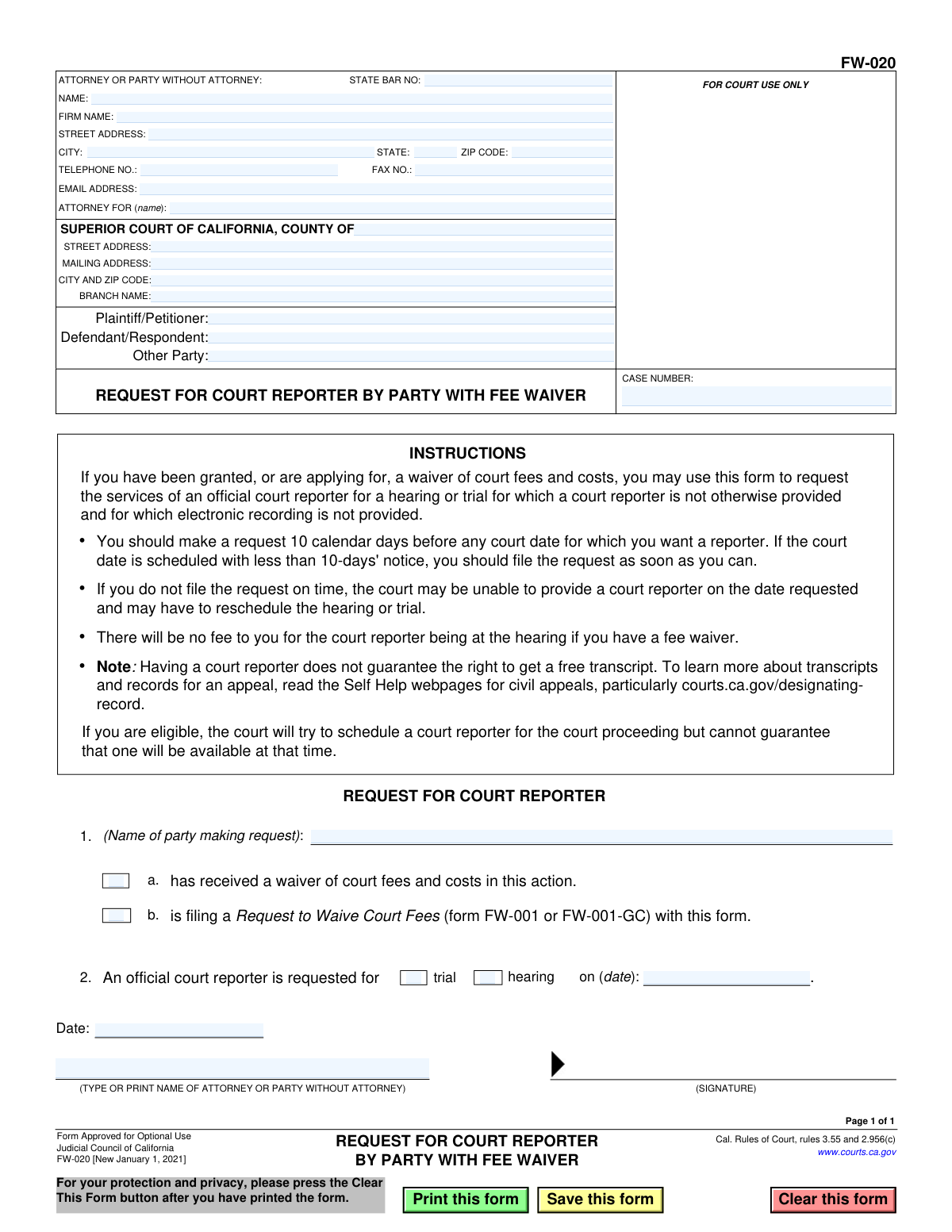
Form FW-020, Request for Court Reporter by Party with Fee Waiver, is a legal document used in California Superior Courts. It allows individuals who have been granted a waiver of court fees to formally request the services of a court reporter for a proceeding where one is not automatically provided, ensuring an official record is created. Today, this form can be filled out quickly and accurately using AI-powered services like Instafill.ai, which can also convert non-fillable PDF versions into interactive fillable forms.
Our AI automatically handles information lookup, data retrieval, formatting, and form filling.
It takes less than a minute to fill out FW-020 using our AI form filling.
Securely upload your data. Information is encrypted in transit and deleted immediately after the form is filled out.
Form specifications
| Form name: | Form FW-020, Request for Court Reporter by Party with Fee Waiver |
| Number of fields: | 32 |
| Number of pages: | 1 |
| Language: | English |
Instafill Demo: How to fill out PDF forms in seconds with AI
How to Fill Out FW-020 Online for Free in 2026
Are you looking to fill out a FW-020 form online quickly and accurately? Instafill.ai offers the #1 AI-powered PDF filling software of 2026, allowing you to complete your FW-020 form in just 37 seconds or less.
Follow these steps to fill out your FW-020 form online using Instafill.ai:
- 1 Navigate to Instafill.ai and upload or select the FW-020 form from the document library.
- 2 Provide your personal and case information, including your name, contact details, case number, and the court's name and address.
- 3 Enter the names of the parties involved in the case (Plaintiff/Petitioner, Defendant/Respondent, etc.).
- 4 In Section 1, indicate your name and check the box that corresponds to your fee waiver status (either already granted or being filed with this request).
- 5 In Section 2, specify whether the reporter is for a trial or a hearing and enter the scheduled date.
- 6 Review all the information auto-filled by the AI for accuracy and completeness.
- 7 Electronically sign and date the form, then download the completed document to file with the court.
Our AI-powered system ensures each field is filled out correctly, reducing errors and saving you time.
Why Choose Instafill.ai for Your Fillable FW-020 Form?
Speed
Complete your FW-020 in as little as 37 seconds.
Up-to-Date
Always use the latest 2026 FW-020 form version.
Cost-effective
No need to hire expensive lawyers.
Accuracy
Our AI performs 10 compliance checks to ensure your form is error-free.
Security
Your personal information is protected with bank-level encryption.
Frequently Asked Questions About Form FW-020
This form is used to request an official court reporter for a hearing or trial if you have a court fee waiver. It is intended for proceedings where a reporter is not automatically provided by the court.
You are eligible to file this form if you have already been granted a waiver of court fees and costs, or if you are submitting a Request to Waive Court Fees (form FW-001) at the same time.
Yes, you should file this form at least 10 calendar days before the court date. If your hearing was scheduled with less notice, you should file the request as soon as possible.
If you don't file the request on time, the court may be unable to provide a court reporter for your hearing. This could lead to your hearing or trial being rescheduled.
No, there will be no fee for the court reporter's presence at the hearing or trial if you have an approved fee waiver.
No, having a court reporter present does not guarantee you a free transcript. Obtaining a transcript, especially for an appeal, is a separate process and may involve a fee.
No, it is not guaranteed. The court will try to schedule a court reporter for your proceeding but cannot promise that one will be available at that specific time.
You will need your case number, court information, and the names of all parties involved. You must also provide your name, address, and contact information, or that of your attorney.
In Section 1, check box 'a' if you have an existing fee waiver, or check box 'b' if you are filing a fee waiver request (Form FW-001) along with this form.
You must file the completed form with the Superior Court where your case is being heard, as indicated in the court information section at the top of the form.
Yes, in Section 2 of the form, you can specify whether you are requesting a court reporter for a trial or a hearing and provide the specific date.
Yes, services like Instafill.ai use AI to auto-fill form fields accurately and save time. This can help you complete the form quickly and reduce the chance of errors.
You can use a service like Instafill.ai to upload the PDF and fill it out on your computer. The platform allows you to type directly into the fields, sign electronically, and download the completed form for filing.
If you have a non-fillable or 'flat' PDF, you can use a tool like Instafill.ai. It can convert the document into an interactive, fillable form that you can easily complete online.
Compliance FW-020
Validation Checks by Instafill.ai
1
Mandatory Case Number
This check ensures that the 'CASE NUMBER' field is not empty. The case number is the primary identifier for the legal action and is essential for associating this request with the correct file in the court's system. If this field is missing, the form cannot be processed or filed, leading to its rejection.
2
Fee Waiver Status Selection Logic
Validates that exactly one of the two checkboxes in section 1 is selected, indicating whether the party 'has received a waiver' or 'is filing a Request to Waive Court Fees' concurrently. This status is the basis for the request, and selecting none or both options creates an ambiguity that prevents the court from determining eligibility. An invalid selection will require the filer to correct the form.
3
Proceeding Type Selection
Ensures that at least one checkbox in section 2, for either 'trial' or 'hearing,' is selected. The form's purpose is to request a reporter for a specific type of court proceeding. Failure to specify the proceeding type makes the request incomplete and action cannot be taken by the court clerk.
4
Valid and Future Hearing/Trial Date
This validation confirms that the date provided in section 2 is a valid, fully-formed date (e.g., MM/DD/YYYY) and that the date is in the future. A past or invalid date makes the request nonsensical and impossible to fulfill. The system should flag this for correction, as the court cannot schedule a reporter for a date that has already passed.
5
Requesting Party Name Presence
Verifies that the name of the party making the request is filled in section 1. This field identifies the individual or entity on whose behalf the request is made. Without this information, the court does not know who is seeking the court reporter, making the request invalid.
6
Signature Name Presence
Checks that the 'TYPE OR PRINT NAME' field accompanying the signature line is completed. This printed name serves to legibly identify the signatory, whether they are the party themselves or their attorney. An empty printed name field can invalidate the signature and the legal standing of the document.
7
Signature Name Consistency
This check compares the printed name in the signature block with the 'ATTORNEY OR PARTY WITHOUT ATTORNEY' name at the top of the form. These names should match to ensure the person signing the form is the same person identified as the filer. A mismatch could indicate a potential error or unauthorized filing, requiring clarification.
8
Valid Signature Date
Ensures the 'Date' field in the signature block contains a valid date and is not a future date. The signature date authenticates when the document was signed. A future date is logically impossible and would invalidate the signature's legal timing, likely causing the form to be rejected until corrected.
9
Filer Contact Information Completeness
Verifies that if a name is provided in the 'ATTORNEY OR PARTY WITHOUT ATTORNEY' field, then the associated address (Street, City, State, Zip) and telephone number fields are also filled. This contact information is critical for the court to communicate with the filer regarding the request's status or any issues. Incomplete information can lead to processing delays or inability to schedule the reporter.
10
Email Address Format
If an email address is provided in the 'EMAIL ADDRESS' field, this validation checks that it follows a standard format (e.g., '[email protected]'). This ensures that if the court uses email for communication, its messages will be deliverable. An invalid format would lead to communication failures.
11
Court County Identification
This check ensures the 'COUNTY OF' field is filled out to specify the Superior Court's location. This is a critical piece of information for routing the document to the correct court jurisdiction and branch. A missing county name will result in the form being rejected as it cannot be directed to the proper venue.
12
Party Identification in Caption
Validates that at least one of the primary party fields ('Plaintiff/Petitioner' or 'Defendant/Respondent') is filled. This information is necessary to correctly identify the case and the parties involved. A form lacking this basic case information is incomplete and cannot be accurately filed.
13
State Bar Number Format
If a value is entered into the 'STATE BAR NO' field, this check validates that it is a numeric value. California State Bar numbers are numeric, and this check prevents data entry errors like including text or symbols. This ensures the attorney can be correctly identified in the state's official records.
Common Mistakes in Completing FW-020
This is one of the most frequent and critical errors. Filers may forget to include the case number or make a typo, often because they are rushing or don't have the case file readily available. Without the correct case number, the court clerk cannot link the request to the proper case file, leading to rejection of the form and significant delays. To avoid this, always double-check the case number against official court documents before submitting.
Individuals representing themselves (pro se litigants) often get confused by this section, either leaving it blank or only partially completing it. They must enter their own full name, address, and contact information here. Failure to provide complete and accurate information can prevent the court from sending important notices, potentially causing the filer to miss critical updates or even the hearing itself.
Users frequently check the wrong box regarding their fee waiver status. They might check box 1a (waiver already granted) when they are actually submitting the waiver application concurrently, which requires checking box 1b. This discrepancy forces the court clerk to manually verify status, causing processing delays or rejection if the status cannot be confirmed. It's crucial to select the box that accurately reflects your current situation.
If a party checks box 1b, indicating they are filing a 'Request to Waive Court Fees' with this form, they often forget to actually include the required FW-001 form. This makes the submission incomplete and guarantees its rejection. The court cannot process the request for a court reporter without a valid, accompanying fee waiver application. Always ensure all referenced documents are attached before filing.
An unsigned legal document is invalid and will be rejected by the court clerk immediately. Similarly, omitting the date can cause issues, as the form explicitly recommends filing at least 10 days before the court date. This mistake often happens in haste. To prevent this, make signing and dating the form the final step in your review process before submission.
Filers may list the wrong county, branch name, or address for the court, especially if they have cases in multiple jurisdictions. This can lead to the form being misfiled in the wrong courthouse, resulting in it never reaching the correct judge or clerk. To avoid this, carefully copy the exact court name and address from previous official case documents. AI-powered tools like Instafill.ai can help prevent this by storing and correctly populating court information for your cases.
The names of the Plaintiff/Petitioner and Defendant/Respondent must be written exactly as they appear on the official court record. People often use abbreviations, nicknames, or introduce minor spelling errors. Any discrepancy can cause the clerk to question the document's validity or have trouble filing it, leading to delays. Always refer to the original complaint or a recent court order to ensure names are identical.
In section 2, users may write the date in a non-standard format, make a typo (e.g., wrong month or day), or leave it blank. An incorrect date means the court will not schedule a reporter for the correct day, and the party will be left without a record of the proceeding. Always use a clear MM/DD/YYYY format and double-check the date against the official court notice for the hearing or trial.
Section 2 requires the filer to check a box for either 'trial' or 'hearing.' People sometimes overlook this and fail to check either box. This ambiguity prevents the court from knowing the nature and potential duration of the proceeding, which can complicate scheduling a reporter. This omission may lead to the court returning the form for completion, delaying the request.
When this form is printed and filled out by hand, poor handwriting can make critical information like the case number, names, and dates impossible to read. This is a common reason for rejection, as the clerk cannot process what they cannot decipher. To avoid this, print legibly in block letters or, preferably, use a computer to fill out the form before printing. If the form is a non-fillable PDF, tools like Instafill.ai can convert it into a fillable version, ensuring all entries are typed and clear.
Saved over 80 hours a year
“I was never sure if my IRS forms like W-9 were filled correctly. Now, I can complete the forms accurately without any external help.”
Kevin Martin Green
Your data stays secure with advanced protection from Instafill and our subprocessors

Robust compliance program
Transparent business model
You’re not the product. You always know where your data is and what it is processed for.
ISO 27001, HIPAA, and GDPR
Our subprocesses adhere to multiple compliance standards, including but not limited to ISO 27001, HIPAA, and GDPR.
Security & privacy by design
We consider security and privacy from the initial design phase of any new service or functionality. It’s not an afterthought, it’s built-in, including support for two-factor authentication (2FA) to further protect your account.
Fill out FW-020 with Instafill.ai
Worried about filling PDFs wrong? Instafill securely fills form-fw-020-request-for-court-reporter-by-party-with-fee-waiver forms, ensuring each field is accurate.