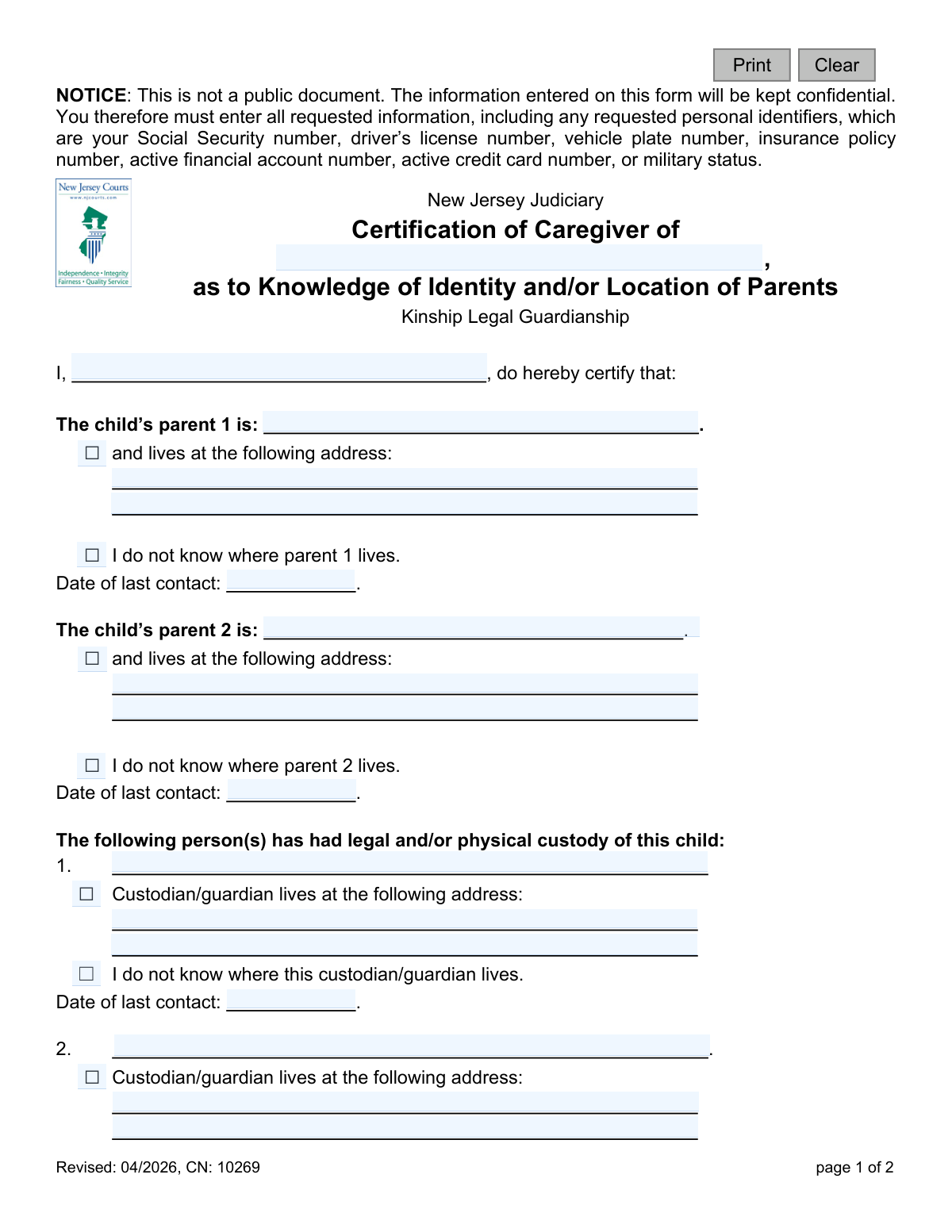
Yes! You can use AI to fill out Certification of Caregiver as to Knowledge of Identity and/or Location of Parents
This form, officially titled "Certification of Caregiver as to Knowledge of Identity and/or Location of Parents," is a legal document for the New Jersey Judiciary. It is used by a caregiver seeking kinship legal guardianship to formally state what they know about the identity and location of the child's biological parents and any previous legal custodians. This information is critical for the court to proceed with the guardianship case. Today, this form can be filled out quickly and accurately using AI-powered services like Instafill.ai, which can also convert non-fillable PDF versions into interactive fillable forms.
CN 10269 is part of the
New Jersey forms category on Instafill.
Our AI automatically handles information lookup, data retrieval, formatting, and form filling.
It takes less than a minute to fill out CN 10269 using our AI form filling.
Securely upload your data. Information is encrypted in transit and deleted immediately after the form is filled out.
Form specifications
| Form name: | Certification of Caregiver as to Knowledge of Identity and/or Location of Parents |
| Number of fields: | 30 |
| Number of pages: | 1 |
| Language: | English |
Instafill Demo: How to fill out PDF forms in seconds with AI
How to Fill Out CN 10269 Online for Free in 2026
Are you looking to fill out a CN 10269 form online quickly and accurately? Instafill.ai offers the #1 AI-powered PDF filling software of 2026, allowing you to complete your CN 10269 form in just 37 seconds or less.
Follow these steps to fill out your CN 10269 form online using Instafill.ai:
- 1 Navigate to Instafill.ai and upload or select the New Jersey Certification of Caregiver form (CN 10269).
- 2 Enter your full name as the certifying caregiver and the full name of the child involved in the guardianship case.
- 3 Provide the name of Parent 1. Check the appropriate box to either provide their current address or state that their location is unknown, including the date of last contact.
- 4 Repeat the process for Parent 2, entering their name and indicating whether their address is known or unknown.
- 5 List the names of any other individuals who have had legal or physical custody of the child, providing their location details in the same manner as for the parents.
- 6 Carefully review all the information you have provided for accuracy and completeness.
- 7 Enter the current date and apply your digital signature to certify that the statements are true to the best of your knowledge.
Our AI-powered system ensures each field is filled out correctly, reducing errors and saving you time.
Why Choose Instafill.ai for Your Fillable CN 10269 Form?
Speed
Complete your CN 10269 in as little as 37 seconds.
Up-to-Date
Always use the latest 2026 CN 10269 form version.
Cost-effective
No need to hire expensive lawyers.
Accuracy
Our AI performs 10 compliance checks to ensure your form is error-free.
Security
Your personal information is protected with bank-level encryption.
Frequently Asked Questions About Form CN 10269
This form is used in New Jersey Kinship Legal Guardianship cases for a caregiver to officially declare what they know about the identity and location of a child's parents and any previous custodians.
The person seeking Kinship Legal Guardianship of a child, referred to as the 'caregiver' on the form, must complete and sign it as part of their court filing.
You must provide the full name of each parent and their last known address. If you don't know their address, you must indicate that and provide the date of your last contact with them.
If you do not know a parent's current address, check the box that says 'I do not know where parent [1 or 2] lives' and write the date you last had contact with them.
This is the most recent date you communicated with the parent or previous custodian, or had knowledge of their whereabouts. Provide this date to the best of your ability.
This refers to any person, other than the parents, who previously had court-ordered legal custody or was the primary person the child lived with (physical custody).
Yes, the form explicitly states it is not a public document and that the information provided will be kept confidential by the New Jersey Judiciary.
By signing, you certify that your statements are true. The form warns that willfully making false statements will subject you to punishment.
You should complete the information for the parent you know. For the other parent, you may write 'Unknown' in the name field and be prepared to explain the circumstances to the court.
This form is typically filed with the Superior Court of New Jersey, Family Part, in the county where the child lives, as part of your complaint for Kinship Legal Guardianship.
If a parent is deceased, you should indicate that on the form in the space for their information (e.g., 'Jane Doe - Deceased'). The court may require you to provide a copy of the death certificate.
Yes, services like Instafill.ai use AI to auto-fill form fields accurately and save time, which can be very helpful for complex legal documents like this one.
You can use a service like Instafill.ai to upload the PDF and fill it out digitally. This allows you to type your answers directly into the fields before printing the completed form for your signature.
If you have a non-fillable PDF, you can use a tool like Instafill.ai to convert it into an interactive, fillable form. Simply upload the document to their platform to get started.
Compliance CN 10269
Validation Checks by Instafill.ai
1
Caregiver Name Is Required
Checks that the caregiver's full name (`cgName`) is provided. This field identifies the person making the certification, and its absence would invalidate the entire document. Failure to provide this name will prevent form submission and prompt the user to enter their name.
2
Child's Name Is Required
Ensures the name of the child (`childName`) at the center of the guardianship case is entered. The form is meaningless without identifying the child it pertains to. If the child's name is missing, the user will be alerted that this is a mandatory field.
3
Parent 1 Name Is Required
Validates that the name of the child's first parent (`cpOneName`) is filled in. Identifying the parents is a primary purpose of this form for legal proceedings. A missing parent name makes the certification incomplete and will trigger an error message.
4
Exclusive Location Choice for Parent 1
Verifies that for Parent 1, the user has selected exactly one option: either providing an address or declaring the location as unknown. This prevents contradictory or incomplete information, which is crucial for legal clarity. If both or neither option is selected, the form will show an error and require the user to make a single choice.
5
Conditional Address for Parent 1
If the user checks the box indicating they know Parent 1's address, this validation ensures the address field (`cpOneAddr`) is not left empty. This check enforces the user's declaration by requiring them to provide the corresponding information. A failure results in a prompt to either enter the address or select the 'unknown location' option instead.
6
Conditional Last Contact Date for Parent 1
If the user checks the box indicating Parent 1's location is unknown, this validation requires the 'Date of last contact' (`cpOneLastContDt`) to be filled. This date provides critical context for the court regarding the caregiver's efforts and knowledge. If the date is missing, the submission will be blocked until the date is provided.
7
Conditional Logic for Parent 2 Information
If a name is provided for Parent 2 (`cpTwoName`), this check ensures that a location option (known address or unknown) is selected. This maintains logical consistency for the second parent's information. An error will be displayed if the condition is not met, guiding the user to provide a clear status.
8
Valid Date Format for All Date Fields
This check scans all date fields on the form (`cpOneLastContDt`, `cpTwoLastContDt`, `dt`, etc.) to ensure they follow a valid and consistent format, such as MM/DD/YYYY. Proper formatting is essential for data integrity and correct interpretation by the judicial system. Any invalid date format will be flagged for correction.
9
Last Contact Date Must Be in the Past
Validates that any 'Date of last contact' entered on the form is not a future date. A last contact date must logically have already occurred. This check prevents data entry errors and ensures the timeline presented to the court is plausible.
10
Certification Date Is Required and Not in the Future
Ensures the signature date (`dt`) is provided and is not a future date. The certification date legally marks when the statements were attested to be true. A missing or future date would invalidate the signature and the document's legal standing, so the form will require a valid current or past date.
11
Signature Is Required
Verifies that the signature field (`sig`) has been completed, whether by a digital signature, typed name, or checkbox affirmation. The signature is the legal attestation that the caregiver understands the penalties for false statements. The form cannot be submitted without this critical confirmation.
12
Conditional Information for Custodians
If a name is entered for a previous custodian/guardian (`cgOneName` or `cgTwoName`), this validation ensures that a location status (either a known address or an unknown location with a last contact date) is also provided. This prevents listing individuals without providing the required associated information. Failure to provide the location details for a listed custodian will result in an error.
Common Mistakes in Completing CN 10269
This occurs when a user provides a partial address while also checking the box for 'I do not know where [the person] lives.' This conflicting information creates ambiguity for the court, which needs a definitive statement. This error will cause the form to be returned for clarification, delaying the legal proceedings until a single, clear option is chosen for each individual.
When a user indicates they do not know a parent's or custodian's location, they frequently forget to fill in the mandatory 'Date of last contact' field. This date is critical evidence for the court to assess the parent's absence and the caregiver's knowledge. An omission here renders the section incomplete and will halt the processing of the certification.
Applicants often focus on filling out the details for parents and custodians and overlook the signature and date lines on the final page. An unsigned or undated certification is legally invalid and will be rejected immediately. This simple oversight can bring the entire kinship legal guardianship process to a standstill until a properly executed form is submitted.
People often write partial names (e.g., 'Jen Smith' instead of 'Jennifer Lynn Smith') or nicknames out of habit. For legal documents, full legal names are required for proper identification and for serving legal notices. Using incomplete names can lead to the rejection of the form or significant delays while the court requests correct information.
A common mistake is to leave out essential parts of an address, such as the apartment number, city, state, or ZIP code. The primary purpose of collecting this address is for legal notification, which is impossible with incomplete information. This error will stop the case from moving forward until a full, verifiable address is provided.
Caregivers sometimes mistakenly list themselves in the section asking for persons who have 'had legal and/or physical custody.' This section is intended to identify *prior* custodians, not the current applicant. This error provides the court with an inaccurate custody history, which can complicate and prolong the legal review process.
Rather than checking the 'I do not know' box, some users will simply leave a person's entire section blank, assuming this implies the information is unknown. This creates ambiguity, as court clerks cannot be sure if the omission was intentional or an oversight. The form will be considered incomplete and returned for clarification.
In the 'Date of last contact' field, users may write imprecise statements like 'about a year ago' or 'last summer.' Legal proceedings require a specific date, even if it is an approximation (e.g., 'Approx. 06/01/2022'), to establish a clear timeline. Vague information is insufficient and will require correction, delaying the case.
Since this form is a PDF, it is often printed and filled out by hand, where poor penmanship can make names, addresses, and dates unreadable. If court staff cannot decipher the information, the form is rendered useless and will be rejected. Using a tool like Instafill.ai to convert the PDF into a fillable version ensures all entries are typed and perfectly legible, preventing this common issue.
The date fields on the form do not specify a required format, leading to inconsistent entries like '01/15/24', 'Jan 15, 2024', or '15/01/2024'. This can cause confusion and data entry errors on the court's end. To avoid this, consistently use the MM/DD/YYYY format. AI-powered form fillers like Instafill.ai can automatically format dates correctly, ensuring consistency and preventing processing errors.
Saved over 80 hours a year
“I was never sure if my IRS forms like W-9 were filled correctly. Now, I can complete the forms accurately without any external help.”
Kevin Martin Green
Your data stays secure with advanced protection from Instafill and our subprocessors

Robust compliance program
Transparent business model
You’re not the product. You always know where your data is and what it is processed for.
ISO 27001, HIPAA, and GDPR
Our subprocesses adhere to multiple compliance standards, including but not limited to ISO 27001, HIPAA, and GDPR.
Security & privacy by design
We consider security and privacy from the initial design phase of any new service or functionality. It’s not an afterthought, it’s built-in, including support for two-factor authentication (2FA) to further protect your account.
Fill out CN 10269 with Instafill.ai
Worried about filling PDFs wrong? Instafill securely fills certification-of-caregiver-as-to-knowledge-of-identity-andor-location-of-parents forms, ensuring each field is accurate.