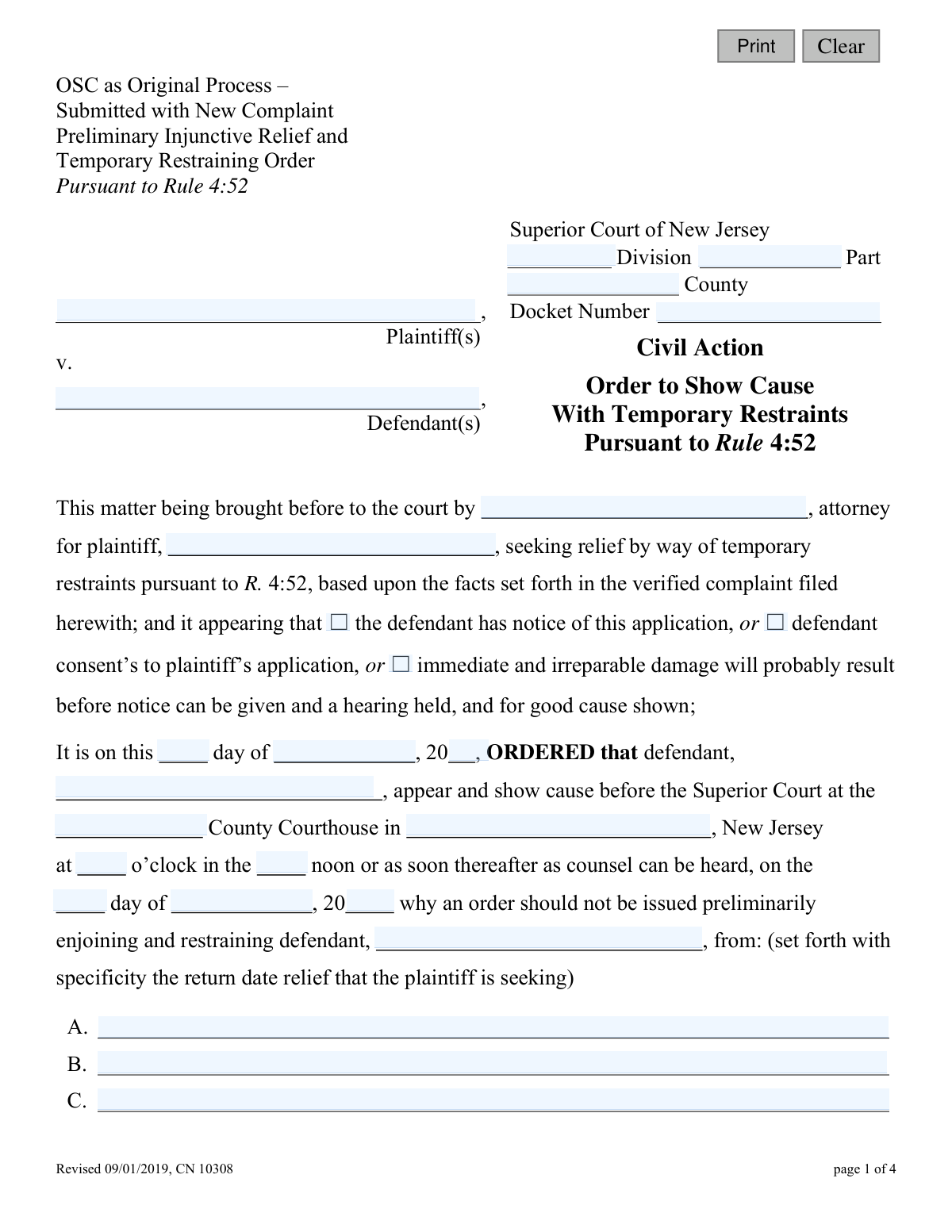
Yes! You can use AI to fill out Order to Show Cause with Temporary Restraints Pursuant to Rule 4:52
The Order to Show Cause with Temporary Restraints (CN 10308) is a legal document filed in the Superior Court of New Jersey to compel a defendant to appear in court and justify why a preliminary injunction should not be granted. It is a critical tool for plaintiffs seeking to prevent immediate and irreparable harm by requesting temporary restraining orders until a formal hearing can be held. Today, this form can be filled out quickly and accurately using AI-powered services like Instafill.ai, which can also convert non-fillable PDF versions into interactive fillable forms.
CN 10308 is part of the
New Jersey forms category on Instafill.
Our AI automatically handles information lookup, data retrieval, formatting, and form filling.
It takes less than a minute to fill out CN 10308 using our AI form filling.
Securely upload your data. Information is encrypted in transit and deleted immediately after the form is filled out.
Form specifications
| Form name: | Order to Show Cause with Temporary Restraints Pursuant to Rule 4:52 |
| Number of fields: | 45 |
| Number of pages: | 1 |
| Language: | English |
Instafill Demo: How to fill out PDF forms in seconds with AI
How to Fill Out CN 10308 Online for Free in 2026
Are you looking to fill out a CN 10308 form online quickly and accurately? Instafill.ai offers the #1 AI-powered PDF filling software of 2026, allowing you to complete your CN 10308 form in just 37 seconds or less.
Follow these steps to fill out your CN 10308 form online using Instafill.ai:
- 1 Navigate to Instafill.ai and upload or select the 'Order to Show Cause with Temporary Restraints' form.
- 2 Use the AI assistant to automatically populate case information, including plaintiff and defendant names, court division, county, and docket number.
- 3 Clearly specify the relief being sought on the return date in the designated sections, detailing the actions you want the court to order.
- 4 Detail the specific temporary restraints you are asking the court to impose on the defendant immediately, pending the full hearing.
- 5 Enter all relevant dates, such as the proposed hearing date, response deadlines, and service timelines as required by court rules.
- 6 Review all AI-populated fields, including attorney information, judge's name, and service instructions, to ensure complete accuracy before finalizing the document for filing with the court.
Our AI-powered system ensures each field is filled out correctly, reducing errors and saving you time.
Why Choose Instafill.ai for Your Fillable CN 10308 Form?
Speed
Complete your CN 10308 in as little as 37 seconds.
Up-to-Date
Always use the latest 2026 CN 10308 form version.
Cost-effective
No need to hire expensive lawyers.
Accuracy
Our AI performs 10 compliance checks to ensure your form is error-free.
Security
Your personal information is protected with bank-level encryption.
Frequently Asked Questions About Form CN 10308
This form is used by a plaintiff to request urgent court intervention, including immediate temporary restraining orders against a defendant, and to schedule a court hearing for further relief.
The plaintiff (the person or entity starting the lawsuit) or their attorney fills out this form to ask the court to stop the defendant from taking certain actions.
You must appear in court on the specified date and file a written response by the deadline listed. You also must file a separate, formal Answer to the complaint within 35 days to avoid a default judgment.
Temporary restraints are immediate restrictions the court imposes before the hearing to prevent urgent harm. The preliminary injunction is the longer-term relief the plaintiff is asking the court to grant at the hearing.
You must submit a verified complaint along with this order. You may also include a legal memorandum and supporting affidavits or certifications to strengthen your application.
If you fail to file an opposition and a formal Answer, the court can grant the plaintiff's requests by default. A phone call to the court is not a substitute for a formal written response.
You must file your original opposition papers with the Clerk of the Superior Court, pay any required fees, and send copies directly to the judge and the plaintiff's attorney.
No, they are two separate documents. The opposition addresses the request for immediate relief, while the Answer is your formal response to the entire lawsuit and must be filed within 35 days of being served.
The form suggests contacting your local Legal Services office or the Legal Services of New Jersey Statewide Hotline for potential free legal assistance. You can also be referred to an attorney through a Lawyer Referral Service.
Yes — services like Instafill.ai use AI to auto-fill form fields accurately and save time, which is especially useful for complex legal documents.
Simply upload the form to the Instafill.ai platform. The AI will make the document interactive, allowing you to easily fill in all the required information before downloading the completed form.
Instafill.ai can convert flat non-fillable PDFs into interactive fillable forms. This allows you to type your information directly into the fields online.
The court will typically hear arguments from both sides on the return date but will not hear testimony unless specifically arranged beforehand.
Compliance CN 10308
Validation Checks by Instafill.ai
1
Docket Number Format and Presence
This check ensures the 'docketNo' field is not empty and conforms to the standard New Jersey court format (e.g., 'COU-L-NNNNNN-YY'). The docket number is a critical unique identifier for the case, and an incorrect or missing number will prevent the document from being filed correctly. If validation fails, the user should be prompted to enter a valid docket number.
2
Completeness of Party Information
Validates that the 'plaName' (Plaintiff) and 'defName' (Defendant) fields are both filled in. These fields are fundamental to identifying the parties involved in the legal action. A submission without this information is incomplete and legally insufficient, as it's unclear who the order applies to.
3
Basis for Order Justification
Ensures that at least one of the checkboxes under the 'appearingThat' section is selected. This selection provides the legal justification for issuing the order without a full hearing (e.g., defendant has notice, consents, or irreparable harm is imminent). Failure to select a basis makes the order legally questionable and will halt processing.
4
Valid and Chronological Order Date
This check verifies that the 'orderDay', 'orderMo', and 'orderYr' fields combine to form a valid calendar date. It also ensures this date is not in the future. An order cannot be dated for a future time, as it reflects an action taken by the court on a specific day.
5
Logical Hearing Date
Validates that the hearing date, composed of 'hearingDay', 'hearingMo', and 'hearingYr', is a valid date that occurs after the order date. A hearing must be scheduled for the future to allow all parties time to prepare and appear. An illogical date would make the order unenforceable.
6
Specificity of Relief Sought
This check requires that at least one of the relief description fields ('reliefDescA', 'reliefDescB', or 'reliefDescC') is completed. The purpose of the order is to compel the defendant to 'show cause' why specific relief should not be granted. If the requested relief is not specified, the order has no substance and is invalid.
7
Specificity of Temporary Restraints
Verifies that if temporary restraints are being requested, at least one of the 'restraintDescA', 'restraintDescB', or 'restraintDescC' fields is filled out. These fields must detail the immediate actions the defendant is prohibited from taking. Vague or missing restraints make the order unenforceable and fail to protect the plaintiff from irreparable harm.
8
Conditional Requirement for Service Description
Checks if the 'serviceType' is set to the alternative method (the second checkbox). If it is, the 'serviceDesc' field must be filled out to explain how service will be accomplished. This is crucial for ensuring due process, as the court must approve non-standard methods of service.
9
Valid Service Timeframe
Ensures the 'serviceTime' field, which specifies the number of days to serve the defendant, contains a positive integer. This timeframe is a court-ordered deadline that must be clear and reasonable. A non-positive or non-numeric value would create ambiguity and could invalidate the service.
10
Chronological Response and Reply Deadlines
This validation performs a logical check on multiple date fields. It ensures the 'defRespDt' (Defendant's Response Date) is before the hearing date, and that the 'plaReplyDt' (Plaintiff's Reply Date) is after the defendant's response date but also before the hearing date. This sequence is critical for maintaining a fair and orderly legal process.
11
Valid Fee Amount Format
Validates that the 'oppositionFee' and 'filingFee' fields contain valid, non-negative numerical values. Court fees must be correctly recorded for accounting and to ensure the filing is accepted by the clerk. An invalid format would cause rejection of the document.
12
County Information Consistency
This check ensures that the county specified in the 'typeCounty' field matches the county in the 'typeCounty2' field. This consistency is important because it confirms the case is filed in the same county where the courthouse is located, preventing jurisdictional confusion and misfiling.
13
Judge Information Completeness
Verifies that if a judge's name is entered in either 'jdgName' or 'jdgName2', the corresponding 'jdgAddr' field for the judge's chambers is also filled. This information is required so that opposition papers can be sent directly to the correct judge, as instructed in the form. Missing this address would disrupt the flow of case documents.
14
Presence of Core Case Identifiers
Ensures that the 'divType' (Division), 'partType' (Part), and 'typeCounty' fields are all completed. These fields are essential for routing the document to the correct department within the New Jersey Superior Court. Missing any of this information will result in filing delays or rejection.
Common Mistakes in Completing CN 10308
Filers, especially those without legal representation, often select the wrong court Division (e.g., Law vs. Chancery) or County. This happens due to unfamiliarity with court jurisdiction rules, which dictate where a case should be heard based on its subject matter and the location of the parties. Filing in the wrong venue can lead to the case being transferred or dismissed, causing significant delays and potentially requiring new filing fees.
The form requires filers to describe the requested relief with 'specificity,' but many use general or unenforceable terms like 'stop all contact.' This occurs because they fail to translate their desired outcome into concrete, actionable prohibitions. A judge is likely to deny a vaguely worded request, as it would be impossible for the defendant to know what they are forbidden from doing and for the court to enforce the order.
To get temporary restraints without first notifying the defendant, a filer must prove 'immediate and irreparable damage' will occur. A common mistake is simply checking this box without providing detailed, factual support in the attached verified complaint. Without specific facts demonstrating why giving notice is dangerous or will render the relief moot, the judge will deny the ex parte request and require the defendant be served before any hearing.
Filers may use nicknames, abbreviations, or slightly different versions of the plaintiff's and defendant's names throughout the documents. This data entry error creates legal ambiguity and can cause serious problems with serving the order and enforcing it later. To avoid this, use the full, correct legal names for all parties on every document, ensuring they match the verified complaint. AI-powered form filling tools like Instafill.ai can help by auto-populating names consistently across all fields.
The form requires specifying how the defendant will be served, but filers often misunderstand the strict legal rules for service of process. They might select a method, like regular mail, that is not permitted for original process without a court order, leading to invalid service. Improper service means the court lacks jurisdiction over the defendant, rendering any order unenforceable and forcing the plaintiff to start the process over, causing major delays.
This form contains several date fields for the hearing and response deadlines that are meant to be filled in by the judge or court clerk. A frequent error is for the filer to guess at these dates or fill them in with their desired schedule. This will lead to the document's rejection, as only the court has the authority to set its own calendar; these fields should be left blank when the order is submitted.
This Order to Show Cause is not a standalone document; it acts as a cover sheet for a full application package. Filers often mistakenly submit only this form, without the mandatory verified complaint, certifications, and legal memorandum mentioned within it. An incomplete submission will be rejected by the clerk's office, halting the request for emergency relief before it is even seen by a judge.
The form has placeholders for a filing fee and an opposition fee, but does not state the amounts, which can change. Filers frequently forget to include a check or miscalculate the required fee, which can be found on the state's judiciary website. The court clerk's office will not accept a filing with an incorrect or missing fee, bringing the entire legal action to a halt until the correct payment is provided.
For defendants, the most critical mistake is filing an opposition to the temporary restraints but failing to file a separate 'Answer' to the underlying complaint within 35 days. The form explicitly warns against this, but many self-represented parties assume one response covers both. This failure can result in a default judgment being entered against the defendant for the entire lawsuit, even if they successfully argued against the initial restraints.
The form requires that opposition and reply papers be sent directly to the assigned judge's chambers. Filers often leave the judge's name and address fields blank, either because they don't know it or they forget to fill it in. This prevents the judge from receiving and reviewing the documents before the hearing, potentially leading to an adjournment or a decision made without considering the party's arguments. Since this form is a non-fillable PDF, tools like Instafill.ai can convert it to a fillable version, making it easier to enter and update such information.
Saved over 80 hours a year
“I was never sure if my IRS forms like W-9 were filled correctly. Now, I can complete the forms accurately without any external help.”
Kevin Martin Green
Your data stays secure with advanced protection from Instafill and our subprocessors

Robust compliance program
Transparent business model
You’re not the product. You always know where your data is and what it is processed for.
ISO 27001, HIPAA, and GDPR
Our subprocesses adhere to multiple compliance standards, including but not limited to ISO 27001, HIPAA, and GDPR.
Security & privacy by design
We consider security and privacy from the initial design phase of any new service or functionality. It’s not an afterthought, it’s built-in, including support for two-factor authentication (2FA) to further protect your account.
Fill out CN 10308 with Instafill.ai
Worried about filling PDFs wrong? Instafill securely fills order-to-show-cause-with-temporary-restraints-pursuant-to-rule-452 forms, ensuring each field is accurate.