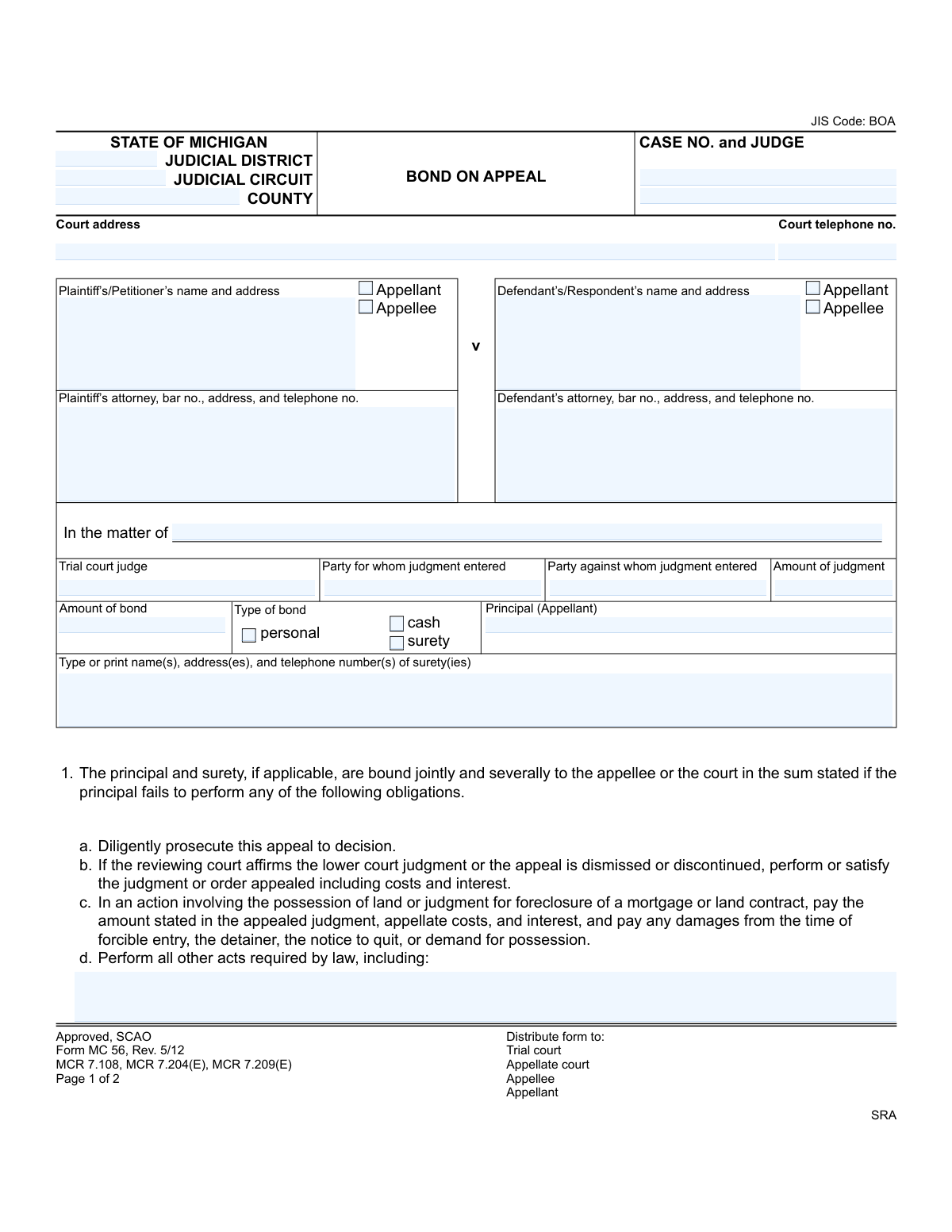
Yes! You can use AI to fill out Form MC 56, Bond on Appeal
Form MC 56, Bond on Appeal, is a legal document used in the Michigan court system when a party (the appellant) appeals a lower court's decision. By filing this bond, the appellant provides a financial guarantee to the court and the opposing party (the appellee) that they will satisfy the original judgment, plus costs and interest, if the appeal is lost or dismissed. This ensures the appellee is protected financially during the appeal process. Today, this form can be filled out quickly and accurately using AI-powered services like Instafill.ai, which can also convert non-fillable PDF versions into interactive fillable forms.
Our AI automatically handles information lookup, data retrieval, formatting, and form filling.
It takes less than a minute to fill out MC 56 using our AI form filling.
Securely upload your data. Information is encrypted in transit and deleted immediately after the form is filled out.
Form specifications
| Form name: | Form MC 56, Bond on Appeal |
| Number of fields: | 43 |
| Number of pages: | 1 |
| Language: | English |
More forms in Court appeal forms
Instafill Demo: How to fill out PDF forms in seconds with AI
How to Fill Out MC 56 Online for Free in 2026
Are you looking to fill out a MC 56 form online quickly and accurately? Instafill.ai offers the #1 AI-powered PDF filling software of 2026, allowing you to complete your MC 56 form in just 37 seconds or less.
Follow these steps to fill out your MC 56 form online using Instafill.ai:
- 1 Navigate to Instafill.ai and upload or select the Michigan Bond on Appeal (Form MC 56).
- 2 Provide the case information, including the judicial district/circuit, case number, and judge's name.
- 3 Enter the names, addresses, and attorney details for all parties, clearly identifying the appellant and appellee.
- 4 Specify the details of the judgment being appealed, including the amount and the parties involved.
- 5 Detail the bond information, including the total amount, the type of bond (personal, cash, or surety), and the names and addresses of the principal and any sureties.
- 6 Review all the information populated by the AI for accuracy. The principal and surety(ies) must then sign the form.
- 7 Have the surety signatures notarized as required, obtain the trial court judge's approval, and file the completed form with the appropriate courts.
Our AI-powered system ensures each field is filled out correctly, reducing errors and saving you time.
Why Choose Instafill.ai for Your Fillable MC 56 Form?
Speed
Complete your MC 56 in as little as 37 seconds.
Up-to-Date
Always use the latest 2026 MC 56 form version.
Cost-effective
No need to hire expensive lawyers.
Accuracy
Our AI performs 10 compliance checks to ensure your form is error-free.
Security
Your personal information is protected with bank-level encryption.
Frequently Asked Questions About Form MC 56
This form is used to post a financial guarantee when appealing a court's decision. It ensures that the person appealing will prosecute the appeal and pay the original judgment, plus costs and interest, if they lose.
The person or party appealing the court's decision, known as the 'Appellant' or 'Principal', must fill out this form. If a surety is required for the bond, the surety must also provide their information and signature.
A surety is a person or company that agrees to be financially responsible if the appellant fails to meet their obligations. Whether you need a surety depends on the type of bond required by the court; a 'surety' bond requires one, while 'cash' or 'personal' bonds may not.
The bond amount is typically set by the court and is related to the original judgment amount, plus anticipated costs and interest. You should refer to the court's order staying the judgment to find the correct amount to list on the form.
A 'personal' bond is your own promise to pay, a 'cash' bond requires you to deposit the full amount with the court, and a 'surety' bond involves a third party guaranteeing the payment. The court order will specify which type of bond is required for your appeal.
By signing, you promise to diligently pursue the appeal, satisfy the original judgment with costs and interest if you lose, and perform any other acts required by law or the court. For criminal cases, this includes surrendering for your sentence if the appeal is unsuccessful.
Yes, the form includes a section for a notary public to witness and verify the surety's signature. The surety must sign the form in the presence of a notary.
The completed and signed form must be approved by the trial court judge and then filed with the trial court clerk. Copies should be distributed to the appellate court, the appellee (the other party), and yourself for your records.
If the reviewing court affirms the lower court's judgment or your appeal is dismissed, you are obligated to satisfy the original judgment, including costs and interest. If you fail to do so, the court or the appellee can claim the funds from the bond.
You will need your case number, court information, the names and addresses of all parties and attorneys, and details of the judgment being appealed. You will also need the name, address, and phone number of any surety being used.
Yes, services like Instafill.ai use AI to accurately auto-fill form fields from your case documents, which can save you time and help prevent errors. This is especially useful for complex forms with repetitive information.
You can use a service like Instafill.ai to fill out the form online. Simply upload the form, and the AI will help you populate the fields with your case information, making the process faster and more efficient.
If you have a flat, non-fillable PDF, you can upload it to a platform like Instafill.ai. The service can convert the non-fillable PDF into an interactive, fillable form that you can complete and sign electronically.
The 'principal' is the appellant, which is the person or party who is appealing the court's decision and is responsible for posting the bond.
Compliance MC 56
Validation Checks by Instafill.ai
1
Validates Case Number Format
This check ensures the 'CASE NO.' field conforms to the specific format required by the Michigan judiciary (e.g., YY-######-XX). Correct formatting is critical for the court's electronic filing and case management systems to accurately link the bond to the corresponding case. A mismatched case number would lead to filing rejection or misdirection of the document, causing significant delays in the appeal process.
2
Ensures Mutually Exclusive Appellant/Appellee Selection
This validation verifies that for each party (Plaintiff and Defendant), only one of the 'Appellant' or 'Appellee' boxes is checked, but not both. A party must be either appealing the decision (appellant) or responding to the appeal (appellee). Allowing both to be selected for a single party would create a logical contradiction, making the form legally ambiguous and requiring manual correction.
3
Requires Surety Details for Surety Bonds
This check mandates that if the 'surety' bond type is selected, the fields for the surety's name, address, and telephone number must be completed. A surety bond is an agreement guaranteed by a third party, and the identity of that guarantor is essential. Without this information, the bond is unenforceable and provides no financial security, defeating its entire purpose.
4
Verifies Logical Bond Amount
This validation compares the 'Amount of bond' to the 'Amount of judgment'. Typically, the bond amount must be equal to or greater than the judgment amount, often by a percentage specified in court rules to cover costs and interest. An insufficient bond amount would fail to meet legal requirements for staying the judgment, rendering the appeal bond ineffective.
5
Validates Notary Commission Expiration
This check confirms that the notary's commission was valid at the time of notarization by comparing the 'My commission expires on' date with the 'Subscribed and sworn to before me on' date. The expiration date must be after the date of notarization. A document notarized by a person with an expired commission is legally void and would be rejected by the court.
6
Enforces Single Bond Type Selection
This validation ensures that exactly one bond type ('personal', 'cash', or 'surety') is selected. Each type has distinct legal implications and requirements for how the bond is secured. Selecting none or more than one type creates ambiguity and would cause the form to be rejected for failing to clearly define the nature of the financial obligation.
7
Confirms Presence of Required Signatures
This check verifies that the 'Signature of principal' field is not empty. If the bond type is 'surety', it also ensures that at least one 'Surety' signature is present. A bond is a contract, and it is not legally binding without the signatures of the parties undertaking the obligation, making this a critical check for the document's validity.
8
Validates Attorney Bar Number Format
This check ensures that if an attorney is listed, their bar number follows the official State Bar of Michigan format (a 'P' followed by a number). This is essential for verifying the attorney's identity and their authority to practice law in the jurisdiction. An incorrect format could indicate a typo or, in a more serious case, an unauthorized individual, which would have severe legal consequences.
9
Ensures Logical Date Sequence
This validation checks that the dates on the form are chronologically logical. For example, the 'Subscribed and sworn to before me on' date (notarization date) cannot be earlier than the 'Date' of the principal's signature. This ensures the document's timeline is plausible and legally sound, preventing challenges to when the obligations were formally witnessed and undertaken.
10
Standardizes Telephone Number Format
This check validates that all telephone number fields on the form adhere to a standard North American format (e.g., 10 digits, optionally with parentheses, spaces, or hyphens). Enforcing a consistent format improves data quality and ensures that court personnel and other parties can successfully make contact when necessary. Failed communication can delay proceedings and cause administrative problems.
11
Validates Judgment Party Identification
This check ensures the 'Party for whom judgment entered' and 'Party against whom judgment entered' fields are filled out. It should also cross-reference these names with the main plaintiff and defendant fields for consistency. This clarity is essential to confirm who is the judgment creditor and who is the judgment debtor in the appeal.
12
Requires Principal's Information
This validation ensures that the name, address, and telephone number of the 'Principal (Appellant)' are provided. The principal is the primary party undertaking the obligations of the bond. Without their complete and accurate contact information, the court cannot properly notify them or enforce the terms of the bond if the appeal fails.
13
Verifies Numeric Currency Fields
This check ensures that the 'Amount of judgment' and 'Amount of bond' fields contain only valid numeric currency data. Allowing text or other characters would lead to calculation errors and render the financial terms of the bond ambiguous. This validation is critical for the financial integrity and enforceability of the document.
Common Mistakes in Completing MC 56
Users often incorrectly identify the parties' roles in the appeal. The party who lost in the lower court and is now filing the appeal is the 'Appellant,' while the other party is the 'Appellee.' This mistake happens because the roles may be reversed from the original trial (e.g., the original defendant is now the appellant). Incorrectly checking these boxes can lead to significant legal confusion, procedural delays, and potential rejection of the bond filing by the court clerk.
Entering the wrong case number or omitting the assigned judge's name is a frequent error. This often occurs due to a simple typo or by referencing a related but incorrect case, such as a lower court proceeding with a different number. An incorrect case number is a critical error that will cause the document to be misfiled or rejected by the court, halting the appeal process until a corrected form is submitted.
The form explicitly requires the attorney's name, bar number, address, and telephone number. Filers, especially non-attorneys, frequently leave the bar number field blank because they don't have it readily available. This omission can lead to the form being considered incomplete, causing delays while the clerk's office verifies the attorney's status or rejects the filing altogether.
The 'Amount of bond' is a court-determined figure and is not always the same as the judgment amount. A common mistake is to enter the judgment amount here or to miscalculate the required sum, which may include costs and interest. Submitting a bond for the wrong amount will result in immediate rejection by the court, as the financial security for the appeal is insufficient.
The notary section is often filled out incorrectly, with common errors including a missing stamp or seal, an expired commission date, or the notary failing to sign. The principal and surety must sign the document in the physical presence of the notary. An improperly notarized bond is legally invalid and will be rejected by the court, requiring the parties to repeat the signing and notarization process.
This is a two-page form, but filers sometimes only complete and submit the first page, especially when working with a non-fillable PDF. Page two contains crucial signature lines for the principal and surety, as well as the entire notary block and judge's approval section. Submitting only page one results in an incomplete and unsigned document that is legally void. AI tools like Instafill.ai can convert flat PDFs into interactive forms, helping ensure all pages and fields are addressed.
When a surety is used, their full legal name, address, and phone number must be provided. Furthermore, the surety must sign to acknowledge they have a personal worth of at least twice the bond amount, above all debts. People often provide incomplete contact details or the surety may not fully understand the financial declaration they are signing, which can invalidate the bond if challenged.
The form has multiple signature lines for the principal, one or more sureties, a notary, and the trial court judge. It is easy for a filer to miss a required signature or for a party to sign on the wrong line (e.g., the principal signing on the surety line). A missing or misplaced signature renders the document invalid and will cause it to be rejected by the court clerk, delaying the entire appeal.
The form requires the filer to check a box indicating whether the bond is 'personal,' 'cash,' or 'surety.' This simple checkbox is surprisingly easy to overlook when focusing on the more complex sections of the form. Failure to specify the bond type creates ambiguity and can cause the clerk's office to return the form for clarification, delaying the filing.
The form requires specifying the 'Amount of judgment,' the 'Party for whom judgment entered,' and the 'Party against whom judgment entered.' Filers may make errors by referencing memory instead of the official court order, leading to incorrect amounts or party names. These details are fundamental to the bond's purpose, and inaccuracies can lead to rejection or future legal challenges regarding the bond's validity.
Saved over 80 hours a year
“I was never sure if my IRS forms like W-9 were filled correctly. Now, I can complete the forms accurately without any external help.”
Kevin Martin Green
Your data stays secure with advanced protection from Instafill and our subprocessors

Robust compliance program
Transparent business model
You’re not the product. You always know where your data is and what it is processed for.
ISO 27001, HIPAA, and GDPR
Our subprocesses adhere to multiple compliance standards, including but not limited to ISO 27001, HIPAA, and GDPR.
Security & privacy by design
We consider security and privacy from the initial design phase of any new service or functionality. It’s not an afterthought, it’s built-in, including support for two-factor authentication (2FA) to further protect your account.
Fill out MC 56 with Instafill.ai
Worried about filling PDFs wrong? Instafill securely fills form-mc-56-bond-on-appeal forms, ensuring each field is accurate.