Yes! You can use AI to fill out Form MC 57, Certificate of Records Transmitted for Appeal and Notice to Parties

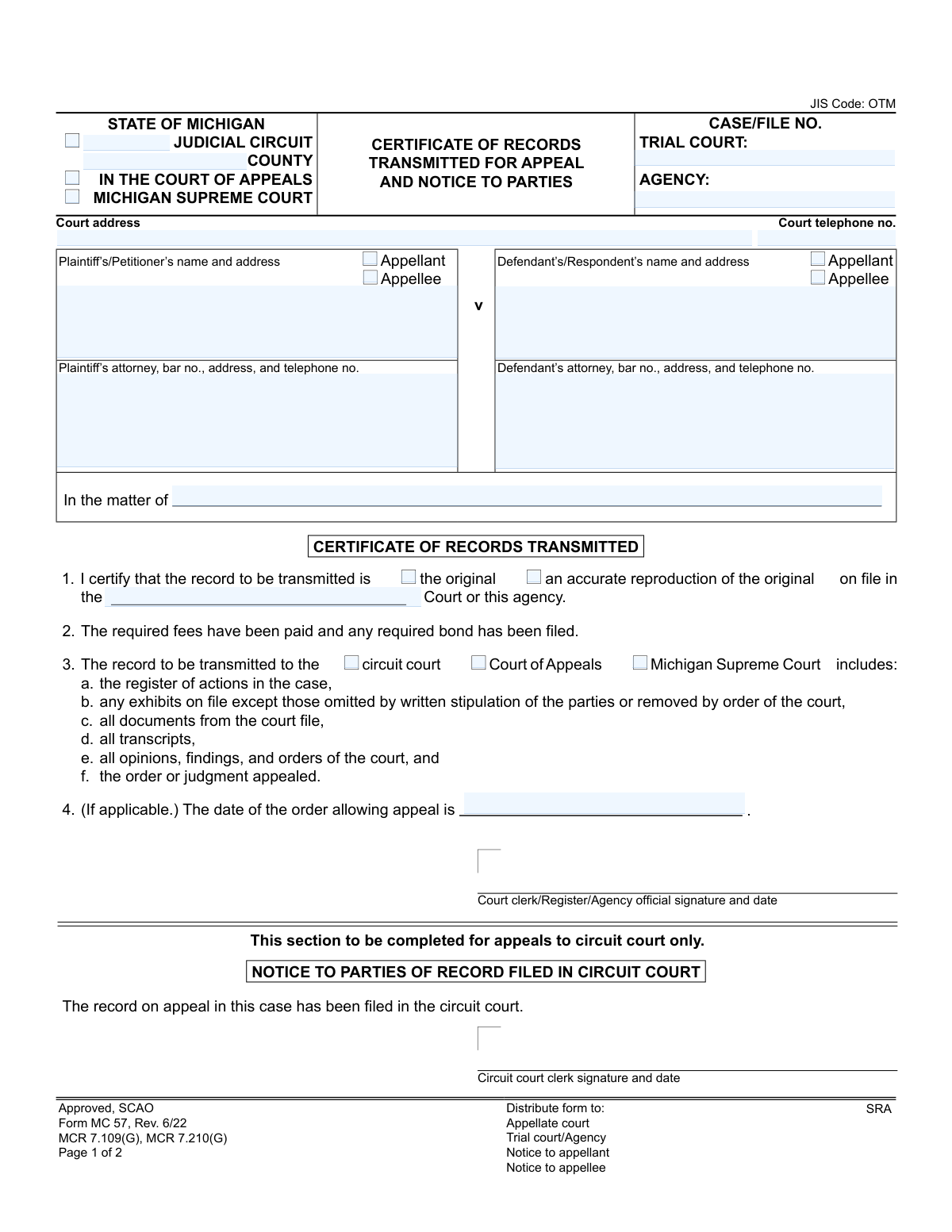
Form MC 57 is a State of Michigan court form used by a trial court clerk or agency official to certify that the complete case record has been prepared and transmitted to the appropriate appellate court (Circuit Court, Court of Appeals, or Michigan Supreme Court). It serves as official confirmation that all necessary documents, transcripts, and exhibits are included in the appeal file and notifies the parties of this action. Today, this form can be filled out quickly and accurately using AI-powered services like Instafill.ai, which can also convert non-fillable PDF versions into interactive fillable forms.
MC 57 is part of the court appeal forms and Michigan court forms categories on Instafill.
Our AI automatically handles information lookup, data retrieval, formatting, and form filling.
It takes less than a minute to fill out MC 57 using our AI form filling.
Securely upload your data. Information is encrypted in transit and deleted immediately after the form is filled out.

Form specifications

Form name: Form MC 57, Certificate of Records Transmitted for Appeal and Notice to Parties
Number of fields: 26
Number of pages: 1
Language: English
main-image

Instafill Demo: How to fill out PDF forms in seconds with AI

How to Fill Out MC 57 Online for Free in 2026

Are you looking to fill out a MC 57 form online quickly and accurately? Instafill.ai offers the #1 AI-powered PDF filling software of 2026, allowing you to complete your MC 57 form in just 37 seconds or less.
Follow these steps to fill out your MC 57 form online using Instafill.ai:
  1. 1 Navigate to Instafill.ai and upload or select the MC 57 form.
  2. 2 Provide the case information, including the trial court case number, agency file number, and the specific appellate court the record is being sent to.
  3. 3 Identify the parties (Plaintiff/Petitioner and Defendant/Respondent) and their attorneys, including names, addresses, and bar numbers.
  4. 4 Complete the certification section by indicating if the record is original or a reproduction and confirming all required fees have been paid.
  5. 5 Enter the date of the order allowing the appeal, if applicable.
  6. 6 The court clerk or agency official will digitally sign and date the certificate to validate the transmission of records.
  7. 7 Review all auto-filled information for accuracy before finalizing, printing, and distributing the form to the appellate court, trial court, and all parties involved in the appeal.

Our AI-powered system ensures each field is filled out correctly, reducing errors and saving you time.

Why Choose Instafill.ai for Your Fillable MC 57 Form?

Speed

Complete your MC 57 in as little as 37 seconds.

Up-to-Date

Always use the latest 2026 MC 57 form version.

Cost-effective

No need to hire expensive lawyers.

Accuracy

Our AI performs 10 compliance checks to ensure your form is error-free.

Security

Your personal information is protected with bank-level encryption.

Frequently Asked Questions About Form MC 57

This form is used by a trial court or agency clerk to certify that the official case record has been sent to the appellate court. It also serves as a notice to all parties involved that the record has been transferred and the appeal can proceed.

This form is completed exclusively by the court clerk, register, or an official from the agency where the case originated. The parties to the appeal (appellant and appellee) or their attorneys do not fill out this form.

Generally, no action is required from you upon receiving this notice. It is for your information to confirm that the case file has been successfully transmitted to the appellate court, which allows the next phase of the appeal, such as briefing, to begin.

The 'Appellant' is the party who was dissatisfied with the lower court's decision and initiated the appeal. The 'Appellee' is the party responding to the appeal, often defending the original court's ruling.

The record consists of all official documents from the original case, including the register of actions, all filed documents and exhibits, transcripts, and the final order or judgment being appealed. This provides the appellate court with all the necessary materials for its review.

This confirms that the appellant has paid the necessary filing fees to both the trial court and the appellate court. The clerk will not transmit the record until these financial obligations are met.

After the record is transmitted, the appellate court's deadlines for filing briefs typically begin. The appellant will file their legal brief first, and then the appellee will have a set time to file their response brief.

You would not fill out this particular form, as it is completed by court staff. However, for other forms you must file in your appeal, AI-powered services like Instafill.ai can auto-fill your information accurately, saving you significant time and effort.

You can upload your appeal forms, like a Claim of Appeal or a motion, to Instafill.ai. The service uses AI to identify and fill in fields with your case information, which helps reduce errors and simplifies the process of preparing complex legal paperwork.

Services like Instafill.ai are designed to solve this problem. They can convert flat, non-fillable PDFs into interactive forms that you can easily fill out online, ensuring your submissions are neat and legible.

The Certificate of Mailing is a sworn declaration by the court clerk. It certifies that they have mailed a copy of this notice to all parties or their attorneys at their last known addresses, serving as official proof of notification.

The register of actions, also known as a docket sheet, is a chronological log of every document filed and every action taken in a case. It provides a complete timeline of the case's proceedings in the lower court.

This form indicates that the procedural step of transferring the record is complete, not that the appeal has been won or lost. If an appeal required permission, the form may note the date the order allowing the appeal was granted.

Compliance MC 57
Validation Checks by Instafill.ai

1
Case Number Presence and Format
This validation ensures that the 'Trial Court Case No' or 'Agency File No' field is populated. It checks that the number conforms to the standard format used by Michigan courts, which is crucial for uniquely identifying the case file being appealed. A missing or malformed case number would prevent the appellate court from locating the correct record, leading to rejection.
2
Exclusive Appellant/Appellee Designation
This check verifies that one party is designated 'Appellant' and the other is 'Appellee'. It is a fundamental requirement of an appeal that there is an appealing party and a responding party. The form will be flagged for correction if both parties are marked as Appellant, both as Appellee, or if these designations are missing.
3
Single Appellate Court Selection
This validation ensures that exactly one destination court is selected in section 3 ('transmitted circuit court', 'transmitted court of appeals', or 'transmitted Michigan Supreme Court'). An appeal record can only be transmitted to a single jurisdiction at a time. Submissions with no selection or multiple selections are ambiguous and will be rejected.
4
Record Type Specification
This check confirms that either 'the original' or 'an accurate reproduction of the original' checkbox is marked in section 1. This information is vital for the receiving court to understand the nature of the documents they are getting. Failure to specify the record type will result in the form being returned for completion.
5
Michigan Attorney Bar Number Format
This rule validates that any provided attorney 'bar no.' follows the official Michigan State Bar format, typically a 'P' followed by a sequence of digits. This ensures the attorney is correctly identified and can be verified as a member in good standing with the state bar. An invalid format could indicate a typo or an unauthorized representative.
6
Appeal Order Date Chronology
This validation checks that the 'appeal order date' is a valid date that occurs on or before the submission date. An appeal cannot be based on a future order, so this check prevents logical and legal impossibilities. It ensures the timeline of the legal process is correctly documented.
7
Completeness of Party Information
This check verifies that the name and address fields for both the Plaintiff/Petitioner and the Defendant/Respondent are not empty. These fields are essential for identifying the primary parties to the appeal. A form submitted without complete party information is legally insufficient and cannot be processed.
8
Case Number Consistency Across Pages
This validation ensures the 'CASE/FILE NO.' entered at the top of page 1 is identical to the 'Case No.' entered on page 2. This is critical for maintaining document integrity and ensuring that pages of the form are not mismatched with other cases. A discrepancy will trigger an error to prevent administrative confusion.
9
Source Court/Agency Identification
This rule validates that the text field for the court or agency name where the record is 'on file in' is completed. This identifies the origin of the case record being transmitted, which is necessary information for the appellate court's reference and jurisdiction. The form is incomplete without specifying the source of the record.
10
Logical Date Sequence for Certification
This check compares the 'appeal order date' with the 'Court clerk... signature and date'. The certification date must be on or after the date the appeal was ordered. Certifying a record for an appeal that has not yet been officially ordered is logically invalid and would be rejected.
11
Plaintiff's Role in Appeal
This validation ensures that for the Plaintiff/Petitioner, either the 'Appellant' or 'Appellee' checkbox is selected. This designation is mandatory to define the plaintiff's legal standing in the appeal. The form cannot be processed without this critical piece of information.
12
Defendant's Role in Appeal
This validation ensures that for the Defendant/Respondent, either the 'Appellant' or 'Appellee' checkbox is selected. This designation is mandatory to define the defendant's legal standing in the appeal. The form cannot be processed without this critical piece of information.
13
Judicial Circuit and County Specification
This check ensures the 'Judicial Circuit' and 'County' fields are not left blank, as they are essential for routing and establishing jurisdiction. The county name should be validated against a list of official Michigan counties. An incomplete or incorrect jurisdiction will cause the filing to be rejected.

Common Mistakes in Completing MC 57

Misidentifying the Appellant and Appellee

Users often confuse the appellant (the party filing the appeal) with the appellee (the party responding to it). This mistake happens due to misunderstanding the legal terms or simple oversight when checking the boxes. Incorrectly identifying the parties can cause significant confusion for the appellate court, potentially requiring amended filings and causing delays in the appeal process. To avoid this, carefully confirm which party initiated the appeal before marking the corresponding 'Appellant' box.

Omitting or Transposing Case and File Numbers

The form requires both a 'Trial Court Case No.' and potentially an 'Agency File No.', and the case number must be repeated on page two. It is a frequent error to enter these numbers incorrectly, transpose digits, or forget to fill them in on all required lines. An incorrect case number can lead to the entire record being misfiled or rejected, halting the appeal until the error is corrected. Always double-check these numbers against official court documents for accuracy on both pages.

Providing Incomplete Attorney Information

The fields for attorney information require a name, bar number, address, and telephone number. A common mistake is omitting the bar number, which is a unique identifier essential for court records and communication. Leaving this or other contact details blank can delay official notices and correspondence, potentially causing a party to miss critical deadlines. Ensure all four pieces of information are entered completely and accurately for the attorneys of all parties.

Selecting the Wrong Destination Court

In Section 3, the filer must certify which court the record is being transmitted to: Circuit Court, Court of Appeals, or Michigan Supreme Court. Accidentally checking the wrong box is a serious error that sends the physical case file to the incorrect venue. This mistake can bring the appeal to a complete stop and requires significant administrative effort to locate the file and reroute it, causing major delays. The correct appellate court must be verified based on the specific legal path of the appeal.

Forgetting the 'Order Allowing Appeal' Date

Section 4 asks for the date of the order allowing the appeal, but it is marked as '(If applicable.)', leading many to skip it. This date is mandatory for any appeal that required the court's permission (an appeal by leave) and establishes the appellate court's jurisdiction. Omitting this date when it is required can lead to the court questioning its authority to hear the case, resulting in delays or motions to amend the certificate. If the appeal was granted by a specific order, that order's date must be entered here.

Missing Clerk Signatures and Dates

This two-page form has multiple signature and date lines for the court clerk, including on the main certificate and the Certificate of Mailing on page two. It is a common oversight for a busy clerk to miss one of these signature blocks. An unsigned certificate is invalid and fails to properly certify the record's transmittal or the mailing of notice, which can create procedural defects and jeopardize the appeal's standing. A final review should always be done to ensure all required signatures and dates are present.

Failing to Enter the Case Number on Page Two

The top of the second page contains a separate field for the 'Case No.' that is often overlooked after completing the detailed first page. If this field is left blank and the pages become separated, the 'Certificate of Mailing' on page two becomes unidentifiable and legally ineffective. This invalidates the proof of service, a critical step that confirms parties were notified, and can cause significant procedural problems. Always ensure the case number is entered on all pages of the form.

Entering Inaccurate or Outdated Party Addresses

The names and addresses for the plaintiff/petitioner and defendant/respondent must be perfectly accurate and current. Using an old address means a party may not receive the 'Notice of Filing,' violating their due process rights and potentially derailing the appeal. This information should be copied exactly from the most recent official court filings. AI-powered form filling tools like Instafill.ai can help prevent these errors by maintaining a consistent and validated record of party details across all case documents.

Using an Obsolete Version of the Form

Courts periodically update their forms, and this one is marked 'Rev. 6/22'. Using an older version can lead to automatic rejection by the court clerk because it may lack required information or reference outdated court rules. This forces the filer to redo the entire certificate on the current version, causing unnecessary delays. Before starting, always verify you have the latest form from the official court website. Since many court PDFs are not fillable, a tool like Instafill.ai can convert the current version into an easy-to-use, fillable format.
Saved over 80 hours a year

“I was never sure if my IRS forms like W-9 were filled correctly. Now, I can complete the forms accurately without any external help.”

Kevin Martin Green

Your data stays secure with advanced protection from Instafill and our subprocessors

Robust compliance program

Transparent business model

You’re not the product. You always know where your data is and what it is processed for.

ISO 27001, HIPAA, and GDPR

Our subprocesses adhere to multiple compliance standards, including but not limited to ISO 27001, HIPAA, and GDPR.

Security & privacy by design

We consider security and privacy from the initial design phase of any new service or functionality. It’s not an afterthought, it’s built-in, including support for two-factor authentication (2FA) to further protect your account.

Fill out MC 57 with Instafill.ai

Worried about filling PDFs wrong? Instafill securely fills form-mc-57-certificate-of-records-transmitted-for-appeal-and-notice-to-parties forms, ensuring each field is accurate.