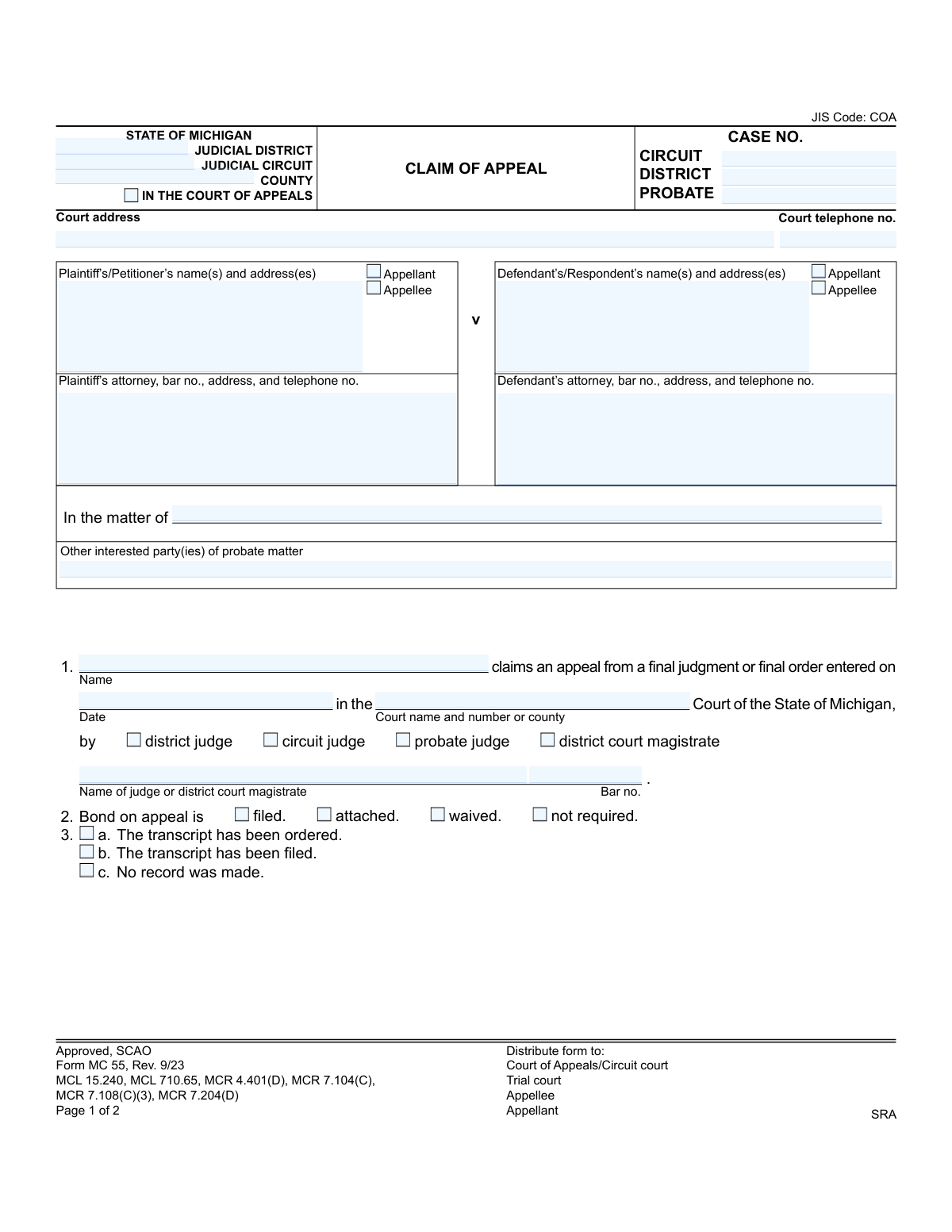
Yes! You can use AI to fill out Form MC 55, Claim of Appeal
Form MC 55, Claim of Appeal, is a legal document used in the Michigan court system to initiate an appeal of a final judgment or order from a circuit, district, or probate court to the Court of Appeals. Filing this form is the first formal step in the appellate process, notifying the courts and all parties involved that a decision is being challenged. Today, this form can be filled out quickly and accurately using AI-powered services like Instafill.ai, which can also convert non-fillable PDF versions into interactive fillable forms.
MC 55 is part of the
court appeal forms, court claim forms and Michigan court forms categories on Instafill.
Our AI automatically handles information lookup, data retrieval, formatting, and form filling.
It takes less than a minute to fill out MC 55 using our AI form filling.
Securely upload your data. Information is encrypted in transit and deleted immediately after the form is filled out.
Form specifications
| Form name: | Form MC 55, Claim of Appeal |
| Number of fields: | 59 |
| Number of pages: | 1 |
| Language: | English |
More forms in Court appeal forms
Instafill Demo: How to fill out PDF forms in seconds with AI
How to Fill Out MC 55 Online for Free in 2026
Are you looking to fill out a MC 55 form online quickly and accurately? Instafill.ai offers the #1 AI-powered PDF filling software of 2026, allowing you to complete your MC 55 form in just 37 seconds or less.
Follow these steps to fill out your MC 55 form online using Instafill.ai:
- 1 Navigate to Instafill.ai and upload or select the Michigan Claim of Appeal, Form MC 55.
- 2 Provide the initial case information, including the judicial district/circuit, county, court address, and case number.
- 3 Enter the names and addresses of the plaintiff/petitioner and defendant/respondent, indicating who is the appellant and who is the appellee, along with their attorney details.
- 4 Specify the details of the final judgment or order being appealed, including the date of entry, the court name, and the name of the judge or magistrate who issued it.
- 5 Indicate the status of the appeal bond (e.g., filed, waived) and the court transcript (e.g., ordered, filed, no record made).
- 6 Check the appropriate boxes if the case involves specific matters such as child custody, guardianship, or a Freedom of Information Act (FOIA) issue.
- 7 Review all the information populated by the AI for accuracy, then sign and date the claim. Complete the Proof of Service section after serving the document to the required parties.
Our AI-powered system ensures each field is filled out correctly, reducing errors and saving you time.
Why Choose Instafill.ai for Your Fillable MC 55 Form?
Speed
Complete your MC 55 in as little as 37 seconds.
Up-to-Date
Always use the latest 2026 MC 55 form version.
Cost-effective
No need to hire expensive lawyers.
Accuracy
Our AI performs 10 compliance checks to ensure your form is error-free.
Security
Your personal information is protected with bank-level encryption.
Frequently Asked Questions About Form MC 55
This form is used to officially begin the process of appealing a final judgment or order from a Michigan district, circuit, or probate court. It notifies the higher court and all parties that you are challenging the lower court's decision.
The person or party who disagrees with a final court order and wants a higher court to review the decision must fill out this form. This party is referred to as the 'Appellant'.
The Appellant is the party filing the appeal to challenge the lower court's decision. The Appellee is the opposing party in the case who responds to the appeal.
You will need your original case number, the date the final judgment was entered, the name of the court and judge who made the decision, and the names and addresses of all other parties involved in the case.
A bond is a financial guarantee you may need to provide to cover the costs of the appeal. You must indicate on the form whether the bond has been filed, is attached, has been waived by the court, or is not required for your type of case.
The transcript is the official written record of the court proceeding. You must state whether you have ordered it from the court reporter, if it has already been filed, or if no record was made.
Section 4 helps the court identify if your case involves high-priority issues like child custody, adoption, or a challenge to a state law. This ensures your case is handled according to any special rules or expedited timelines that may apply.
This section is your sworn statement certifying that you have sent a copy of your Claim of Appeal to all other parties in the case. You must list who you served, the date, and the method of service (personal or mail).
The form must be filed with the Michigan Court of Appeals. You must also provide copies to the trial court that made the original decision and to all other parties (the Appellees).
Yes, you can represent yourself and file this form on your own. However, the appeals process is legally complex, and seeking advice from an attorney is often recommended.
Yes, services like Instafill.ai use AI to accurately auto-fill form fields, which can save you time and help prevent errors. The AI can extract information from your case documents to populate the form.
You can upload the Claim of Appeal PDF to the Instafill.ai platform. The service will make the form fillable online, and you can provide your information to have the fields completed automatically before you download and file it.
If you have a non-fillable or 'flat' PDF, you can use a service like Instafill.ai. It can convert the document into an interactive, fillable form that you can easily complete on your computer.
Compliance MC 55
Validation Checks by Instafill.ai
1
Case Number Consistency Across Pages
This validation ensures that the 'Case No.' field on Page 2 is identical to one of the case number fields ('circuit', 'district', or 'probate') provided on Page 1. This is critical for maintaining document integrity and ensuring all pages of the filing are correctly associated with the same case. A mismatch could lead to the appeal being misfiled or rejected.
2
Logical Appellant and Appellee Designation
This check verifies that there is at least one party designated as 'Appellant' and at least one party designated as 'Appellee' across the plaintiff and defendant sections. It also ensures that no single party is marked as both. This is a fundamental requirement for an appeal, as it defines the opposing sides of the legal action.
3
Final Judgment Date Validity
This validation confirms that the 'final judgment or final order' date is not only present but is also a valid, correctly formatted date. Furthermore, it checks that the date is in the past and not a future date. An invalid or future date would make the claim nonsensical and legally void, as an appeal can only be filed against a judgment that has already occurred.
4
Exclusive Bond Status Selection
This check ensures that exactly one option from the 'Bond on appeal' section ('filed', 'attached', 'waived', 'not required') is selected. Selecting zero or multiple options creates ambiguity regarding the status of the appeal bond, which is a critical procedural step. The system should flag the submission for correction if this rule is violated.
5
Exclusive Transcript Status Selection
This validation verifies that the user has selected exactly one option from the transcript status section ('The transcript has been ordered', 'The transcript has been filed', 'No record was made'). The status of the trial court transcript is essential for the appellate court to understand what records will be available for review. Failure to provide a clear, singular status will halt the processing of the appeal.
6
Exclusive Judge Type Selection
This check ensures that exactly one judge type ('district judge', 'circuit judge', 'probate judge', 'district court magistrate') is selected. This information is crucial for identifying the authority of the judicial officer who made the original ruling. Selecting more than one or none at all would create ambiguity and require manual clarification, delaying the case.
7
Attorney Bar Number Format
This validation checks that if an attorney's name is provided, the corresponding bar number field is also filled and follows the expected Michigan State Bar format (e.g., 'P' followed by digits). A valid bar number is essential for verifying the attorney's credentials and authority to represent their client. An invalid or missing number can lead to rejection of the filing.
8
Proof of Service Completeness
For each 'Proof of Service' entry, this validation ensures that if a name is entered, a corresponding service date and service method ('personal service' or 'first-class mail') are also provided. An incomplete entry is invalid as it fails to provide the necessary details to constitute legal proof of service. The system should reject entries where a name is present but other required service details are missing.
9
Proof of Service Date Logic
This check verifies that the date of service listed in the 'Proof of Service' section is on or after the 'Claim of Appeal' signature date. Serving a document before it has been finalized and signed is logically and legally impossible. This validation prevents clerical errors that could invalidate the proof of service.
10
Required Signatures Presence
This validation confirms that the 'Appellant/Attorney signature' and the 'Proof of Service' signature fields are not empty. While a system cannot verify a physical signature, it can ensure that a digital signature has been applied or a name has been typed in the designated field. A missing signature renders the document legally non-binding and will result in immediate rejection.
11
Lower Court Identification
This check ensures the 'Court name and number or county' field is not empty. This information is vital as it explicitly identifies the lower court from which the appeal originates. Without this, the Court of Appeals cannot locate the original case file or direct communications correctly.
12
Party Identification Completeness
This validation ensures that the names and addresses for at least one plaintiff/petitioner and one defendant/respondent are provided. An appeal cannot proceed without clearly identifying the primary parties involved in the dispute. A failure to provide this information would make the filing incomplete and unprocessable.
13
Court Telephone Number Format
This check validates that the 'Court telephone no.' field contains a properly formatted phone number (e.g., 10 digits with optional hyphens or parentheses). This ensures that court staff can contact the lower court if necessary without dealing with data entry errors. An invalid number can cause unnecessary delays if communication is required.
Common Mistakes in Completing MC 55
Filers often confuse the terms 'Appellant' and 'Appellee.' The Appellant is the party filing the appeal to challenge the lower court's decision, while the Appellee is the party defending that decision. Incorrectly checking these boxes can cause confusion in the case caption and subsequent filings, potentially requiring correction and causing delays. To avoid this, remember that if you are the one filing this form, you are the Appellant.
The date in Section 1 must be the exact date the final judgment or order being appealed was formally entered by the court clerk, not the date of the hearing or the date the judge made a verbal ruling. This date is critical as it starts the clock for the strict appeal deadline. Using the wrong date could lead to the Court of Appeals dismissing the case as untimely. Always refer to the date stamp on the official, written order to ensure accuracy.
Many filers either forget to fill out the 'Proof of Service' section on the second page or complete it incorrectly. This section is not optional; it is a sworn statement certifying that you have legally notified the other parties of the appeal. An appeal filed without a completed Proof of Service is considered defective and can be dismissed by the court. Before filing, ensure you have served all opposing parties and attorneys and have meticulously filled in their names, the date of service, and the method used.
The form requires the bar number for every attorney listed, including the judge. This unique identifier is essential for the court to correctly identify legal professionals. Omitting this information forces court clerks to look it up, causing processing delays and potentially leading to the rejection of the filing until it is corrected. Always have the bar numbers for all attorneys and the judge handy before you begin filling out the form.
In Section 3, a filer might check that the 'transcript has been ordered' without having actually completed the required steps, such as filing the necessary form and paying the court reporter. The transcript of the lower court proceedings is a core part of the appeal record. Incorrectly stating its status can significantly delay the appeal, as the case cannot proceed until the record is complete. To avoid this, you must formally order the transcript from the court reporter before or at the same time as filing the appeal.
Section 4 contains checkboxes for specific case types that are given priority by the court, such as child custody disputes or involuntary mental health cases. Failing to check the appropriate box is a common oversight. This can result in a time-sensitive case being placed in the standard queue, losing its eligibility for expedited review and causing significant, unnecessary delays for the parties involved. Carefully review all options in Section 4 to see if your case qualifies for priority handling.
When specifying the court where the judgment was entered, people often write a generic name like 'District Court' instead of the full, proper name like '48th District Court.' This ambiguity makes it difficult for the Court of Appeals to identify the correct lower court from which to request the case file. This can lead to delays while the clerk seeks clarification. Always use the full and official name of the court as it appears on the original court documents.
A surprising number of forms are submitted without the required signature of the appellant or their attorney, or without the corresponding date. An unsigned legal document is invalid and will be rejected by the court clerk. This can be a fatal error if the filing deadline passes before the mistake is corrected and the form is resubmitted. Always perform a final check of the entire form, paying special attention to the signature lines on both the main claim and the Proof of Service section.
The form requires the lower court's case number to link the appeal to the correct original case. Filers may enter this number incorrectly, omit parts of it, or place it in the wrong field (e.g., putting a District Court number in the Circuit Court box). This error can cause significant administrative problems, including misfiling or an inability to locate the lower court record. To prevent this, carefully copy the complete case number exactly as it appears on the final order you are appealing.
Section 2 requires the filer to declare the status of the appeal bond. Leaving this section blank or choosing the wrong option creates uncertainty for the court and the opposing party. The bond status determines whether the lower court's judgment is stayed (paused) during the appeal. An incorrect selection can lead to improper enforcement of the judgment or delays while the court requests clarification. AI-powered tools like Instafill.ai can help prevent such omissions by flagging required fields and ensuring all necessary selections are made before finalization.
Filers sometimes provide incomplete names or addresses for plaintiffs, defendants, or other interested parties. In probate matters, it's common to forget to list all 'Other interested party(ies)'. This can lead to improper service and notice, potentially jeopardizing the validity of the appeal and causing delays while the information is corrected. It's crucial to list the full, correct name and current address for every single party involved in the case. If the form is a non-fillable PDF, a tool like Instafill.ai can convert it into an easily fillable version, reducing the chance of accidentally skipping a field.
Saved over 80 hours a year
“I was never sure if my IRS forms like W-9 were filled correctly. Now, I can complete the forms accurately without any external help.”
Kevin Martin Green
Your data stays secure with advanced protection from Instafill and our subprocessors

Robust compliance program
Transparent business model
You’re not the product. You always know where your data is and what it is processed for.
ISO 27001, HIPAA, and GDPR
Our subprocesses adhere to multiple compliance standards, including but not limited to ISO 27001, HIPAA, and GDPR.
Security & privacy by design
We consider security and privacy from the initial design phase of any new service or functionality. It’s not an afterthought, it’s built-in, including support for two-factor authentication (2FA) to further protect your account.
Fill out MC 55 with Instafill.ai
Worried about filling PDFs wrong? Instafill securely fills form-mc-55-claim-of-appeal forms, ensuring each field is accurate.