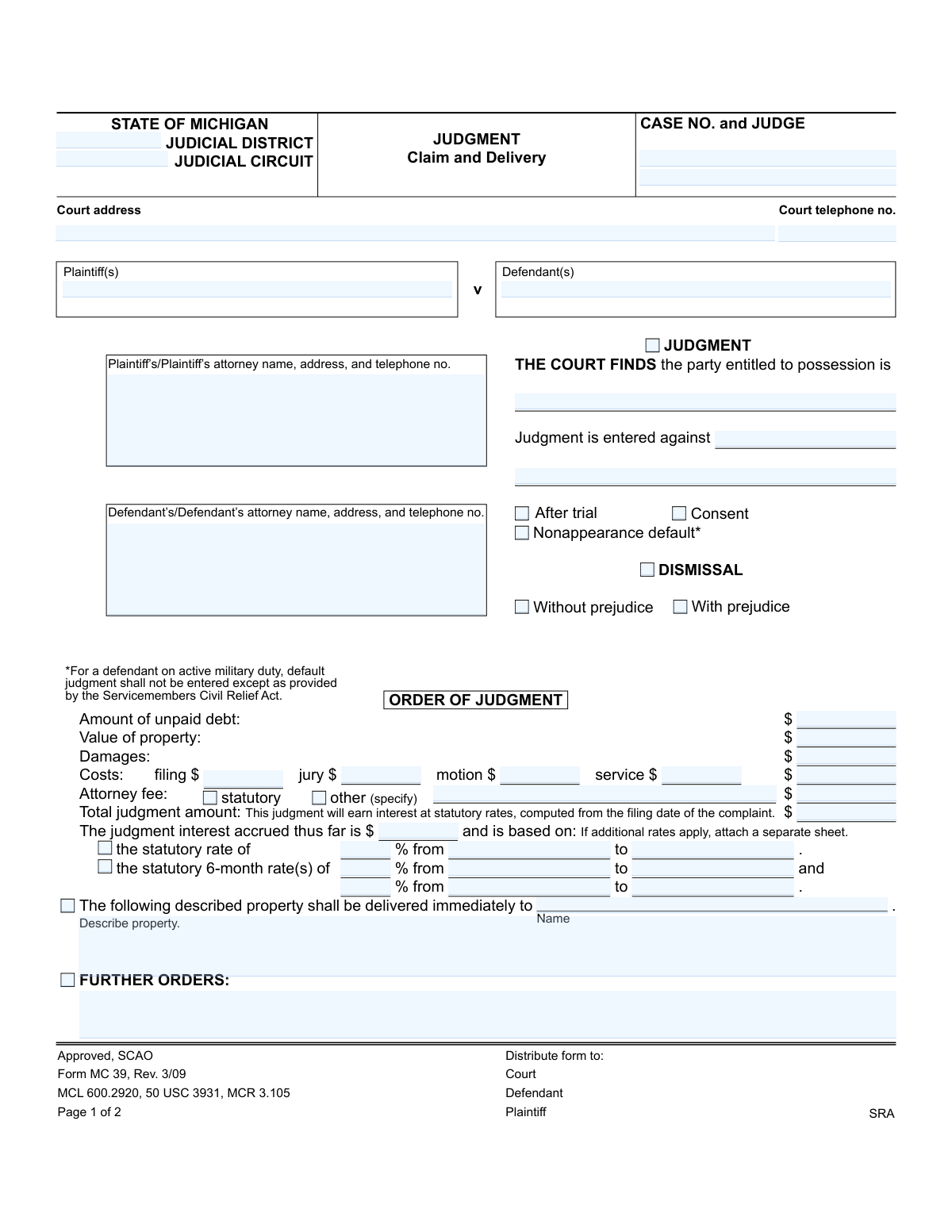
Yes! You can use AI to fill out Form MC 39, Judgment, Claim and Delivery

Form MC 39, Judgment, Claim and Delivery, is a legal document used in the Michigan judicial system to finalize a lawsuit concerning the recovery of personal property. It officially records the court's decision, specifying which party is entitled to possession of the property, the value of the property, and any associated damages or costs awarded. Today, this form can be filled out quickly and accurately using AI-powered services like Instafill.ai, which can also convert non-fillable PDF versions into interactive fillable forms.
MC 39 is part of the court claim forms and Michigan court forms categories on Instafill.
Our AI automatically handles information lookup, data retrieval, formatting, and form filling.
It takes less than a minute to fill out MC 39 using our AI form filling.
Securely upload your data. Information is encrypted in transit and deleted immediately after the form is filled out.

Form specifications

Form name: Form MC 39, Judgment, Claim and Delivery
Number of fields: 55
Number of pages: 1
Language: English
main-image

Instafill Demo: How to fill out PDF forms in seconds with AI

How to Fill Out MC 39 Online for Free in 2026

Are you looking to fill out a MC 39 form online quickly and accurately? Instafill.ai offers the #1 AI-powered PDF filling software of 2026, allowing you to complete your MC 39 form in just 37 seconds or less.
Follow these steps to fill out your MC 39 form online using Instafill.ai:
  1. 1 Navigate to Instafill.ai and upload or select the Michigan Form MC 39.
  2. 2 Provide the case information, including the judicial district/circuit, case number, judge, and court address.
  3. 3 Enter the full names and contact details for the plaintiff(s), defendant(s), and their respective attorneys.
  4. 4 Indicate the court's findings by checking the appropriate boxes for who is entitled to possession and the basis of the judgment (e.g., after trial, consent, default).
  5. 5 Input the specific monetary amounts for unpaid debt, property value, damages, court costs, and attorney fees as ordered by the court.
  6. 6 Clearly describe the property that is to be delivered and list any further orders from the judge.
  7. 7 Review all the AI-populated fields for accuracy before the judgment is signed by the judge and certified by the court clerk.

Our AI-powered system ensures each field is filled out correctly, reducing errors and saving you time.

Why Choose Instafill.ai for Your Fillable MC 39 Form?

Speed

Complete your MC 39 in as little as 37 seconds.

Up-to-Date

Always use the latest 2026 MC 39 form version.

Cost-effective

No need to hire expensive lawyers.

Accuracy

Our AI performs 10 compliance checks to ensure your form is error-free.

Security

Your personal information is protected with bank-level encryption.

Frequently Asked Questions About Form MC 39

This form is a final court order that resolves a 'Claim and Delivery' lawsuit in Michigan. It officially declares who has the right to possess specific property and details any financial awards, such as unpaid debt, damages, or court costs.

The judge signs and issues this form as the court's final decision. However, the attorney for the winning party typically drafts a proposed judgment with all the necessary details for the judge to review and sign.

Claim and Delivery is a legal action to recover possession of specific personal property that is being wrongfully held by someone else. This judgment form is the final ruling that concludes such a case.

A judgment 'After trial' is decided by the judge after hearing evidence. A 'Consent' judgment means both parties agreed to the terms, and a 'Nonappearance default' judgment is entered when one party fails to appear or respond in court.

This section itemizes all money involved in the case, including any unpaid debt, the value of the property, damages awarded, and court costs like filing and service fees. These amounts are totaled to determine the final judgment amount.

The form orders the immediate delivery of the property to the person named. If the other party does not comply voluntarily, you may need to seek further court assistance to enforce the judgment and recover the property.

This is a certification by the court clerk confirming that an official copy of the signed judgment was mailed to all parties or their attorneys. It serves as proof that everyone involved has been formally notified of the court's decision.

This note means the winning party has 28 days from the date the judgment is signed to begin enforcement actions, like seizing property. After 28 days, they may need to provide further notice to the other party and get court permission to proceed with enforcement.

The judgment amount will accrue interest at statutory rates until it is paid. The party who won the judgment can also take further legal action to collect the debt, such as garnishing your wages or seizing assets.

Yes, while the judge issues the final order, attorneys can use services like Instafill.ai to accurately auto-fill a proposed judgment form with case details, saving time and reducing errors before submitting it to the court.

You can use a service like Instafill.ai to convert the flat, non-fillable PDF into an interactive, fillable form. This allows you to easily type information directly into the fields before printing for submission.

Simply upload the MC 39 form to Instafill.ai, and its AI will identify all the fields. You can then quickly input all the case information, financial figures, and party details to generate a clean, completed form ready for submission as a proposed judgment.

You will need the full case details (case number, judge, court), names and addresses of all parties and attorneys, a detailed breakdown of all financial amounts (debt, damages, costs), and a clear description of the property in question.

Compliance MC 39
Validation Checks by Instafill.ai

1
Verifies Total Judgment Amount Calculation
This validation confirms that the 'Total judgment amount' is the correct sum of all preceding financial fields: 'Amount of unpaid debt', 'Value of property', 'Damages', 'Costs', and 'Attorney fee'. This is a crucial integrity check to prevent mathematical errors that could lead to incorrect financial awards and subsequent legal challenges. An incorrect total would invalidate the financial portion of the judgment.
2
Ensures Single Judgment Basis Selection
Validates that only one basis for the judgment is selected from the mutually exclusive options: 'After trial,' 'Consent,' or 'Nonappearance default.' A judgment can only have one legal basis, so selecting multiple options would create a legally ambiguous and invalid document. This check ensures the legal foundation of the judgment is clear and singular.
3
Requires Property Description if Delivery is Ordered
This check validates that if a name is entered in the 'delivery name' field, the 'property description' field must not be empty. An order to deliver property is unenforceable without a clear and unambiguous description of what is to be delivered. This prevents future disputes and ensures the order can be executed correctly by law enforcement or the parties.
4
Validates Case Number Presence and Format
Checks that the 'CASE NO.' field is not empty and follows the expected format for the State of Michigan judicial system. This number is the primary key for identifying the case in all court records and related systems. A missing or malformed case number would make the judgment impossible to file, track, or enforce correctly.
5
Flags Default Judgment for Military Service Verification
If 'Nonappearance default' is selected, this validation flags the submission for a mandatory check against the Servicemembers Civil Relief Act (SCRA). The form explicitly notes that default judgments against active military members have special requirements. This check ensures compliance with federal law and protects the rights of servicemembers, preventing the entry of an illegal judgment.
6
Requires Specification for 'Other' Attorney Fee
If the 'other' checkbox is selected for 'Attorney fee,' this validation ensures that the 'specify attorney fee' text field is filled out. This is necessary to provide a legal basis and explanation for any non-statutory attorney fee award. Failure to specify the reason would make the fee award legally questionable and likely voidable upon review.
7
Ensures Judge's Signature and Date are Present
This is a critical completeness check to verify that the 'Judge signature and date' field is populated. A judgment is not legally valid or enforceable until it has been signed and dated by the presiding judge. A submission lacking this information is merely a draft and has no legal effect, requiring it to be returned for completion.
8
Validates Logical Date Range for Interest Rates
This validation checks that for any interest rate period (e.g., 'sr date 1' to 'sr date 2'), the 'from' date is not after the 'to' date. This ensures the date range for interest calculation is logical and prevents nonsensical or impossible calculations. An invalid date range would make the interest calculation unenforceable and require amendment.
9
Ensures Case Number Consistency Across Pages
This validation verifies that the 'Case No.' field on page 2 is identical to the 'CASE NO.' field on page 1. Maintaining consistency is essential for ensuring that all pages of the document are correctly associated with the same legal case. A mismatch could lead to filing errors or parts of the document being misattributed to another case.
10
Validates Monetary Field Formatting
This check ensures that all fields representing dollar amounts ('unpaid debt', 'property value', 'damages', 'costs', etc.) contain valid numerical data, formatted as currency. This prevents data entry errors, such as including text or non-numeric symbols, which would corrupt financial calculations. It is fundamental for the accuracy of the financial orders in the judgment.
11
Requires Identification of Party Entitled to Possession
This validation ensures that the field 'party entitled to possession' is filled out, identifying either the plaintiff or defendant. This is the core finding in a Claim and Delivery action, determining who has the legal right to the property in question. Omitting this information would make the primary purpose of the judgment unclear and unenforceable.
12
Validates Certificate of Mailing Date Logic
This check ensures the 'COM date' (Certificate of Mailing date) is a valid date and is on or after the 'Judge signature and date'. The judgment cannot be mailed before it is officially signed and granted by the judge. This validation maintains the logical and procedural integrity of the court's notification process.
13
Ensures Single Dismissal Type Selection
If the 'DISMISSAL' box is checked, this validation ensures that only one dismissal type, either 'With prejudice' or 'Without prejudice,' is also selected. These two options have fundamentally different legal consequences for future litigation. Selecting both or neither when a dismissal is indicated would render the order ambiguous and legally defective.

Common Mistakes in Completing MC 39

Incorrect or Incomplete Case Number

Users often enter the case number incorrectly, omitting the year prefix, the case type code, or using dashes instead of slashes. This happens due to carelessness or unfamiliarity with court-specific formatting. An incorrect case number can lead to the judgment being misfiled or rejected by the court clerk, causing significant delays and preventing the judgment from being linked to the correct court record.

Calculation Errors in Monetary Awards

Manually adding the various costs, damages, and unpaid debt to arrive at the 'Total judgment amount' is highly prone to error. People often miscalculate the sum of filing, motion, service, and other costs. A mistake here results in an incorrect judgment amount, which can lead to legal challenges, disputes over payment, and the need for a corrected order, wasting time and resources for all parties.

Vague or Ambiguous Property Description

In the section for property to be delivered, filers may use generic descriptions like 'the car' or 'the equipment'. This is insufficient for legal enforcement. The consequence is that the order may be unenforceable, as law enforcement or the opposing party cannot definitively identify the specific property. To avoid this, provide a detailed description including make, model, serial numbers, VINs, or any other unique identifiers.

Incorrect Statutory Interest Calculation

The interest calculation section is complex, with options for different rates and date ranges. Users frequently misinterpret the statutory requirements or make mathematical errors when calculating the interest accrued. This leads to an incorrect total judgment value, which can shortchange the plaintiff or unfairly burden the defendant, often requiring later court action to amend the judgment.

Incomplete or Inaccurate Party Information

Mistakes such as misspelling plaintiff or defendant names, or providing outdated addresses for attorneys, are very common. These errors often occur due to simple typos or not verifying the latest information. The primary consequence is a failure of service; if parties don't receive the final judgment, it can invalidate deadlines for appeals or enforcement actions and lead to due process challenges.

Conflicting Basis for Judgment Selection

A user might inadvertently check multiple boxes indicating the basis for the judgment, such as checking both 'After trial' and 'Consent'. This creates ambiguity about the legal foundation of the judgment. Such a contradiction can render the judgment defective and unenforceable until a corrected version is submitted and signed by the judge, delaying the resolution of the case.

Failure to Specify 'Other' Attorney Fees

When claiming attorney fees under the 'other' category, filers often check the box but forget to provide a specific reason or statutory basis in the provided space. This omission makes the fee award vulnerable to being challenged and potentially disallowed by the court or on appeal. Always provide a clear, concise justification for any non-standard attorney fee request.

Omitting Information on the Certificate of Mailing

The 'Certificate of Mailing' on page 2 is often overlooked or left incomplete by the party preparing the proposed judgment for the court clerk. If the clerk fails to sign and date this section, there is no official record that the judgment was mailed to all parties. This can create a critical flaw in the proof of service, allowing a party to later claim they never received notice of the judgment.

Inconsistent Information Between Pages

A simple but frequent mistake is entering a slightly different case number or party name on page 2 than what is on page 1. This clerical error happens during manual data entry and can cause confusion and processing delays. It's crucial to ensure all identifying information is identical across all pages of the document to maintain its integrity.

Submitting a Proposed Judgment Without All Necessary Figures

Parties may submit the proposed judgment to the judge with monetary fields like 'Damages' or 'Costs' left blank, expecting the court to fill them in. This is incorrect; the party seeking the judgment is responsible for providing all calculated amounts for the judge's review. An incomplete form will be returned, delaying the entry of the final judgment. AI-powered tools like Instafill.ai can help prevent these errors by validating data, performing calculations, and ensuring all required fields are completed before submission. Since this form is often a non-fillable PDF, Instafill.ai can also convert it into an interactive, fillable version to streamline the process.
Saved over 80 hours a year

“I was never sure if my IRS forms like W-9 were filled correctly. Now, I can complete the forms accurately without any external help.”

Kevin Martin Green

Your data stays secure with advanced protection from Instafill and our subprocessors

Robust compliance program

Transparent business model

You’re not the product. You always know where your data is and what it is processed for.

ISO 27001, HIPAA, and GDPR

Our subprocesses adhere to multiple compliance standards, including but not limited to ISO 27001, HIPAA, and GDPR.

Security & privacy by design

We consider security and privacy from the initial design phase of any new service or functionality. It’s not an afterthought, it’s built-in, including support for two-factor authentication (2FA) to further protect your account.

Fill out MC 39 with Instafill.ai

Worried about filling PDFs wrong? Instafill securely fills form-mc-39-judgment-claim-and-delivery forms, ensuring each field is accurate.