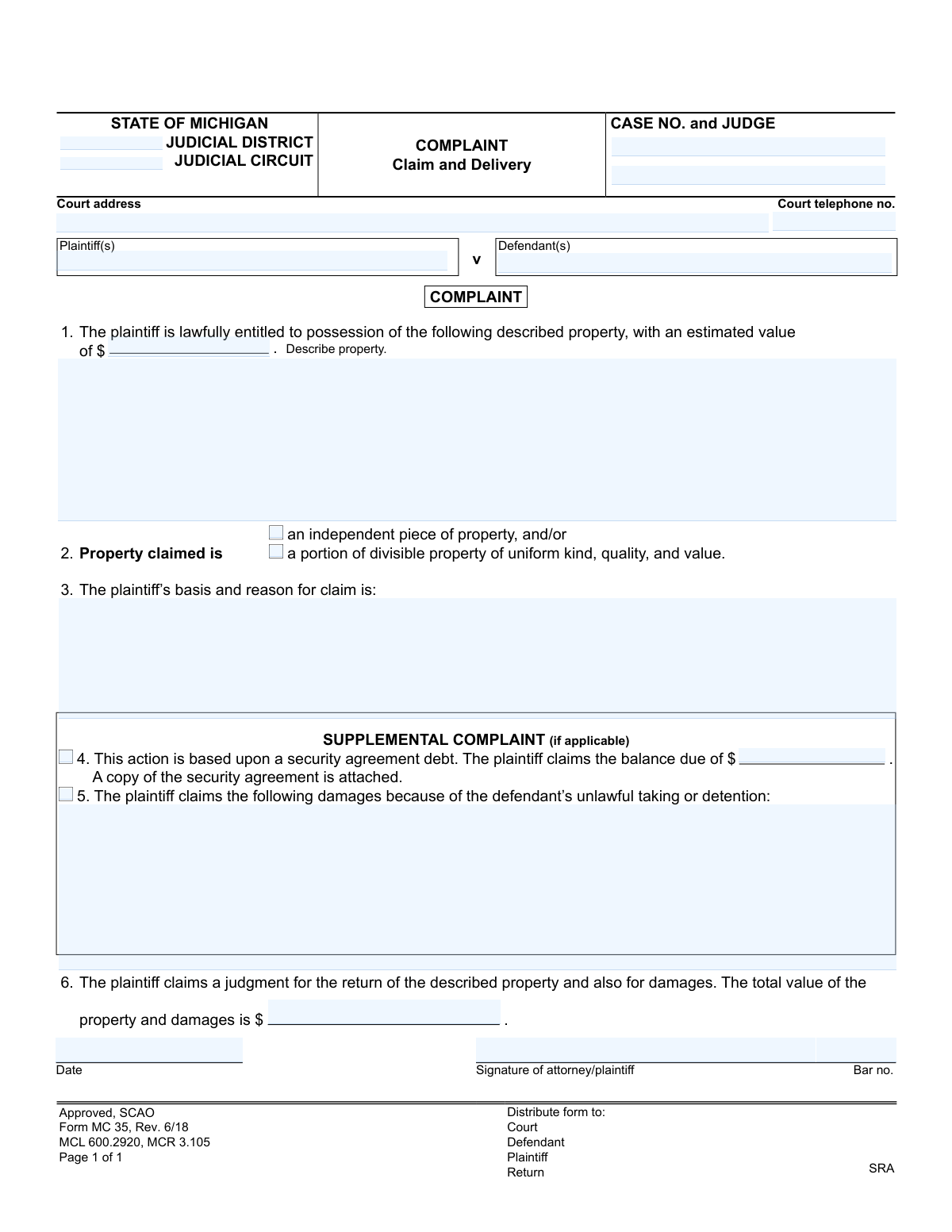
Yes! You can use AI to fill out Form MC 35, Complaint, Claim and Delivery

Form MC 35, Complaint, Claim and Delivery, is a legal document filed in Michigan courts to start a lawsuit to reclaim possession of specific personal property from someone who is wrongfully holding it. It allows the plaintiff to describe the property, state its value, and explain the legal basis for their right to possession, as well as claim damages. Today, this form can be filled out quickly and accurately using AI-powered services like Instafill.ai, which can also convert non-fillable PDF versions into interactive fillable forms.
MC 35 is part of the court claim forms and Michigan court forms categories on Instafill.
Our AI automatically handles information lookup, data retrieval, formatting, and form filling.
It takes less than a minute to fill out MC 35 using our AI form filling.
Securely upload your data. Information is encrypted in transit and deleted immediately after the form is filled out.

Form specifications

Form name: Form MC 35, Complaint, Claim and Delivery
Number of fields: 21
Number of pages: 1
Language: English
main-image

Instafill Demo: How to fill out PDF forms in seconds with AI

How to Fill Out MC 35 Online for Free in 2026

Are you looking to fill out a MC 35 form online quickly and accurately? Instafill.ai offers the #1 AI-powered PDF filling software of 2026, allowing you to complete your MC 35 form in just 37 seconds or less.
Follow these steps to fill out your MC 35 form online using Instafill.ai:
  1. 1 Navigate to Instafill.ai and upload or select the Michigan Complaint, Claim and Delivery (Form MC 35).
  2. 2 Provide the court information, including the judicial district, circuit, case number, and judge's name.
  3. 3 Enter the full names and addresses for both the plaintiff(s) and defendant(s) as prompted by the AI.
  4. 4 Describe the property you are seeking to recover, its estimated value, and the legal basis for your claim.
  5. 5 If the action is based on a security agreement debt, provide the balance due and attach a copy of the agreement.
  6. 6 Detail any monetary damages you are claiming due to the defendant's unlawful taking or detention of the property.
  7. 7 Review all entered information for accuracy, then use the platform to sign, date, and download the completed MC 35, ready for filing.

Our AI-powered system ensures each field is filled out correctly, reducing errors and saving you time.

Why Choose Instafill.ai for Your Fillable MC 35 Form?

Speed

Complete your MC 35 in as little as 37 seconds.

Up-to-Date

Always use the latest 2026 MC 35 form version.

Cost-effective

No need to hire expensive lawyers.

Accuracy

Our AI performs 10 compliance checks to ensure your form is error-free.

Security

Your personal information is protected with bank-level encryption.

Frequently Asked Questions About Form MC 35

This form is used in Michigan to initiate a lawsuit to recover personal property that you believe is being wrongfully held by someone else. It serves as the official complaint filed with the court to demand the property's return.

The 'plaintiff' is the person or company who is lawfully entitled to the property and is filing the form. The 'defendant' is the person or company currently in possession of the property who is being sued for its return.

You must provide a clear description of the property you are trying to recover and a reasonable, good-faith estimate of its current market value.

This is where you must briefly explain the legal reason you are entitled to the property. For example, you could state that you are the titled owner or that the defendant defaulted on a purchase agreement.

Complete this section only if your claim is based on a debt secured by the property, such as a car loan. You must state the balance due and attach a copy of the security agreement.

Yes, if your claim is based on a security agreement as mentioned in the 'Supplemental Complaint' section, you must attach a copy of that agreement.

You can claim monetary damages for losses incurred due to the defendant's unlawful possession of the property. This could include lost revenue, rental costs for a replacement, or repair costs if the property was damaged.

After filing, the complaint must be formally served on the defendant. The court will then manage the case, which may lead to a hearing or trial to determine who has the right to the property.

Yes, services like Instafill.ai use AI to accurately auto-fill form fields from your saved information, which can save you significant time and help prevent errors.

You can use a service like Instafill.ai to upload the form and fill it out electronically. The platform allows you to easily type in your information, save your progress, and ensure all fields are completed correctly before printing.

If you have a non-fillable or 'flat' PDF, you can use a tool like Instafill.ai. It can convert the non-fillable PDF into an interactive, fillable form that you can complete on your computer.

An 'independent piece' is a unique item, like a specific vehicle. A 'portion of divisible property' refers to a quantity of items that are identical and interchangeable, such as 100 bushels of wheat from a larger silo.

The complaint must be signed and dated by the plaintiff or the plaintiff's attorney. If an attorney signs, they must also provide their bar number.

Compliance MC 35
Validation Checks by Instafill.ai

1
Ensures Plaintiff and Defendant are Identified
This validation checks that the Plaintiff(s) and Defendant(s) fields are not empty. These fields are fundamental to any legal action, as they identify the parties involved. A complaint that fails this check is legally deficient and cannot be filed, as the court would not know who is suing whom.
2
Verifies Property Description is Provided
This check ensures the text area for describing the property is filled out. In a 'Claim and Delivery' action, the specific property to be recovered is the subject of the lawsuit. If the property is not adequately described, the complaint is ambiguous, and a court cannot issue a meaningful order for its return.
3
Validates Format of Estimated Property Value
This validation ensures the 'estimated value' field contains a valid numerical currency value, allowing for numbers, commas, and a decimal point. This value is critical for determining the court's jurisdiction and potential bond amounts. An invalid format would cause calculation errors and prevent the form from being processed correctly.
4
Ensures Exclusive Selection of Property Type
This check verifies that exactly one of the two checkboxes, 'an independent piece of property' or 'a portion of divisible property', is selected. This selection clarifies the nature of the property for the court and affects how it may be seized or valued. If neither or both are selected, the form is ambiguous and should be rejected for clarification.
5
Confirms Basis for Claim is Articulated
This validation confirms that the 'plaintiff’s basis and reason for claim' field is not empty. This section is the legal heart of the complaint, explaining why the plaintiff is lawfully entitled to the property. A submission without this information lacks a stated cause of action and would be dismissed by the court.
6
Conditional Validation for Security Agreement Debt
This check is triggered if the 'This action is based upon a security agreement debt' option is selected. It then validates that the 'balance due' field is filled with a valid, non-zero monetary amount. This ensures that when a secured debt is the basis for the claim, the specific amount owed is clearly stated as required for the court's record.
7
Verifies Consistency of Total Value Calculation
This validation checks if the 'total value of the property and damages' is equal to the sum of the 'estimated value' and the 'damages' fields. This acts as a safeguard against clerical errors that could lead to incorrect judgments or filing fees. If the values do not add up, the system should flag the discrepancy for user review and correction.
8
Validates Signature Date Format and Plausibility
This check ensures the 'Date' field contains a valid date in a standard format (e.g., MM/DD/YYYY) and is not a date in the future. The signature date establishes the timeline of the legal filing and attests to the information's accuracy at that time. An invalid or future date would render the document's timing questionable and could lead to its rejection.
9
Conditional Validation of Attorney Bar Number
This validation checks that if the form is signed by an attorney, the 'Bar no.' field is populated and conforms to the expected state format (e.g., 'P' followed by digits in Michigan). This is essential for verifying the attorney's credentials and authority to practice before the court. A missing or invalid bar number could cause the filing to be rejected pending verification.
10
Ensures Court and Case Identifiers are Present
This check verifies that the 'Judicial District/Circuit' and 'Case No.' fields are filled, if a case number has been assigned. These identifiers are essential for routing the document to the correct court and associating it with the correct case file. A submission lacking this information cannot be filed or docketed correctly.
11
Validates Court Telephone Number Format
This check ensures the 'Court telephone no.' field, if provided, contains a valid 10-digit phone number, potentially with standard formatting. While often pre-filled, validating this ensures that any manually entered court contact information is usable and correctly formatted. An invalid number could hinder communication between parties and the court.
12
Verifies Signature Field Completion
For digital submissions, this check ensures that the 'Signature' field has been acted upon, either through a digital signature process or by typing a name in a designated e-signature field. The signature is fundamental for attesting to the truthfulness of the complaint under penalty of perjury. An unsigned complaint has no legal effect and will be rejected outright.

Common Mistakes in Completing MC 35

Incorrect or Incomplete Court Information

Filers, especially those without legal representation, often do not know the specific Judicial District or Circuit for their case. Entering incorrect information can lead to the complaint being filed in the wrong jurisdiction, causing significant delays or outright rejection of the filing. To avoid this, verify the correct court using the Michigan Courts website; AI-powered tools like Instafill.ai can also help by pre-populating correct court details based on a provided address or case type.

Vague or Ambiguous Property Description

The form requires a clear description of the property, but filers often provide generalities like 'a vehicle' instead of specifics like 'a 2021 Red Ford F-150, VIN...'. This ambiguity can make the claim unenforceable and lead to dismissal, as the court and defendant don't know exactly what property is at issue. Always include unique identifiers like serial numbers, VINs, or detailed physical descriptions to ensure the claim is precise.

Unsubstantiated Property Valuation

The 'estimated value' must be a reasonable, good-faith estimate of the property's current market value, not the original purchase price. People often guess or inflate this value, which can affect filing fees and court jurisdiction, and can be challenged by the defendant. This mistake can discredit the filer and delay the case; research comparable items for sale to determine a realistic value before filling out the form.

Insufficient Explanation for Basis of Claim

Section 3 requires the legal reason why the plaintiff is entitled to the property, but many filers provide a long story of events without stating a clear legal basis like ownership or a superior lien. A weak or purely emotional explanation is not legally sufficient and can lead to the complaint being dismissed for failure to state a claim. The statement must clearly and concisely articulate the legal right to possession.

Forgetting to Attach Required Security Agreement

When a claim is based on a security agreement debt, the form explicitly requires a copy of the agreement to be attached. It is a very common oversight to forget this attachment, which renders the supplemental complaint incomplete. This will result in a deficiency notice from the court, halting the proceedings until the document is properly filed and served.

Inconsistent or Incorrect Financial Calculations

The form requires several financial figures, including property value, balance due, and damages, which must add up correctly in the 'total value' field. Filers often make simple arithmetic errors or list numbers that don't align, undermining their credibility. To avoid this, double-check all calculations before submission. Using an AI-powered tool like Instafill.ai can prevent these errors by performing calculations automatically and ensuring consistency across related fields.

Using an Outdated Version of the Form

Court forms are periodically updated, as noted by the 'Rev. 6/18' on this form. Using an older, obsolete version is a frequent mistake that can cause the court clerk to reject the filing immediately, wasting time and filing fees. Always ensure you have the most current version by downloading it directly from the official SCAO (State Court Administrative Office) website before you begin. If you only have a flat PDF, a tool like Instafill.ai can convert it into a fillable version.

Incorrectly Identifying Plaintiff and Defendant

Parties representing themselves sometimes get confused and reverse the roles of plaintiff and defendant on the form. The plaintiff is the party filing the complaint, and the defendant is the party the complaint is against. This seemingly simple error will cause the filing to be rejected and require a complete, corrected refiling, wasting significant time and effort.

Claiming Non-Recoverable Damages

In the damages section, filers may attempt to claim damages that are not legally recoverable in this type of action, such as emotional distress or speculative business losses. These claims are typically struck by the court and can weaken the overall case. Damages should be limited to actual, provable financial losses resulting directly from the unlawful detention of the property.

Improperly Handling the 'Case No.' and 'Judge' Fields

For a new filing, the 'Case No.' and 'Judge' fields are assigned by the court clerk upon submission. Filers often mistakenly leave them blank without understanding why, or they write 'To be assigned,' which can cause processing confusion. This can delay the official filing of the complaint. It is best to confirm the local court's specific procedure, but generally, these fields should be left blank for the clerk to complete.

Incorrectly Filling the Attorney/Signature Section

Attorneys sometimes forget to include their bar number, which is required for identification and can delay processing. Self-represented (pro se) plaintiffs may be confused by the 'Bar no.' field and either leave the signature area blank or fill it in incorrectly. A pro se litigant should sign and date the form, and can simply leave the bar number field blank or write 'Pro Se'.

Misclassifying the Property Type

The form asks if the property is 'an independent piece' or 'a portion of divisible property,' and filers can be unsure which to choose. For example, is one chair from a matching dining set 'independent' or a 'portion'? Misclassifying this can complicate legal arguments and the remedy ordered by the court. Careful consideration of the property's nature and how it relates to other items is required before checking the box.
Saved over 80 hours a year

“I was never sure if my IRS forms like W-9 were filled correctly. Now, I can complete the forms accurately without any external help.”

Kevin Martin Green

Your data stays secure with advanced protection from Instafill and our subprocessors

Robust compliance program

Transparent business model

You’re not the product. You always know where your data is and what it is processed for.

ISO 27001, HIPAA, and GDPR

Our subprocesses adhere to multiple compliance standards, including but not limited to ISO 27001, HIPAA, and GDPR.

Security & privacy by design

We consider security and privacy from the initial design phase of any new service or functionality. It’s not an afterthought, it’s built-in, including support for two-factor authentication (2FA) to further protect your account.

Fill out MC 35 with Instafill.ai

Worried about filling PDFs wrong? Instafill securely fills form-mc-35-complaint-claim-and-delivery forms, ensuring each field is accurate.