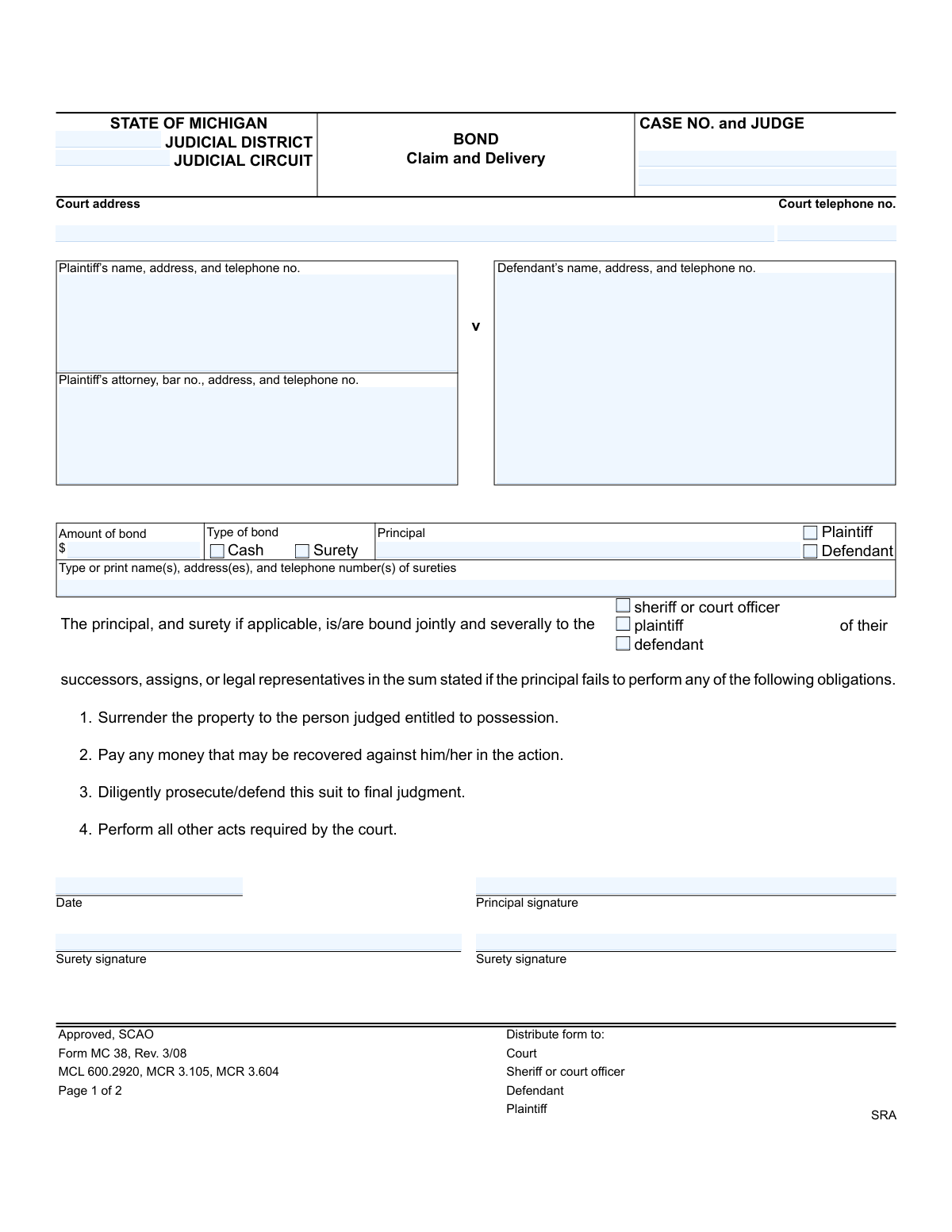
Yes! You can use AI to fill out Form MC 38, Bond, Claim and Delivery
The Michigan Form MC 38, Bond for Claim and Delivery, is a legal document filed in a judicial circuit or district court to secure a bond in a civil action for the recovery of personal property. It guarantees that the principal party will surrender the property, pay any recovered money, and fulfill all court requirements as ordered by the judge. Today, this form can be filled out quickly and accurately using AI-powered services like Instafill.ai, which can also convert non-fillable PDF versions into interactive fillable forms.
Our AI automatically handles information lookup, data retrieval, formatting, and form filling.
It takes less than a minute to fill out MC 38 using our AI form filling.
Securely upload your data. Information is encrypted in transit and deleted immediately after the form is filled out.
Form specifications
| Form name: | Form MC 38, Bond, Claim and Delivery |
| Number of fields: | 35 |
| Number of pages: | 1 |
| Language: | English |
More forms in Court claim forms
Instafill Demo: How to fill out PDF forms in seconds with AI
How to Fill Out MC 38 Online for Free in 2026
Are you looking to fill out a MC 38 form online quickly and accurately? Instafill.ai offers the #1 AI-powered PDF filling software of 2026, allowing you to complete your MC 38 form in just 37 seconds or less.
Follow these steps to fill out your MC 38 form online using Instafill.ai:
- 1 Navigate to Instafill.ai and upload or select the MC 38 Bond, Claim and Delivery form.
- 2 Provide the case information, including the court, case number, judge, and the names and addresses of the plaintiff and defendant.
- 3 Specify the bond details, such as the total amount and whether it is a cash or surety bond.
- 4 Identify the principal (plaintiff or defendant) and provide the names and contact information for any sureties involved.
- 5 Review the information auto-filled by the AI for accuracy and completeness, making any necessary corrections.
- 6 The principal and sureties must sign the form. This can be done electronically or by printing the form for wet ink signatures.
- 7 If required, have the surety acknowledgments sworn and notarized before filing the approved bond with the court and distributing copies to all relevant parties.
Our AI-powered system ensures each field is filled out correctly, reducing errors and saving you time.
Why Choose Instafill.ai for Your Fillable MC 38 Form?
Speed
Complete your MC 38 in as little as 37 seconds.
Up-to-Date
Always use the latest 2026 MC 38 form version.
Cost-effective
No need to hire expensive lawyers.
Accuracy
Our AI performs 10 compliance checks to ensure your form is error-free.
Security
Your personal information is protected with bank-level encryption.
Frequently Asked Questions About Form MC 38
This form is a legal bond used in a Michigan lawsuit to recover property. It acts as a financial guarantee that the person taking possession of the property will return it or pay its value if the court ultimately rules against them.
The party in a lawsuit who wants to take immediate possession of disputed property before a final court judgment must fill out this form. This person is known as the 'principal' on the bond.
A cash bond requires you to deposit the full bond amount in cash with the court. A surety bond involves a third party (a person or company) who promises to pay the bond amount if you fail to meet your legal obligations.
A surety is a person or company that agrees to be financially responsible for the bond. The form requires the surety to swear that their personal worth is at least twice the bond amount, over and above all their debts.
The bond amount is set by the court, as specified in MCR 3.105. It is typically based on the value of the property being seized, often at least double the value to cover potential costs and damages.
The principal is the person whose obligations are guaranteed by the bond. In a Claim and Delivery action, this is usually the plaintiff seeking to recover property, but it can also be the defendant in certain circumstances.
Yes, the second page of the form includes a section that must be completed and signed by a notary public or deputy court clerk. The surety must sign in the presence of the notary.
Once the form is completed, signed, and notarized, it must be submitted to the court for a judge's approval and filing. Copies must then be distributed to the court, the sheriff/court officer, the defendant, and the plaintiff.
If the principal fails to surrender the property or pay money as ordered by the court, the bond can be forfeited. This means the surety will be legally required to pay the opposing party up to the full amount of the bond.
Yes, services like Instafill.ai use AI to accurately auto-fill form fields with your case and personal information, which helps save time and reduce errors.
To fill out this form online, you can upload it to a platform like Instafill.ai. The tool will make the form fillable, allowing you to type in your information, select checkboxes, and add your signature electronically before downloading or printing.
You can use a service like Instafill.ai, which can convert flat, non-fillable PDFs into interactive forms that you can easily complete and sign online.
The Case Number and Judge's name are assigned by the court when the lawsuit is first filed. This information will be present on all official court documents related to your case.
Compliance MC 38
Validation Checks by Instafill.ai
1
Case Number Format and Presence
This check verifies that the 'CASE NO.' field is not empty and conforms to the standard Michigan court case number format. A valid case number is essential for associating the bond with the correct legal action in the court's records. If the format is incorrect or the field is empty, the form submission should be rejected to prevent filing errors and delays.
2
Bond Amount is a Positive Number
Validates that the 'Amount of bond' field contains only a positive numeric value, allowing for decimals. This is critical as the bond amount represents a specific financial liability and must be clearly and accurately defined. An invalid or non-positive entry would make the bond legally unenforceable and should block submission until corrected.
3
Exclusive Bond Type Selection
Ensures that either 'Cash' or 'Surety' is selected for 'Type of bond', but not both. The type of bond determines the source of the financial guarantee and dictates which subsequent sections of the form are required. Failure to select one and only one type creates ambiguity and should prompt the user to make a clear choice.
4
Conditional Surety Information Requirement
This validation checks that if 'Surety' is selected as the 'Type of bond', then the surety name(s), address(es), telephone number(s), and signature(s) are provided. A surety bond is invalid without a clearly identified and committed surety. If the bond type is 'Surety' and this information is missing, the form is incomplete and cannot be processed.
5
Attorney Bar Number Format
Verifies that the 'bar no.' for the plaintiff's attorney is present and follows the format for a Michigan State Bar number (e.g., 'P' followed by five digits). This number uniquely identifies the attorney and confirms their license to practice, which is a requirement for legal representation. An invalid or missing bar number could indicate an unauthorized representative and must be corrected.
6
Notary Commission Expiration Date
This check ensures the 'My commission expires on' date for the notary public is a valid future date. It also validates that this expiration date is after the date the document was 'Subscribed and sworn to'. A document notarized by someone with an expired commission is legally invalid, so this check is crucial for the bond's enforceability.
7
Logical Date Sequence
Confirms that the 'Subscribed and sworn to before me on' date is on or after the primary 'Date' field where the principal and sureties sign. A notary cannot witness a signature that has not yet occurred. This logical check prevents the creation of a legally questionable document with impossible timelines.
8
Required Party Information
Ensures that the names and addresses for both the plaintiff and defendant are fully provided. These fields are fundamental to identifying the primary parties involved in the legal action and the bond. Missing this information would render the document ambiguous and legally insufficient, so the submission should be blocked until it is complete.
9
Exclusive Principal Selection
Validates that either 'Plaintiff' or 'Defendant' is selected as the 'Principal', but not both. The principal is the party whose obligations are being guaranteed by the bond. Ambiguity on this point would make it unclear who is bound by the bond's terms, making the form invalid until a single principal is chosen.
10
Surety Acknowledgment of Worth
This check verifies that if the bond type is 'Surety', the acknowledgment section on page 2 is completed, including the surety signatures. This section is a sworn statement that the sureties have sufficient personal assets to cover the bond amount. Without this sworn acknowledgment, the financial backing of the surety is not legally affirmed, and the bond is incomplete.
11
Telephone Number Format
This validation inspects all telephone number fields (court, plaintiff, defendant, attorney, sureties) to ensure they conform to a standard 10-digit format, with or without formatting characters. Correct contact information is vital for communication between the court, officers, and all parties involved. The system should flag improperly formatted numbers to ensure they are corrected before submission.
12
Principal Signature Presence
Verifies that the 'Principal signature' field has been signed (e.g., a digital signature is applied or a confirmation checkbox is ticked). The principal's signature is the primary act that binds them to the obligations listed on the bond. A bond without the principal's signature is not a valid contract and is completely unenforceable.
13
Exclusive 'Bound To' Recipient
Ensures that only one recipient ('sheriff or court officer', 'plaintiff', or 'defendant') is selected as the party to whom the principal and surety are bound. This selection clarifies who can make a claim against the bond. Selecting more than one or none at all creates legal ambiguity and the form should be considered incomplete.
14
Notary County Validation
This check validates that the notary's county of commission is provided. If the 'Acting in the County of' field is filled out, it confirms that the notary is legally permitted to act in that location. This is essential for verifying the legitimacy of the notarization, as notaries have specific geographic jurisdictions.
Common Mistakes in Completing MC 38
Users often get confused about whether to select 'Plaintiff' or 'Defendant' as the 'Principal'. The principal is the party who is required to post the bond to secure the property or fulfill a court obligation. Selecting the wrong party misrepresents who is legally bound by the bond's terms, which can lead to the bond being rejected by the court and significant delays in the case. To avoid this, carefully read the court order or legal context that requires the bond to determine which party is responsible for posting it.
When a 'Surety' bond is chosen, filers frequently leave the surety's name, address, and phone number fields blank or incomplete. This information is critical for the court and opposing party to verify the surety's identity and financial standing. An incomplete form will be rejected, rendering the bond invalid until the information is provided and properly filed. Ensure all surety details are typed or printed legibly and completely.
A common error is for sureties to sign the form without having their signatures notarized on the second page. The 'Subscribed and sworn to before me' section is a legal oath that must be witnessed by a notary public. Skipping this step invalidates the surety's obligation and the bond itself, causing the court to reject the filing. Sureties must sign in the physical or remote presence of a licensed notary.
Sureties often sign page two without fully understanding the declaration that they are worth 'twice the penalties in the bond, over and above all debts and legal exemptions.' This is a serious financial commitment and a sworn statement of their net worth. Misrepresenting this can have severe legal consequences, including perjury charges. Sureties must accurately assess their financial situation before signing this legally binding acknowledgment.
Filers may enter an incorrect dollar amount for the bond, either through a typo or misunderstanding the court's order. The bond amount is a critical term set by the court or statute, and any discrepancy will cause the filing to be rejected. This mistake delays the legal process until a corrected bond is submitted. Always double-check the court order or relevant legal documents to confirm the exact amount required before filling out the form.
The top section of the form requires specific case details like 'CASE NO. and JUDGE,' 'JUDICIAL DISTRICT,' and 'JUDICIAL CIRCUIT.' People often leave these fields blank or provide illegible handwritten information, making it impossible for the clerk to file the document correctly. This leads to the document being returned and can cause you to miss important deadlines. Using an AI-powered tool like Instafill.ai can help by auto-filling and validating this information from a case file, ensuring accuracy and legibility.
The form explicitly lists who must receive a copy: the Court, Sheriff, Defendant, and Plaintiff. A frequent mistake is to only file the bond with the court and neglect to serve it on the other required parties. This failure constitutes improper service, which can lead to procedural delays, motions to set aside the bond, or other legal challenges from the opposing party. Always create and distribute copies as instructed on the form.
The form requires the filer to specify who the principal is 'bound to' by checking 'sheriff or court officer,' 'plaintiff,' or 'defendant.' This choice defines the beneficiary of the bond's guarantee. Choosing the wrong party can misdirect the legal obligation and render the bond ineffective for its intended purpose, leading to rejection or future legal disputes. The correct party is typically the one who would suffer damages if the principal fails to perform their obligations.
This court form is often available as a non-fillable PDF, forcing users to print and complete it by hand. This results in common errors like illegible handwriting, information written outside the designated fields, and missed sections. Such submissions can be rejected by court clerks for being unprofessional or unreadable. Tools like Instafill.ai can convert these flat PDFs into interactive, fillable forms, ensuring all data is neat, properly placed, and easy to read.
When a party is represented by an attorney, it is a common oversight to omit the attorney's state bar number. This number is a required piece of information for all court filings as it uniquely identifies the attorney of record. Leaving it out can cause the clerk's office to reject the document or require an amended filing, creating unnecessary administrative hurdles and delays. AI form-filling tools can store and automatically populate this information to prevent such errors.
Saved over 80 hours a year
“I was never sure if my IRS forms like W-9 were filled correctly. Now, I can complete the forms accurately without any external help.”
Kevin Martin Green
Your data stays secure with advanced protection from Instafill and our subprocessors

Robust compliance program
Transparent business model
You’re not the product. You always know where your data is and what it is processed for.
ISO 27001, HIPAA, and GDPR
Our subprocesses adhere to multiple compliance standards, including but not limited to ISO 27001, HIPAA, and GDPR.
Security & privacy by design
We consider security and privacy from the initial design phase of any new service or functionality. It’s not an afterthought, it’s built-in, including support for two-factor authentication (2FA) to further protect your account.
Fill out MC 38 with Instafill.ai
Worried about filling PDFs wrong? Instafill securely fills form-mc-38-bond-claim-and-delivery forms, ensuring each field is accurate.