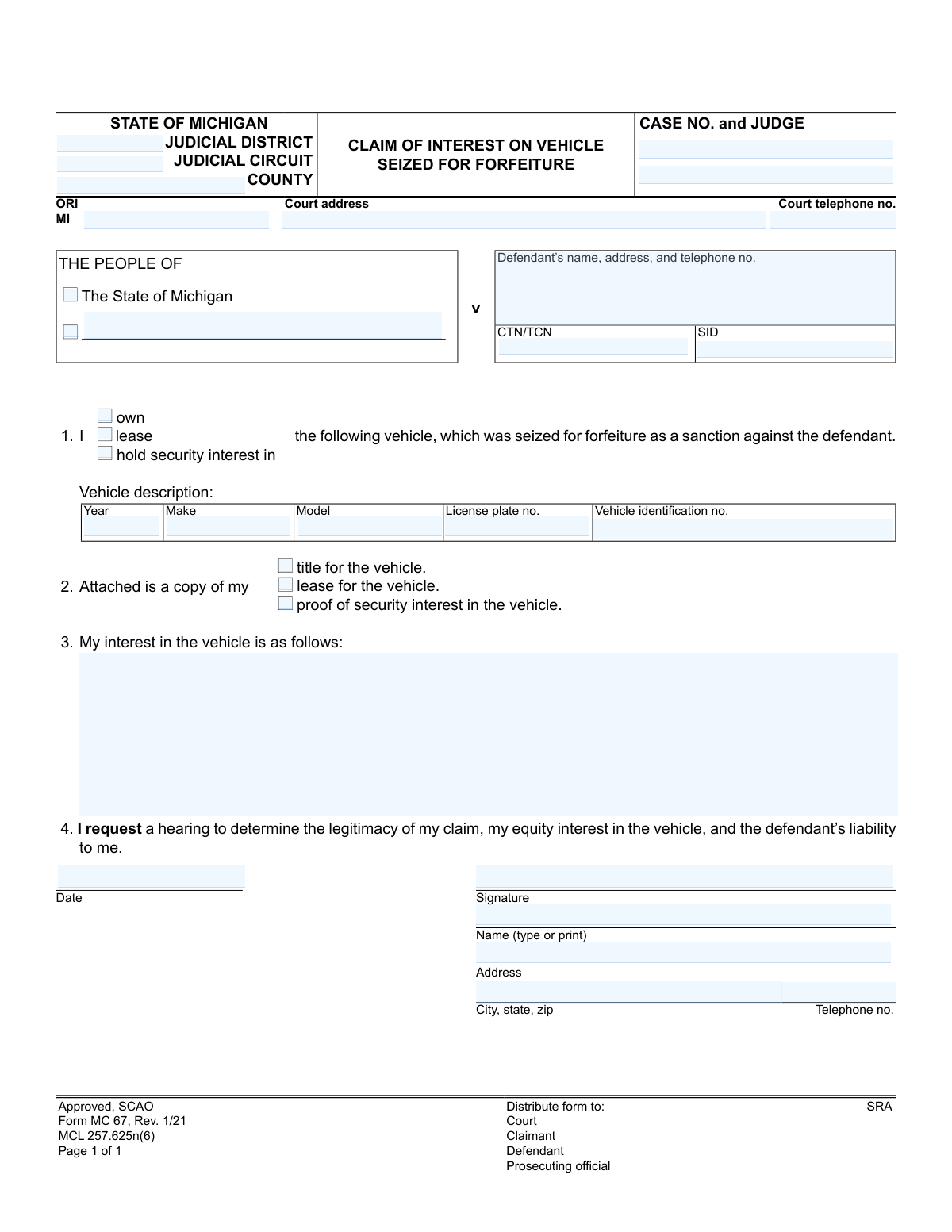
Yes! You can use AI to fill out Form MC 67, Claim of Interest on Vehicle Seized for Forfeiture

Form MC 67 is a legal document used in the state of Michigan for an individual or entity to claim an ownership, lease, or security interest in a vehicle that has been seized for forfeiture. It initiates a process for the court to determine the legitimacy of the claim and the claimant's equity in the vehicle. Today, this form can be filled out quickly and accurately using AI-powered services like Instafill.ai, which can also convert non-fillable PDF versions into interactive fillable forms.
MC 67 is part of the court claim forms and Michigan court forms categories on Instafill.
Our AI automatically handles information lookup, data retrieval, formatting, and form filling.
It takes less than a minute to fill out MC 67 using our AI form filling.
Securely upload your data. Information is encrypted in transit and deleted immediately after the form is filled out.

Form specifications

Form name: Form MC 67, Claim of Interest on Vehicle Seized for Forfeiture
Number of fields: 32
Number of pages: 1
Language: English
main-image

Instafill Demo: How to fill out PDF forms in seconds with AI

How to Fill Out MC 67 Online for Free in 2026

Are you looking to fill out a MC 67 form online quickly and accurately? Instafill.ai offers the #1 AI-powered PDF filling software of 2026, allowing you to complete your MC 67 form in just 37 seconds or less.
Follow these steps to fill out your MC 67 form online using Instafill.ai:
  1. 1 Navigate to Instafill.ai and upload or select the Form MC 67.
  2. 2 Provide the court and case details, including the judicial district, case number, and judge's name.
  3. 3 Specify your relationship to the vehicle by checking whether you own, lease, or hold a security interest in it.
  4. 4 Enter the complete vehicle information, such as year, make, model, license plate number, and Vehicle Identification Number (VIN).
  5. 5 Clearly describe your interest in the vehicle and indicate which supporting documents (e.g., title, lease agreement) are attached.
  6. 6 Review all entered information for accuracy, then electronically sign and date the form.
  7. 7 Download the completed form to distribute to the court, claimant, defendant, and prosecuting official as required.

Our AI-powered system ensures each field is filled out correctly, reducing errors and saving you time.

Why Choose Instafill.ai for Your Fillable MC 67 Form?

Speed

Complete your MC 67 in as little as 37 seconds.

Up-to-Date

Always use the latest 2026 MC 67 form version.

Cost-effective

No need to hire expensive lawyers.

Accuracy

Our AI performs 10 compliance checks to ensure your form is error-free.

Security

Your personal information is protected with bank-level encryption.

Frequently Asked Questions About Form MC 67

This form is used to assert your ownership, lease, or financial interest in a vehicle that has been seized by law enforcement. It formally requests a court hearing to determine your legal rights to the property.

You should fill out this form if you are the owner, leaseholder, or a lienholder (like a bank) of a seized vehicle, and you are not the defendant in the criminal case that led to the seizure.

You must attach a copy of the document that proves your claim, such as the vehicle's title, the lease agreement, or proof of your security interest like a loan contract.

This information is typically found on the notice of seizure or other official court documents related to the case. If you cannot find it, you may need to contact the prosecuting official or the clerk of the court in the jurisdiction where the vehicle was seized.

In this section, briefly describe your relationship to the vehicle and your financial stake. For example, state that you are the sole owner, a co-owner, or the lienholder with an outstanding loan balance.

Filing this form initiates a legal process to have your claim heard by a judge. The court will schedule a hearing to evaluate your claim and decide on the disposition of the vehicle.

You must file the form with the court handling the forfeiture case. The form indicates that copies should also be distributed to yourself (the claimant), the defendant, and the prosecuting official.

Yes, as a co-owner you can and should file this form to protect your equity interest in the vehicle. The court will determine the legitimacy and extent of your specific share.

Yes, there are strict deadlines for filing a claim on a seized asset. You should file this form immediately upon learning of the seizure to ensure you do not miss the deadline and forfeit your interest.

Yes, services like Instafill.ai use AI to help you accurately auto-fill form fields with your information, saving time and reducing the chance of errors.

You can upload the MC 67 PDF to the Instafill.ai platform. Their service will make the form interactive, allowing you to type your information directly into the fields before downloading the completed document for submission.

If you have a non-fillable or 'flat' PDF, you can use a tool like Instafill.ai. It can convert the document into a smart, fillable form that you can easily complete on your computer.

Compliance MC 67
Validation Checks by Instafill.ai

1
Vehicle Identification Number (VIN) Format
Validates that the Vehicle Identification Number (VIN) is exactly 17 characters long and contains only valid alphanumeric characters (excluding I, O, and Q). This is critical for uniquely and accurately identifying the specific vehicle in question, as an incorrect VIN could invalidate the claim or associate it with the wrong asset. If the format is incorrect, the user should be prompted to review and correct the entry.
2
Case Number and Judge Completeness
Ensures that the 'CASE NO. and JUDGE' field is not empty. This information is essential for linking the claim form to the correct legal proceeding within the judicial system. Without a valid case number, the clerk's office cannot process the claim or file it with the appropriate case, leading to significant delays or rejection of the claim.
3
Exclusive Interest Type Selection
Verifies that the claimant has selected exactly one checkbox from the options in section 1 ('own', 'lease', 'hold security interest in'). A claimant cannot simultaneously own and lease the same vehicle in this context. This check prevents ambiguity and ensures the claim has a clear, singular legal basis, which is necessary for the court to adjudicate the interest.
4
Logical Consistency Between Interest and Proof
Checks that the type of proof selected in section 2 corresponds logically to the interest claimed in section 1. For example, if 'own' is checked, 'title for the vehicle' should be selected as proof. This validation prevents contradictory submissions and ensures the provided evidence directly supports the nature of the claim being made.
5
Vehicle Year Validity
Validates that the 'Year' field for the vehicle is a 4-digit number and falls within a reasonable range (e.g., between 1900 and the current year plus one). This prevents data entry errors, such as typos or nonsensical dates, ensuring the vehicle information is plausible and accurate. An invalid year could cause issues with vehicle identification and record matching.
6
Claimant Contact Information Completeness
Ensures that the claimant's Name, Address, City, state, zip, and Telephone no. fields are all filled out. This information is mandatory for the court and other parties to communicate with the claimant regarding hearing dates, requests for information, and the outcome of the claim. Incomplete contact information can result in the claimant missing critical updates or deadlines.
7
Claimant Telephone Number Format
Checks that the claimant's telephone number is entered in a valid format, such as a 10-digit number (e.g., XXX-XXX-XXXX). This ensures the contact information is usable and that court officials or attorneys can successfully reach the claimant if needed. An improperly formatted number is functionally useless and could be flagged for user correction.
8
Signature Date Logic
Verifies that the 'Date' field next to the signature is a valid calendar date and is not set to a future date. The signature date legally attests to when the claim was made. A future date is logically impossible and would invalidate the attestation, so the system should reject it and prompt the user for the current date.
9
Description of Interest Completeness
Ensures the free-text field in section 3, 'My interest in the vehicle is as follows:', is not left empty. This section is where the claimant must articulate the specifics of their financial or ownership stake. A blank description provides no basis for the claim, making it impossible for the court to evaluate its legitimacy.
10
Defendant Information Presence
Validates that the 'Defendant’s name, address, and telephone no.' field contains a name. Identifying the defendant is fundamental to the legal context of the forfeiture, as the vehicle was seized as a sanction against them. Without the defendant's name, the claim cannot be properly associated with the primary legal action.
11
ZIP Code Format
Checks that the 'City, state, zip' field contains a ZIP code that follows a valid format (either 5 digits like '12345' or 9 digits like '12345-6789'). Correct formatting is essential for ensuring any mailed correspondence from the court reaches the claimant. This simple check improves the reliability of mail delivery.
12
Attachment Requirement for Proof
Validates that if a checkbox is selected in section 2 ('title', 'lease', 'proof of security interest'), a corresponding file has been uploaded. The form explicitly states 'Attached is a copy of my...', making the documentary evidence a required component of the claim. This check ensures the user doesn't forget to provide the necessary proof to substantiate their claim.

Common Mistakes in Completing MC 67

Incomplete or Incorrect Court and Case Information

Claimants often fail to correctly fill in the Judicial District, Case Number, and Judge's name. This typically happens when they don't have the official seizure notice or court filing in front of them. An error here can lead to the claim being rejected, misfiled, or significantly delayed, potentially causing the claimant to miss strict legal deadlines and forfeit their interest in the vehicle.

Transposing Digits in the Vehicle Identification Number (VIN)

The 17-character VIN is long and complex, making it highly susceptible to manual data entry errors like transposing numbers or confusing letters like 'O' and 'I' with '0' and '1'. An incorrect VIN identifies the wrong vehicle, rendering the entire claim invalid for the vehicle that was actually seized. To prevent this, meticulously copy the VIN from an official document like the title or registration, or use an AI-powered form filler like Instafill.ai which can help validate such data.

Forgetting to Attach Required Proof of Interest

The form requires the claimant to attach a copy of the vehicle's title, lease, or proof of security interest, but people often forget this crucial step. A claim submitted without the required supporting documentation is considered incomplete and may be dismissed by the court without a hearing. Always double-check that you have made a copy of the relevant document and physically attached it to the form before submission.

Providing a Vague Description of Financial Interest

In section 3, many claimants simply write "owner" or "have a loan," which is insufficient. The court needs specific details to determine the legitimacy and value of the claimant's equity. A vague description weakens the claim and may result in a lower valuation or dismissal. You should clearly state your financial stake, including purchase date, loan balance, and who holds the loan.

Forgetting to Sign or Date the Form

It is a surprisingly common and critical mistake to leave the signature or date field blank, often due to stress or haste. An unsigned legal form is invalid and will be rejected immediately by the court clerk. By the time the claimant is notified of the error, the statutory deadline for filing the claim may have passed, resulting in the automatic loss of their property.

Using an Outdated or Unreliable Mailing Address

The court will use the claimant's address to mail critical legal notices, including the hearing date and time. Using an old address means you will not receive these notices, will miss the hearing, and will lose your claim by default. Always provide a current, reliable mailing address and notify the court immediately if you move while the case is pending.

Confusing the 'Claimant' with the 'Defendant'

When the vehicle owner is not the person facing criminal charges, they may mistakenly write their own name in the 'Defendant's name' box. This creates significant legal confusion, incorrectly identifying the parties involved in the forfeiture action. This delays the process and requires correction to avoid the claim being dismissed.

Illegible Handwriting on a Printed Form

Since this form is a non-fillable PDF, it must be printed and completed by hand, often leading to illegible entries. If a court clerk cannot decipher the case number, VIN, or claimant's name, the form cannot be processed correctly, leading to rejection or fatal data entry errors. To avoid this, print clearly in block letters or use a service like Instafill.ai, which can convert the document into a fillable version, allowing you to type your information for perfect clarity.

Selecting the Incorrect Type of Interest

In section 1, claimants must check whether they 'own', 'lease', or 'hold security interest in' the vehicle, and the legal distinctions are important. A co-owner might incorrectly check 'own', or a lienholder might confuse 'lease' with 'security interest'. This misrepresents the legal basis for the claim and can undermine the claimant's credibility if their attached documents and testimony contradict the selection.
Saved over 80 hours a year

“I was never sure if my IRS forms like W-9 were filled correctly. Now, I can complete the forms accurately without any external help.”

Kevin Martin Green

Your data stays secure with advanced protection from Instafill and our subprocessors

Robust compliance program

Transparent business model

You’re not the product. You always know where your data is and what it is processed for.

ISO 27001, HIPAA, and GDPR

Our subprocesses adhere to multiple compliance standards, including but not limited to ISO 27001, HIPAA, and GDPR.

Security & privacy by design

We consider security and privacy from the initial design phase of any new service or functionality. It’s not an afterthought, it’s built-in, including support for two-factor authentication (2FA) to further protect your account.

Fill out MC 67 with Instafill.ai

Worried about filling PDFs wrong? Instafill securely fills form-mc-67-claim-of-interest-on-vehicle-seized-for-forfeiture forms, ensuring each field is accurate.