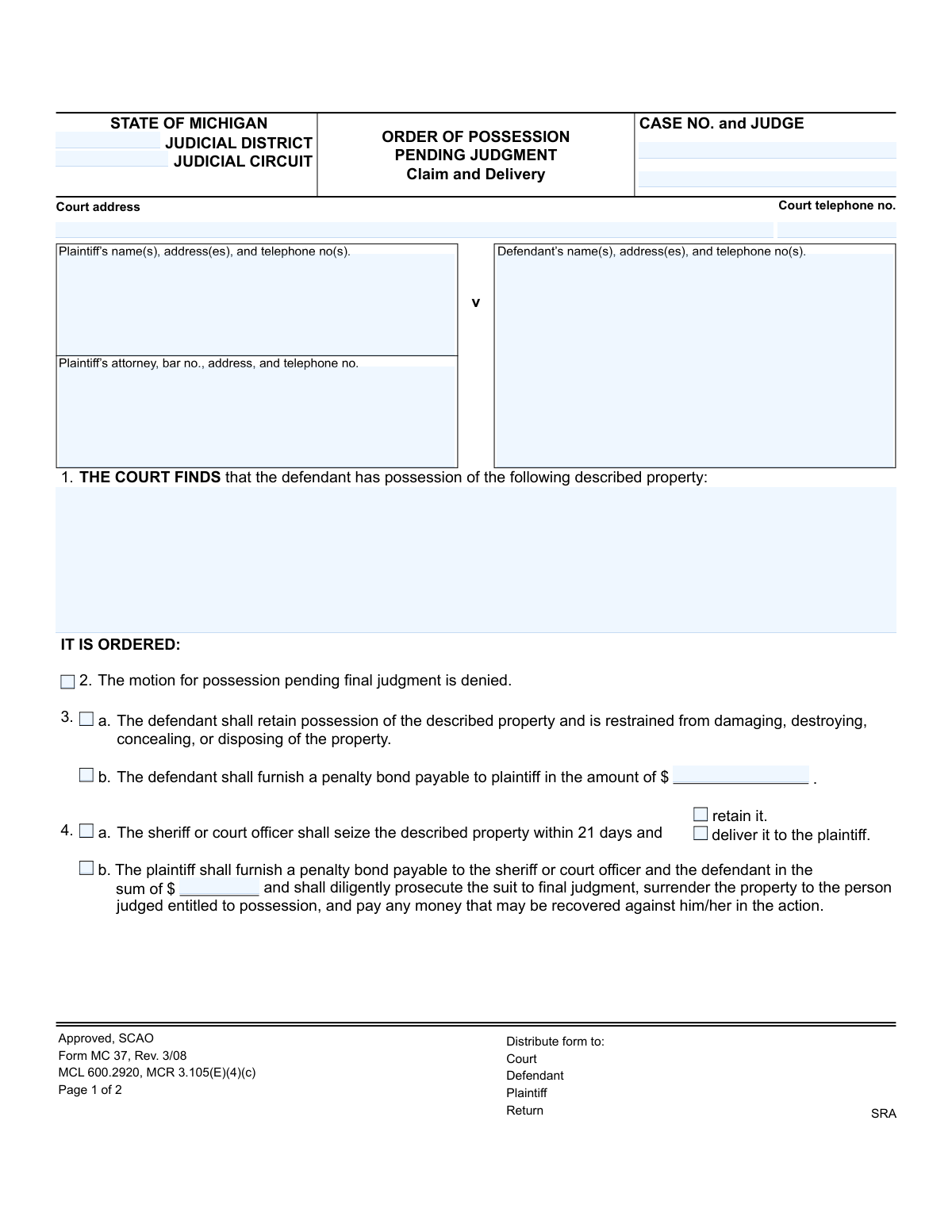
Yes! You can use AI to fill out Order of Possession Pending Judgment, Claim and Delivery
The Order of Possession Pending Judgment, Claim and Delivery (Form MC 37) is a legal document issued by a Michigan court in a civil action concerning the right to possess personal property. It outlines the court's decision on whether the plaintiff or defendant will hold the disputed property until the case is fully resolved, and may require the posting of a bond. Today, this form can be filled out quickly and accurately using AI-powered services like Instafill.ai, which can also convert non-fillable PDF versions into interactive fillable forms.
Our AI automatically handles information lookup, data retrieval, formatting, and form filling.
It takes less than a minute to fill out MC 37 using our AI form filling.
Securely upload your data. Information is encrypted in transit and deleted immediately after the form is filled out.
Form specifications
| Form name: | Order of Possession Pending Judgment, Claim and Delivery |
| Number of fields: | 47 |
| Number of pages: | 1 |
| Language: | English |
More forms in Court claim forms
Instafill Demo: How to fill out PDF forms in seconds with AI
How to Fill Out MC 37 Online for Free in 2026
Are you looking to fill out a MC 37 form online quickly and accurately? Instafill.ai offers the #1 AI-powered PDF filling software of 2026, allowing you to complete your MC 37 form in just 37 seconds or less.
Follow these steps to fill out your MC 37 form online using Instafill.ai:
- 1 Navigate to Instafill.ai and upload or select the Michigan Form MC 37.
- 2 Enter the case information, including the judicial district/circuit, court address, case number, and judge's name.
- 3 Provide the full names, addresses, and contact information for both the plaintiff and the defendant, as well as their attorneys if applicable.
- 4 Clearly describe the property that is the subject of the claim and delivery action in the designated section.
- 5 The judge will complete the 'IT IS ORDERED' section, indicating the court's ruling on possession and setting the amount for any required penalty bonds.
- 6 After the order is issued, the serving officer (sheriff or court officer) will complete the 'RETURN' section, detailing the outcome of serving the order and seizing the property.
- 7 Review all information for accuracy before the judge signs and dates the order to ensure its validity.
Our AI-powered system ensures each field is filled out correctly, reducing errors and saving you time.
Why Choose Instafill.ai for Your Fillable MC 37 Form?
Speed
Complete your MC 37 in as little as 37 seconds.
Up-to-Date
Always use the latest 2026 MC 37 form version.
Cost-effective
No need to hire expensive lawyers.
Accuracy
Our AI performs 10 compliance checks to ensure your form is error-free.
Security
Your personal information is protected with bank-level encryption.
Frequently Asked Questions About Form MC 37
This form is a court order issued by a judge in a 'Claim and Delivery' case. It determines who will possess a specific piece of property while the lawsuit is still ongoing and before a final decision is made.
A judge completes and signs this order after a hearing on a motion for possession. While the plaintiff initiates the request, the judge makes the final determination and authorizes the order.
Claim and Delivery is a type of lawsuit filed to recover possession of specific personal property from someone who is wrongfully holding it. This order is a temporary measure within that larger legal action.
If the judge denies the motion, the plaintiff's request to take possession of the property before a final judgment is rejected. The defendant will typically retain the property during the case, though they may be ordered not to damage or dispose of it.
A penalty bond is a financial guarantee to protect the other party from potential damages. A plaintiff must post a bond to cover the defendant's losses if the seizure is later found to be wrongful, and a defendant may sometimes post one to keep the property.
If the order is granted, a sheriff or an appointed court officer is responsible for seizing the property from the defendant. They must do so within 21 days of the order being issued.
The 'Return' section is completed by the sheriff or court officer. It serves as their official report on whether they successfully served the order, seized the property, or were unable to locate the defendant or the property.
As the plaintiff, you will sign this section only after the sheriff or court officer has successfully seized the property and delivered it to you. Your signature confirms that you have received the property.
The sheriff or court officer will document their unsuccessful attempts on the 'Return' section of the form. The case will proceed, but the temporary seizure of property cannot be completed.
The property description must be very specific so it can be easily identified for seizure. Include details like serial numbers, model numbers, brand names, colors, and any other unique identifying marks.
While a judge completes this specific order, you can use AI for related documents like the initial complaint or motion. Services like Instafill.ai use AI to accurately auto-fill your information on those forms, saving time and reducing errors.
You can use Instafill.ai to complete the necessary initial court filings, such as the complaint or motion. Simply upload the correct form, and the AI helps populate fields with your name, address, and case details, making preparation faster.
If you have a flat, non-fillable PDF, you can use a service like Instafill.ai. It can convert the document into an interactive, fillable form that you can complete and save easily online.
Compliance MC 37
Validation Checks by Instafill.ai
1
Case Number Consistency Across Pages
Validates that the 'Case No.' field on page 2 is identical to the 'Case No.' on page 1. This is critical for ensuring that the return of service is correctly associated with the original court order. A mismatch could lead to incorrect case file updates and legal complications.
2
Mutually Exclusive Order Directives
Ensures that conflicting directives are not selected simultaneously. Specifically, the order cannot be both denied (item 2) and have property ordered to be seized (item 4a). This check prevents the issuance of an ambiguous and unenforceable order.
3
Conditional Plaintiff Bond Amount
Verifies that if the court orders the property to be seized (item 4a), then a monetary value is entered for the plaintiff's penalty bond ('penalty bond amount 2'). The bond is a legal requirement to protect the defendant from wrongful seizure. Failure to specify the bond amount makes the seizure order incomplete and invalid.
4
Valid Date Formatting
Checks that all date fields on the form, such as 'service date', 'delivery date', and 'filing date', adhere to a standard format like MM/DD/YYYY. This ensures data consistency and prevents errors in legal timelines and record-keeping. Incorrectly formatted dates can lead to misinterpretation of deadlines and actions.
5
Logical Sequence of Service and Delivery Dates
Validates that the 'delivery date' (item 2 on page 2) occurs on or after the 'service date' (item 1 on page 2). It is logically impossible to deliver property to the plaintiff before it has been seized from the defendant. This check maintains the chronological integrity of the reported events.
6
Completeness of Property Description
Ensures that the 'property description 1' field is not empty when an order for possession or seizure is granted (items 3 or 4). A clear description is essential for the court officer to identify the correct property to be seized. An order without a property description is unenforceable.
7
Exclusive Return of Service Status
Confirms that either the 'PERSONAL SERVICE' section (item 1, page 2) or the 'RETURN-FAILURE TO SERVE/SEIZE' section (item 3, page 2) is completed, but not both. These sections represent mutually exclusive outcomes of the service attempt. Filling both would create a contradictory and nonsensical record of the officer's actions.
8
Service Fee Calculation
Validates that the 'total fee' is the correct sum of the 'service fee', 'service mileage fee', and 'other fee' fields. This ensures accurate billing and financial accounting for the services rendered by the court officer. An incorrect total could lead to billing disputes and administrative rework.
9
Bond Filing Deadline Validity
Checks that the 'filing date' for the bond (item 5) is a valid date and logically precedes the date of seizure ('service date'). The form explicitly states that no seizure can be made before the bond is filed. This validation enforces a critical prerequisite for the seizure action.
10
Attorney Bar Number Format
Verifies that the 'plaintiff attorney, bar no.' field follows the specific format required for a Michigan State Bar number, which typically starts with a 'P' and is followed by digits. This helps confirm the identity and credentials of the representing attorney. An invalid number could indicate a data entry error or an unauthorized practitioner.
11
Mandatory Case Identification
Ensures that the primary case identifiers, including 'Case No.', 'Judge', and 'Court address', are filled out on the first page. This information is fundamental to the document's identity and its connection to a specific legal proceeding. A form missing this data cannot be properly filed or acted upon.
12
Acknowledgment Date Consistency
Validates that the plaintiff's 'acknowledgment date' is on or after the 'delivery date' recorded by the court officer. The plaintiff cannot acknowledge receipt of the property before it was officially delivered. This check ensures the timeline of events is logical and consistent.
13
Seizure Timeframe Compliance
Verifies that the 'service date', if a seizure occurred, is within 21 days of the judge's signature date on the order. Item 4a specifies this legal timeframe for executing the seizure. This check ensures the action was performed within the court-mandated period.
Common Mistakes in Completing MC 37
This mistake involves providing a generic description of the property to be seized, such as 'the car' or 'my tools.' It often happens when the filer doesn't have specific identifying information readily available. An ambiguous description can make it impossible for the court officer to identify and seize the correct item, potentially rendering the court order unenforceable and leading to significant delays or failure of the entire process.
Users frequently enter the wrong Case Number, Judge's name, or select the incorrect Judicial District/Circuit. This is usually a simple transcription error from other case documents. The consequence is severe: the order may be rejected by the clerk, filed in the wrong case, or sent to the wrong court, causing major delays and requiring the form to be corrected and re-filed.
A common error is swapping the names, addresses, and phone numbers for the plaintiff (the one filing the motion) and the defendant (the one possessing the property). This happens when rushing and not carefully reading the field labels. An order with reversed parties is fundamentally invalid and will be immediately rejected by the court, forcing the filer to start over.
Filers, particularly those without legal representation, sometimes fill out the 'RETURN' or 'ACKNOWLEDGMENT BY PLAINTIFF' sections on the second page when preparing the initial proposed order. This is incorrect, as the 'RETURN' section is exclusively for the sheriff or court officer to complete after serving the order, and the 'ACKNOWLEDGMENT' is for the plaintiff to sign only upon actual receipt of the property. Filling these out early creates confusion and shows a misunderstanding of the legal workflow.
The form requires a penalty bond amount to be specified in section 3 or 4 to protect the opposing party. Filers often leave this amount blank in the proposed order, assuming the judge will fill it in. An order submitted without a proposed bond amount may be considered incomplete and rejected, delaying the hearing. The filer should propose an amount, typically twice the value of the property, for the judge to approve or amend.
When preparing the proposed order for the judge, a filer might mistakenly check conflicting options, such as checking both box 2 ('The motion...is denied') and box 4 ('The sheriff...shall seize the described property'). This stems from a misunderstanding that they are preparing a document for the judge to sign, not filling out a questionnaire. A contradictory order is nonsensical and will be rejected by the judge, requiring a corrected version to be submitted.
Filers may provide an incomplete address for the defendant, such as one missing an apartment number or listing only a P.O. Box. This is a critical error because the court order must be personally served on the defendant by a court officer. An invalid address makes service impossible, halting the legal process until a correct, physical address can be provided and verified.
Courts periodically update their forms to comply with new laws and rules, indicated by a revision date (e.g., 'Rev. 3/08'). Using an old version downloaded from an unofficial source or saved from a previous case is a common mistake. Court clerks are required to reject outdated forms, which wastes time and filing fees and forces the filer to redo the work on the correct version.
When a form is only available as a non-fillable PDF, people often print it and fill it out by hand. If the handwriting is illegible, it can lead to critical data entry errors by the court clerk, such as misspelling names or entering the wrong case number. To avoid this, use an AI-powered tool like Instafill.ai, which can convert flat PDFs into fillable versions, ensuring all entries are typed, clear, and accurate.
When the plaintiff is represented by an attorney, forgetting to include their state bar number is a frequent oversight. This number is a mandatory identifier that confirms the attorney is licensed and in good standing. A filing without a valid bar number is considered incomplete and will be rejected by the court clerk, delaying the entire process until the information is corrected.
Saved over 80 hours a year
“I was never sure if my IRS forms like W-9 were filled correctly. Now, I can complete the forms accurately without any external help.”
Kevin Martin Green
Your data stays secure with advanced protection from Instafill and our subprocessors

Robust compliance program
Transparent business model
You’re not the product. You always know where your data is and what it is processed for.
ISO 27001, HIPAA, and GDPR
Our subprocesses adhere to multiple compliance standards, including but not limited to ISO 27001, HIPAA, and GDPR.
Security & privacy by design
We consider security and privacy from the initial design phase of any new service or functionality. It’s not an afterthought, it’s built-in, including support for two-factor authentication (2FA) to further protect your account.
Fill out MC 37 with Instafill.ai
Worried about filling PDFs wrong? Instafill securely fills order-of-possession-pending-judgment-claim-and-delivery forms, ensuring each field is accurate.