Yes! You can use AI to fill out State of Michigan, Form MC 25, Notice of Intent to Escheat Unclaimed Personal Property
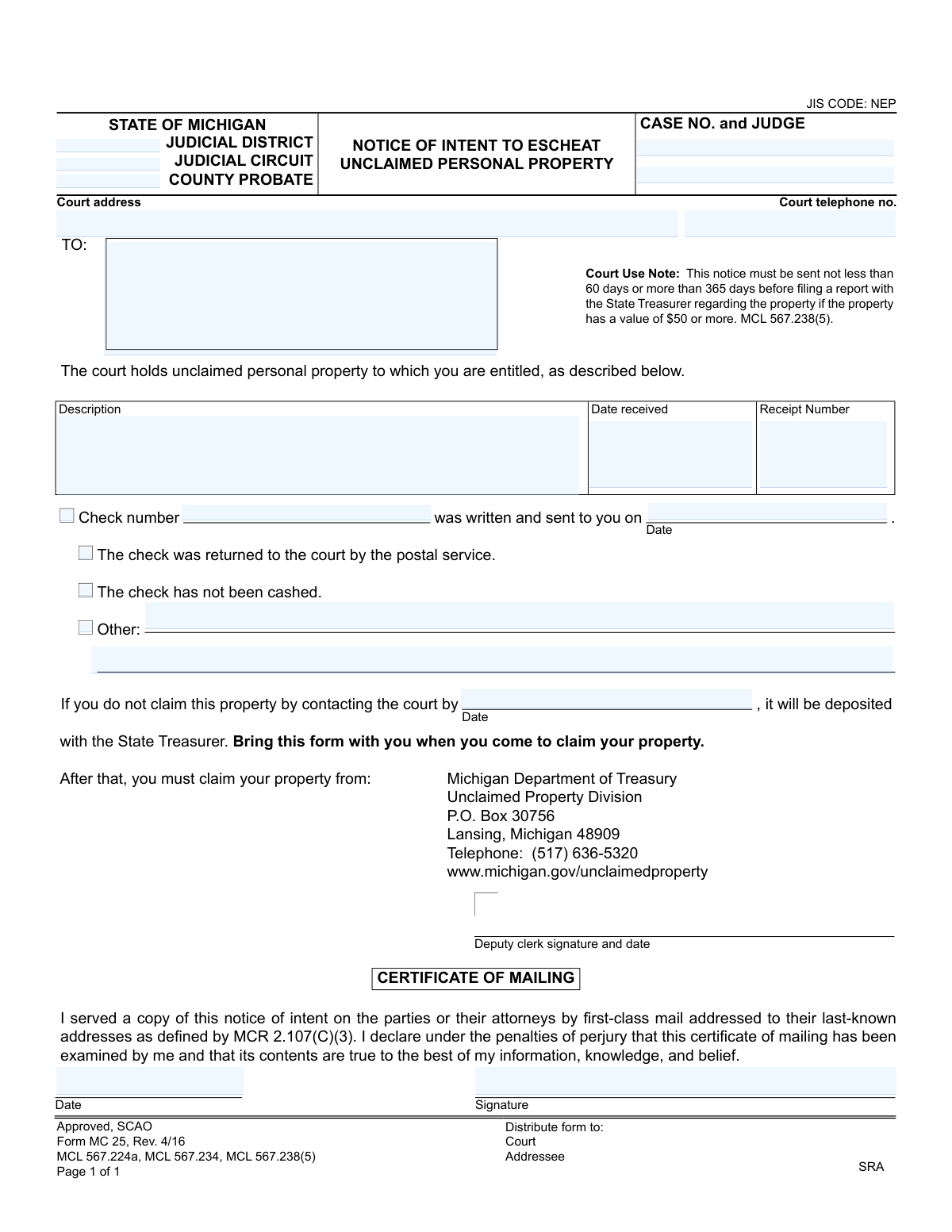
Form MC 25 is a legal notice issued by a Michigan court to inform an individual that they are entitled to unclaimed personal property being held by the court. This document warns the recipient that if they do not claim the property by a specified date, it will be transferred to the Michigan Department of Treasury as escheated property. Today, this form can be filled out quickly and accurately using AI-powered services like Instafill.ai, which can also convert non-fillable PDF versions into interactive fillable forms.
Our AI automatically handles information lookup, data retrieval, formatting, and form filling.
It takes less than a minute to fill out MC 25 using our AI form filling.
Securely upload your data. Information is encrypted in transit and deleted immediately after the form is filled out.
Form specifications
| Form name: | State of Michigan, Form MC 25, Notice of Intent to Escheat Unclaimed Personal Property |
| Number of fields: | 22 |
| Number of pages: | 1 |
| Language: | English |
More forms in Court claim forms
Instafill Demo: How to fill out PDF forms in seconds with AI
How to Fill Out MC 25 Online for Free in 2026
Are you looking to fill out a MC 25 form online quickly and accurately? Instafill.ai offers the #1 AI-powered PDF filling software of 2026, allowing you to complete your MC 25 form in just 37 seconds or less.
Follow these steps to fill out your MC 25 form online using Instafill.ai:
- 1 Navigate to Instafill.ai and upload or select the Michigan MC 25 form.
- 2 Provide the court information, including the judicial district, circuit, case number, and judge's name.
- 3 Enter the full name and address of the individual or entity to whom the notice is being sent.
- 4 Describe the unclaimed personal property, including details like check numbers, dates, and receipt numbers if applicable.
- 5 Specify the deadline by which the recipient must contact the court to claim their property.
- 6 Review all the information entered by the AI and yourself for accuracy before the deputy clerk signs and dates the notice.
- 7 Complete the Certificate of Mailing section after the notice has been sent via first-class mail.
Our AI-powered system ensures each field is filled out correctly, reducing errors and saving you time.
Why Choose Instafill.ai for Your Fillable MC 25 Form?
Speed
Complete your MC 25 in as little as 37 seconds.
Up-to-Date
Always use the latest 2026 MC 25 form version.
Cost-effective
No need to hire expensive lawyers.
Accuracy
Our AI performs 10 compliance checks to ensure your form is error-free.
Security
Your personal information is protected with bank-level encryption.
Frequently Asked Questions About Form MC 25
This notice is sent by a Michigan court to inform you that they are holding unclaimed personal property, such as an uncashed check, that belongs to you. It is a final notification to claim your property before it is transferred to the State of Michigan.
No, you do not need to fill out this form. It is a notice sent to you by the court, which has already completed all the necessary information for your reference.
Escheat is the legal process where unclaimed private property is transferred to the state government. This notice gives you a final opportunity to claim your property directly from the court before this transfer occurs.
You must contact the court listed at the top of the form before the deadline specified in the middle of the page. When you go to the court to claim your property, be sure to bring this notice with you.
If you miss the deadline, the property will be sent to the Michigan Department of Treasury's Unclaimed Property Division. You will then have to file a claim with the state to get your property back, which is a separate process.
You must bring this notice form with you. It is also highly recommended to bring a valid government-issued photo ID to prove your identity.
You received this notice because the court has property in your name, typically valued at $50 or more, that has gone unclaimed. This often happens with checks that were returned by the postal service or were never cashed.
The form provides details under the 'Description' section, which may include a check number and the date it was written. This information specifies the property you are entitled to claim.
You must contact the Michigan Department of Treasury's Unclaimed Property Division using the contact information provided on the bottom half of the notice. You can visit their website to search for your property and begin the claims process.
No, there is no fee to claim your own property, whether from the court or the State of Michigan. Be cautious of any third-party service that offers to help you claim it for a fee.
While you don't need to fill out this specific notice, AI services like Instafill.ai can be very helpful if you need to complete other related documents, such as a claim form from the State Treasury. These tools can accurately auto-fill your information, saving you time and effort.
This notice is for your information and does not need to be filled out. However, if you must file a separate claim form later and it's a PDF, you can upload it to Instafill.ai to quickly and accurately complete it online.
Services like Instafill.ai can convert flat, non-fillable PDFs into interactive forms you can type directly into. This makes it easy to complete any necessary paperwork cleanly and professionally before printing.
Compliance MC 25
Validation Checks by Instafill.ai
1
Case Number Format Validation
Ensures the 'Case number' field conforms to the standard Michigan court case numbering format. This is crucial for accurate record-keeping and linking the notice to the correct court file. A failure to validate would prevent submission until the number is corrected, avoiding filing errors.
2
Required Court Identifiers
Verifies that the 'County Probate', 'Case number', and 'Court address' fields are all populated. These fields are essential for identifying the specific jurisdiction and case from which the unclaimed property originates. If any of these fields are missing, the form cannot be processed as its origin is ambiguous.
3
Court Telephone Number Format
Checks that the 'Court telephone number' is a valid 10-digit US phone number, potentially with an extension. This ensures that the recipient of the notice has a valid and correctly formatted number to contact the court. An invalid format would trigger an error message prompting the user to correct the entry.
4
Addressee Presence
Confirms that the 'TO:' field, which identifies the intended recipient of the notice, is not empty. The entire purpose of the form is to notify a specific person or entity, so this field is mandatory. A blank field would make the notice undeliverable and legally invalid.
5
Property Description Completeness
Validates that the 'Description' field for the unclaimed property is filled out. The recipient must be able to understand what property the notice refers to. An empty description field would render the notice useless and prevent the form from being submitted.
6
Date Received is a Past or Present Date
Ensures the 'Date received' field contains a valid date that is on or before the current date. The court cannot have received property on a future date. This check prevents logical impossibilities and data entry errors.
7
Check Status Selection Logic
If a 'Check number' is entered, this validation ensures that at least one of the corresponding status checkboxes ('The check was returned...', 'The check has not been cashed.', or 'Other:') is selected. This provides a necessary explanation for why the check is considered unclaimed property. Failure to select a reason would result in an incomplete record.
8
Conditional 'Other' Explanation
If the 'Other:' checkbox is selected as the reason for the check's status, this validation requires that the corresponding text area for explanation is not empty. This ensures that selecting 'Other' is accompanied by a meaningful description, preventing ambiguity. The form would be considered incomplete without this explanation.
9
Claim By Date is in the Future
Verifies that the 'claim by date' is a valid date that occurs after the 'Certificate of Mailing' date. The recipient must be given a future deadline to claim their property. A past or same-day deadline would be illogical and legally non-compliant, so the system will reject such entries.
10
60-Day Minimum Notice Period
This is a critical business rule validation based on the note on the form (MCL 567.238(5)). It checks that the 'claim by date' is at least 60 days after the 'COM date' (Certificate of Mailing date). This ensures the court is providing the legally required notice period for the recipient to act. A shorter period would invalidate the notice and halt the escheatment process.
11
Certificate of Mailing Date and Signature Presence
Validates that both the 'Date' and 'Signature' fields within the 'CERTIFICATE OF MAILING' section are filled. This certification is a legal attestation that the notice was sent. Without both a date and a signature, the certificate is incomplete and the legal requirement for proving service has not been met.
12
Check Date is a Past or Present Date
Validates that the 'check date' is a valid date that occurs on or before the current date. A check cannot be written on a future date. This check prevents data entry errors and ensures the timeline of events is logical.
Common Mistakes in Completing MC 25
Court clerks often handle numerous cases and can easily transpose digits or omit parts of the case number due to manual data entry. An incorrect case number makes it difficult for both the court and the recipient to reference the correct legal file, leading to significant delays or rejection of the claim. To avoid this, always double-check the number against the official court record before finalizing the form.
The recipient's address is often copied from case files that may be months or years old. If this address is not the most current one available or is transcribed incorrectly, the notice will be returned as undeliverable, and the individual will lose the opportunity to claim their property before it escheats. It is critical to verify the address against the last-known address as defined by MCR 2.107(C)(3) to ensure proper service.
Filers may write a generic description like 'unclaimed funds' instead of providing specific details. This lack of clarity can confuse the recipient, who may not recognize the property as theirs, leading to the notice being ignored. A proper description should include the amount, source (e.g., 'Juror Fee'), and any relevant identifiers like a receipt number to ensure quick recognition and processing.
The form requires a specific deadline, and the governing statute (MCL 567.238(5)) dictates a precise window for this notice. A common mistake is to manually calculate this date incorrectly, potentially invalidating the notice and creating legal complications for the court. An invalid notice can nullify the escheatment process, forcing it to be restarted, wasting time and public resources.
When the unclaimed property is a check, it is easy to overlook entering the specific check number and issuance date. This information is vital for the court's accounting department to locate the transaction, void the old check, and reissue the funds. Missing details force a manual, time-consuming search through records, significantly delaying the claimant's payment.
In the rush to process paperwork, the deputy clerk may forget to sign or date the notice or the Certificate of Mailing. A missing signature can render the legal notice invalid, while a missing date on the certificate makes it impossible to prove compliance with mailing deadlines. This critical error can undermine the entire escheatment process and require the notice to be reissued from scratch.
When this form is filled out by hand, illegible handwriting for critical fields like the case number, dates, or recipient's name is a frequent issue. This can lead to misinterpretation, data entry errors, and delivery failures, ultimately preventing the recipient from getting the notice. Since this form is often a non-fillable PDF, using a tool like Instafill.ai can convert it into a fillable version, ensuring all entries are clear, legible, and accurate.
The form provides checkboxes to indicate if a check was returned by the post office or was never cashed. Clerks may hastily check the wrong box or forget to mark one at all based on the case file notes. This provides inaccurate information to the recipient and complicates the court's internal record-keeping when trying to resolve the issue and reissue the funds.
A simple typo in the court's address or telephone number can make it impossible for the recipient to make their claim. This error often occurs when using old templates or when a clerk is unfamiliar with a specific court's details. This prevents the recipient from acting on the notice, defeating its purpose and leading to frustration and the unnecessary escheatment of their property.
When the standard check status options don't apply, the 'Other' field must be used, but it is often filled with vague notes like 'payment issue.' This fails to provide the necessary context for the recipient or other court staff to understand the situation. The explanation should be concise but complete, clearly stating the unique reason the property is being held to avoid confusion and expedite resolution.
Saved over 80 hours a year
“I was never sure if my IRS forms like W-9 were filled correctly. Now, I can complete the forms accurately without any external help.”
Kevin Martin Green
Your data stays secure with advanced protection from Instafill and our subprocessors

Robust compliance program
Transparent business model
You’re not the product. You always know where your data is and what it is processed for.
ISO 27001, HIPAA, and GDPR
Our subprocesses adhere to multiple compliance standards, including but not limited to ISO 27001, HIPAA, and GDPR.
Security & privacy by design
We consider security and privacy from the initial design phase of any new service or functionality. It’s not an afterthought, it’s built-in, including support for two-factor authentication (2FA) to further protect your account.
Fill out MC 25 with Instafill.ai
Worried about filling PDFs wrong? Instafill securely fills state-of-michigan-form-mc-25-notice-of-intent-to-escheat-unclaimed-personal-property forms, ensuring each field is accurate.