Yes! You can use AI to fill out Form CR-137, Abandonment of Appeal (Misdemeanor)

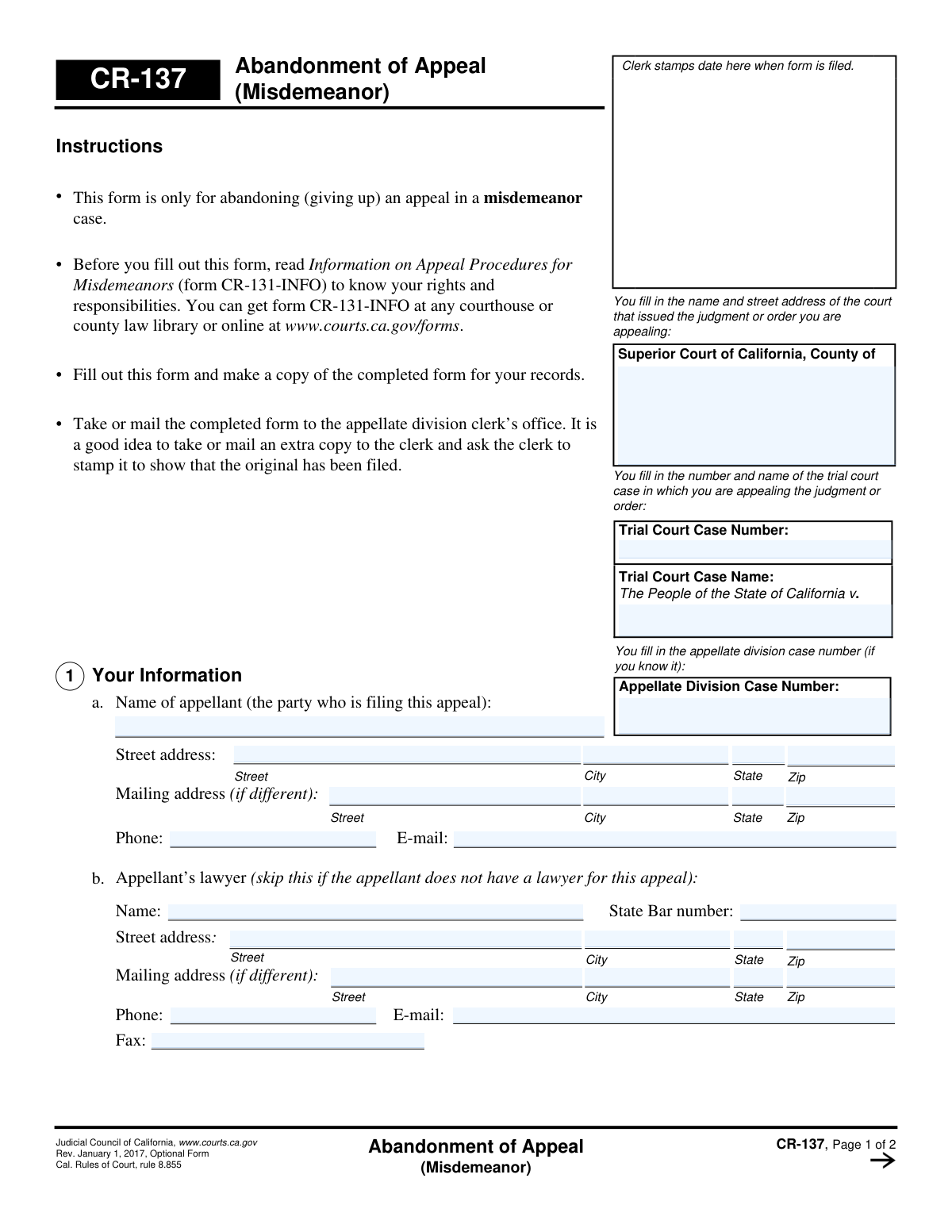
Form CR-137 is a legal document used in the California court system for an appellant to formally declare they are giving up, or abandoning, their appeal in a misdemeanor case. Filing this form with the appellate division clerk's office effectively ends the appeal process, making the trial court's judgment final. Today, this form can be filled out quickly and accurately using AI-powered services like Instafill.ai, which can also convert non-fillable PDF versions into interactive fillable forms.
CR-137 is part of the California court forms and court appeal forms categories on Instafill.
Our AI automatically handles information lookup, data retrieval, formatting, and form filling.
It takes less than a minute to fill out CR-137 using our AI form filling.
Securely upload your data. Information is encrypted in transit and deleted immediately after the form is filled out.

Form specifications

Form name: Form CR-137, Abandonment of Appeal (Misdemeanor)
Number of fields: 37
Number of pages: 1
Language: English
main-image

Instafill Demo: How to fill out PDF forms in seconds with AI

How to Fill Out CR-137 Online for Free in 2026

Are you looking to fill out a CR-137 form online quickly and accurately? Instafill.ai offers the #1 AI-powered PDF filling software of 2026, allowing you to complete your CR-137 form in just 37 seconds or less.
Follow these steps to fill out your CR-137 form online using Instafill.ai:
  1. 1 Navigate to Instafill.ai and upload or select the Form CR-137, Abandonment of Appeal (Misdemeanor).
  2. 2 Provide the court and case information, including the Superior Court name, trial court case number and name, and the appellate division case number.
  3. 3 Enter the personal information for the appellant (the person appealing) or their lawyer, including name, address, and contact details.
  4. 4 Review the pre-filled statement on page 2 that confirms the abandonment of the appeal.
  5. 5 Use the AI assistant to verify that all required fields are completed accurately and all information is correct.
  6. 6 Date and sign the form. The signature can be from the appellant or their attorney.
  7. 7 Download the completed form, make a copy for your records, and file the original with the appellate division clerk's office.

Our AI-powered system ensures each field is filled out correctly, reducing errors and saving you time.

Why Choose Instafill.ai for Your Fillable CR-137 Form?

Speed

Complete your CR-137 in as little as 37 seconds.

Up-to-Date

Always use the latest 2026 CR-137 form version.

Cost-effective

No need to hire expensive lawyers.

Accuracy

Our AI performs 10 compliance checks to ensure your form is error-free.

Security

Your personal information is protected with bank-level encryption.

Frequently Asked Questions About Form CR-137

This form is used to officially notify the court that you are voluntarily giving up or withdrawing your appeal in a California misdemeanor case.

The appellant, who is the person that originally filed the appeal in the misdemeanor case, or their attorney should complete and sign this form.

No, Form CR-137 is specifically for abandoning an appeal in a misdemeanor case only. A different process or form would be required for a felony appeal.

You will need your case details, including the trial court case name and number, your personal contact information, and your attorney's information if you have one. You should also include the appellate division case number if you know it.

The form states you should fill in the appellate division case number 'if you know it.' If you do not have this number, you can leave it blank, but providing it helps the court process your abandonment more quickly.

You must file the completed form with the appellate division clerk’s office. You can either take it in person or mail it, and it is recommended to keep a file-stamped copy for your records.

By signing and filing this form, you are formally abandoning your appeal. This action is generally final and will result in the dismissal of your appeal, ending the appellate process.

Yes, the instructions strongly recommend reading the 'Information on Appeal Procedures for Misdemeanors' (form CR-131-INFO) to understand your rights and the consequences of abandoning your appeal.

The form is labeled as 'Optional,' which means it is the court's recommended method to formalize the abandonment. Using this form ensures your intent is clearly documented with the court.

The Trial Court Case Number is the original case number from your misdemeanor trial. The Appellate Division Case Number is a new number assigned specifically to your appeal when it was filed.

Yes, services like Instafill.ai use AI to help you accurately auto-fill form fields, which can save time and reduce errors.

You can use a service like Instafill.ai to fill out this form online. Simply upload the form, and the tool will help you complete the necessary fields digitally before you print it for submission.

If you have a non-fillable or 'flat' PDF, you can upload it to Instafill.ai. The service can convert it into an interactive, fillable form for you to complete online.

Compliance CR-137
Validation Checks by Instafill.ai

1
Ensures Trial Court County is Provided
This validation checks that the county name for the 'Superior Court of California, County of' field is filled in. This information is critical for identifying the correct court jurisdiction where the original case was heard. Without this, the form cannot be routed to the proper appellate division clerk for processing.
2
Validates Trial Court Case Number Presence
This check verifies that the 'Trial Court Case Number' field is not empty. This number is the primary unique identifier for the case being appealed and is essential for the court to locate the correct case file. A submission without this number would be rejected as it cannot be processed.
3
Confirms Filer Identity is Provided
This validation ensures that either the appellant's information (Section 1b) or their lawyer's information (Section 1a) is completed, including name and address. The court must be able to identify and contact the party filing the abandonment. If neither section is filled out, the filing is considered anonymous and invalid.
4
Validates State Bar Number Format
If a lawyer's information is provided in Section 1a, this rule validates that the 'State Bar number' is a valid numerical format (e.g., a 5-6 digit number). This is important for verifying the attorney's credentials and their authority to act on behalf of the appellant. An invalid number would flag the submission for review to prevent unauthorized filings.
5
Standardizes Phone Number Format
This check ensures that all phone number fields are entered in a consistent, valid format, such as a 10-digit number. Proper formatting is essential for the court's communication systems and ensures they can successfully contact the filer if needed. Submissions with invalid formats will be rejected to prevent communication failures.
6
Verifies Email Address Structure
This validation checks that any provided email address follows the standard '[email protected]' format. This is crucial for official electronic communication and service of documents from the court. An invalid email address would cause important notifications to fail, potentially jeopardizing the case.
7
Ensures ZIP Code is a Valid Format
This check verifies that all ZIP code fields contain a valid 5-digit or 9-digit (ZIP+4) format. Correct ZIP codes are essential for the timely and accurate delivery of physical mail from the court. An invalid ZIP code will cause the form to be rejected to prevent mailing errors.
8
Requires Printed Name for Signature
This validation confirms that the 'Type or print your name' field below the signature line is filled out. A signature is legally valid only when the identity of the signer is clear and legible. This field provides that clarity, and without it, the abandonment cannot be officially accepted.
9
Requires Signature Date
This check verifies that the date field next to the signature line is filled with a valid date. The signature date is legally significant as it establishes the exact moment the appellant or their attorney formally decided to abandon the appeal. Forms without a valid signature date will be considered incomplete and rejected.
10
Cross-Validates Signer's Identity
This logical check compares the printed name in the signature block against the names provided for the appellant (Section 1b) and the lawyer (Section 1a). The signer must be one of these two parties to have the authority to abandon the appeal. A mismatch indicates a potentially unauthorized filing and will be flagged for immediate review.
11
Ensures Case Number Consistency Across Pages
This check verifies that the 'Appellate Division Case Number' entered in the header of page 2 is identical to the number entered on page 1. This is a crucial data integrity check to ensure the pages of the document are correctly associated with the same case. Mismatched numbers would render the document confusing and potentially invalid.
12
Requires Full Address if Street is Provided
This rule ensures that if a street address is entered for either the appellant or the lawyer, the corresponding City, State, and ZIP fields are also completed. A partial address is unusable for mailing or location purposes. This check prevents the submission of incomplete contact information that could hinder communication.
13
Validates Defendant Name in Case Title
This check ensures that the defendant's name has been entered in the 'Trial Court Case Name' field after 'The People of the State of California v.'. The case name, which includes the defendant, is a fundamental piece of information needed to identify the specific legal proceeding. Leaving this blank would make it impossible to match the form to the correct case record.

Common Mistakes in Completing CR-137

Incomplete Court Identification

Filers often write a generic court name, such as 'Superior Court,' without specifying the county. This happens when they don't have the original court documents handy for reference. An incomplete court name can cause the form to be rejected or sent to the wrong courthouse, leading to significant delays in processing the abandonment of the appeal.

Mixing Up Trial and Appellate Case Numbers

This form requires both the original Trial Court Case Number and the Appellate Division Case Number. Filers frequently confuse the two, place them in the wrong fields, or omit the appellate number even when it has been assigned. This error can cause major processing delays as court clerks must manually search for the correct case files to link the abandonment.

Incorrectly Formatting the Trial Court Case Name

The form pre-fills the case name as 'The People of the State of California v.' and expects the user to only enter the defendant's name. A common mistake is to re-type the entire phrase or enter a name that doesn't exactly match court records. This can lead to filing errors and difficulty linking the abandonment to the correct case in the court's system.

Forgetting to Complete the Header on Page 2

Many people focus on the main body of the form and forget to fill out the repeating information in the header of the second page. The header requires the Appellate Division Case Name and Number to be entered again. If the pages are separated during processing, an unlabeled second page can be lost, rendering the filing incomplete and ineffective.

Filling Out the Attorney Section When Self-Represented

Appellants representing themselves (in 'pro per') sometimes mistakenly fill out Section 1a, which is exclusively for an attorney's information. This creates confusion for the court regarding who is officially representing the appellant. If you do not have a lawyer for the appeal, you must skip Section 1a entirely and complete your personal information in Section 1b.

Mismatched Signature and Printed Name

In Section 3, the signature must belong to the person whose name is printed below it, whether that is the appellant or their attorney. A frequent error is for one person to sign but print another's name, which can invalidate the document. This raises legal questions about who authorized the abandonment of the appeal, leading to rejection of the form.

Using the Form for an Ineligible Case Type

This form, CR-137, is explicitly for abandoning an appeal in a misdemeanor case. A critical mistake is using it for a felony, an infraction, or a civil case. Filing the wrong form will result in an automatic rejection by the court clerk, wasting valuable time and potentially causing the filer to miss strict deadlines for abandoning the appeal through the correct procedure.

Omitting the Signature Date

The date of the signature is a legally significant part of the form, as it establishes the precise moment the appellant formally gives up their appeal rights. Forgetting to fill in the date in Section 3 is a common oversight that can lead to the form being rejected and returned for correction. This simple mistake can delay the final resolution of the case.

Submitting an Illegible Handwritten Form

Because this form is available as a PDF, many people print it and fill it out by hand. If the handwriting is not perfectly clear, court clerks may be unable to read critical information like names or case numbers, leading to data entry errors or outright rejection of the form. To prevent this, it is best to type the information. AI-powered tools like Instafill.ai can convert non-fillable PDFs into fillable versions, allowing you to type directly onto the form for maximum clarity.

Confusing Street vs. Mailing Address

The form provides separate fields for a physical 'Street address' and a 'Mailing address.' People often enter the same information in both or put a P.O. Box in the street address field. This can cause official court notices to be sent to the wrong location and be returned as undeliverable. If you use a P.O. Box, it must be entered only in the 'Mailing address' field to ensure you receive all correspondence.
Saved over 80 hours a year

“I was never sure if my IRS forms like W-9 were filled correctly. Now, I can complete the forms accurately without any external help.”

Kevin Martin Green

Your data stays secure with advanced protection from Instafill and our subprocessors

Robust compliance program

Transparent business model

You’re not the product. You always know where your data is and what it is processed for.

ISO 27001, HIPAA, and GDPR

Our subprocesses adhere to multiple compliance standards, including but not limited to ISO 27001, HIPAA, and GDPR.

Security & privacy by design

We consider security and privacy from the initial design phase of any new service or functionality. It’s not an afterthought, it’s built-in, including support for two-factor authentication (2FA) to further protect your account.

Fill out CR-137 with Instafill.ai

Worried about filling PDFs wrong? Instafill securely fills form-cr-137-abandonment-of-appeal-misdemeanor forms, ensuring each field is accurate.

Related forms by category

California court forms Judicial Council of California Form SC-105, Request for Court Order and Answer (Small Claims), Judicial Council of California Form SC-120, Defendant’s Claim and ORDER to Go to Small Claims Court (Small Claims), Judicial Council of California Form SER-001, Request for Sheriff to Serve Court Papers, Judicial Council of California Form SER-001, Request for Sheriff to Serve Court Papers, Affidavit for Collection of Personal Property California Probate Code Section 13100, Form POS-040, Proof of Service—Civil, Declaration of Facts of Death (California Superior Court), declaration-of-marriage-for-court-proceeding-california-family-law, ADOPT-200, Adoption Request, ADOPT-200, Stepparent Adoption Request, ADOPT-210, Adoption Agreement, ADOPT-310, Contact After Adoption Agreement, Judicial Council of California Form ADOPT-200, Adoption Request, Form ADR-107, Mediation Attendance Sheet, Form ADR-110, Order Appointing Referee, Form ADR-109, Stipulation or Motion for Order Appointing Referee, Form ADR-102, Request for Trial De Novo After Judicial Arbitration, Form ADR-108, Referee's Report (Code Civ. Proc., §§ 638, 639), Form ADR-106, Petition to Confirm, Correct, or Vacate Contractual Arbitration Award, Form ADR-104, Rejection of Award and Request for Trial After Attorney-Client Fee Arbitration · + 127 more →
court appeal forms Form N161, Appellant's Notice (All appeals except small claims track appeals and appeals to the Family Division of the High Court), Designation of Record on Appeal (Civil) (Maricopa County Justice Courts, Arizona) (Form APP 8150-702), Form N161, Appellant’s notice (All appeals except small claims track appeals and appeals to the Family Division of the High Court), Declaration for Court of Appeal Proceedings, Form MC 55, Claim of Appeal, Form MC 56, Bond on Appeal, Form MC 57, Certificate of Records Transmitted for Appeal and Notice to Parties, Form MC 60, Notice of Record Return from Circuit Court/Court of Appeals, Form MC 501, Reporter/Recorder Certificate of Ordering Transcript on Appeal, Form MC 503, Motion to Change Time for Filing Transcript on Appeal, Civil Appeal Case Information Statement, Form APP-014, Appellant's Proposed Statement on Appeal (Unlimited Civil Case), Form CR-125, Notice of Appeal—Commitment (Penal Code or Welfare and Institutions Code), Form APP-002, Notice of Appeal/Cross-Appeal (Unlimited Civil Case), Form CR-134, Notice Regarding Record on Appeal (Misdemeanor), Form CR-135, Proposed Statement on Appeal (Misdemeanor), Form CR-136, Order Concerning Appellant's Proposed Statement on Appeal (Misdemeanor), Form CR-142, Notice of Appeal and Record on Appeal (Infraction), form-cr-143-proposed-statement-on-appeal-infraction, form-cr-105-defendants-financial-statement-on-eligibility-for-appointment-of-counsel-and-reimbursement-and-record-on · + 1 more →