Yes! You can use AI to fill out Form VL-100, Prefiling Order—Vexatious Litigant

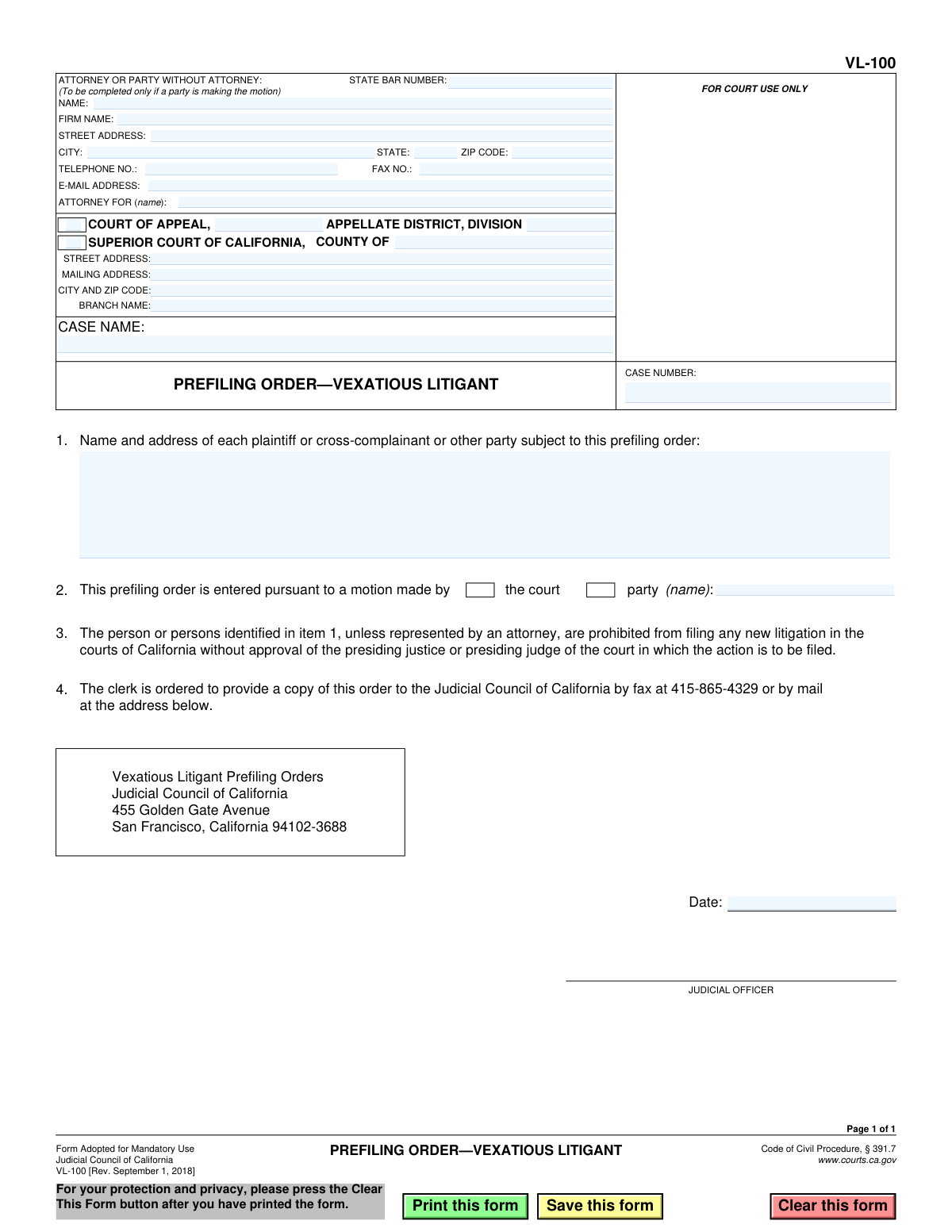
The Prefiling Order—Vexatious Litigant (Form VL-100) is a legal document used by California courts to formally restrict individuals found to be vexatious litigants. Issued under Code of Civil Procedure § 391.7, this order prevents the named person from filing new lawsuits in California courts without first obtaining permission from the presiding judge, thereby curbing abuse of the judicial system. Today, this form can be filled out quickly and accurately using AI-powered services like Instafill.ai, which can also convert non-fillable PDF versions into interactive fillable forms.
VL-100 is part of the California court forms and court filing forms categories on Instafill.
Our AI automatically handles information lookup, data retrieval, formatting, and form filling.
It takes less than a minute to fill out VL-100 using our AI form filling.
Securely upload your data. Information is encrypted in transit and deleted immediately after the form is filled out.

Form specifications

Form name: Form VL-100, Prefiling Order—Vexatious Litigant
Number of fields: 31
Number of pages: 1
Language: English
main-image

Instafill Demo: How to fill out PDF forms in seconds with AI

How to Fill Out VL-100 Online for Free in 2026

Are you looking to fill out a VL-100 form online quickly and accurately? Instafill.ai offers the #1 AI-powered PDF filling software of 2026, allowing you to complete your VL-100 form in just 37 seconds or less.
Follow these steps to fill out your VL-100 form online using Instafill.ai:
  1. 1 Navigate to Instafill.ai and upload your VL-100 form or select it from the platform's template library.
  2. 2 Enter the court information, including the appellate district/division, county, and the specific superior court's address and branch name.
  3. 3 Input the full case name and the corresponding case number in the designated fields.
  4. 4 Provide the information for the attorney or party without an attorney, including name, address, state bar number, and contact details.
  5. 5 Clearly identify the name and address of each person subject to the prefiling order in section 1.
  6. 6 The judicial officer will indicate if the order is based on a party's motion or the court's own initiative, then date and sign the order.
  7. 7 Review the completed form for accuracy, then save, download, and file it with the court clerk as required.

Our AI-powered system ensures each field is filled out correctly, reducing errors and saving you time.

Why Choose Instafill.ai for Your Fillable VL-100 Form?

Speed

Complete your VL-100 in as little as 37 seconds.

Up-to-Date

Always use the latest 2026 VL-100 form version.

Cost-effective

No need to hire expensive lawyers.

Accuracy

Our AI performs 10 compliance checks to ensure your form is error-free.

Security

Your personal information is protected with bank-level encryption.

Frequently Asked Questions About Form VL-100

This is a court order issued by a judge that officially identifies a person as a 'vexatious litigant'. It prohibits that person from filing any new litigation in California courts without first getting permission from the presiding judge of that court.

A judicial officer (a judge) completes and signs this form. It is an official court order resulting from a motion, not a form that a litigant fills out themselves.

A vexatious litigant is someone who has a history of filing lawsuits without legal merit, for purposes of harassment, or that are repeatedly unsuccessful. The specific legal criteria are defined in California's Code of Civil Procedure § 391.

The court clerk is ordered to send a copy to the Judicial Council of California. The individual's name is then added to a public, statewide list of vexatious litigants who are subject to prefiling orders.

Yes, but you must first file an application and get permission from the presiding judge of the court where you want to file the new case. You cannot simply file a new lawsuit on your own.

No, the order explicitly states the prohibition applies to the person unless they are 'represented by an attorney'. If you hire a licensed California attorney to file a new case, the prefiling restriction does not apply to that case.

This section is for the information of the party (or their attorney) who filed the motion to have someone declared a vexatious litigant. It is not for the person who is the subject of the order.

A prefiling order is issued after a motion is made to the court. This motion can be filed by a defendant in a lawsuit or initiated by the court itself.

Item 1 requires the full name and address of each person who is being declared a vexatious litigant. This information must be accurate to ensure the order is correctly applied and recorded by the Judicial Council.

The form instructs the court clerk to provide a copy of the order to the Judicial Council of California. The mailing address and fax number for the 'Vexatious Litigant Prefiling Orders' department are listed directly on the form.

While a judge fills out the final VL-100 order, AI can help prepare the related legal documents, like the motion to declare a party a vexatious litigant. Services like Instafill.ai use AI to auto-fill form fields accurately and save time.

You can upload your court form to the Instafill.ai platform. The AI will identify all the form fields, allowing you to enter your information once and have it automatically and accurately placed throughout the document.

You can use a service like Instafill.ai, which can convert flat, non-fillable PDFs into interactive, fillable forms. This allows you to easily type your information directly into the document online, save it, and print it for filing.

Compliance VL-100
Validation Checks by Instafill.ai

1
Case Number Presence and Format
Verifies that the 'CASE NUMBER' field is not empty and conforms to the standard format for California court case numbers. This is critical for associating the prefiling order with the correct legal case in the court's records. A missing or malformed case number will result in filing rejection or misfiling.
2
Case Name Completeness
Ensures the 'CASE NAME' field is filled out. The case name is a primary identifier for the litigation to which this order applies. Without it, the document is ambiguous and cannot be correctly processed or filed by the court clerk.
3
Court Type Selection
Validates that either the 'COURT OF APPEAL' or 'SUPERIOR COURT OF CALIFORNIA' checkbox is selected. This selection determines the jurisdictional level of the court issuing the order, which is fundamental for its legal authority and proper routing. The form is incomplete without this specification.
4
Superior Court County Requirement
Checks that if 'SUPERIOR COURT OF CALIFORNIA' is selected, the 'COUNTY OF' field is also filled. For Superior Courts, the county is a mandatory part of the court's official name and jurisdiction. An order missing the county is legally insufficient and cannot be executed.
5
Vexatious Litigant Identification
Ensures that the text area in item 1, for the 'Name and address of each plaintiff or cross-complainant or other party subject to this prefiling order', is not empty. This field contains the core information of the order—who is being restricted. An empty field would render the entire order void and without effect.
6
Motion Source Selection
Validates that a selection is made in item 2, indicating whether the motion was made by 'the court' or a 'party'. This information is required for the official court record to document the origin of the order. Failure to make a selection results in an incomplete form.
7
Conditional Filer Information Requirement
Performs a logical check to ensure that if 'party' is selected in item 2, the 'ATTORNEY OR PARTY WITHOUT ATTORNEY' information block is completed. This is necessary to identify the moving party. If this information is missing when required, the court cannot verify who requested the order.
8
State Bar Number Format
Checks that if a State Bar Number is entered in the 'AttyBarNo_dc' field, it is a valid numeric format. This helps verify the attorney's credentials with the California State Bar. An invalid number could indicate a data entry error or an unauthorized filer.
9
Email Address Format Validation
Verifies that any value entered in the 'E-MAIL ADDRESS' field follows a standard email format (e.g., [email protected]). This ensures that electronic service and communication from the court or other parties will be deliverable. An invalid format would lead to communication failures.
10
Telephone Number Format
Ensures the 'TELEPHONE NO.' field contains a number in a recognizable format (e.g., 10 digits with optional hyphens or parentheses). Valid contact information is essential for court personnel or opposing counsel to communicate with the filer. This check prevents the storage of unusable contact data.
11
ZIP Code Format Validation
Validates that the ZIP code in the court's address ('CrtCityZip_ft') and the attorney's address ('Zip_ft') are in a valid 5-digit or 9-digit format. Correct ZIP codes are crucial for mail delivery and for accurately identifying locations in the court's database. An invalid ZIP code can delay or prevent mail delivery.
12
Order Date Validation
Checks that the 'Date' field is a valid, non-future date. This date represents when the judicial officer signed the order, establishing its effective date. An invalid or future date would call the legal validity and timing of the order into question.
13
Court Address Completeness
Verifies that the court's street address and city/zip code fields are filled out. A complete court address is required for the document to be official and to ensure any return correspondence is sent to the correct location. Missing address information creates ambiguity about the issuing court.

Common Mistakes in Completing VL-100

Incorrect or Incomplete Court Information

Filers often enter the wrong court branch, use a mailing P.O. Box instead of the required physical street address, or confuse Superior Court and Court of Appeal fields. This error can cause the document to be filed in the wrong venue or be rejected outright by the court clerk, leading to significant delays. To avoid this, meticulously verify the exact court name and address on the court's official website before filling out the form.

Using an Ambiguous or Incorrect Case Name

The case name, or caption, is often abbreviated or entered inconsistently with other court filings (e.g., "Smith v. Jones" instead of "Johnathan Smith v. Jones Corporation, et al."). This ambiguity makes it difficult for the clerk to associate the order with the correct case file, potentially causing it to be misfiled or rejected. Always use the full, official case name exactly as it appears on the initial complaint or other key documents.

Omitting or Transposing the Case Number

The case number is the single most important identifier for a legal action, yet it is frequently omitted or entered with transposed digits. An incorrect or missing case number will almost certainly cause the court clerk to reject the filing, as it cannot be docketed or linked to the existing case. Carefully double-check every digit of the case number against official court records before submission.

Incomplete Attorney or Pro Se Filer Details

The section for the filing party's information has multiple required fields, and it's common for filers to leave parts blank, such as their firm name, full address, or phone number. This missing information prevents the court and other parties from sending important notices, which can lead to missed deadlines or hearings. Ensure every field in this section is filled out completely and accurately.

Forgetting the Attorney's State Bar Number

For attorneys, the State Bar Number is a mandatory, unique identifier that is often overlooked during data entry. Its absence can lead to filing rejection or delays while the clerk's office verifies the attorney's identity and good standing with the bar. This field is not optional and must be completed if the form is filed by an attorney.

Failing to Clearly Identify the Vexatious Litigant in Item 2

Item 2 is the most critical part of the order, requiring the full name and address of the person being declared a vexatious litigant. A common and serious error is providing an incomplete name, omitting known aliases, or listing an old address. This makes the order difficult to enforce and can render it ineffective, so it is crucial to list all known identifying information.

Incorrectly Identifying the Moving Party in Item 1

In Item 1, the filer must state the name of the party who brought the motion for the prefiling order. People sometimes mistakenly enter the defendant's name, their own name (if they are not the moving party), or leave it blank entirely. This confuses the official record of the proceeding and may cause the court to return the order for correction.

Forgetting to Check the Box in Item 3

Item 3 requires the filer to specify whether the motion was initiated by a party or by the court itself via a simple checkbox. Overlooking this step leaves the order's procedural origin ambiguous and makes the form incomplete. A clerk is likely to reject a form with this omission until the correct box is checked.

Misidentifying the Represented Party

The 'ATTORNEY FOR (name):' field is intended for the name of the client, not the attorney. Attorneys sometimes mistakenly write their own name or the law firm's name in this space, creating confusion about who they are representing in the matter. This simple error can lead to rejection and requires resubmission with the correct client's name.

Submitting an Obsolete Form Version

Courts frequently update their forms, and the VL-100 form clearly indicates its revision date ('Rev. September 1, 2018'). Using an older version can lead to automatic rejection because it may lack required information or contain outdated legal citations. Always download the latest version of any legal form directly from the official Judicial Council website before you begin. AI-powered tools like Instafill.ai can also help ensure you are using the correct, current version of a form.
Saved over 80 hours a year

“I was never sure if my IRS forms like W-9 were filled correctly. Now, I can complete the forms accurately without any external help.”

Kevin Martin Green

Your data stays secure with advanced protection from Instafill and our subprocessors

Robust compliance program

Transparent business model

You’re not the product. You always know where your data is and what it is processed for.

ISO 27001, HIPAA, and GDPR

Our subprocesses adhere to multiple compliance standards, including but not limited to ISO 27001, HIPAA, and GDPR.

Security & privacy by design

We consider security and privacy from the initial design phase of any new service or functionality. It’s not an afterthought, it’s built-in, including support for two-factor authentication (2FA) to further protect your account.

Fill out VL-100 with Instafill.ai

Worried about filling PDFs wrong? Instafill securely fills form-vl-100-prefiling-ordervexatious-litigant forms, ensuring each field is accurate.

Related forms by category

California court forms Judicial Council of California Form SC-105, Request for Court Order and Answer (Small Claims), Judicial Council of California Form SC-120, Defendant’s Claim and ORDER to Go to Small Claims Court (Small Claims), Judicial Council of California Form SER-001, Request for Sheriff to Serve Court Papers, Judicial Council of California Form SER-001, Request for Sheriff to Serve Court Papers, Affidavit for Collection of Personal Property California Probate Code Section 13100, Form POS-040, Proof of Service—Civil, Declaration of Facts of Death (California Superior Court), declaration-of-marriage-for-court-proceeding-california-family-law, ADOPT-200, Adoption Request, ADOPT-200, Stepparent Adoption Request, ADOPT-210, Adoption Agreement, ADOPT-310, Contact After Adoption Agreement, Judicial Council of California Form ADOPT-200, Adoption Request, Form ADR-107, Mediation Attendance Sheet, Form ADR-110, Order Appointing Referee, Form ADR-109, Stipulation or Motion for Order Appointing Referee, Form ADR-102, Request for Trial De Novo After Judicial Arbitration, Form ADR-108, Referee's Report (Code Civ. Proc., §§ 638, 639), Form ADR-106, Petition to Confirm, Correct, or Vacate Contractual Arbitration Award, Form ADR-104, Rejection of Award and Request for Trial After Attorney-Client Fee Arbitration · + 557 more →
court filing forms Debtor’s(s’) Chapter 13 Plan (Containing a Motion for Valuation), Form MC 98, Statement of Grievance Regarding e-Filing Access Plan, Form MC 502, Notice of Filing of Transcript and Affidavit of Mailing, Form MC 503, Motion to Change Time for Filing Transcript on Appeal, Form MC 514, Receipt of Prepaid Filing Fees for MiFILE Transaction, Form EFS-005-JV/JV-141, Electronic Service: Consent, Withdrawal of Consent, Address Change (Juvenile), Form EFS-006, Withdrawal of Consent to Electronic Service (Electronic Filing and Service), Form EFS-020, Proposed Order (Cover Sheet), Form EFS-005-CV, Consent to Electronic Service and Notice of Electronic Service Address, Judicial Council of California, Form EFS-007, Request for Exemption from Mandatory Electronic Filing and Service, Form EFS-010, Notice of Change of Electronic Service Address, Form EFS-008, Order of Exemption from Mandatory Electronic Filing and Service, Form VL-125, Order on Application to Vacate Prefiling Order and Remove Plaintiff/Petitioner from Judicial Council Vexatious Litigant List, Form VL-120, Application for Order to Vacate Prefiling Order and Remove Plaintiff/Petitioner From Judicial Council Vexatious Litigant List