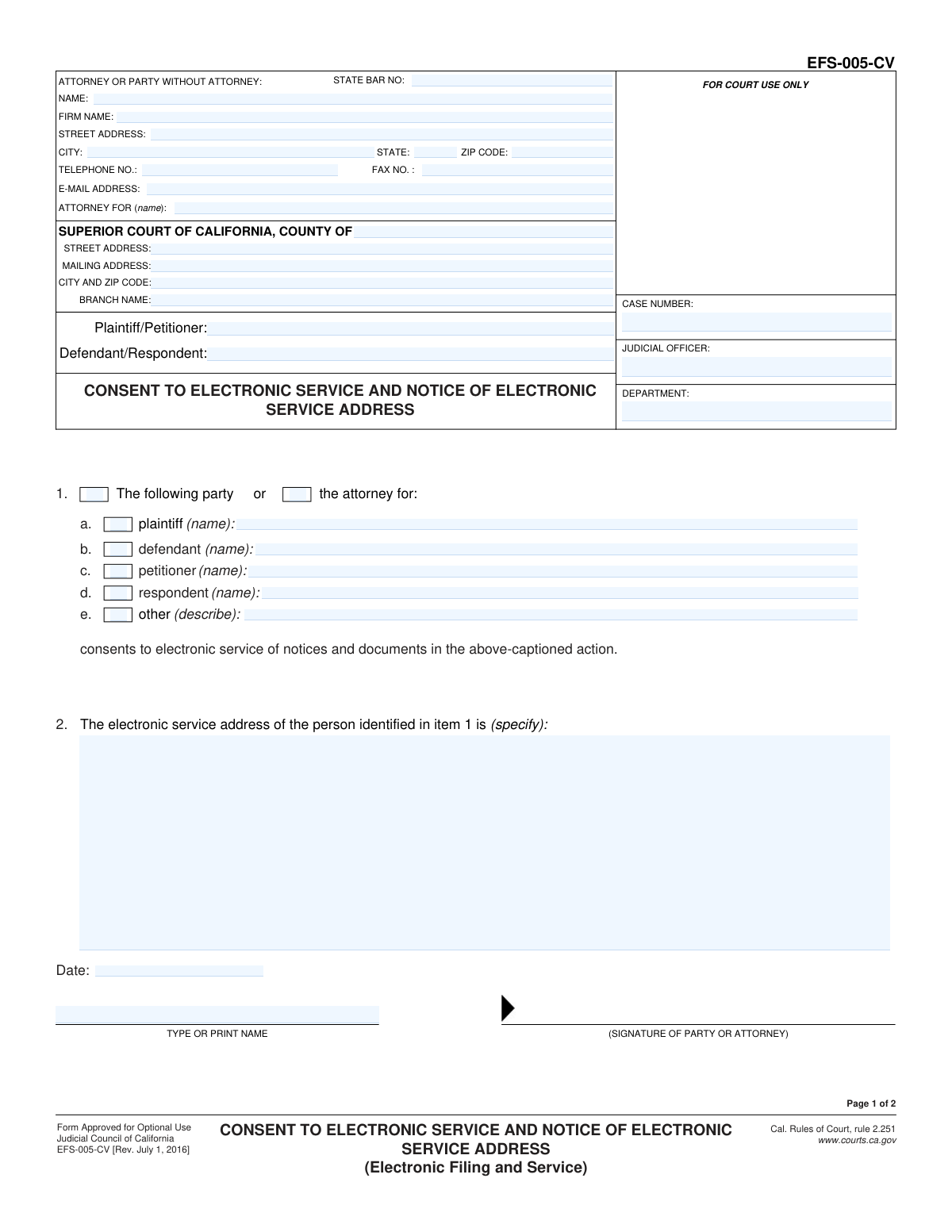
Yes! You can use AI to fill out Form EFS-005-CV, Consent to Electronic Service and Notice of Electronic Service Address
This form, officially titled 'Consent to Electronic Service and Notice of Electronic Service Address,' is used in California courts for a party or their attorney to formally agree to receive case-related documents and notices electronically. By filing this form, you provide an official electronic service address (like an email) and opt-in to the e-service system, which can speed up the legal process. Today, this form can be filled out quickly and accurately using AI-powered services like Instafill.ai, which can also convert non-fillable PDF versions into interactive fillable forms.
Our AI automatically handles information lookup, data retrieval, formatting, and form filling.
It takes less than a minute to fill out EFS-005-CV using our AI form filling.
Securely upload your data. Information is encrypted in transit and deleted immediately after the form is filled out.
Form specifications
| Form name: | Form EFS-005-CV, Consent to Electronic Service and Notice of Electronic Service Address |
| Number of fields: | 51 |
| Number of pages: | 1 |
| Language: | English |
Instafill Demo: How to fill out PDF forms in seconds with AI
How to Fill Out EFS-005-CV Online for Free in 2026
Are you looking to fill out a EFS-005-CV form online quickly and accurately? Instafill.ai offers the #1 AI-powered PDF filling software of 2026, allowing you to complete your EFS-005-CV form in just 37 seconds or less.
Follow these steps to fill out your EFS-005-CV form online using Instafill.ai:
- 1 Navigate to Instafill.ai and upload or select Form EFS-005-CV.
- 2 Use the AI assistant to automatically populate court and case information, such as the county, branch name, and case number.
- 3 Enter your information as the attorney or party without an attorney, including your name, address, and contact details.
- 4 In section 1, check the box that identifies your role in the case (e.g., plaintiff, defendant) and provide the party's name.
- 5 In section 2, clearly specify the electronic service address (e.g., your email address) where you consent to receive documents.
- 6 Review all the information for accuracy, then date and apply your digital signature to the form.
- 7 If you are serving this form on other parties, complete the 'Proof of Electronic Service' on page 2, detailing who was served and when.
Our AI-powered system ensures each field is filled out correctly, reducing errors and saving you time.
Why Choose Instafill.ai for Your Fillable EFS-005-CV Form?
Speed
Complete your EFS-005-CV in as little as 37 seconds.
Up-to-Date
Always use the latest 2026 EFS-005-CV form version.
Cost-effective
No need to hire expensive lawyers.
Accuracy
Our AI performs 10 compliance checks to ensure your form is error-free.
Security
Your personal information is protected with bank-level encryption.
Frequently Asked Questions About Form EFS-005-CV
This form is used to officially notify the court and other parties in a legal case that you agree to receive documents and notices electronically, such as by email, instead of by physical mail.
Any party or their attorney in a California civil case who wants to receive court documents electronically must complete and file this form. It is used to provide consent and specify the electronic address for service.
This is typically the email address where you agree to receive official legal documents. It is crucial to provide an email that you check regularly, as documents sent to this address are considered legally served.
Enter your own name and contact information in the 'ATTORNEY OR PARTY WITHOUT ATTORNEY' section. You can leave the 'STATE BAR NO.' and 'FIRM NAME' fields blank and write 'Self-Represented' on the 'ATTORNEY FOR (name):' line.
You must fill out Page 1 to provide your consent. Page 2, the 'Proof of Electronic Service,' is filled out by the person sending this form to prove they have served it on the other parties electronically.
After signing the form, you must file the original with the court and 'serve' (formally send) a copy to all other parties involved in the case.
Generally, consenting to electronic service is optional and this form is used to opt-in. However, some local court rules may require electronic service, so it is best to check the specific rules for your court.
Once your consent is filed and served, the court and other parties can legally send you official documents at the electronic address you provided. You are then responsible for monitoring that address for any notices or filings.
This section is a sworn declaration that you have sent a copy of the completed consent form to the other parties electronically. It serves as your proof to the court that you properly notified everyone of your consent.
If you choose to serve your completed consent form to other parties via U.S. mail instead of electronically, you should not fill out page 2. Instead, you would fill out and attach a different form, POS-030 (Proof of Service by First-Class Mail).
Yes, services like Instafill.ai use AI to accurately auto-fill form fields with your case and personal information, which saves time and helps prevent common errors.
You can use a service like Instafill.ai to easily complete this form online. Simply upload the PDF, and the platform will make it an interactive, fillable form that you can complete, sign, and download from your browser.
If you have a non-fillable or 'flat' PDF, you can upload it to a platform like Instafill.ai. Their technology can convert the static document into an interactive form that you can easily fill out on your computer.
Compliance EFS-005-CV
Validation Checks by Instafill.ai
1
Ensures Case Number Consistency Across Pages
This check verifies that the Case Number entered on Page 1 is identical to the Case Number on Page 2. Maintaining a consistent Case Number is critical for associating all pages of the document correctly within the court's filing system. A mismatch could lead to the document being misfiled or rejected, causing delays in the legal process.
2
Validates Party Name for Selected Party Type
This rule ensures that if a party type checkbox (e.g., plaintiff, defendant) is selected in item 1, the corresponding name field for that party is not empty. This is essential for clearly identifying which party is consenting to electronic service. Failure to provide a name for the selected party makes the consent ambiguous and will result in form rejection.
3
Enforces Single Party Consent per Form
This validation checks that only one party type (plaintiff, defendant, petitioner, respondent, or other) is selected in item 1. Each consent form is intended for a single party or their attorney. Selecting multiple parties on one form can create legal ambiguity and will cause the submission to be rejected for clarification.
4
Requires Description for 'Other' Party Type
This validation ensures that if the 'other' checkbox in item 1e is selected, the adjacent description field is completed. This is necessary to specify the role of the party who does not fit into the standard categories. An empty description field would make the filing incomplete and lead to its rejection by the court clerk.
5
Validates Electronic Service Address Format
This check verifies that the address provided in item 2 ('The electronic service address...') is a syntactically valid email address, such as [email protected]. Since the entire purpose of this form is to consent to electronic service, a valid email address is absolutely critical. An invalid address would render the consent useless and cause service of process to fail.
6
Ensures Electronic Service Address is Provided
This validation confirms that the electronic service address field in item 2 is not left blank. This field is the most critical piece of information on the form, as it specifies where legal documents should be sent electronically. A missing address defeats the purpose of the form and will result in an immediate rejection.
7
Verifies State Bar Number Format
This rule validates that the 'STATE BAR NO.' field contains only numeric digits. The State Bar number is a unique identifier for attorneys licensed in California, and it must conform to a standard format. Submitting a non-numeric or incorrectly formatted number can prevent the court from verifying the attorney's identity and standing.
8
Validates Signature Date
This check ensures that the 'Date' field next to the signature line is a valid calendar date and is not set to a future date. The signature date legally attests to when the consent was given. An invalid or future date can call the document's authenticity into question and may lead to its rejection by the court.
9
Ensures Completeness of Attorney Information
This validation checks that if the 'ATTORNEY FOR (name)' field is populated, then the 'NAME' and 'STATE BAR NO.' fields in the attorney information block are also completed. This ensures that when an attorney is filing on behalf of a party, their identifying information is fully provided for verification. Incomplete attorney details can lead to filing delays or rejection.
10
Requires Declarant Address for Proof of Service
This rule verifies that in the 'PROOF OF ELECTRONIC SERVICE' section on page 2, either the declarant's residence/business address (item 1a) or their electronic service address (item 1b) is provided. This information is required to identify the person making the declaration of service. Missing address information makes the proof of service invalid.
11
Validates Presence of Service Date and Time
This check ensures that the date of service (item 1c) and time of service (item 2d) are both provided on the Proof of Electronic Service page. The exact date and time are legally significant details that establish when the service was completed. Omitting this information invalidates the proof of service and will result in its rejection.
12
Ensures Recipient Details are on Proof of Service
This validation confirms that the 'Name of person served' (item 2a) and their 'Electronic service address' (item 2b) are both filled out on the proof of service. This information is essential to clearly document who received the notice and where it was sent. Incomplete recipient information makes the proof of service defective and legally insufficient.
13
Validates ZIP Code Format
This check ensures that the 'ZIP CODE' field contains a valid 5-digit or 9-digit (XXXXX-XXXX) US postal code. Correct formatting is necessary for mail delivery and address validation by the court's systems. An invalid ZIP code could lead to returned mail and communication failures.
14
Verifies Signature or Printed Name Presence
This check ensures that the 'TYPE OR PRINT NAME' field is filled and, in an electronic system, that a digital signature is applied. A signature is required to execute the document and make the consent legally binding. A form submitted without a name and signature is considered incomplete and has no legal effect.
Common Mistakes in Completing EFS-005-CV
A frequent error is entering a personal email address (e.g., from Gmail or Yahoo) in Item 2. The 'electronic service address' is typically a specific address assigned by an Electronic Filing Service Provider (EFSP) used for official court communications. Using the wrong address means you will not receive legally served documents, which can lead to missed deadlines or default judgments. Always verify the correct service address with your EFSP and enter it precisely as provided.
Users often check a box in Item 1 (e.g., 'plaintiff' or 'defendant') but forget to write the party's full name in the corresponding text field. This creates ambiguity about who is actually consenting to electronic service, which can lead to the form's rejection by the court. To avoid this, ensure you both check the correct box identifying the party's role and legibly write the party's full legal name as it appears in the case caption.
Many filers misunderstand the purpose of Page 2. This page is exclusively for proving that you electronically served this specific Consent form (EFS-005-CV) on another party. It is not a general proof of service for other documents, nor should it be used if you served the form by mail (the form explicitly states to use POS-030 for mail service). Incorrectly using this page can invalidate your proof of service and cause procedural delays.
The Case Number and Case Name must be entered at the top of both Page 1 and Page 2. It is a common mistake to leave the information on Page 2 blank or to make a transcription error. If the pages are separated, this omission can cause the Proof of Service to be misfiled or rejected, invalidating the service. AI-powered form filling tools like Instafill.ai can prevent this by automatically populating recurring information accurately across all pages of a document.
In the header, the 'ATTORNEY FOR (name):' field must contain the name of the party the attorney is representing, not the attorney's own name. A party representing themselves ('pro se' or 'in pro per') should indicate that status here. Leaving this field blank or filling it incorrectly creates confusion for the court and opposing counsel about who is being represented, potentially delaying the case.
An unsigned or undated legal document is invalid and will be rejected by the court clerk. This simple oversight often happens when filers are in a hurry. The signature on Page 1 confirms consent, and the signature on Page 2 is a declaration under penalty of perjury. Always perform a final check to ensure both the signature and date fields are completed before filing.
Legal forms require absolute clarity. A handwritten form with an illegible case number, party name, or—most critically—electronic service address can be rejected or lead to missed communications. It is strongly recommended to type the information. If you only have a flat, non-fillable PDF, tools like Instafill.ai can convert it into a fillable version, ensuring all your entries are clear, professional, and accurate.
On Page 2, filers must provide 'My electronic service address' (the sender) in item 1.b and the 'Electronic service address of person served' (the recipient) in item 2.b. It is easy to mix these up or enter the same address in both fields. This error invalidates the proof of service, as it fails to demonstrate that the document was sent to the correct party. Carefully double-check that the sender's address is in 1.b and the recipient's is in 2.b.
The form requires the specific Street Address, Mailing Address, and Branch Name of the Superior Court. Filers unfamiliar with the court may enter a generic address or guess the branch, especially since the street and mailing addresses can differ. Incorrect court information can cause filings to be misdirected or rejected. Always verify the exact and complete address details on the court's official website before completing this section.
Saved over 80 hours a year
“I was never sure if my IRS forms like W-9 were filled correctly. Now, I can complete the forms accurately without any external help.”
Kevin Martin Green
Your data stays secure with advanced protection from Instafill and our subprocessors

Robust compliance program
Transparent business model
You’re not the product. You always know where your data is and what it is processed for.
ISO 27001, HIPAA, and GDPR
Our subprocesses adhere to multiple compliance standards, including but not limited to ISO 27001, HIPAA, and GDPR.
Security & privacy by design
We consider security and privacy from the initial design phase of any new service or functionality. It’s not an afterthought, it’s built-in, including support for two-factor authentication (2FA) to further protect your account.
Fill out EFS-005-CV with Instafill.ai
Worried about filling PDFs wrong? Instafill securely fills form-efs-005-cv-consent-to-electronic-service-and-notice-of-electronic-service-address forms, ensuring each field is accurate.