Yes! You can use AI to fill out Victim’s Assistance and Survivor Protection Act (VASPA) Filing Packet
This packet contains the necessary forms for individuals in New Jersey to file a complaint under the Victim’s Assistance and Survivor Protection Act (VASPA). It is used by victims of specific offenses like stalking, sexual contact, or cyber-harassment to request a Temporary Protective Order (TPO) from the Superior Court. This process is distinct from filing for a domestic violence restraining order. Today, this form can be filled out quickly and accurately using AI-powered services like Instafill.ai, which can also convert non-fillable PDF versions into interactive fillable forms.
VASPA Filing Packet (CN: 13133) is part of the
court filing forms and New Jersey forms categories on Instafill.
Our AI automatically handles information lookup, data retrieval, formatting, and form filling.
It takes less than a minute to fill out VASPA Filing Packet (CN: 13133) using our AI form filling.
Securely upload your data. Information is encrypted in transit and deleted immediately after the form is filled out.
Form specifications
| Form name: | Victim’s Assistance and Survivor Protection Act (VASPA) Filing Packet |
| Number of fields: | 191 |
| Number of pages: | 1 |
| Language: | English |
Instafill Demo: How to fill out PDF forms in seconds with AI
How to Fill Out VASPA Filing Packet (CN: 13133) Online for Free in 2026
Are you looking to fill out a VASPA FILING PACKET (CN: 13133) form online quickly and accurately? Instafill.ai offers the #1 AI-powered PDF filling software of 2026, allowing you to complete your VASPA FILING PACKET (CN: 13133) form in just 37 seconds or less.
Follow these steps to fill out your VASPA FILING PACKET (CN: 13133) form online using Instafill.ai:
- 1 Navigate to Instafill.ai and upload the VASPA Filing Packet or select it from their template library.
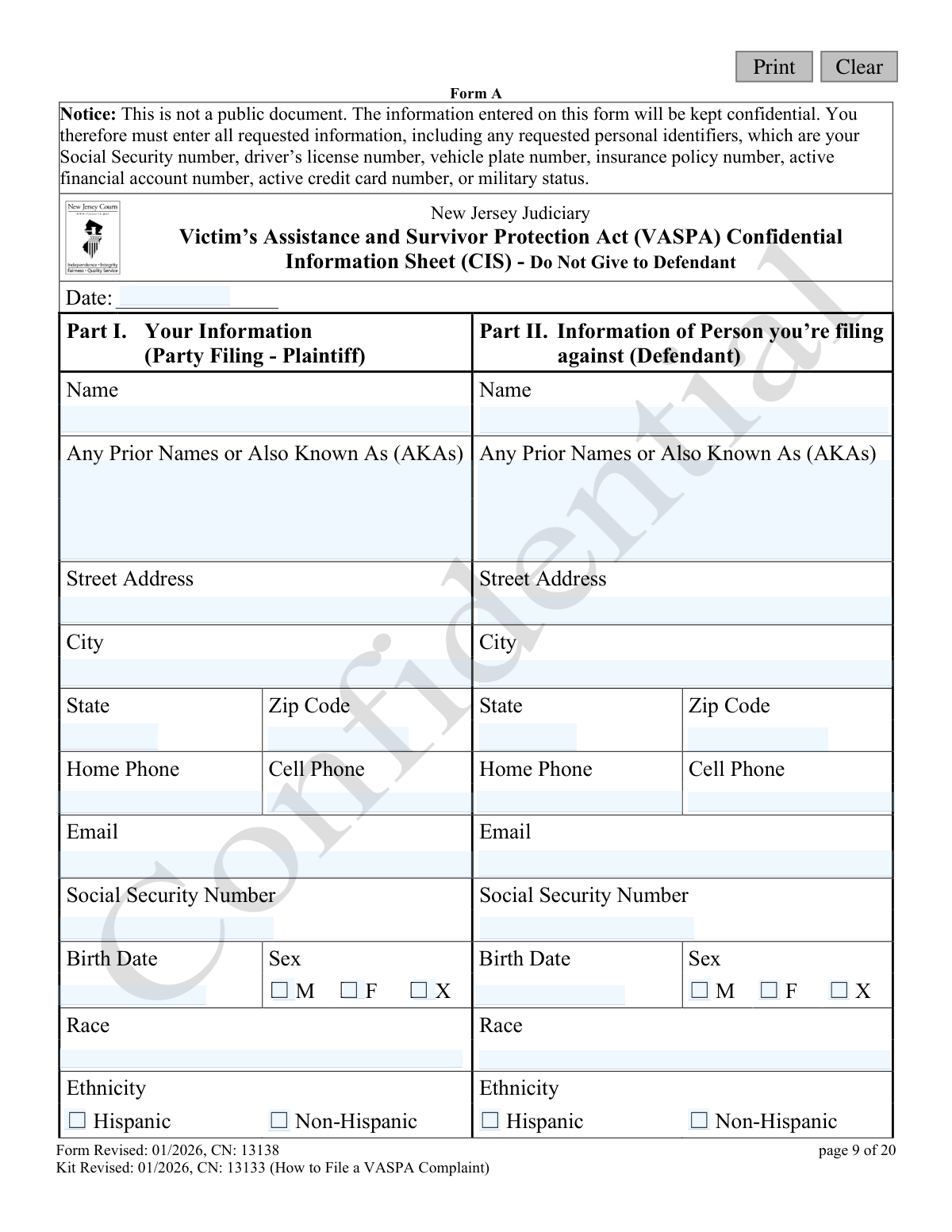
- 2 Use the AI assistant to automatically populate the Confidential Information Sheet (Form A) with the required details for the plaintiff, defendant, and parent/guardian if applicable.
- 3 Complete the Verified Complaint (Form B) by providing a specific account of the incident(s) and checking the relevant criminal offenses.
- 4 If amending a previous order, fill out the Application to Amend VASPA TPO (Form D), clearly stating the requested changes, such as adding protected locations or parties.
- 5 Carefully review all the information auto-filled by the AI across all forms for accuracy and completeness.
- 6 Digitally sign the certification sections on the required forms to attest that the information is true.
- 7 Download the completed packet and submit it to the appropriate New Jersey Superior Court Family Division, either electronically through the Judiciary Electronic Document System (JEDS) or in person.
Our AI-powered system ensures each field is filled out correctly, reducing errors and saving you time.
Why Choose Instafill.ai for Your Fillable VASPA Filing Packet (CN: 13133) Form?
Speed
Complete your VASPA Filing Packet (CN: 13133) in as little as 37 seconds.
Up-to-Date
Always use the latest 2026 VASPA Filing Packet (CN: 13133) form version.
Cost-effective
No need to hire expensive lawyers.
Accuracy
Our AI performs 10 compliance checks to ensure your form is error-free.
Security
Your personal information is protected with bank-level encryption.
Frequently Asked Questions About Form VASPA Filing Packet (CN: 13133)
This packet is used to file for a Temporary Protective Order (TPO) if you are a victim of nonconsensual sexual contact, sexual penetration, lewdness, cyber-harassment, or stalking by someone who does not meet the definition of a domestic violence offender.
You are eligible if you are a victim of specific offenses like stalking or nonconsensual sexual contact. A parent or guardian can also file on behalf of a minor child or an adult with a developmental disability.
Do not use this packet if the person who harmed you is a spouse, former spouse, household member, someone you have a child with, or someone you have dated. In those cases, you must file for a domestic violence restraining order under the Prevention of Domestic Violence Act (PDVA).
Yes, you can file on behalf of a minor child, but not if the person you are filing against is the child's other parent or guardian. In that specific situation, you must call the Division of Permanency and Protection at 1-877-NJ-ABUSE.
For a new complaint, you must complete the Confidential Information Sheet (Form A) and the Verified Complaint (Form B). You may also use the Additional Information Sheet (Form C) if you need more space to describe the incident.
No, the defendant will not see the information you provide on the Confidential Information Sheet (Form A). This form is kept confidential by the court and is not shared with the other party.
You can submit your completed packet electronically through the Judiciary Electronic Document System (JEDS) or file it in person at the Superior Court Family Division. You may file in the county where the incident occurred, where you live, or where the defendant lives.
A hearing for a temporary order is typically held the same day you file during normal business hours. If you file after 4 p.m. or on a weekend, court staff will contact you on the next business day to schedule the hearing.
To change an existing TPO, you must fill out and submit the Application to Amend VASPA TPO (Form D). This form allows you to request adding protected locations or people, or ask for other specific relief from the court.
You must provide the most current address you know for the defendant so the police can serve them with the court order. The form also asks for other places the defendant might be found, such as their workplace, to assist with service.
No, court staff cannot provide legal advice. They can explain court procedures and help you with forms, but for legal advice, you should make every effort to obtain the assistance of a lawyer.
Yes, services like Instafill.ai use AI to help you accurately auto-fill form fields, which can save you time and reduce errors. This ensures your information is entered correctly before submission.
Simply upload the VASPA packet PDF to the Instafill.ai platform. The AI will identify the form fields, allowing you to fill them out online, and you can then download the completed, signed document for submission.
If you have a non-fillable or 'flat' PDF, you can use a service like Instafill.ai. It can convert any non-fillable PDF into an interactive, fillable form that you can complete and sign electronically.
Compliance VASPA Filing Packet (CN: 13133)
Validation Checks by Instafill.ai
1
Ensures Filer Eligibility for VASPA
This check verifies that the relationship between the plaintiff and defendant, as described in Form B Section 2d, does not meet the criteria for a domestic violence case under the PDVA (e.g., spouse, household member, dating relationship). VASPA is specifically for victims of certain crimes who do not have a domestic relationship with the defendant. If the relationship qualifies for a PDVA restraining order, this filing will be rejected and the user will be directed to the correct process.
2
Validates Complaint Type Selection
On Form B, the user must select exactly one complaint type: either 'Verified Complaint' for a new filing or 'Amended Verified Complaint' for an existing case. This check ensures one and only one box is checked. This selection is critical as it dictates which subsequent sections of the form are mandatory, and failure to select one will prevent the form from being processed.
3
Conditional Requirement for Guardian Information
This validation checks if the 'Plaintiff is a minor or an incapacitated adult?' box is marked 'Yes' on Form B. If it is, the system then requires the guardian's name to be filled out on Form B and the corresponding Parent/Guardian section (Part III) on the Confidential Information Sheet (Form A) to be completed. This is essential for establishing the filer's legal standing to act on behalf of the victim.
4
Completeness of New Allegation Details
For a new 'Verified Complaint' (Form B), this check ensures that Section 2 is fully completed. The user must provide a specific narrative of the incident(s), including dates and times, in Section 2a, and must also check at least one corresponding criminal offense box in Section 2b. An incomplete allegation section prevents the court from understanding the basis for the protective order request, leading to dismissal.
5
Validates Docket Number for Amendments
When filing an 'Application to Amend' (Form D), a valid docket number must be entered. This check verifies that the docket number field is not empty and follows the expected format (e.g., starts with 'FV -'). Without a correct docket number, the court cannot link the amendment request to the existing Temporary Protective Order (TPO), making the submission impossible to process.
6
Date Field Format and Logic
This validation inspects all date fields across the forms (e.g., Birth Date, Incident Date, Prior Filing Date) to ensure they are in a valid format (MM/DD/YYYY). It also performs a logical check to ensure dates are not in the future and that birth dates are reasonable. Incorrect or illogical dates can cause legal and administrative errors, leading to the rejection of the filing.
7
Defendant Address for Service of Process
This check confirms that the defendant's home address fields (Street, City, State, Zip) on Form B are completed. This information is legally required and absolutely critical for law enforcement to serve the defendant with the temporary order and notice to appear in court. If the address is missing, the case cannot proceed as the defendant cannot be properly notified.
8
Specificity of Amendment Request on Form D
When a user files Form D to amend a TPO, this check ensures that at least one of the three request sections (barring from locations, adding protected parties, or other relief) is filled out with a specific request and reason. An application to amend that does not actually request any changes is illogical and will be rejected. The system will prompt the user to specify the desired amendment before submission.
9
Amended Complaint Prerequisite Information
If 'Amended Verified Complaint' is selected on Form B, this validation ensures the user provides the date of the original complaint filing in Section 3a. The date must be a valid date prior to the current date. This confirms that there is a pre-existing complaint to amend and provides a clear timeline for the court, preventing submission of an invalid amendment.
10
Interpreter Language Specification
On the Confidential Information Sheet (Form A), if the 'spoken language interpreter required' box is checked, this validation ensures the 'language' field is not left blank. This is crucial for the court to arrange for the correct interpreter, ensuring the filer can fully participate in court proceedings and that their rights are protected. Failure to specify a language will delay the hearing.
11
Mandatory Certification Signature and Date
This check verifies that the certification section on each submitted form (B, C, and D) has been signed (or a typed name entered in the signature line) and dated. The certification is a sworn statement that the information provided is true, and it is a legal requirement for the document to be considered valid by the court. Unsigned forms are not legally binding and will be rejected.
12
Conditional Requirement for Criminal Complaint Details
On Form B, Section 2c, if the user answers 'Yes' to 'Has a criminal complaint been filed in this matter?', this validation makes the 'case number' and 'charges' fields mandatory. This information is vital for the Family Part judge to coordinate with any parallel criminal proceedings and avoid conflicting orders. Missing this information would require court staff to manually follow up, delaying the process.
13
Social Security Number Format
This validation checks that any Social Security Number entered on the Confidential Information Sheet (Form A) follows the standard 9-digit format (XXXXXXXXX or XXX-XX-XXXX). While not always mandatory, if a value is entered, it must be correctly formatted to ensure data integrity for court records and identification purposes. An incorrectly formatted number will trigger an error message prompting the user to correct it.
14
Prohibits Filing for Minor Against Parent/Guardian
This is a critical pre-submission check based on the filer's relationship to the defendant. If the filing is on behalf of a minor and the defendant is the minor's parent or guardian, the system will block the submission. The form instructions explicitly state that such cases must be reported to the Division of Permanency and Protection (1-877 NJ ABUSE), not filed under VASPA. This prevents misfiling in the wrong jurisdiction.
Common Mistakes in Completing VASPA Filing Packet (CN: 13133)
Filers often confuse the criteria for the Victim’s Assistance and Survivor Protection Act (VASPA) with the Prevention of Domestic Violence Act (PDVA). This happens because they don't carefully read the eligibility requirements, which are based on the relationship to the defendant (e.g., spouse, household member, dating relationship). Filing under the wrong act will lead to the case being dismissed, causing significant delays in getting protection. To avoid this, carefully review the 'Who Should Use This Packet?' and 'Do NOT use this packet if:' sections on page 1 before starting.
A common error is providing only a home address for the defendant or leaving work/other locations blank on Form A and Form B. Filers may not know all the details or may not realize their importance. This is a critical mistake because if law enforcement cannot find the defendant to serve the Temporary Protective Order (TPO), the order is not in effect and provides no legal protection. It is crucial to list all known addresses (home, work, gym, friend's house) with as much detail as possible, including typical days and times, to ensure the order can be served successfully.
In Section 2 of Form B, filers often write a general or purely emotional account of events rather than a specific, factual one. Under stress, it's easy to forget to include precise dates, times, locations, and a step-by-step description of the defendant's actions. A vague narrative weakens the complaint and may not provide the judge with enough information to grant a TPO. To prevent this, use the Additional Information Sheet (Form C) if needed and focus on clearly detailing each incident, referencing the specific criminal offenses listed.
Filers may mistakenly enter sensitive, confidential information (like their Social Security Number or emergency contact) on the Verified Complaint (Form B), which the defendant will receive. Conversely, they might omit crucial identifying details about the defendant from the Confidential Information Sheet (Form A). This compromises the filer's privacy and safety or hinders the court's ability to process the case. Always double-check that personal identifiers are only on Form A and that the complaint (Form B) contains only the necessary case details.
When a parent or guardian files on behalf of someone else, they often mix up where to put their own information versus the victim's (the minor or incapacitated adult). For example, they might list themselves as the 'Plaintiff' on Form B instead of the victim. This creates confusion and can cause processing delays or require correction. The instructions clearly state to enter the minor's or incapacitated adult's information in the Plaintiff section and the filer's information in the designated Parent/Guardian fields.
On Form B, after describing the incident, filers must check the boxes corresponding to the alleged criminal offenses (e.g., Stalking, Cyber-Harassment). People often overlook this step or are unsure which boxes to check based on their narrative. Failing to check the correct boxes can lead to a mismatch between the complaint's narrative and the legal basis for the order, potentially weakening the case. It is important to read the definitions provided on pages 4-5 and select all offenses that apply to the described conduct.
The instructions state that a hearing will be scheduled very quickly after filing, often the same day, and that the filer must be available. A common mistake is filing the packet and then being unreachable by phone or email. If the court staff cannot contact you to schedule the hearing, your application may be dismissed, and you will have to start the entire process over. After submitting your forms, remain available and check your phone and email frequently for communication from the court.
Each form that requires a narrative or request, such as Form B, C, and D, ends with a certification section that must be signed and dated. Filers, often in a hurry or under stress, can easily overlook this final step on one or more pages. An unsigned certification renders the form invalid and will prevent the court from considering it, halting the entire process. Before submitting, review every page to ensure all required signature and date fields are completed. AI-powered tools like Instafill.ai can help by flagging missing signatures before submission.
The packet contains forms for both a new complaint (Form B) and an application to amend an existing order (Form D). A filer wishing to add a new incident to a pending case might incorrectly fill out a new complaint instead of using Section 3 ('Amending my Verified Complaint') on Form B. This can create duplicate cases or confusion. It is essential to identify whether you are starting a new case, adding details to a pending one, or changing an existing order, and then use the correct form or section.
When using Form D to amend a TPO, filers may request that the defendant be barred from a location but provide an incomplete or vague address, such as 'my work' or 'the kids' school.' This makes the provision difficult or impossible for law enforcement to enforce. For an order to be effective, you must provide the complete and exact street address, city, and name of every location you want the defendant barred from. Using an AI form-filler like Instafill.ai can help validate addresses to ensure they are complete and accurate.
Saved over 80 hours a year
“I was never sure if my IRS forms like W-9 were filled correctly. Now, I can complete the forms accurately without any external help.”
Kevin Martin Green
Your data stays secure with advanced protection from Instafill and our subprocessors

Robust compliance program
Transparent business model
You’re not the product. You always know where your data is and what it is processed for.
ISO 27001, HIPAA, and GDPR
Our subprocesses adhere to multiple compliance standards, including but not limited to ISO 27001, HIPAA, and GDPR.
Security & privacy by design
We consider security and privacy from the initial design phase of any new service or functionality. It’s not an afterthought, it’s built-in, including support for two-factor authentication (2FA) to further protect your account.
Fill out VASPA Filing Packet (CN: 13133) with Instafill.ai
Worried about filling PDFs wrong? Instafill securely fills victims-assistance-and-survivor-protection-act-vaspa-filing-packet forms, ensuring each field is accurate.