Fill out Wohngeld forms
with AI.
Wohngeld, or housing benefit, is a vital social support system in Germany designed to ensure that individuals and families with lower incomes can afford adequate and appropriate housing. This category covers the essential documentation required to apply for financial assistance, whether in the form of a rent subsidy (Mietzuschuss) for tenants or a subsidy for homeowners (Lastenzuschuss). Navigating these requirements is a critical step for many households to maintain their standard of living amidst rising housing costs, as the application process determines eligibility based on specific criteria like household size, total income, and monthly rent or mortgage obligations.
By continuing, you acknowledge Instafill's Privacy Policy and agree to get occasional product update and promotional emails.
About Wohngeld forms
Most applicants for these forms are tenants, students, or retirees who find that their housing expenses are disproportionate to their monthly earnings. The documentation process requires a thorough disclosure of household members, income sources, and living conditions, which can often be time-consuming and complex to navigate manually. Because accurate reporting is necessary for the housing office to calculate the correct benefit amount, having a clear understanding of these forms is essential for a successful application.
To simplify the administrative burden, tools like Instafill.ai use AI to fill these forms in under 30 seconds, handling sensitive data accurately and securely. This approach allows you to focus on gathering your supporting documents while the AI manages the technical task of populating the application forms, ensuring your submission is clear and professional.
Every form on this page can be completed without typing. Instafill is form filling software that reads a PDF and fills it for you — including flat and scanned documents that carry no fillable fields at all.
Forms in This Category
The forms in this category have a median Form Complexity Index of 81/100 (Very Complex), measured across 2 forms by field count, input difficulty, length, conditional logic and structure. See how it is calculated.
| Form Name | Pages | FCI | |
|---|---|---|---|
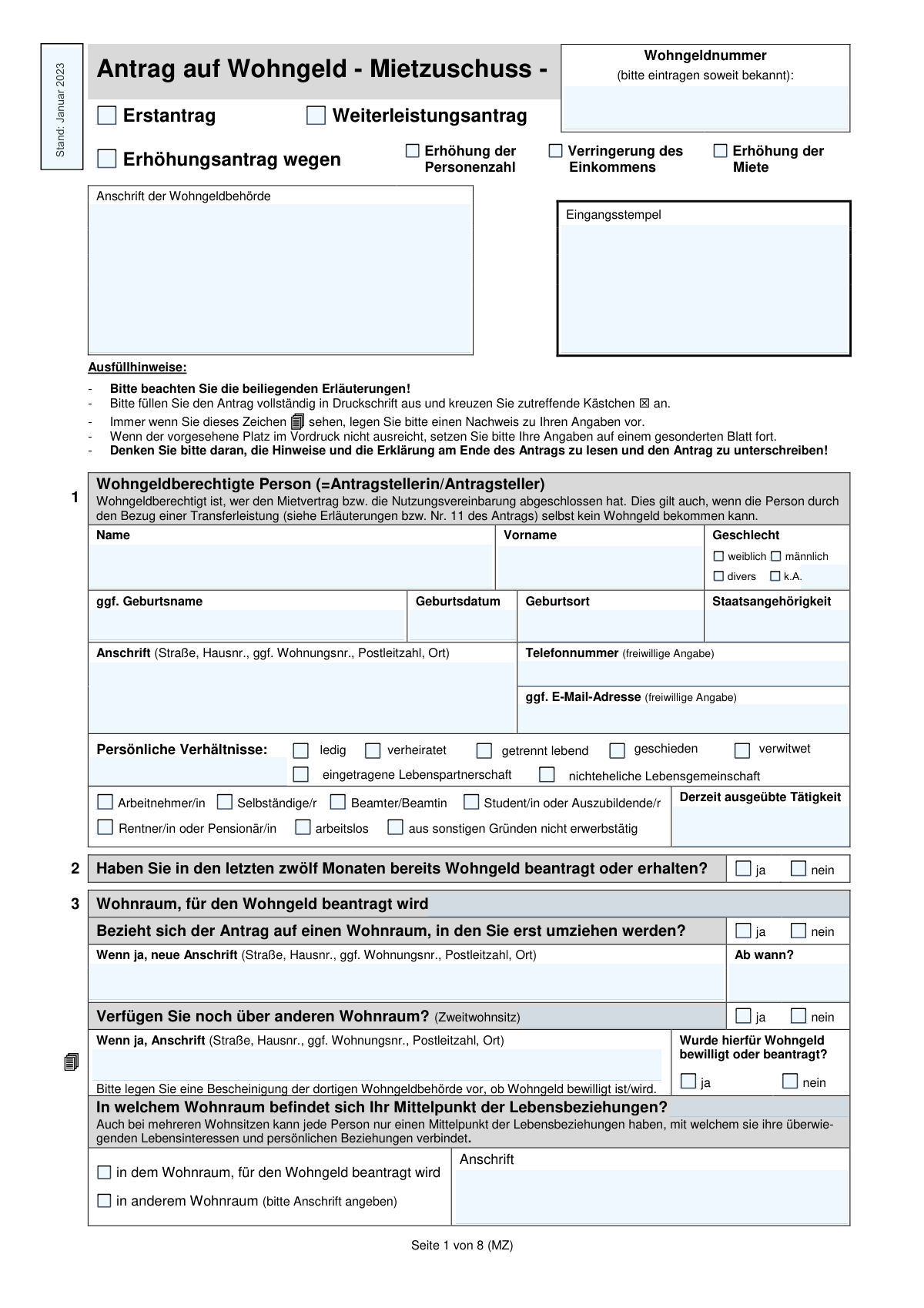
| 1. | Antrag auf Wohngeld (Mietzuschuss) | 8 | Very Complex 81 |
| 2. | Wohngeldantrag für den Mietzuschuss | 11 | Complex 77 |
- Enterprise-grade security & data encryption
- 99%+ accuracy powered by AI
- 1,000+ forms from all industries
- Complete forms in under 60 seconds
How to Choose the Right Form
Navigating German social benefits can be complex, but choosing the right housing benefit form depends entirely on your living situation. If you are a tenant seeking financial assistance to cover your monthly rent, you have come to the right place.
The Standard Form for Tenants
The primary document in this category is the Wohngeldantrag für den Mietzuschuss. This is the official application used across Germany for individuals and families who rent their homes and require a subsidy to manage living costs.
You should choose this form if you belong to one of the following groups:
- Tenants or Subtenants: Individuals renting an apartment, a room, or a house.
- Nursing Home Residents: People living in specialized care facilities who pay for their accommodation.
- Cooperative Members: Individuals living in a cooperative-owned apartment under a rental-like agreement.
Is this the right application for you?
Before you begin filling out the Wohngeldantrag für den Mietzuschuss, ensure you meet the basic criteria for a "Mietzuschuss" (rent subsidy). If you own your home (an owner-occupied apartment or house) and need help with mortgage payments or maintenance costs, you would typically require a different application known as a "Lastenzuschuss."
What You Will Need to Complete the Form
To complete the Wohngeldantrag für den Mietzuschuss accurately using Instafill.ai, you will need to gather specific data points. The form requires detailed information on:
- Household Composition: The number of people living in the home and their relationship to you.
- Income Documentation: Proof of earnings for every person in the household to determine eligibility.
- Housing Costs: Your exact "Kaltmiete" (cold rent) and additional utility expenses.
Using our AI-powered tools, you can transform the standard PDF into a fillable format, ensuring all mandatory fields are addressed correctly before you submit the document to your local Wohngeldbehörde (Housing Benefit Office).
Form Comparison
| Form | Purpose | Eligible Group | Key Requirements |
|---|---|---|---|
| Wohngeldantrag für den Mietzuschuss | Official application for rent subsidies to reduce housing costs for low-income tenants. | Tenants or subtenants living in a rented apartment with limited household income. | Requires information on household size, total income, rent amount, and personal assets. |
Tips for Wohngeld forms
To complete the Wohngeldantrag accurately, you will need your rental agreement, recent pay stubs, and proof of utility costs ready. Having these digital files or physical papers organized beforehand prevents interruptions and ensures all figures entered match your official records.
The amount of housing benefit depends heavily on the number of people living in the residence. Ensure you list everyone accurately, including children and non-working relatives, as their income status and relationship to the applicant directly affect the eligibility calculation.
A common mistake is entering the total 'warm' rent in a field designated for 'Kaltmiete' or base rent. Carefully separate your base rent from heating and service charges to ensure the authorities calculate your subsidy based on the correct legal parameters.
Filling out complex housing forms manually can be time-consuming and prone to errors. AI-powered tools like Instafill.ai can complete these forms in under 30 seconds with high accuracy, and your data stays secure during the process, making it a major time-saver for busy applicants.
Do not overlook smaller income streams such as child benefits, maintenance payments, or part-time earnings. Failing to disclose all household income can lead to significant delays in processing or the requirement to pay back benefits at a later date.
While you can fill out the form digitally, some local housing offices still require a physical signature. Review the specific instructions for your municipality to see if you can submit the PDF via email or if you need to print and mail the signed document.
Frequently Asked Questions
This form is the official application for a rent subsidy in Germany, designed for tenants who need financial assistance to cover their housing costs. It helps the local authorities determine if your household income and rent expenses qualify you for government support.
Generally, tenants, subtenants, and residents of nursing homes with low incomes may apply using the Mietzuschuss form. Eligibility depends on the number of household members, the total household income, and the amount of your monthly rent.
Once completed, the form should be submitted to your local housing benefit office (Wohngeldbehörde) in your city or district administration. Many offices now allow submission via mail, in person, or sometimes through digital portals provided by the local government.
Yes, AI-powered tools like Instafill.ai can process Wohngeld forms by extracting data from your supporting documents and placing it accurately into the required fields. This technology simplifies the application process by automating the data entry usually required for these complex forms.
Using traditional manual methods, these forms can take significant time to complete due to the detailed income and household data required. However, with AI tools like Instafill.ai, you can fill out these forms in under 30 seconds by automatically populating the fields from your source documents.
You will usually need to provide a copy of your rental agreement, proof of your current rent payments, and income statements for all household members. Depending on your situation, additional proof of assets or special expenses might also be requested by the housing office.
You should submit your application as soon as you meet the eligibility criteria, as benefits are generally paid from the first day of the month in which the application was received. Retroactive payments for months prior to the application date are typically not granted.
In most cases, Wohngeld is approved for a period of 12 months. After this period, you must submit a renewal application (Weiterleistungsantrag) to continue receiving financial support, provided you still meet the requirements.
Yes, while the Mietzuschuss form is for tenants, homeowners who live in their own property apply for a different type of benefit called 'Lastenzuschuss'. Both are forms of Wohngeld, but they require different details regarding mortgage payments and maintenance costs.
You are legally required to inform the Wohngeldbehörde immediately of any significant changes in your household income, rent, or the number of people living in your home. These changes can lead to an increase, decrease, or termination of your housing benefit payments.
Glossary
- Form Complexity Index
- Instafill’s 0–100 measure of how much effort a form takes to complete, calculated deterministically from the form’s own structure rather than estimated. It combines the number of fillable fields (the largest factor), how difficult those fields are to complete based on their type, the number of pages that contain fields, the amount of conditional “fill-only-if” logic, and how many sections the form is divided into, then adds modifiers for tables and repeating lists, bundled instruction pages, and dense page layouts. A higher score means the form is harder to fill out by hand. The forms in this category have a median Form Complexity Index of 81/100 (Very Complex). See exactly how it is calculated.
- Mietzuschuss
- A specific type of housing benefit (Wohngeld) paid to tenants to help cover their monthly rent. It is the most common form of housing assistance for those who do not own their home.
- Haushaltsmitglieder
- All persons living permanently in the residence, including spouses, partners, and children. The total number of household members is a key factor in determining the amount of benefit granted.
- Gesamteinkommen
- The combined annual income of all household members, minus specific tax-free allowances and deductions. This total is used to check if the household falls below the required income threshold.
- Bruttokaltmiete
- The base rent plus 'cold' operating costs like water and waste disposal, but excluding heating and hot water. This is the figure used by the authorities to calculate the subsidy amount.
- Bewilligungszeitraum
- The approval period during which the housing benefit is paid, typically lasting 12 months. After this period expires, a renewal application must be filed to continue receiving payments.
- Transferleistungen
- Other social benefits such as Bürgergeld or BAföG that already include housing components. Individuals receiving these payments are generally excluded from applying for Wohngeld to avoid double-funding.
- Lastenzuschuss
- A form of housing benefit specifically for homeowners who live in their own house or apartment. It helps cover expenses like mortgage interest, maintenance costs, and property taxes.
- Wohngeldbehörde
- The local government office or municipal department responsible for evaluating applications and distributing housing benefit funds.