Yes! You can use AI to fill out Motor Carrier Questionnaire
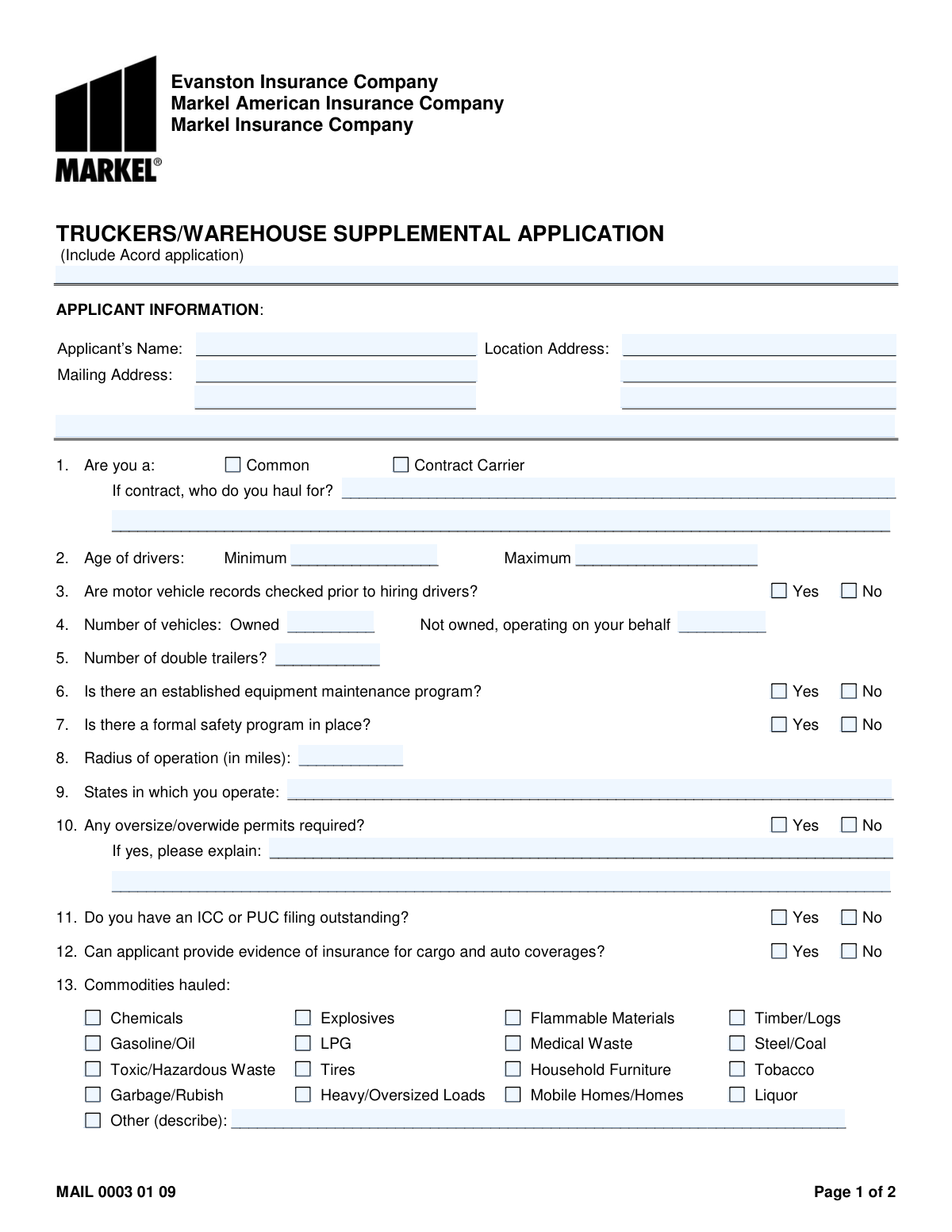
The Motor Carrier Questionnaire is a comprehensive form used by insurance companies to assess the risk profile of a transportation or trucking business. It collects critical data on the applicant's operations, including carrier type, commodities hauled, vehicle fleet, driver qualifications, safety programs, and other business activities to determine eligibility and premiums for coverage like auto liability and motor truck cargo. Today this form can be filled out quickly and accurately using AI-powered services like Instafill.ai, which can also convert non-fillable PDF versions into interactive fillable forms.
Our AI automatically handles information lookup, data retrieval, formatting, and form filling.
It takes less than a minute to fill out MAIL 0003 01 09 using our AI form filling.
Securely upload your data. Information is encrypted in transit and deleted immediately after the form is filled out.
Form specifications
| Form name: | Motor Carrier Questionnaire |
| Number of fields: | 98 |
| Number of pages: | 2 |
| Language: | English |
| Categories: | CAR forms |
Instafill Demo: How to fill out PDF forms in seconds with AI
How to Fill Out MAIL 0003 01 09 Online for Free in 2026
Are you looking to fill out a MAIL 0003 01 09 form online quickly and accurately? Instafill.ai offers the #1 AI-powered PDF filling software of 2026, allowing you to complete your MAIL 0003 01 09 form in just 37 seconds or less.
Follow these steps to fill out your MAIL 0003 01 09 form online using Instafill.ai:
- 1 Navigate to Instafill.ai and upload or select the Motor Carrier Questionnaire form.
- 2 Use the AI assistant to automatically populate applicant details, including business name, addresses, and contact information.
- 3 Specify your carrier type (Common or Contract), operating radius, and the states where you conduct business.
- 4 Provide details about your vehicle fleet, driver age requirements, and check the boxes for all commodities you haul.
- 5 Answer questions about your safety programs, insurance history, and any other business operations like warehousing or towing.
- 6 Review all the information for accuracy, then provide the required digital signatures from the applicant and agent to finalize the questionnaire.
Our AI-powered system ensures each field is filled out correctly, reducing errors and saving you time.
Why Choose Instafill.ai for Your Fillable MAIL 0003 01 09 Form?
Speed
Complete your MAIL 0003 01 09 in as little as 37 seconds.
Up-to-Date
Always use the latest 2026 MAIL 0003 01 09 form version.
Cost-effective
No need to hire expensive lawyers.
Accuracy
Our AI performs 10 compliance checks to ensure your form is error-free.
Security
Your personal information is protected with bank-level encryption.
Frequently Asked Questions About Form MAIL 0003 01 09
This form is an application for commercial transportation insurance. It should be completed by trucking or transportation businesses to provide underwriters with details about their operations, vehicles, drivers, and safety protocols.
If the specific commodity you transport is not listed, you should check the box for "Other (describe)". Then, provide a clear and concise description of the goods you haul in the corresponding text field.
A 'Common Carrier' is a business that hauls goods for the general public. A 'Contract Carrier' hauls goods exclusively for specific companies under a contract. You must select the option that accurately describes your business.
You must enter the details for your Auto Liability and Motor Truck Cargo insurance. This includes the insurance carrier's name, policy number, limits of liability, and the policy expiration date for each coverage.
An ICC/PUC filing is a certificate of insurance filed with federal or state regulators to prove you have the required liability coverage. You should indicate if you have any pending or required filings that have not yet been completed.
A formal safety program typically includes documented policies, procedures, and regular training for drivers on safety protocols. An established equipment maintenance program involves having scheduled service and repair records for your vehicles.
'Vehicles Owned' are vehicles titled in your company's name. 'Vehicles Not Owned (Operating on Your Behalf)' refers to vehicles you lease or those operated by owner-operators under your authority.
Yes, if you subcontract any of your operations to another company, you must check 'Yes' for that question. You will then need to describe the type of work you subcontract and its total annual cost.
You only need to fill in the details for this section if you checked 'Yes' to requiring oversize or overwide permits. You should then describe the items being hauled and the states where permits are needed.
The form must be signed and dated by an authorized representative of the applicant's business. The insurance agent or producer submitting the application must also provide their signature and license number.
Yes, services like Instafill.ai use AI to help you complete forms like this one. They can accurately auto-fill many fields based on your information, which saves time and helps prevent errors.
To fill this form out online, you can use a service like Instafill.ai. Simply upload the document, and their platform will make it an interactive form that you can complete and sign digitally.
If your PDF is not fillable, you can use a tool like Instafill.ai to convert it into an interactive, fillable form. This allows you to easily type your information into the fields instead of printing the form and filling it out by hand.
Compliance MAIL 0003 01 09
Validation Checks by Instafill.ai
1
Conditional Requirement for 'Other Commodity Description'
This check verifies that if the 'Other (describe)' checkbox is selected in the 'Commodities Hauled' section, the corresponding 'Other Commodity Description' text field is not empty. It is important to capture details on all commodities being hauled for accurate risk assessment and underwriting. If this validation fails, the form submission is blocked, and the user is prompted to either provide a description or uncheck the 'Other' box.
2
Mutually Exclusive Selection for Safety and Maintenance Programs
This validation ensures that a user cannot select both 'Yes' and 'No' for the same program, such as 'Formal safety program in place'. Answering both 'Yes' and 'No' to a single question is a logical contradiction that makes the data unusable. If a user selects one option, the other should be disabled or an error should be presented upon submission attempt, forcing the user to make a single, clear choice.
3
Logical Consistency of Driver Age Range
This check ensures that the 'Minimum Driver Age' entered is less than or equal to the 'Maximum Driver Age'. It also verifies that the minimum age is a legally and practically plausible number (e.g., 18 or higher). This prevents data entry errors and ensures the reported driver age range is logical. A failure would trigger an error message requiring the user to correct the age values before proceeding.
4
Conditional Requirement for 'Oversize/Overwide Permit Details'
This validation confirms that if the applicant checks 'Oversize/overwide permits required - Yes', the 'Oversize/Overwide Permit Details' text field must be completed. This information is critical for understanding the scope of non-standard operations and associated risks. If the details are missing, the submission will be rejected until the user provides the required description of the permits.
5
Hazardous Materials Hauling Requires Safety Program
This check cross-references commodity selections with safety program declarations. If any hazardous material commodity (e.g., 'Explosives', 'Chemicals', 'Toxic/Hazardous Waste') is checked, the system must verify that 'Formal safety program in place — Yes' is also selected. Hauling hazardous materials is a high-risk activity that legally and practically requires a formal safety program, and failure to declare one is a major compliance and safety red flag.
6
Conditional Requirement for Contract Carrier Details
This validation ensures that if the 'Contract Carrier' checkbox is selected, the 'Contract Hauling For (Company/Principal)' field is filled out. Knowing the specific companies an applicant hauls for is essential for assessing counterparty risk and understanding the nature of the business. A failed validation would prevent submission and prompt the user to enter the name of the principal company.
7
Total Vehicle Count Sanity Check
This check validates that the sum of 'Vehicles Owned' and 'Vehicles Not Owned' is a positive integer (greater than zero). A transportation company must have at least one vehicle to be operational, so a total of zero indicates a data entry error or an incomplete application. If the total is zero, the form should not be accepted, as it represents a non-viable operation.
8
Insurance Policy Expiration Date Validity
This validation ensures that the 'Auto Liability Expiration Date' and 'Motor Truck Cargo Expiration Date' are valid dates and are not in the past. Current, active insurance is a fundamental requirement for legal operation and risk mitigation. If an expiration date is in the past, the application should be flagged for immediate review or rejected, as it indicates a lapse in required coverage.
9
Signature Date Format and Recency
This check verifies that the 'Signature Date' is a valid calendar date and is not set to a future date. An invalid or future date can call the legal validity of the signature and the application into question. This ensures the application was signed on or before the date of submission, preventing post-dating or data entry errors.
10
Conditional Requirement for Warehousing Details
This validation confirms that if 'Warehousing - Yes' is selected, the 'Warehousing Location' and 'Warehouse Area (sq. ft.)' fields are both completed. Declaring warehousing operations without providing location and size details leaves a critical gap in the risk profile. Failure to provide these details would block submission until the required information is entered.
11
Carrier Type Completeness Check
This validation ensures that the applicant has selected at least one carrier type, either 'Common' or 'Contract'. The carrier type is a fundamental piece of information that defines the business's operating model and regulatory obligations. The form should not be submittable until the applicant specifies how they operate their business.
12
Consistency Check for Heavy Loads and Permits
This check flags a potential inconsistency if 'Heavy/Oversized Loads' is checked under commodities, but 'Oversize/overwide permits required - No' is also selected. While not always a definitive error, hauling oversized loads almost always requires permits, so this combination is highly suspect. A failure would trigger a warning, prompting the user to review their selections for accuracy before final submission.
Common Mistakes in Completing MAIL 0003 01 09
A frequent error is checking 'Yes' to a question but leaving the corresponding detail field blank, such as stating oversize permits are required but not describing them. This creates confusion, requires follow-up, and delays application processing. To avoid this, carefully review each question and its dependencies, ensuring you only fill out the fields required by your answers. AI-powered tools like Instafill.ai can prevent this by automatically showing or hiding conditional fields based on your input, ensuring a complete and consistent submission.
Applicants often misunderstand the legal distinction between a 'Common Carrier' (hauling for the general public) and a 'Contract Carrier' (hauling for specific customers under contract). Selecting the wrong type or failing to provide the required details for a contract carrier can lead to incorrect risk assessment and premium calculation. Before answering, confirm your business's operating authority and be prepared to list the companies you haul for if you operate under contract.
Failing to check all applicable boxes in the 'Commodities Hauled' section is a critical error that can be considered misrepresentation. For example, a carrier might occasionally transport tires or chemicals without selecting those specific options, which could lead to denied claims if an incident involves an unlisted commodity. To prevent this, review your shipping manifests to create a comprehensive list of everything you transport, and use the 'Other (describe)' field for unlisted items.
Applicants may enter a rough estimate for the 'Radius of Operation (Miles)' field, not realizing its importance for determining insurance rates and compliance. An inaccurate radius can result in inadequate coverage or policy violations if a vehicle is involved in an accident outside the stated area. To avoid this, calculate your maximum typical distance from your home base and list all states of operation accurately to ensure your policy reflects your true exposure.
The distinction between 'Vehicles Owned' and 'Vehicles Not Owned (Operating on Your Behalf)' is often a point of confusion, especially for businesses that use owner-operators or long-term leases. Incorrectly reporting these numbers directly impacts premium calculations and can lead to being overcharged or, more dangerously, underinsured. Carefully tally all vehicles operating under your authority, separating those titled to the business from those operated on your behalf by others.
Several sections include an 'Other (describe)' option, which applicants often check without providing a clear description in the corresponding text field. This omission leaves underwriters with incomplete information, forcing them to make assumptions or delay the application for clarification. Always provide a concise but thorough explanation for any 'Other' selections to ensure your unique operations are properly understood and covered.
Applicants may check 'Yes' for having a 'Formal safety program' or 'Established equipment maintenance program' without having documented, consistently enforced procedures. This is often done to appear more favorable but can be considered misrepresentation if investigated after a claim, potentially leading to a denied claim. Only select 'Yes' if you have written programs, training records, and maintenance logs to substantiate your claim.
The insurance table requires specific details like carrier names, policy numbers, limits, and expiration dates, which are frequently left blank or entered incorrectly. This halts the verification process and can jeopardize contracts or renewals that depend on proof of coverage. To avoid delays, have your current insurance declaration pages on hand when filling out the form to accurately transcribe all required information. If the form is a non-fillable PDF, a tool like Instafill.ai can convert it to a fillable version to make data entry easier.
Many carriers subcontract loads or use owner-operators but fail to check 'Subcontract any operations - Yes' and provide the required details. This is a significant omission as it represents a transfer of risk that insurers must evaluate, often requiring proof of insurance from the subcontractor. Hiding this activity can lead to policy cancellation or denial of claims related to a subcontractor's actions, so it is crucial to be transparent about all subcontracting activities.
A frequent contradiction occurs when an applicant checks 'Heavy/Oversized Loads' in the commodities section but then selects 'Oversize/overwide permits required - No.' This conflicting information signals a misunderstanding of the form or operational requirements, leading to delays. Hauling oversized loads almost always requires permits, so ensure your answers are consistent: if you haul oversized freight, acknowledge the need for permits and provide details as requested.
Saved over 80 hours a year
“I was never sure if my IRS forms like W-9 were filled correctly. Now, I can complete the forms accurately without any external help.”
Kevin Martin Green
Your data stays secure with advanced protection from Instafill and our subprocessors

Robust compliance program
Transparent business model
You’re not the product. You always know where your data is and what it is processed for.
ISO 27001, HIPAA, and GDPR
Our subprocesses adhere to multiple compliance standards, including but not limited to ISO 27001, HIPAA, and GDPR.
Security & privacy by design
We consider security and privacy from the initial design phase of any new service or functionality. It’s not an afterthought, it’s built-in, including support for two-factor authentication (2FA) to further protect your account.
Fill out MAIL 0003 01 09 with Instafill.ai
Worried about filling PDFs wrong? Instafill securely fills motor-carrier-questionnaire forms, ensuring each field is accurate.