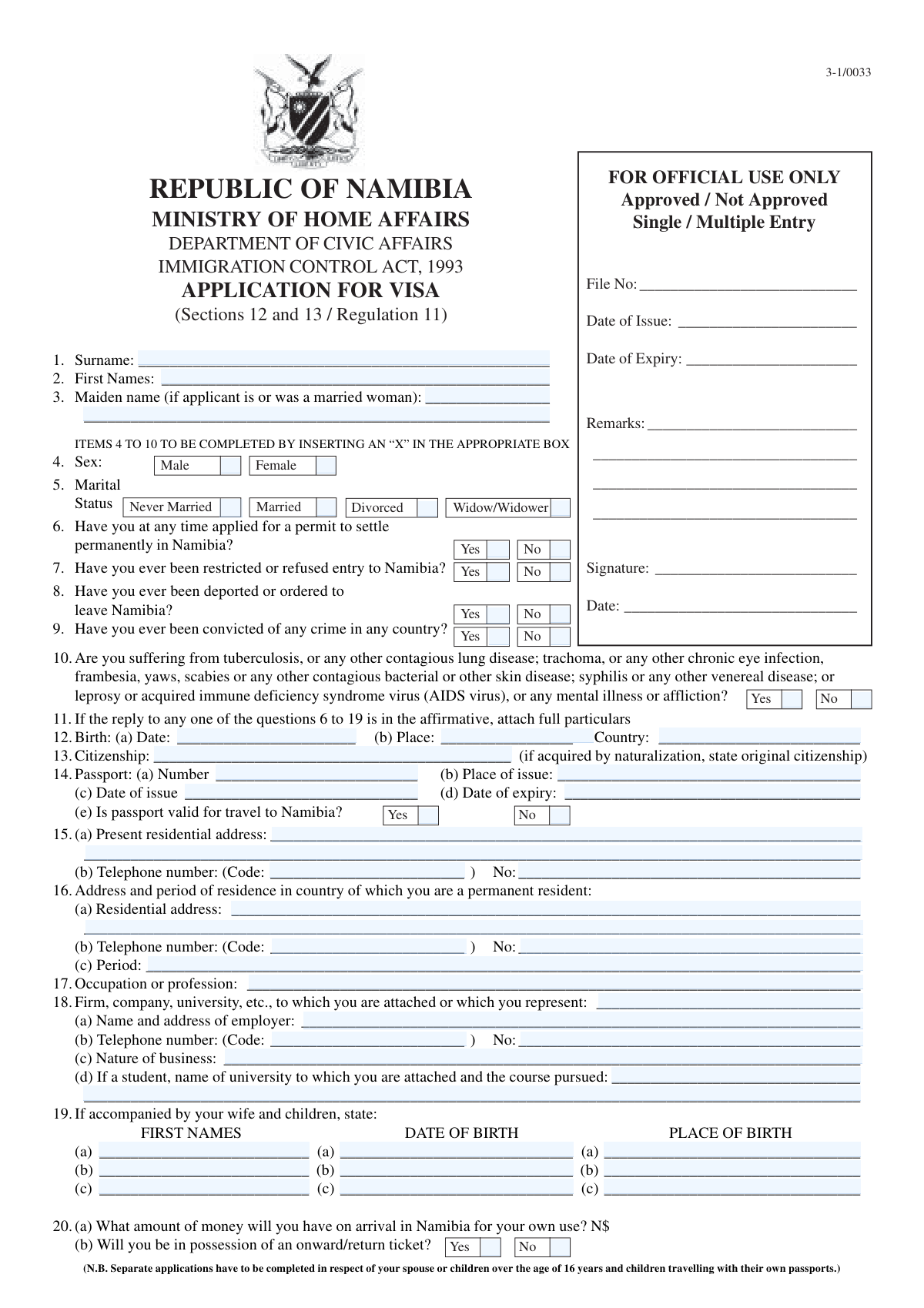
Yes! You can use AI to fill out Republic of Namibia, Ministry of Home Affairs, Application for Visa (Sections 12 and 13 / Regulation 11)
This is an official document from the Namibian Ministry of Home Affairs required for individuals seeking to enter the country. It collects personal, passport, and travel information to process visa applications for holiday, business, work, transit, or return purposes. Today, this form can be filled out quickly and accurately using AI-powered services like Instafill.ai, which can also convert non-fillable PDF versions into interactive fillable forms.
Our AI automatically handles information lookup, data retrieval, formatting, and form filling.
It takes less than a minute to fill out 3-1/0033 using our AI form filling.
Securely upload your data. Information is encrypted in transit and deleted immediately after the form is filled out.
Form specifications
| Form name: | Republic of Namibia, Ministry of Home Affairs, Application for Visa (Sections 12 and 13 / Regulation 11) |
| Number of fields: | 109 |
| Number of pages: | 2 |
| Language: | English |
Instafill Demo: How to fill out PDF forms in seconds with AI
How to Fill Out 3-1/0033 Online for Free in 2026
Are you looking to fill out a 3-1/0033 form online quickly and accurately? Instafill.ai offers the #1 AI-powered PDF filling software of 2026, allowing you to complete your 3-1/0033 form in just 37 seconds or less.
Follow these steps to fill out your 3-1/0033 form online using Instafill.ai:
- 1 Navigate to Instafill.ai and upload or select the Namibian Application for Visa form.
- 2 Provide your personal information, including your full name, date and place of birth, citizenship, and marital status.
- 3 Enter your passport details, current residential address, and occupation information.
- 4 Answer the series of yes/no questions regarding your immigration history, criminal record, and health status.
- 5 Complete Part A or B, detailing the purpose of your visit, intended duration, and proposed address in Namibia.
- 6 Review all the information auto-filled by the AI for accuracy and make any necessary corrections.
- 7 Electronically sign and date the declaration to certify that all the information provided is true and complete.
Our AI-powered system ensures each field is filled out correctly, reducing errors and saving you time.
Why Choose Instafill.ai for Your Fillable 3-1/0033 Form?
Speed
Complete your 3-1/0033 in as little as 37 seconds.
Up-to-Date
Always use the latest 2026 3-1/0033 form version.
Cost-effective
No need to hire expensive lawyers.
Accuracy
Our AI performs 10 compliance checks to ensure your form is error-free.
Security
Your personal information is protected with bank-level encryption.
Frequently Asked Questions About Form 3-1/0033
This is the official Application for Visa for the Republic of Namibia. It is used by foreign nationals to apply for entry into Namibia for purposes like holidays, business, work, transit, or for residents to apply for a return visa.
Any foreign national whose citizenship requires a visa for entry into Namibia must complete this form before their travel. This applies whether you are visiting for tourism, business, work, or just passing through.
You only need to complete one part. Part A is for new applicants seeking a Holiday, Business, Work, or Transit Visa, while Part B is for current Namibian residents applying for a Return Visa to re-enter the country.
Yes, the form specifies that separate applications must be completed for a spouse and for any children over the age of 16. Children of any age traveling on their own passports also require a separate application.
You must produce your passport or travel document. Depending on your application type, you may also need to submit proof of your right of residence in Namibia or proof of an onward/return ticket.
If you answer 'Yes' to questions about previous visa applications, entry refusals, deportations, criminal convictions, or certain health conditions, you must attach a separate document providing full details and explanations.
In item 17 ('Occupation or profession'), write 'Student'. Then, in item 18(d), provide the name of your university and the course you are pursuing.
No, the form explicitly states that only the signature of the applicant will be accepted. You must personally sign and date the declaration at the bottom of the form.
If you have a non-fillable PDF, you can use a service like Instafill.ai. It can convert flat PDFs into interactive, fillable forms so you can easily type your information directly into the fields.
Yes, services like Instafill.ai use AI to help you complete forms accurately and efficiently. You can save your personal information and let the AI auto-fill recurring fields like your name, address, and passport details.
Simply upload the form's PDF to the Instafill.ai platform. The tool will make it interactive, allowing you to type your answers or use the auto-fill feature to complete the application in minutes before printing it for submission.
This field is for any applicant who is or was a married woman. You should enter the family name you used before your first marriage.
You should submit your completed application and all required documents to the nearest Namibian embassy, high commission, or consulate in your country of residence. Check their specific submission procedures.
This refers to your valid Namibian residence permit. If this permit is not already endorsed in your passport, you must submit separate proof of it along with your application.
Compliance 3-1/0033
Validation Checks by Instafill.ai
1
Passport Date Consistency Check
This validation ensures that the 'Passport Date of Expiry' (item 14d) is chronologically after the 'Passport Date of Issue' (item 14c). It is a logical impossibility for a passport to expire before it is issued. If this check fails, it indicates a data entry error that would invalidate the passport information and could lead to the rejection of the application.
2
Passport Validity for Duration of Stay
This check verifies that the 'Passport Date of Expiry' (item 14d) is after the 'Intended date and port of departure' (Part A, item 9c). Many countries, including Namibia, require a passport to be valid for a certain period beyond the intended departure date. This validation prevents applicants from traveling on a passport that may expire during their stay, which could cause significant legal and logistical issues.
3
Conditional Requirement for Adverse History
This validation checks if any of the questions from 6 to 10 have been answered with a 'Yes'. If so, it ensures that item 11, which requires attaching 'full particulars', is not empty or has an associated attachment. This is critical for immigration officials to assess potential risks, and failure to provide the required explanation for an affirmative answer will result in an incomplete application.
4
Maiden Name Field Applicability
This check ensures that the 'Maiden name' field (item 3) is only populated if the applicant has selected 'Female' for Sex (item 4) and their marital status is 'Married' or 'Widow/Widower'. The field is not applicable to male applicants or unmarried women. This validation prevents incorrect data entry and ensures the data collected is relevant to the applicant's profile.
5
Exclusive Selection for Checkbox Groups
For all questions with mutually exclusive options (e.g., items 4 'Sex', 5 'Marital Status', and Yes/No questions 6-10), this validation ensures that only one box is checked per question. Submitting a form where both 'Male' and 'Female' or both 'Yes' and 'No' are selected for the same question creates ambiguity. The system should flag this as an error and require the user to make a single, definitive choice.
6
Logical Date of Birth Verification
This validation confirms that the 'Date of Birth' (item 12a) is a plausible date in the past. It checks that the date is not in the future and that the applicant's calculated age is within a reasonable range (e.g., between 0 and 120 years). This prevents obvious data entry mistakes and ensures the applicant's age is recorded correctly for identity and eligibility purposes.
7
Travel Itinerary Chronology
This check verifies that the 'Intended date of departure' (Part A, item 9c) is after the 'Intended date of arrival' (Part A, item 1). An applicant cannot depart before they arrive. This logical check is fundamental to establishing a valid travel plan and prevents nonsensical data that would require manual correction or clarification.
8
Conditional Business Details Requirement
This validation rule is triggered if the 'Purpose of your visit' (Part A, item 2a) is stated as 'Business'. It then ensures that the 'Nature of business' field (Part A, item 2b) is not empty and contains a detailed explanation. This is crucial for officials to understand the applicant's activities in Namibia and to ensure they are not intending to perform unauthorized work.
9
Conditional Student Information Requirement
This validation checks if the 'Occupation or profession' (item 17) is listed as 'Student'. If it is, the system must verify that the fields for 'name of university' and 'course pursued' (item 18d) are completed. This ensures that applicants claiming student status provide the necessary institutional details for verification, preventing misuse of this category.
10
Mutual Exclusion of Part A and Part B
The form explicitly states 'COMPLETE ONLY PART A OR B'. This validation ensures that the applicant has filled out fields in either Part A (Holiday/Business/Work/Transit Visa) or Part B (Return Visa), but not both. If data is present in both sections, the submission should be flagged as ambiguous and require the applicant to clarify which visa type they are applying for.
11
Accompanying Child Age Limit
This check validates the 'DATE OF BIRTH' for each accompanying child listed in item 19. Based on the note on the form, children over the age of 16 must complete a separate application. This validation would calculate the age of each child and flag any who are over 16, informing the applicant of the separate application requirement.
12
Completeness of Core Identity Fields
This is a fundamental check to ensure that critical mandatory fields are not left blank. It verifies that 'Surname' (item 1), 'First Names' (item 2), 'Date of Birth' (item 12a), 'Citizenship' (item 13), and 'Passport Number' (item 14a) have been filled. An application cannot be processed without this core identifying information, and failure would result in immediate rejection for incompleteness.
13
Return Visa Date Chronology
For applicants filling out Part B (Return Visa), this validation ensures the 'Expected date of return' (Part B, item 1c) is after the 'Date of departure' (Part B, item 1b). This logical check is essential for processing a return visa, as the purpose is to leave and then come back at a later date. An invalid date sequence would make the travel plan nonsensical.
14
Date Format and Validity
This validation applies to all date fields on the form (e.g., Date of Birth, Passport Issue/Expiry, Travel Dates). It checks that the input conforms to a consistent, valid format (e.g., DD/MM/YYYY) and represents a real calendar date (e.g., not '32/13/2024'). This prevents data corruption and processing errors that arise from incorrectly formatted or non-existent dates.
Common Mistakes in Completing 3-1/0033
Item 11 explicitly requires applicants who answer 'Yes' to any question from 6 to 10 to attach full particulars. People often check 'Yes' but forget to include the required supporting documents or written explanations, leading to an incomplete application. This will cause significant processing delays as officials must request the missing information, or it could lead to an outright rejection. To avoid this, carefully review your answers and prepare all necessary attachments before submitting the form.
Applicants, especially those working or studying abroad, may mistakenly enter the same address for both 'Present residential address' (Item 15) and 'Address...in country of which you are a permanent resident' (Item 16). This creates confusion about their residency status and ties to their home country, which can raise questions and delay the application. Ensure you provide the full, correct address for where you currently live and a separate one for your legal permanent residence if they differ.
In Part A, question 2(b) asks for a detailed explanation if the purpose of the visit is 'business,' but many applicants simply write 'Business' or 'Meetings.' This lack of specificity can lead to scrutiny and delays, as immigration officials need to understand the exact nature of the activities to be conducted. To prevent this, clearly describe the business activities, including the names of companies you will meet, your role, and the scope of your work in Namibia.
The form requires numerous dates (birth, passport issue/expiry, travel) but does not specify a universal format like DD/MM/YYYY. Applicants often use their home country's convention (e.g., MM/DD/YYYY), leading to ambiguity and potential data entry errors by officials, which could cause a rejection based on a misinterpreted expiry date. To avoid this, always use a clear, non-ambiguous format like DD-MMM-YYYY (e.g., 05-JAN-2024) or ensure consistency throughout the document.
The form clearly states 'NOTE: COMPLETE ONLY PART A OR B,' but applicants sometimes fill out portions of both sections out of confusion. Part A is for new holiday/business/work visas, while Part B is for return visas for existing residents. Completing the wrong section or both will invalidate the application and require resubmission, causing significant delays. Carefully determine which section applies to your situation before you begin writing.
Applicants traveling with family may overlook Item 19, which asks for the details of their accompanying spouse and children. Even though the note mentions separate applications for children over 16, this section must still be completed for all accompanying family members on the main applicant's visa request. Failure to list them can cause complications during the application process or upon arrival, so ensure all family members traveling with you are listed correctly.
Fields like Item 18 (Employer Details) and Part A, Item 3 (Places to be visited in Namibia) require full names, addresses, and telephone numbers. Applicants often provide just a company name or a hotel name without a full address or contact number. This missing information makes it difficult for officials to verify the legitimacy of the visit, a critical step that can lead to delays or rejection. Always gather and enter complete, verifiable contact information for your employer and any hosts or hotels in Namibia.
The final declaration at the bottom of the form requires the applicant's signature and the date, but this is one of the most common and critical errors. An unsigned form is legally invalid and will be immediately rejected, forcing the applicant to start the process over. This mistake often happens when applicants are focused on the detailed questions and overlook the final step. Always double-check that you have personally signed and dated the form in the designated spaces before submission.
In sections 4 through 10, applicants must place an 'X' in the appropriate 'Yes' or 'No' box for each question. It's a common error to accidentally skip one of these mandatory questions, especially when filling out the form quickly. An unanswered question renders the application incomplete and will halt the process until a correction is made. Using a tool like Instafill.ai can help by highlighting required fields and ensuring none are missed, especially on flat PDFs that it can convert into fillable forms.
Manually entering the passport number, issue date, and expiry date from the document into Item 14 can easily lead to transcription errors. A single wrong digit in the passport number or a swapped day and month in a date can cause a mismatch with official records, leading to application rejection. To prevent this, meticulously double-check every character and date against your physical passport. AI-powered tools like Instafill.ai can help eliminate these errors by accurately extracting information directly from a scan of your passport.
Saved over 80 hours a year
“I was never sure if my IRS forms like W-9 were filled correctly. Now, I can complete the forms accurately without any external help.”
Kevin Martin Green
Your data stays secure with advanced protection from Instafill and our subprocessors

Robust compliance program
Transparent business model
You’re not the product. You always know where your data is and what it is processed for.
ISO 27001, HIPAA, and GDPR
Our subprocesses adhere to multiple compliance standards, including but not limited to ISO 27001, HIPAA, and GDPR.
Security & privacy by design
We consider security and privacy from the initial design phase of any new service or functionality. It’s not an afterthought, it’s built-in, including support for two-factor authentication (2FA) to further protect your account.
Fill out 3-1/0033 with Instafill.ai
Worried about filling PDFs wrong? Instafill securely fills republic-of-namibia-ministry-of-home-affairs-application-for-visa-sections-12-and-13-regulation-11 forms, ensuring each field is accurate.