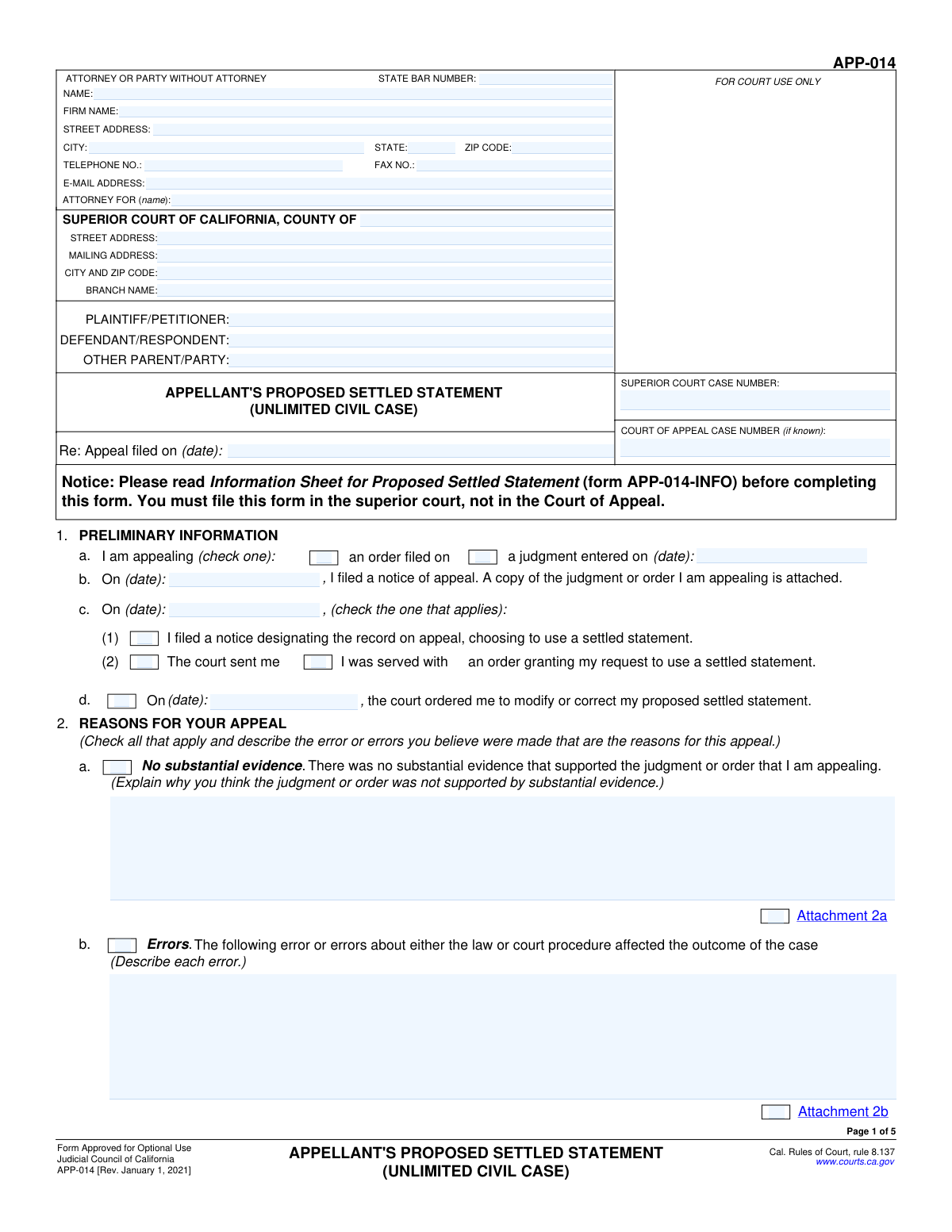
Yes! You can use AI to fill out Form APP-014, Proposed Settled Statement (Unlimited Civil Case)
Form APP-014 is a legal document filed in the California Courts of Appeal for unlimited civil cases. It serves as a substitute for a reporter's transcript, providing a summary of the trial court's proceedings, including testimony, evidence, and rulings relevant to the issues being appealed. This form is essential for appellants who choose or are required to proceed with a settled statement, ensuring the appellate court has a sufficient record to review the case. Today, this form can be filled out quickly and accurately using AI-powered services like Instafill.ai, which can also convert non-fillable PDF versions into interactive fillable forms.
Our AI automatically handles information lookup, data retrieval, formatting, and form filling.
It takes less than a minute to fill out APP-014 using our AI form filling.
Securely upload your data. Information is encrypted in transit and deleted immediately after the form is filled out.
Form specifications
| Form name: | Form APP-014, Proposed Settled Statement (Unlimited Civil Case) |
| Number of fields: | 107 |
| Number of pages: | 5 |
| Language: | English |
| Categories: | NJ state forms, PA state forms |
Instafill Demo: How to fill out PDF forms in seconds with AI
How to Fill Out APP-014 Online for Free in 2026
Are you looking to fill out a APP-014 form online quickly and accurately? Instafill.ai offers the #1 AI-powered PDF filling software of 2026, allowing you to complete your APP-014 form in just 37 seconds or less.
Follow these steps to fill out your APP-014 form online using Instafill.ai:
- 1 Navigate to Instafill.ai and upload or select Form APP-014, the Proposed Settled Statement.
- 2 Use the AI assistant to accurately fill in your attorney/party information, as well as the Superior Court and Court of Appeal case numbers and details.
- 3 Detail the basis for your appeal, specifying whether it's from a judgment or an order, and clearly state the reasons, such as lack of substantial evidence or procedural errors.
- 4 Provide a comprehensive summary of all relevant party and witness testimony, including details on objections, exhibits presented, and court rulings on them.
- 5 Summarize the trial court's findings, rulings on motions, and any disputes over jury instructions that are pertinent to your appeal, attaching additional pages if necessary.
- 6 Carefully review all the information entered for accuracy and completeness, then e-sign the document and provide the date before saving or printing for filing with the court.
Our AI-powered system ensures each field is filled out correctly, reducing errors and saving you time.
Why Choose Instafill.ai for Your Fillable APP-014 Form?
Speed
Complete your APP-014 in as little as 37 seconds.
Up-to-Date
Always use the latest 2026 APP-014 form version.
Cost-effective
No need to hire expensive lawyers.
Accuracy
Our AI performs 10 compliance checks to ensure your form is error-free.
Security
Your personal information is protected with bank-level encryption.
Frequently Asked Questions About Form APP-014
This form is a Proposed Settled Statement, used in a court appeal to create an official summary of the trial court proceedings when a reporter's transcript is not used. The party who is appealing the case (the appellant) and has chosen to proceed with a settled statement must complete and file this form.
Yes, you can. You must enter the Superior Court case number, but the Court of Appeal case number field can be left blank if one has not yet been assigned or is unknown to you.
Check the box for your reason, such as 'No substantial evidence' or 'Errors,' and provide a detailed explanation in the corresponding text box. If you need more space than provided, you can check the 'Attachment' box and include the additional information on a separate, clearly labeled page.
You must provide the name of the person who testified, the date of their testimony, and a complete and accurate summary of what they said that is relevant to your appeal. This includes their responses to questions from attorneys or the court.
If witnesses other than the main parties provided testimony relevant to your appeal, you must check 'Yes' in Section 4. You will then need to complete and attach the 'Other Party and Nonparty Witness Testimony and Evidence Attachment' (form APP-014A).
In Section 6, check 'Yes' and use the space provided to summarize the motion. You should describe who made the motion, the arguments presented, any testimony involved, and the court's final ruling.
Objections made during the trial are critical for an appeal because they preserve legal issues for the appellate court to review. You must detail who objected, the basis for the objection, and the judge's ruling (sustained or overruled) for any testimony relevant to your appeal.
After you sign and date the form, you must file it with the superior court and serve a copy on all other parties in the case. Always consult the California Rules of Court and any local court rules for specific deadlines and procedures.
Yes, services like Instafill.ai use AI to accurately auto-fill form fields with your case and personal information, which saves time and helps reduce errors. However, the legal substance of your arguments and testimony summaries must be your own.
Simply upload the form's PDF to the Instafill.ai platform. The AI will make the document interactive, allowing you to provide your information once and have it automatically populated in all the correct fields.
You can use a service like Instafill.ai, which is designed to convert flat, non-fillable PDFs into interactive forms. This allows you to easily type your information directly into the fields before printing for submission.
A judgment is the final decision that resolves the entire case, while an order is a court's ruling on a specific issue or motion that may not be final. You must check the box that corresponds to the specific court decision you are appealing and provide the date it was filed or entered.
The attachments are simply additional pages you can use when you need more space to provide a complete answer than the form allows. Ensure each attachment is clearly labeled with the corresponding item number (e.g., 'Attachment 3b') and submitted with your form.
Compliance APP-014
Validation Checks by Instafill.ai
1
Superior Court Case Number Presence
Checks that the 'Superior Court Case Number' field is not empty. This number is the primary identifier for the case at the trial court level and is essential for linking the appeal to the correct legal record. A submission without this number cannot be processed and will be rejected for being incomplete.
2
Date Field Format and Validity
Verifies that all date fields, such as 'Appeal Filing Date' and 'Judgment Entry Date', are entered in a valid MM/DD/YYYY format and represent a real calendar date. This ensures data consistency and allows for chronological comparisons between different event dates. Incorrectly formatted dates will prevent the form from being submitted and require user correction.
3
Appeal Date Chronology
Ensures the 'Appeal Filing Date' is on or after the 'Judgment Entry Date'. An appeal cannot be filed before the judgment it is appealing has been officially entered. This logical check prevents fundamentally incorrect submissions and ensures the timeline of events is legally plausible.
4
Conditional Explanation for 'No Substantial Evidence'
Validates that if the 'No substantial evidence' checkbox is checked, the corresponding 'Explanation for No Substantial Evidence' text area is filled. This is crucial because the checkbox makes a legal assertion that must be supported by a detailed explanation for the appeal to be considered. Failure to provide the explanation will result in an incomplete and likely invalid reason for appeal.
5
Conditional Description for 'Errors'
Checks that if the 'Errors' checkbox is selected as a reason for appeal, the 'Description of Errors' text area is not empty. The court requires a specific description of the alleged legal or procedural errors to review the case. A submission with this checkbox ticked but without a description is incomplete and will be rejected.
6
Mutually Exclusive Testimony Status
Verifies that for the 'Parties Testified?' question, only one of the 'Yes' or 'No' checkboxes is selected. Selecting both or neither creates ambiguity about a key fact of the trial. This check ensures the user provides a clear, unambiguous answer before proceeding.
7
Required Testimony Details on 'Yes'
Ensures that if 'Yes (Parties Testified?)' is checked, the 'Party Name', 'Testimony Date', and 'Party Testimony Summary' fields are all filled out. This information is the core of the testimony section and is required to understand who testified, when, and about what. Without this data, the 'Yes' answer is meaningless and the submission is incomplete.
8
Email Address Format
Validates that the value entered in the 'Email Address' field conforms to a standard email format (e.g., [email protected]). This is critical for ensuring the court and other parties can reliably send electronic communications and notices. An invalid email address could lead to missed deadlines and communications, jeopardizing the party's case.
9
ZIP Code Format Validation
Checks that the 'Zip Code' field for the attorney or party's address contains a valid 5-digit or 9-digit (ZIP+4) numerical format. Correctly formatted ZIP codes are essential for the timely and accurate delivery of physical mail and legal documents. An invalid format will trigger an error, requiring the user to correct the entry before submission.
10
Required Motion Description
Validates that if the 'Yes (Fill out b.)' checkbox under 'Summary of Motions' is selected, the 'Motion Description' text area is filled. The purpose of this section is to detail a disagreement with a court's ruling on a motion, which requires a description of the motion itself. An empty description field makes this section incomplete and the reason for appeal unclear.
11
Signature Fields Completion
Ensures that both the 'Signature Date' and 'Typed or Printed Name' fields are completed before submission. A signature, along with the date and printed name, is a legal requirement to attest to the truthfulness of the form's contents. The form is legally invalid without this information and will be rejected.
12
Party Name Consistency
This check compares the values entered for 'Plaintiff/Petitioner Name' and 'Defendant/Respondent Name' across the multiple sections where they appear. It ensures the names are spelled identically throughout the document to avoid confusion and maintain a consistent legal record. Inconsistencies could lead to processing delays or legal challenges regarding the identity of the parties.
13
Conditional Objection Details Requirement
This validation ensures that if the 'Yes (Objection to Testimony?)' checkbox is selected, the 'Objections to Testimony Details' text area is filled out. Simply stating that an objection was made is insufficient; the court needs to know the nature of the objection and the court's ruling to evaluate it as part of the appeal. Failure to provide these details renders the point moot and the form incomplete.
14
Appeal Subject Selection
Verifies that at least one of the checkboxes, 'An order filed' or 'A judgment entered', is selected under the 'Appeal Subject' section. The appeal must be based on a specific court action, and this selection clarifies the basis of the appeal. Submitting the form without selecting either option leaves the subject of the appeal ambiguous and would result in rejection.
Common Mistakes in Completing APP-014
Filers often enter slight variations of party names or case numbers across the multiple sections of the form. This happens due to typos or using abbreviations in one section and full names in another. Such inconsistencies can cause confusion and processing delays, as court clerks must verify that all sections refer to the same case and individuals. To avoid this, carefully copy the exact full names and case numbers from official court documents for every entry, or use a tool like Instafill.ai which can auto-populate recurring information consistently across the entire document.
This form contains many conditional fields that must be filled out only after a specific checkbox is marked 'Yes'. A frequent mistake is checking 'Yes' (e.g., 'Yes (Parties Testified?)') but then failing to provide the required follow-up information in the 'Party Testimony Summary' section. This leaves the filing incomplete and can lead to its rejection or weaken the legal argument. Always double-check that for every 'Yes' answer, you have completed the corresponding detailed explanation or summary section as instructed.
Fields like 'Explanation for No Substantial Evidence' and 'Description of Errors' require a detailed, persuasive summary of the legal grounds for the appeal. Many filers provide overly brief or conclusory statements that lack the necessary detail to be effective. This significantly undermines the purpose of the form, which is to clearly articulate the appeal's basis. To prevent this, prepare a thorough, well-reasoned explanation beforehand, citing specific facts and legal principles, rather than trying to summarize a complex argument on the fly.
Entering the 'Superior Court Case Number' or 'Court of Appeal Case Number' with transposed digits, incorrect prefixes, or missing characters is a critical error. Case numbers are the primary identifier for a legal action, and an incorrect one can lead to the document being misfiled or rejected outright. This mistake often occurs due to simple data entry errors. It is crucial to meticulously cross-reference the number with official court notices; AI-powered tools like Instafill.ai can also help by validating data formats to catch potential errors.
Filers frequently make errors related to attachments, either by checking a box for an attachment (e.g., 'Attachment 2b') without including the document, or by including an attachment but forgetting to check the corresponding box on the form. This creates an incomplete or confusing record for the court. To avoid this, create a checklist of all required attachments as you fill out the form and verify that each one is both physically included and properly indicated on the form before submission.
The form requires several distinct dates, such as 'Judgment Entry Date,' 'Appeal Filing Date,' and 'Court Order Modification Date.' People often confuse these dates, which can have serious consequences, potentially leading to the dismissal of an appeal if it appears to be untimely. Each date corresponds to a specific legal event. Carefully review court records to find the exact date for each required field and ensure you are entering it in the correct location.
Leaving fields like 'State Bar Number,' 'Telephone Number,' or 'Email Address' blank is a common oversight. The court and opposing counsel rely on this information for all official communication. Missing or inaccurate contact details can lead to missed deadlines, unheard motions, and significant procedural disadvantages. Always fill out the 'Attorney or Party Information' section completely and accurately. If the form is a non-fillable PDF, a tool like Instafill.ai can convert it to a fillable version to ensure no fields are accidentally skipped.
When filling out the 'Superior Court Information,' filers in large counties often provide the main court address but forget to specify the 'Court Branch Name.' This is critical because different branches handle different types of cases or geographic areas. Omitting the branch name can cause documents to be delayed or misrouted within the court system. Always include the specific branch where the original case was heard to ensure proper and timely processing.
In the 'Attorney For Name' field, parties representing themselves (pro se) sometimes mistakenly enter their own name, or an attorney might list their law firm instead of the specific client they represent. This field is meant to clearly state which party (e.g., 'John Smith, Plaintiff') the listed attorney is representing. Misinformation here can create ambiguity regarding legal representation. Pro se filers should leave this blank, while attorneys must ensure they list their client's full name and role in the case.
Forgetting to physically or electronically sign the form and enter the 'Signature Date' is one of the most common and easily avoidable mistakes. An unsigned legal document is generally considered invalid and will be rejected by the court clerk, causing the filer to miss critical deadlines. Always perform a final review of the form with the sole purpose of checking for a valid signature and the correct date before you file.
Saved over 80 hours a year
“I was never sure if my IRS forms like W-9 were filled correctly. Now, I can complete the forms accurately without any external help.”
Kevin Martin Green
Your data stays secure with advanced protection from Instafill and our subprocessors

Robust compliance program
Transparent business model
You’re not the product. You always know where your data is and what it is processed for.
ISO 27001, HIPAA, and GDPR
Our subprocesses adhere to multiple compliance standards, including but not limited to ISO 27001, HIPAA, and GDPR.
Security & privacy by design
We consider security and privacy from the initial design phase of any new service or functionality. It’s not an afterthought, it’s built-in, including support for two-factor authentication (2FA) to further protect your account.
Fill out APP-014 with Instafill.ai
Worried about filling PDFs wrong? Instafill securely fills form-app-014-proposed-settled-statement-unlimited-civil-case forms, ensuring each field is accurate.