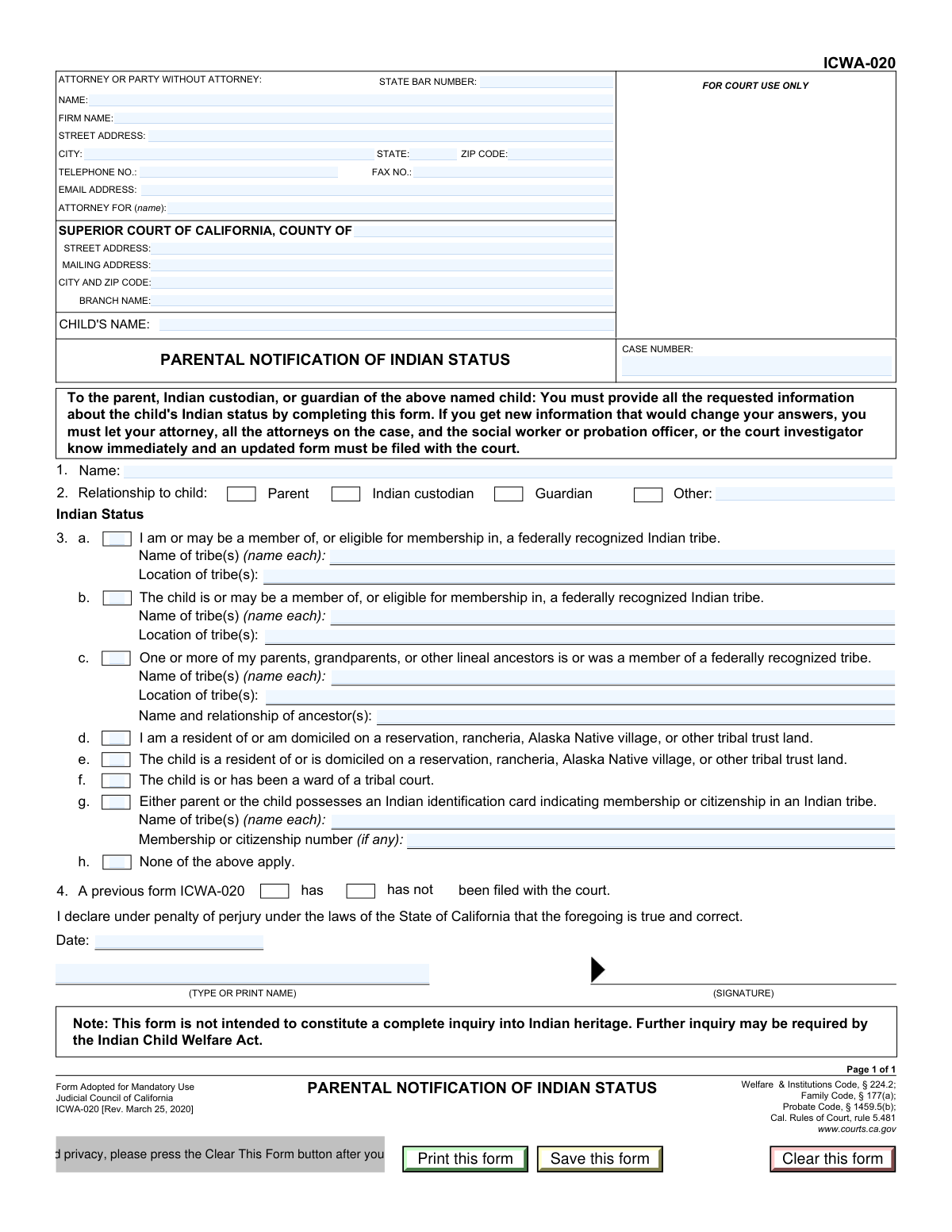
Yes! You can use AI to fill out Form ICWA-020, Parental Notification of Indian Status
Form ICWA-020, Parental Notification of Indian Status, is a legal document required by California courts in cases involving child custody, such as dependency, family law, and probate matters. Its purpose is to gather information from a child's parent or guardian to determine if the child has Native American ancestry, which would invoke the protections of the Indian Child Welfare Act (ICWA). This declaration is crucial for ensuring legal compliance and protecting the rights of the child and tribe. Today, this form can be filled out quickly and accurately using AI-powered services like Instafill.ai, which can also convert non-fillable PDF versions into interactive fillable forms.
ICWA-020 is part of the
rental forms category on Instafill.
Our AI automatically handles information lookup, data retrieval, formatting, and form filling.
It takes less than a minute to fill out ICWA-020 using our AI form filling.
Securely upload your data. Information is encrypted in transit and deleted immediately after the form is filled out.
Form specifications
| Form name: | Form ICWA-020, Parental Notification of Indian Status |
| Number of fields: | 49 |
| Number of pages: | 1 |
| Language: | English |
More forms in Rental forms
Instafill Demo: How to fill out PDF forms in seconds with AI
How to Fill Out ICWA-020 Online for Free in 2026
Are you looking to fill out a ICWA-020 form online quickly and accurately? Instafill.ai offers the #1 AI-powered PDF filling software of 2026, allowing you to complete your ICWA-020 form in just 37 seconds or less.
Follow these steps to fill out your ICWA-020 form online using Instafill.ai:
- 1 Navigate to Instafill.ai and upload your ICWA-020 form or select it from their template library.
- 2 Provide the court and case information, including the county, branch name, and case number, as well as your attorney or personal contact details.
- 3 Answer the questions regarding the child's potential Indian status, including any known tribal affiliations of the child, parents, or ancestors.
- 4 Specify your relationship to the child (e.g., parent, guardian) and indicate whether a previous ICWA-020 form has been filed for this case.
- 5 Carefully review all the information automatically populated by the AI to ensure its accuracy and completeness.
- 6 Electronically sign and date the form to declare under penalty of perjury that the provided information is true and correct.
- 7 Download, save, or print the completed ICWA-020 form, ready for filing with the appropriate California Superior Court.
Our AI-powered system ensures each field is filled out correctly, reducing errors and saving you time.
Why Choose Instafill.ai for Your Fillable ICWA-020 Form?
Speed
Complete your ICWA-020 in as little as 37 seconds.
Up-to-Date
Always use the latest 2026 ICWA-020 form version.
Cost-effective
No need to hire expensive lawyers.
Accuracy
Our AI performs 10 compliance checks to ensure your form is error-free.
Security
Your personal information is protected with bank-level encryption.
Frequently Asked Questions About Form ICWA-020
Form ICWA-020, Parental Notification of Indian Status, is used in California courts to determine if a child involved in a case has Native American heritage. This is required to comply with the Indian Child Welfare Act (ICWA), which has specific rules for cases involving Indian children.
The child's parent, Indian custodian, or legal guardian involved in a welfare, family law, or probate court case is required to complete and sign this form.
You will need your court case number, the court's address, and any information you have about your or your child's potential membership or eligibility for membership in a federally recognized Indian tribe. This includes the names and locations of tribes and the names of any ancestors who were members.
You should still complete the form to the best of your ability. If you have any reason to believe there might be Indian heritage, even if you are unsure, you should indicate that and provide any details you have, such as an ancestor's name.
If none of the situations listed in items 3.a through 3.g apply, you should check the box for 3.h, which states 'None of the above apply.' This informs the court that, to your knowledge, the child does not have Indian status under ICWA.
Question 3.a asks about your (the person filling out the form) potential tribal membership. Question 3.b specifically asks about the child's potential tribal membership.
If you get new information that changes your answers, you must immediately notify your attorney, all other attorneys on the case, and the social worker or probation officer. You are required to file an updated ICWA-020 form with the court.
The completed and signed form must be filed with the Superior Court listed on the form for your specific case. You must also provide copies to all attorneys, the social worker, or the probation officer involved in the case.
The court and other parties will use the information to determine if the Indian Child Welfare Act (ICWA) applies to your case. If there is a possibility of Indian heritage, the court will likely require that the relevant tribe(s) be notified.
Yes, you can use AI-powered services like Instafill.ai to help fill out this form. These tools can accurately auto-fill your personal and case information, which helps save time and reduce errors.
To fill out the form online, you can upload the ICWA-020 PDF to Instafill.ai. The service will make the form fillable and guide you through the fields, allowing you to type your information directly and then download the completed document for printing and signing.
If you have a non-fillable or 'flat' PDF, you can use a service like Instafill.ai. It can convert the non-fillable PDF into an interactive, fillable form that you can easily complete on your computer.
Signing under penalty of perjury means you are legally swearing that all the information you have provided on the form is true and correct to the best of your knowledge. Providing false information can have serious legal consequences.
Yes, this section must be completed. If you have an attorney, they will fill it out; if you are representing yourself, you must enter your own name, address, and contact information.
Compliance ICWA-020
Validation Checks by Instafill.ai
1
Exclusive Relationship Selection
This check ensures that exactly one checkbox is selected from the 'Relationship to child' section (Parent, Indian custodian, Guardian, Other). Selecting none or multiple options creates ambiguity about the declarant's legal standing. If validation fails, the user should be prompted to select only one option that best describes their relationship to the child.
2
Conditional 'Other' Relationship Specification
This validation is triggered if the 'Other' checkbox is selected in the 'Relationship to child' section. It verifies that the adjacent text field, meant for specifying the relationship, is not empty. This is crucial for the court to understand the declarant's connection to the child when it falls outside the standard categories. Failure to provide this detail will result in a rejection, asking the user to specify the relationship.
3
Declaration and Signature Fields Completion
This check verifies that the 'Date' and 'Declarant's Printed Name' fields at the bottom of page 1 are both filled. These fields, along with the signature, are legally required to execute the declaration under penalty of perjury. An incomplete declaration is invalid, so the form cannot be submitted until both fields are completed.
4
Declaration Date Validity
This validation ensures the 'Date' field in the declaration section contains a valid, properly formatted date that is not in the future. A post-dated or invalid date would invalidate the declaration. If the date is invalid, the system should prompt the user to enter the current date in the correct format.
5
Mutually Exclusive Indian Status (3.a-g vs 3.h)
This is a critical logical check on the Indian Status section. It ensures that if '3.h None of the above apply' is selected, none of the checkboxes from 3.a to 3.g can be selected. Conversely, if any of 3.a through 3.g are checked, 3.h must be unchecked. This prevents a contradictory submission, which would require clarification and delay proceedings.
6
Indian Status Section Completeness
This validation ensures that the user has made a selection within the Indian Status section (items 3.a through 3.h). The entire purpose of the form is to declare Indian status, so at least one box must be checked. If no box is checked, the form is incomplete and must be returned to the user for completion.
7
Conditional Tribe Information for 3.a
If the checkbox for '3.a I am or may be a member of...' is checked, this validation ensures the corresponding 'Name of tribe(s)' and 'Location of tribe(s)' fields are not empty. Checking the box without providing details is insufficient for the court and social services to perform their required inquiries. The user will be prompted to provide the tribe details or uncheck the box.
8
Conditional Ancestor Information for 3.c
When the checkbox for '3.c One or more of my... ancestors is or was a member...' is checked, this validation confirms that the 'Name of tribe(s)', 'Location of tribe(s)', and 'Name and relationship of ancestor(s)' fields are all filled. This information is essential for tracing lineage as required by ICWA. An error will be shown if the box is checked but the details are missing.
9
Conditional Tribe Name for Indian ID Card (3.g)
If the checkbox for '3.g Either parent or the child possesses an Indian identification card...' is selected, this check verifies that the 'Name of tribe(s)' field is filled out. The existence of an ID card is a strong indicator of affiliation, and the tribe name is necessary for notification and verification. The form will be considered incomplete if this information is missing.
10
Exclusive Previous Filing Status (Section 4)
This check ensures that for Section 4, exactly one of the two options ('has' or 'has not' been filed) is selected. This provides a clear, unambiguous answer regarding the case history of this form. The system should prevent submission if neither or both options are checked.
11
Case Number Presence and Format
This validation confirms that the 'CASE NUMBER' field is not empty and, if possible, matches the standard format for the specified court county. The case number is the primary identifier for the legal proceeding and is absolutely essential for the clerk to file the document correctly. A missing or malformed case number will lead to rejection of the filing.
12
Child's Name Presence
This check ensures the 'CHILD'S NAME' field is filled out. The child is the subject of the proceeding, and their name is a fundamental piece of identifying information for the case. A form submitted without the child's name is unusable and will be rejected.
13
Attorney/Party Contact Information Completeness
This validation verifies that the primary contact fields for the filing party or attorney (Name, Street Address, City, State, ZIP Code, and Telephone No.) are all filled. This information is mandatory for all court filings for service of process and communication. The form is considered improperly filled if this section is incomplete.
14
State Bar Number Format
This check validates that the 'STATE BAR NUMBER' field, if filled, contains only numerical digits. This ensures the number is valid for lookup in the California State Bar directory. Submitting a non-numeric or incorrectly formatted number can cause issues in identifying the attorney of record.
15
ZIP Code Format
This validation ensures that the 'ZIP CODE' field for both the attorney/party and the court contains a valid 5-digit or 9-digit (ZIP+4) format. Correct ZIP codes are essential for mail delivery and for verifying the address's location. An invalid format could lead to returned mail and delays in communication.
Common Mistakes in Completing ICWA-020
A frequent error is checking box 3.h ('None of the above apply') while also checking one or more of the boxes from 3.a to 3.g. This creates a logical contradiction that makes the form invalid and requires clarification, delaying the court's ICWA determination. You must choose either one or more options from 3.a-g OR only 3.h. Carefully review your selections to ensure they are not mutually exclusive.
When providing tribe information, individuals may list general names (e.g., 'Sioux') instead of the specific, federally recognized tribal entity (e.g., 'Standing Rock Sioux Tribe'). This ambiguity forces the court to conduct broader, more time-consuming research to provide proper notice. Always use the full, official name of the tribe as recognized by the federal government to ensure accurate and timely notification.
A common error is checking a box like 3.a, 3.c, or 3.g but then failing to fill in the corresponding required information, such as the tribe name, location, or ancestor details. This happens when filers are in a hurry or don't have the information immediately available. An incomplete entry prevents the court from taking necessary next steps and will likely result in a request for an amended form.
Forgetting to sign and date the form under penalty of perjury is a critical and common mistake. An unsigned form is legally invalid and will be rejected by the court clerk, halting all progress on the case until a properly executed form is submitted. This simple oversight can cause unnecessary delays and require you to refile the document.
People often forget to fill in the full court name, branch, and especially the exact case number in the header. This happens due to oversight or not having the court documents handy. An incomplete header can lead to the form being rejected by the clerk or misfiled, causing significant delays in the legal proceedings.
When checking box 3.c, filers sometimes provide the tribe name but forget to list the specific name and relationship of the ancestor (e.g., 'Jane Doe - Paternal Grandmother'). This missing information is critical for tribal enrollment offices to verify lineage and determine the child's eligibility for membership. Without these details, the inquiry may be returned as incomplete, stalling the ICWA process.
Some individuals, particularly if they believe ICWA does not apply, leave the entire 'Indian Status' section (boxes 3.a through 3.h) blank. The form requires an affirmative declaration; if none of the conditions in 3.a-g apply, you must check box 3.h. Leaving this section empty renders the form incomplete and legally insufficient, as it fails to make a clear statement about Indian heritage.
This form is often available as a flat PDF, leading people to fill it out by hand. Illegible handwriting for critical details like names and case numbers can cause data entry errors by the court clerk or misinterpretation by social services. To prevent this, print clearly in block letters or use a tool like Instafill.ai, which can convert non-fillable PDFs into fillable versions, allowing you to type your answers for maximum clarity.
Individuals representing themselves often get confused by the header section designed for attorneys, leaving it blank or filling inapplicable fields like 'State Bar Number'. If you do not have an attorney, you must enter your own name and contact information in the appropriate fields. AI-powered tools like Instafill.ai can help guide users to fill the correct fields based on whether they are an attorney or a self-represented party.
In section 1, filers must specify their relationship to the child. A common mistake is checking 'Other' but failing to write in the specific relationship (e.g., 'Aunt,' 'Step-parent'). This ambiguity can raise questions about the declarant's legal standing or knowledge of the child's heritage. Always provide a clear and specific description if your relationship is not 'Parent' or 'Guardian'.
Saved over 80 hours a year
“I was never sure if my IRS forms like W-9 were filled correctly. Now, I can complete the forms accurately without any external help.”
Kevin Martin Green
Your data stays secure with advanced protection from Instafill and our subprocessors

Robust compliance program
Transparent business model
You’re not the product. You always know where your data is and what it is processed for.
ISO 27001, HIPAA, and GDPR
Our subprocesses adhere to multiple compliance standards, including but not limited to ISO 27001, HIPAA, and GDPR.
Security & privacy by design
We consider security and privacy from the initial design phase of any new service or functionality. It’s not an afterthought, it’s built-in, including support for two-factor authentication (2FA) to further protect your account.
Fill out ICWA-020 with Instafill.ai
Worried about filling PDFs wrong? Instafill securely fills form-icwa-020-parental-notification-of-indian-status forms, ensuring each field is accurate.