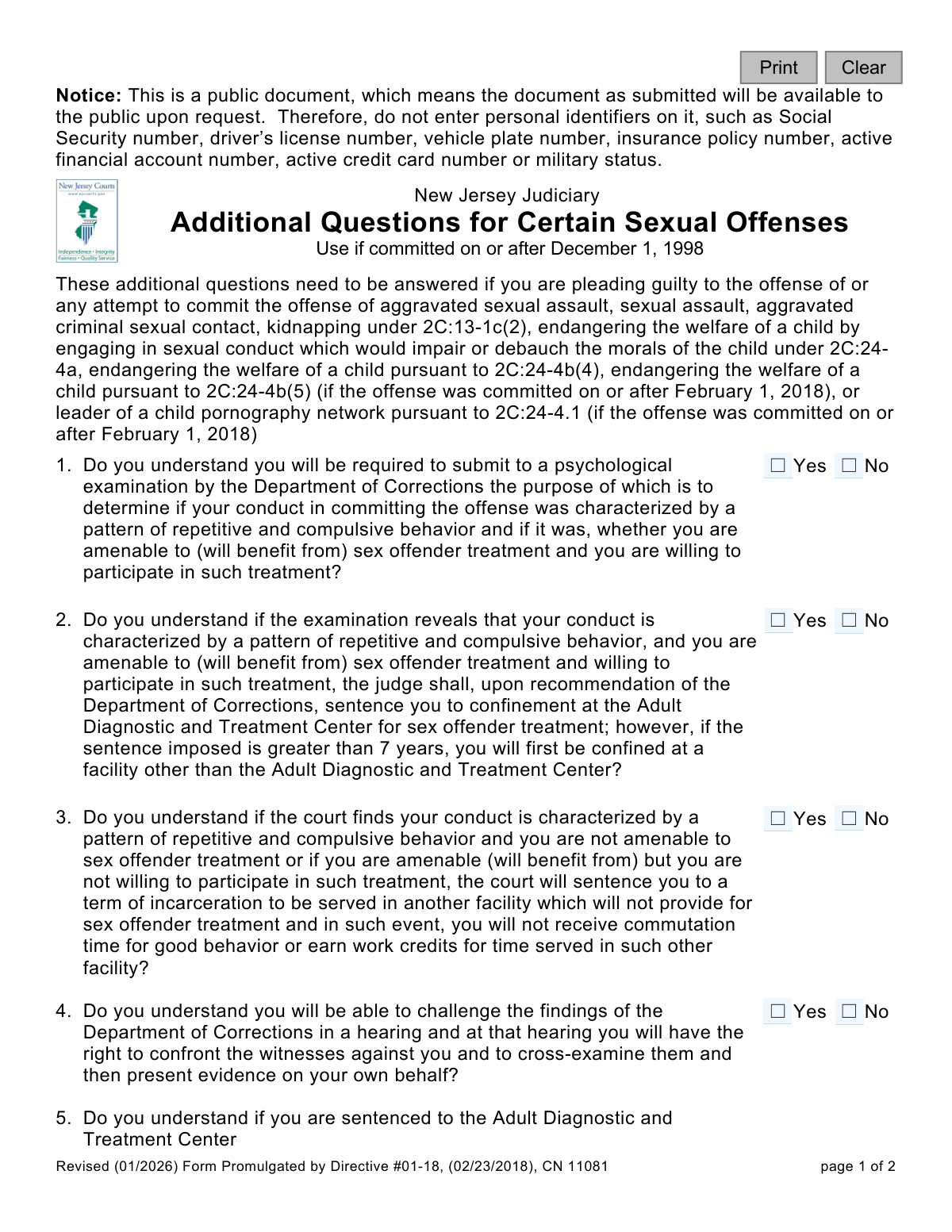
Yes! You can use AI to fill out Additional Questions for Certain Sexual Offenses - Committed on or After December 1, 1998 (Plea 04)
Form Plea 04, 'Additional Questions for Certain Sexual Offenses,' is a legal document used by the New Jersey Judiciary for defendants pleading guilty to specific sexual crimes. It ensures the defendant understands the consequences of their plea, including mandatory psychological evaluations, potential sentencing to the Adult Diagnostic and Treatment Center, and unique parole conditions. Today, this form can be filled out quickly and accurately using AI-powered services like Instafill.ai, which can also convert non-fillable PDF versions into interactive fillable forms.
Plea 04 is part of the
New Jersey forms category on Instafill.
Our AI automatically handles information lookup, data retrieval, formatting, and form filling.
It takes less than a minute to fill out Plea 04 using our AI form filling.
Securely upload your data. Information is encrypted in transit and deleted immediately after the form is filled out.
Form specifications
| Form name: | Additional Questions for Certain Sexual Offenses - Committed on or After December 1, 1998 (Plea 04) |
| Number of fields: | 26 |
| Number of pages: | 1 |
| Language: | English |
Instafill Demo: How to fill out PDF forms in seconds with AI
How to Fill Out Plea 04 Online for Free in 2026
Are you looking to fill out a PLEA 04 form online quickly and accurately? Instafill.ai offers the #1 AI-powered PDF filling software of 2026, allowing you to complete your PLEA 04 form in just 37 seconds or less.
Follow these steps to fill out your PLEA 04 form online using Instafill.ai:
- 1 Navigate to Instafill.ai and upload or select the New Jersey Plea 04 form.
- 2 With legal counsel, carefully read the introductory section to confirm the form applies to the specific offense in the plea agreement.
- 3 Proceed through questions 1-7, which detail the implications of the plea regarding psychological examinations, sentencing, and parole.
- 4 For each question, check the 'Yes' or 'No' box to formally acknowledge understanding of the statement, as advised by your attorney.
- 5 Electronically sign and date the form in the designated fields for the Defendant, Defense Attorney, and Prosecutor.
- 6 Review the entire completed document with your attorney to ensure all acknowledgments are accurate before submission to the court.
Our AI-powered system ensures each field is filled out correctly, reducing errors and saving you time.
Why Choose Instafill.ai for Your Fillable Plea 04 Form?
Speed
Complete your Plea 04 in as little as 37 seconds.
Up-to-Date
Always use the latest 2026 Plea 04 form version.
Cost-effective
No need to hire expensive lawyers.
Accuracy
Our AI performs 10 compliance checks to ensure your form is error-free.
Security
Your personal information is protected with bank-level encryption.
Frequently Asked Questions About Form Plea 04
This form is for defendants in New Jersey pleading guilty to specific sexual offenses committed on or after December 1, 1998. It ensures the defendant understands the potential consequences related to psychological evaluation, sentencing, and treatment as part of their plea.
This form is required if you are pleading guilty to aggravated sexual assault, sexual assault, aggravated criminal sexual contact, certain types of kidnapping or endangering the welfare of a child, or being a leader of a child pornography network.
It is an evaluation by the Department of Corrections to determine if your conduct shows a pattern of repetitive and compulsive behavior. The results help the court decide on the appropriate sentencing, including potential confinement at the Adult Diagnostic and Treatment Center (ADTC) for sex offender treatment.
If sentenced to the ADTC, your parole will not follow normal guidelines and will instead be based on your progress in sex offender treatment. It is possible that you could spend more time in treatment at the ADTC than you would in a standard state prison.
If the court finds you would benefit from treatment but you are unwilling to participate, you will be sentenced to a different facility that does not provide such treatment. You will not be eligible for commutation time for good behavior or earn work credits during your incarceration.
Yes, you have the right to challenge the Department of Corrections' findings in a court hearing. At the hearing, you can confront witnesses against you, cross-examine them, and present your own evidence.
This means the submitted form can be accessed by the public upon request. Therefore, you must not include sensitive personal identifiers like your Social Security number, driver's license number, or active financial account numbers.
A female defendant who qualifies for treatment will not be confined at the all-male Adult Diagnostic and Treatment Center. She will be sent to a different facility designated by the Commissioner of Corrections where she will receive similar sex offender treatment.
This form is part of your official plea agreement and is submitted to the court handling your case. Your defense attorney will guide you through signing it and ensuring it is filed correctly with the New Jersey Judiciary.
Yes, services like Instafill.ai use AI to accurately auto-fill form fields, which can save time and help avoid errors. However, since this is a critical legal document, you must review all information carefully with your attorney before signing.
You can use a service like Instafill.ai to upload the PDF and fill it out on your computer or mobile device. The platform makes the form interactive, allowing you to type your answers, sign electronically, and then download the completed document.
If you have a flat or scanned PDF that you cannot type into, you can use a tool like Instafill.ai. It can convert non-fillable PDFs into interactive, fillable forms that you can complete and sign electronically.
The form must be signed and dated by three parties: the defendant, the defendant's defense attorney, and the prosecutor.
Your parole eligibility will be significantly altered and will not follow standard guidelines. Your release will depend on your progress in treatment or, if not in treatment, after serving a mandatory minimum term without the benefit of credits for good behavior or work.
Compliance Plea 04
Validation Checks by Instafill.ai
1
Ensures All Questions Are Answered
This validation confirms that every question from 1 through 7, including all sub-parts of question 5, has received a 'Yes' or 'No' response. Incomplete forms can invalidate a plea agreement by failing to establish a full record of the defendant's understanding. A failed validation would prevent submission and highlight the unanswered questions for the user to complete.
2
Plea Comprehension Alert
This check flags any 'No' response to questions 1 through 7 for mandatory human review. A 'No' answer indicates the defendant may not fully understand the consequences of their guilty plea, which could render the plea invalid. While not blocking submission, this validation triggers a high-priority alert to the court clerk or judge to address the potential lack of understanding before accepting the plea.
3
Verifies Defendant Signature Presence
This check ensures that the defendant's signature field (`sigDefName`) is not empty. The defendant's signature is the most critical element, signifying their personal acknowledgment and understanding of the form's content. Without it, the document has no legal standing, so a failed validation must block the form from being processed.
4
Verifies Defense Attorney Signature Presence
This validation confirms that the defense attorney's signature field (`sigDefAtty`) has been filled. The attorney's signature attests that they have advised their client regarding the content of the form and the consequences of the plea. A missing signature raises questions about legal counsel and could be grounds to challenge the plea, so the form is considered incomplete until signed.
5
Verifies Prosecutor Signature Presence
This check ensures the prosecutor's signature field (`sigProscName`) is completed. The prosecutor's signature indicates their agreement and acknowledgment of the terms being presented to the defendant as part of the plea. A missing prosecutor's signature would render the document incomplete from the state's perspective, thus preventing its official filing.
6
Ensures Valid Signature Date Format
This validation checks that all three signature date fields (`sigDtDef`, `sigDtDefAtty`, `sigDtProsec`) are entered in a recognized and consistent date format, such as MM/DD/YYYY. This is essential for data integrity and creating an unambiguous legal record. A submission with an invalid format would be rejected, prompting the user to correct the date entry.
7
Checks for Future or Illogical Dates
This validation ensures that none of the signature dates are set in the future or are unreasonably far in the past (e.g., before 1998). A future date is impossible and indicates a data entry error, while an illogical past date might also be an error. This check maintains the credibility and accuracy of the legal record, and a failure would require the user to correct the date before submission.
8
Confirms Signature Date Proximity
This check verifies that the defendant's, defense attorney's, and prosecutor's signature dates are all within a reasonable timeframe of each other, such as the same day or within a few business days. Since these signatures are typically part of the same plea proceeding, significant date discrepancies could indicate a procedural error. A large gap would trigger a warning for review.
9
Prohibits Personal Identifiers
This check scans all text fields, especially signature fields, for patterns that match prohibited personal identifiers like Social Security Numbers or driver's license numbers, as explicitly warned on the form. This is crucial because the form is a public document, and including such data would create a privacy breach. If a potential identifier is found, the submission is blocked, and the user is instructed to remove the sensitive information.
10
Defendant Signature Date Applicability
This check specifically verifies that the defendant's signature date is on or after December 1, 1998. The form explicitly states it is for offenses committed on or after this date, so the plea proceeding must logically occur after this threshold. This validation confirms the form is being used for the correct time period, and a failure would indicate a potential misapplication of the form for the given case.
11
Restricts Question Responses to 'Yes'/'No'
This validation ensures that the input for questions 1 through 7 is strictly limited to the provided 'Yes' or 'No' options. Allowing free-text or other values would introduce ambiguity and undermine the purpose of obtaining clear, unequivocal answers from the defendant. If any other value is detected, the submission is blocked until the response is corrected to either 'Yes' or 'No'.
12
Form Version Validity Check
This validation compares the date of submission against the form's revision date of '01/2026'. It ensures that the form is not being used after it has been superseded or expired. Using an outdated form could lead to legal challenges, as the questions or requirements may have changed. If the submission date is on or after the revision date, the system should block the submission and direct the user to the current version.
Common Mistakes in Completing Plea 04
The form explicitly warns users not to include personal identifiers like Social Security or driver's license numbers because it is a public document. This mistake often happens when people fill out forms on autopilot, providing information that is commonly requested elsewhere. The consequence is the permanent public exposure of sensitive personal data, which can lead to identity theft. To avoid this, always read all notices and instructions carefully before entering any information.
This form is a legal instrument to confirm the defendant's understanding of the consequences of a guilty plea. Answering 'No' to any question indicates a lack of understanding, which can invalidate the plea agreement. This may cause the judge to halt the proceedings, question the validity of the plea, and require further clarification in court, leading to significant delays. The defendant must only check 'Yes' after a thorough review and explanation from their defense attorney.
With a series of dense, lengthy questions, it is easy to accidentally skip one of the 'Yes/No' checkboxes. Because this is a legal affidavit, every single question must be answered to create a complete record. An incomplete form will be rejected by the court clerk, delaying the acceptance of the plea and potentially requiring a new hearing date.
Question 5 is broken into three distinct sub-parts (a, b, and c), each requiring its own 'Yes' or 'No' response. Individuals may read the main question stem and provide a single answer, overlooking the subsequent parts. Leaving any part of a multi-section question unanswered renders the form incomplete and will lead to its rejection by the court, delaying the plea acceptance.
The form requires dated signatures from the defendant, defense attorney, and prosecutor. A common error is forgetting to sign, or signing on the wrong line, especially when multiple parties are handling the document. A missing or misplaced signature completely invalidates the document's legal standing, requiring it to be re-circulated and re-signed by all parties, which can cause serious delays in the legal process.
The date next to each signature is a critical piece of information, as it legally records when the acknowledgment was made. People often forget to add the date or write the wrong date out of habit (e.g., writing the previous day's date). This can create ambiguity about the timeline of the plea and may cause the court to reject the form for clerical insufficiency, requiring correction and resubmission.
The form contains complex legal and psychological terminology ('amenable to treatment,' 'preponderance of the evidence,' 'commutation time'). A defendant may feel pressured to check 'Yes' to all questions to expedite the process without fully grasping the severe, long-term consequences. This undermines the legal standard of a 'knowing and voluntary' plea and can lead to future legal challenges or a profound misunderstanding of the sentence. It is critical to review every question with a defense attorney until it is fully understood.
If the form is printed and filled out by hand, illegible handwriting for names, dates, or even checked boxes can be a significant issue. Court documents must be clear and unambiguous for the permanent record. If a clerk or judge cannot read the information, the form will be rejected, forcing all parties to complete a new one. Using a fillable PDF version prevents this; tools like Instafill.ai can convert non-fillable PDFs into fillable versions to ensure all entries are legible.
Courts and government agencies frequently update their forms. This form is noted as 'Revised (01/2026)' and promulgated by a specific directive. Using an older, obsolete version could mean the questions or legal notices are not current. This would result in the court rejecting the submission, forcing the legal team to refile with the correct document and delaying the case.
The form's header explicitly lists the specific New Jersey statutes for which it is required. A paralegal, clerk, or even an attorney could mistakenly use this form for a plea related to a different, unlisted offense. This would result in submitting incorrect and irrelevant legal acknowledgments, which the court would reject, creating unnecessary administrative work and delaying the resolution of the case.
Saved over 80 hours a year
“I was never sure if my IRS forms like W-9 were filled correctly. Now, I can complete the forms accurately without any external help.”
Kevin Martin Green
Your data stays secure with advanced protection from Instafill and our subprocessors

Robust compliance program
Transparent business model
You’re not the product. You always know where your data is and what it is processed for.
ISO 27001, HIPAA, and GDPR
Our subprocesses adhere to multiple compliance standards, including but not limited to ISO 27001, HIPAA, and GDPR.
Security & privacy by design
We consider security and privacy from the initial design phase of any new service or functionality. It’s not an afterthought, it’s built-in, including support for two-factor authentication (2FA) to further protect your account.
Fill out Plea 04 with Instafill.ai
Worried about filling PDFs wrong? Instafill securely fills additional-questions-for-certain-sexual-offenses-committed-on-or-after-december-1-1998-plea-04 forms, ensuring each field is accurate.