Yes! You can use AI to fill out Adult Guardianship - Certification of Physician or Psychologist
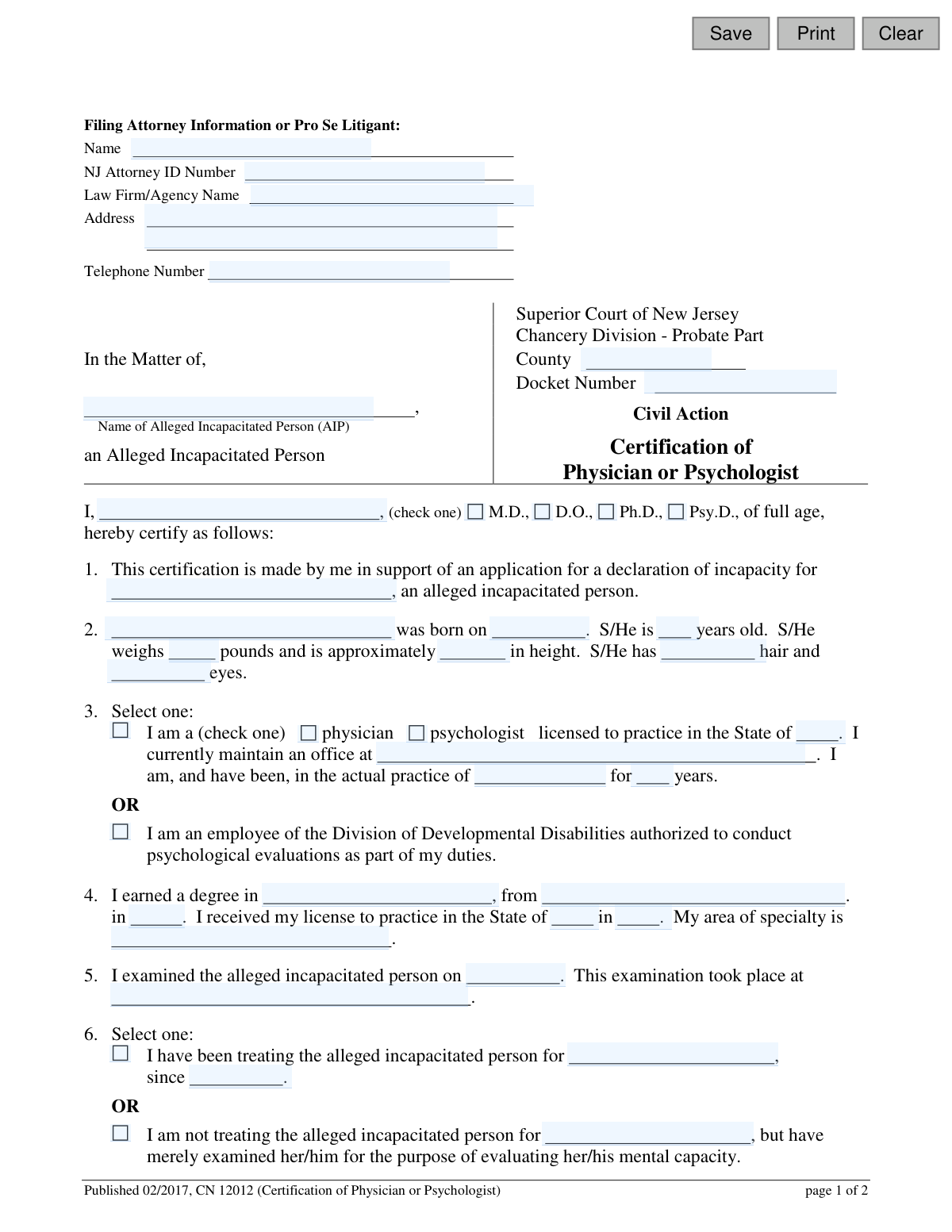
The Certification of Physician or Psychologist (CN 12012) is a legal document for the Superior Court of New Jersey used in adult guardianship proceedings. It requires a licensed physician or psychologist to certify their evaluation of an alleged incapacitated person's mental capacity to manage their own affairs. This certification is critical evidence for the court when deciding whether to appoint a guardian. Today, this form can be filled out quickly and accurately using AI-powered services like Instafill.ai, which can also convert non-fillable PDF versions into interactive fillable forms.
CN 12012 is part of the
New Jersey forms category on Instafill.
Our AI automatically handles information lookup, data retrieval, formatting, and form filling.
It takes less than a minute to fill out CN 12012 using our AI form filling.
Securely upload your data. Information is encrypted in transit and deleted immediately after the form is filled out.
Form specifications
| Form name: | Adult Guardianship - Certification of Physician or Psychologist |
| Number of fields: | 64 |
| Number of pages: | 1 |
| Language: | English |
Instafill Demo: How to fill out PDF forms in seconds with AI
How to Fill Out CN 12012 Online for Free in 2026
Are you looking to fill out a CN 12012 form online quickly and accurately? Instafill.ai offers the #1 AI-powered PDF filling software of 2026, allowing you to complete your CN 12012 form in just 37 seconds or less.
Follow these steps to fill out your CN 12012 form online using Instafill.ai:
- 1 Navigate to Instafill.ai and upload or select the 'Certification of Physician or Psychologist' form.
- 2 Enter the filing attorney's or pro se litigant's information, including name, NJ Attorney ID, and contact details.
- 3 Input the case information, such as the county, docket number, and the full name of the alleged incapacitated person (AIP).
- 4 The certifying physician or psychologist must provide their professional credentials, license information, and details about their examination of the AIP.
- 5 Detail the diagnosis, prognosis, and professional opinion on the AIP's ability to govern themselves and manage their affairs, specifying any areas where capacity is retained.
- 6 Indicate whether the AIP is capable of attending the court hearing and provide a justification if they are not.
- 7 Carefully review all the provided information for accuracy before the certifying professional electronically signs and dates the document to finalize it.
Our AI-powered system ensures each field is filled out correctly, reducing errors and saving you time.
Why Choose Instafill.ai for Your Fillable CN 12012 Form?
Speed
Complete your CN 12012 in as little as 37 seconds.
Up-to-Date
Always use the latest 2026 CN 12012 form version.
Cost-effective
No need to hire expensive lawyers.
Accuracy
Our AI performs 10 compliance checks to ensure your form is error-free.
Security
Your personal information is protected with bank-level encryption.
Frequently Asked Questions About Form CN 12012
This form is used in New Jersey adult guardianship cases to provide the court with a professional medical or psychological evaluation of an 'Alleged Incapacitated Person' (AIP). It is a critical piece of evidence used to determine if an individual requires a guardian.
This form must be completed by a licensed physician (M.D. or D.O.), a licensed psychologist (Ph.D. or Psy.D.), or an authorized employee of the Division of Developmental Disabilities who conducts psychological evaluations. The professional must certify their credentials and their relationship to the person being evaluated.
You will need the AIP's full name, date of birth, age, and basic physical descriptors like weight, height, hair color, and eye color. You must also provide details from your examination, including your diagnosis, prognosis, and opinion on their capacity.
In Section 9, you must state your professional opinion on whether the person is completely unable to manage their affairs or if they retain capacity in specific areas. If they have partial capacity, you must check the boxes for the areas (e.g., medical, financial, residential) where they can still make their own decisions.
Sections 7 and 10 of the form allow you to attach a separate report. If your examination findings or the factual basis for your diagnosis are too extensive for the space provided, you can write 'See attached report' and include a more detailed document with the form.
This section requires your professional opinion on whether the alleged incapacitated person is medically or psychologically capable of attending the court hearing. If you believe they cannot attend, you must provide the specific reasons for their inability to do so.
Yes, the notice at the top of the form clearly states that it is not a public document and the information provided will be kept confidential. This is to ensure all necessary details can be provided for the court's private review.
Section 12 is a conflict of interest statement. By signing, you are certifying that you are not related to the AIP and have no financial or professional conflicts that would compromise the impartiality of your evaluation, ensuring your opinion is objective.
This is the person or law firm that is filing the guardianship action with the court. You, as the certifying professional, should provide the completed form to them for submission as part of the legal case.
Yes, AI-powered services like Instafill.ai can help you fill out this form more efficiently. These tools can accurately auto-fill fields with your professional information and case details, saving time and reducing the risk of manual errors.
You can use a service like Instafill.ai to upload the PDF and fill it out in your web browser. The platform allows you to easily type information into the fields, check boxes, and save your progress before printing the completed document for signature.
If you have a flat, non-fillable PDF, you can use a tool like Instafill.ai to convert it into an interactive, fillable form. Simply upload the document, and the service will automatically detect the fields, allowing you to type your answers directly onto the form.
Section 3 requires you to identify your professional status. You must select whether you are a licensed physician or psychologist in private practice OR an employee of the Division of Developmental Disabilities authorized to conduct these evaluations.
Once completed and signed, this form should be returned to the attorney or individual who requested the evaluation. They are responsible for filing it with the Superior Court of New Jersey, Chancery Division - Probate Part as part of the official guardianship proceeding.
Compliance CN 12012
Validation Checks by Instafill.ai
1
AIP Age and Date of Birth Consistency
This validation checks that the manually entered age of the Alleged Incapacitated Person (AIP) is consistent with their date of birth. The system should calculate the age based on the 'aipDob' field and compare it to the value entered in the 'aipAge' field. This is important for data integrity and to catch potential typos. If the values do not match, the user should be prompted to correct either the date of birth or the age.
2
NJ Attorney ID Format
This check ensures that the 'attyId' field is a valid New Jersey Attorney ID number. While the exact format may vary, it should typically be a numeric value of a certain length. This validation prevents the entry of placeholder text or incorrect IDs, ensuring the attorney can be properly identified by the court system. An invalid entry should trigger an error message explaining the expected format.
3
Mutually Exclusive Professional Status
In Section 3, the certifier must identify as either a licensed professional in private practice or an employee of the Division of Developmental Disabilities. This check ensures that only one of these two options is selected and that all required fields for the selected option are completed. This is crucial for establishing the basis of the certifier's authority. If both or neither are selected, the form submission should be blocked until the user makes a valid choice.
4
Conditional Requirement for Incapacity Areas
This validation applies to Section 9, which details the AIP's capacity. If the certifier selects 'unfit and unable... in some areas', this check ensures that at least one specific area of retained capacity (e.g., medical, legal, financial) is also checked. This prevents a logically inconsistent submission where limited incapacity is declared without specifying what the person *can* do. If the condition is not met, an error should prompt the user to select at least one area of capacity.
5
Conditional Requirement for Court Attendance Reason
In Section 11, if the certifier indicates that the AIP 'is not' capable of attending the court hearing, the corresponding text field ('attendHearingDesc') must be completed. This check ensures that a justification is provided for the AIP's absence, which is a critical piece of information for the court. Failure to provide a reason when required should prevent form submission and prompt the user to fill in the explanation.
6
Chronological Date Validation
This check verifies the logical sequence of several key dates on the form. It ensures the AIP's Date of Birth ('aipDob') is before the Examination Date ('aipExamDt'), and that the Examination Date is on or before the Signature Date ('sigDt'). This prevents illogical or impossible date entries, which could invalidate the entire certification. An error should be displayed if any date is out of chronological order.
7
Professional Credentials Completeness
This validation ensures that all fields related to the certifier's professional credentials in Section 4 are filled out. This includes degree, university, year of degree, state of license, year of license, and specialty. This information is vital for the court to assess the qualifications and credibility of the person making the certification. The form should not be submittable if any of these required credential fields are left blank.
8
Diagnosis and Prognosis Requirement
This check confirms that the 'aipDiag' (diagnosis) and 'aipProg' (prognosis) fields in Section 8 are not empty. These fields contain the core medical or psychological opinion that forms the basis of the guardianship application. Submitting the form without this information would render it useless, so this check ensures this critical information is provided.
9
Signature Name and Certifier Name Match
This validation compares the printed name under the signature ('sigName') with the certifier's name at the top of the form ('drName'). The names should match to confirm that the person signing the document is the same person who is making the certification. A mismatch could indicate an error or a fraudulent submission and should trigger a warning for the user to review and correct the names.
10
Years in Practice vs. License Year Consistency
This is a logical check between the 'drPracticeYrs' (years in practice) and 'drLicYr' (year of license). The number of years in practice should not be greater than the number of years that have passed since the license was obtained. For example, if the license was obtained in 2020, the years in practice cannot be 10. This helps catch data entry errors and ensures the certifier's experience is stated plausibly.
11
Conditional Requirement for 'Other' Capacity Description
In Section 9, if the 'other' checkbox is selected as an area of retained capacity, this validation ensures the corresponding description field ('otherDesc') is not empty. This is necessary to provide the court with a clear and specific understanding of the 'other' capacity the AIP retains. The form should not be submitted if the 'other' box is checked but the description is blank.
12
Treatment Start Date Logic
This check applies to Section 6. If the certifier indicates they have been treating the AIP, the 'since' date ('treatingAipDt') must be a valid date that occurs before the examination date ('aipExamDt'). This ensures a logical timeline of the professional relationship with the AIP. An invalid or future date should be flagged as an error.
13
Court Case Identifiers Presence
This validation ensures that the 'typeCounty' and 'Docket Number' fields are completed. These identifiers are essential for associating the certification with the correct legal case in the correct jurisdiction. Without this information, the document cannot be properly filed by the court clerk, causing significant delays. The submission should be blocked if these fields are empty.
14
Professional Title Selection
This check ensures that one of the professional title checkboxes ('drType': M.D., D.O., Ph.D., or Psy.D.) is selected at the top of the certification. This is a fundamental piece of information that establishes the certifier's professional background and the nature of their expertise. The form should be considered incomplete and block submission if no title is selected.
Common Mistakes in Completing CN 12012
Filers often forget to enter the correct County and Docket Number at the top of the form. This happens when the form is filled out before the case is officially filed or when the filer doesn't have the information readily available. Without this data, the court clerk cannot link the certification to the correct legal case, causing significant filing delays and potential rejection of the document. Always confirm the exact case details before completing the form, and use tools like Instafill.ai to create templates that pre-populate this information for recurring case types.
The Alleged Incapacitated Person's (AIP) name is often misspelled or fails to exactly match the name used on other court documents, such as the initial petition. This occurs due to typos or the use of a nickname instead of the full legal name. Such inconsistencies create legal ambiguity and may require filing amended documents, delaying the guardianship proceedings. To avoid this, carefully cross-reference the name with legal identification and other court filings.
In sections 7 and 10, professionals may provide vague or conclusory statements instead of detailed, objective factual observations. For example, writing 'patient is confused' is less effective than 'patient could not state the current year, identify their location, or recall their children's names.' This weakens the certification's credibility and may lead a judge to question the expert's opinion, potentially requiring a new evaluation. The basis for the opinion must be described with specific, observable facts.
The form allows professionals to attach a more detailed report in sections 7 and 10, but they may forget to physically include it or fail to explicitly state 'See attached report dated [date]'. This leaves the court with an incomplete picture of the AIP's condition, as the on-form summary is often insufficient. This error can lead to the certification being deemed incomplete, causing major delays until the full report is submitted.
A common error in Section 9 is selecting that the person is 'unfit... in some areas' but then failing to check any of the specific boxes (medical, financial, etc.) where they retain capacity. This contradiction leaves the court with no clear guidance on the scope of the proposed guardianship. This mistake forces the court to guess the certifier's intent or schedule another hearing for clarification, delaying the appointment of a guardian.
The certifying physician or psychologist may fail to fill out their license state, license year, years in practice, or area of specialty in sections 3 and 4. This information is essential for the court to verify the expert's qualifications and establish their credibility to offer an opinion on capacity. Missing credentials can lead a judge to give the certification less weight or even reject it, requiring a new evaluation from a different professional.
In Section 11, stating the AIP cannot attend the hearing but providing a weak, non-medical, or missing reason is a frequent mistake. The court presumes the AIP has a right to be present, and waiving it requires a specific, compelling medical justification like 'Patient is bed-bound and attending would pose a significant health risk.' A vague reason like 'it would be stressful' is insufficient and may be rejected by the judge, forcing an appearance.
The examination date listed in Section 5 may be too old, making the findings potentially irrelevant to the AIP's current condition. Courts require a recent evaluation (often within 30-60 days) to make a determination of incapacity. Submitting a form with a stale date can lead to the certification being challenged and rejected, forcing a new, costly examination and delaying the proceedings.
The most critical error is when the certifying professional forgets to sign and date the form on page 2. An unsigned certification is legally invalid and will be immediately rejected by the court clerk, halting the entire guardianship process. A missing date also creates issues regarding the timeliness of the evaluation. This simple oversight requires the form to be sent back for completion, causing unnecessary and frustrating delays.
The form asks for both the AIP's date of birth and their current age in Section 2. A common mistake is a manual miscalculation of the age based on the birthdate, creating an inconsistency on the form. While minor, this error can reflect poorly on the overall accuracy of the document. Using an AI-powered form filler like Instafill.ai can prevent this by automatically calculating the age based on the entered date of birth, ensuring consistency and accuracy.
Since this form is often provided as a non-fillable PDF, it is frequently printed and filled out by hand. Illegible handwriting for critical information like names, diagnoses, or factual descriptions can render the document useless. If the court clerk or judge cannot read the information, the form will be rejected. To avoid this, it is best to use a tool like Instafill.ai that can convert a flat PDF into a digitally fillable version, ensuring all entries are clear, legible, and professional.
Saved over 80 hours a year
“I was never sure if my IRS forms like W-9 were filled correctly. Now, I can complete the forms accurately without any external help.”
Kevin Martin Green
Your data stays secure with advanced protection from Instafill and our subprocessors

Robust compliance program
Transparent business model
You’re not the product. You always know where your data is and what it is processed for.
ISO 27001, HIPAA, and GDPR
Our subprocesses adhere to multiple compliance standards, including but not limited to ISO 27001, HIPAA, and GDPR.
Security & privacy by design
We consider security and privacy from the initial design phase of any new service or functionality. It’s not an afterthought, it’s built-in, including support for two-factor authentication (2FA) to further protect your account.
Fill out CN 12012 with Instafill.ai
Worried about filling PDFs wrong? Instafill securely fills adult-guardianship-certification-of-physician-or-psychologist forms, ensuring each field is accurate.